Showing posts with label neil young. Show all posts

Sunday, January 30, 2022

Neil Young, Time Fades Away (Classic Albums)

Neil Young is in the news this week with his stand against Spotify's propagation of anti-vaccine propaganda in the form of Joe Rogan. Young's willingness to cut against the grain of expectations has always been one of his defining features and one of my favorite things about him. After all, this is a man who was sued by his own label in the 80s for not making "representative" albums!

His first major bucking of expectations is one of my favorite albums of his: Time Fades Away. It came right after Young hit the big time with Harvest, his 1972 record full of catchy hits like "Heart of Gold" that embodied the spirit of the whole Laurel Canyon singer-songwriter thing. According to a famous statement of his, Young decided to move from the middle of the road into "the ditch." His ditch albums of the seventies began with Time Fades Away, a strange live album without the hits documenting a difficult tour. It was out of print for decades, embargoed by Young himself. I got my copy on LP, purchased by my wife off of eBay before Young finally released it from the vault. 

The Time Fades Away tour came after both original Crazy Horse guitarist Danny Whitten and roadie Bruce Berry died of drug overdoses. Whitten was supposed to be on the tour but was let go because his substance abuse left him in no condition to play. He died soon after, on the cusp of the tour, which had to have weighed heavy on Young. If Harvest represented the mellowing of the hippie dream into relaxing folk-pop music, Time Fades Away was an angry obituary for the failed counterculture, a running theme in the "Ditch Trilogy" that also included On the Beach and Tonight's the Night.

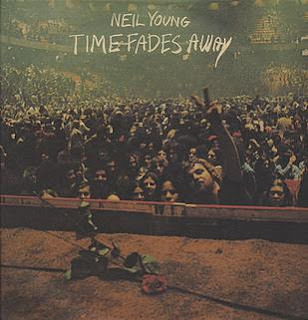
The album's cover implies this elegiac tone with its sepia-colored photograph of a rock show audience. The children of the Aquarian Age are there to commune and be groovy, but that looks like an artifact of the distant past even in 1973. The kid flashing the peace sign in front has no clue what's about to hit him when an angry and grieving Young hits the stage. There will be no good vibes to be had. 

Being a live album, Young's disenchantment hits the listener with more immediacy on Time Fades Away. It starts with the title song, a rocking ragged number that sounds like a bad hangover come to life. The feel and title set the tone for what's to follow. The hippie world of being forever young and carefree was a lie. Time comes for us all, even the dreamers. When it does, it's ugly. 

After that comes the tender piano ballad of "Journey Through the Past." Here the passage of time brings nostalgia rather than despair. It's a song of going home to a place you've left long ago and it's always resonated with me. Like Young, I grew up in a small town and moved far away but always kept it in my heart even though it seems like a strange place whenever I return. We all need these memory palaces to make life bearable. Arthur Schopenhauer, a ridiculously pessimistic philosopher, felt that our few chances at happiness depended on our being able to reflect on the good times we do manage to wrest out of this difficult existence. 

Young does not let the listener stay in this reverie, however. Next up comes "Yonder Stands the Sinner." We are back to the desperate hangover sound of the title track, complete with cracking voice and junk-sick blue notes. It sounds positively happy compared to "L.A.," an able entry in the Los Angeles as Hell genre. I myself fancy Southern California, but it seems in the 70s many rock musicians who came there left a bit worse for wear. (I think here of David Bowie going into cocaine psychosis and weighing a hundred pounds and The Stooges' seven minute cry for help "LA Blues.") Ben Keith's steel guitar, which made Harvest so mellow, pierces here. We aren't in rural Ontario anymore. 

Side one ends deceptively with "Love in Mind," a song recorded two years early in 1971 before Young migrated over to the Ditch. It has the same sad wistfulness of "Journey Through the Past" but feels a lot less tired. Knowing that fact helps you hear the desperation in the rest of the album. 

Like all good albums, side one has a soft landing and side two begins with a shift in tone. "Don't Be Denied" is a song of youth and memory, but looking back in anger. The small town of "Journey Through the Past" has become a trap, a place to be escaped. I too understand the dialectic of leaving the small town. The memories of the intimacy and simplicity of childhood in such a place clash with the memories of the small-mindedness and narrow horizons that arise from the same circumstances. It's a loud dirge, vocals straining and guitars screeching. Easy so see from this how Young was a grunge godfather.

"The Bridge" follows, swinging the pendulum back to ballad territory. At first it seems to be building a simple metaphor for love, but Young sings about the bridge falling under "lies" and trying to build it again. The plea for love and understanding here lies on a bed of pain. "Heart of Gold" had that kind of longing in it, but it's much harder to ignore here.

Things end with the hard rocking and appropriately named "Last Dance." It's a song about waking up on Monday morning facing yet another soul-sucking week of work. The riff stabs, Keith's steel guitar pierces again. This is the sound of our daily malaise personified, but the words promise the possibility of escape. Young's chant of "no no no" is a stirring rage against the dying of the light. By the end of the album we have gone full circle from the emotional wreckage of the failed hippie dream to a cry of resistance against giving into the daily malaise of modern life. 

This is not pretty-sounding music, but like a truly great live album it lets in a couple of bum notes and strained vocals so that a deeper, ecstatic truth emerges. It was too true for Young's taste, which is why he left it in the vault for so long. Who wants to be reminded of their darkest days? As we live through our own dark times this seeming curio of a legacy artist's career can be a balm for the soul. Neil Young may not be on Spotify anymore, but most of the time I was spinning this LP it was never meant to be heard, anyway. 

Sunday, June 14, 2020

Neil Young, "Campaigner"


I have spent several years engaging in a research project related to American history in the mid 1970s. I feel like that period is a secret fulcrum. Globalization, deindustrialization, neoliberalism, and mass incarceration really surfaced then, along with the social and political shocks of Watergate, the Fall of Saigon, and an economic crisis. What we are living through right now feels like an even bigger confluence, with the Trump presidency, a pandemic, economic crisis, and mass protests over racism happening all at once.

A key difference in these moments is that in the mid-70s the protest movement of the prior decade were flaming out, whereas now they seem to be getting stronger. One era was defined by resignation, ours is defined by engagement, mostly because the scale of death and political collapse is so horrific. In the mid-70s that resignation was maybe best expressed in Neil Young's famous "ditch trilogy" of challenging albums.

He recorded one album in that period, Hitchhiker, that only recently found an official release (although he re-recorded some of the songs for later albums.) One song put on a later album was "Campaigner," with the key line "Even Richard Nixon has got soul." It's a surprise considering that in the song "Ohio" Young called out Nixon by name for being responsible for the Kent State shooting. This song is a kind of radical act of empathy, an acknowledgement that Nixon was still a human being no matter how awfully he had behaved.

A sign that we are in a different turning point nowadays is that I cannot imagine hearing the lines "Even Donald Trump has got soul" and keeping a straight face. Nixon was a horrible person, but he was all too human. In his hatred for the Ivy League and his chip on his shoulder from having come from humble origins there's a little bit in Nixon I can empathize with. This is impossible with Trump, a moral black hole who seems to represent nothing but his own unfettered greed and ego.

The time we are in now is more radically catastrophic than the mid-70s. There won't be any time for wistful empathy for the oppressors. In the end, that might prove freeing.

Tuesday, December 6, 2016

Classic Albums: Neil Young, On The Beach


Winter has come. The leaves as gone, and the morning air has a hardness in it. It is not the best backdrop for contemplating the horrors that the next four years are about to bring us. As always, I turn to music during times of seasonal change, both political and climatological.

I have found comfort in Neil Young's "ditch trilogy" of albums from the mid-1970s. (After going to the middle of the road with Harvest, he steered things into rougher territory for a bit.) 1974's On The Beach in particular stands out. For a long time this album was out of print due to Young's insistence, which has always baffled me, since it's so good, and copies of the likes of Landing On Water and This Note's For You were always easy to find when On The Beach was languishing in the vaults. Perhaps it's because this album is a too raw reminder of a tough time in his life, but then again, the more harrowing Tonight's The Night was never swept under the rug.

The ditch trilogy began with the live album Time Fades Away, from 1973, a chronicle of Young's difficult tour that year. It started right after Crazy Horse guitarist Danny Whitten was kicked out of his band, after which he soon died of a drug overdose. That came on the eve of the tour, and really set the tone. After hitting it big with mellow songs like "Heart Of Gold," Young was playing to stadium audiences of new fans expecting a laid back 70s folkie vibe, not the blast of chaotic noise on songs he hadn't yet released. After that he recorded the aforementioned Tonight's the Night, a supremely dark album that he shelved until 1975.

On The Beach was recorded last, but was released in the middle. In a lot of ways, it is an album of recovery. After two years of personal turmoil, Young was beginning to find perspective. In the past I have listened to this album in times of personal crisis, since it seems to show that even the worst storms can be braved, even if you take some permanent damage from them. I've recently been listening to it again as I contemplate our nation's own crisis.

It starts with "Walk On." If they ever make a biopic of my life I'd want this song playing over the opening credits. It's bouncy and sunny, like no other song on the album, which is why it's weird to hear it first. It's a song about going through a bad patch and coming out alive, and being a lot less concerned about what people think of you. I know in my own personal crisis in my mid-30s I came out of it stronger, but also far less trusting of others and their opinions of me. "Sooner or later/ It all gets real." No kidding.

Next up comes "See The Sky About To Rain," what I think of as the weakest song on the album, mostly due to the lyrics. As much as I love Young, his overindulgence in the hippie weed leads to some over-baked words. The first lines of the song are "See the sky about to rain/ Broken clouds and rain." He rhymes rain with rain, for crying out loud! I do have to say that it has a nice little vibe, and imparts the feeling of a dreary rainy day, especially the great Ben Keith's weeping steel guitar. His work on songs like "Old Man" was one of the best things about Harvest, and he's definitely the highlight on this track. This song is a leftover from that period, and it shows.

The mood changes on "Revolution Blues," where we are plunged into a deep dark canyon for the rest of the album. It's obviously inspired by Charles Manson, and is sung from the perspective of him or someone a lot like him. The groove is sinister but it swings, too, which makes sense because Band stalwarts Rick Danko and Levon Helm are on bass and drums. The former's melodic tones and the latter's back on the beat funk perfectly compliment the wails Neil gets from Old Black. One theme of On The Beach, named for an apocalyptic film, is the death of the sixties, which Manson so perfectly symbolized. The narrator of the song talks of killing "famous stars" in Laurel Canyon, home of so many of the singer-songwriter troubadors that emerged from the previous decade, including much of Young' circle. In that respect it's a kind of death wish.

The bleakness continues on the fourth track, "For The Turnstiles." The electricity and funk of the last song is suddenly gone, with only the darkness left. There's a plucking banjo, and Young singing so high that his voice breaks, the kind of raw embellishment that would show up a lot on the ditch trilogy records. This song is very countrified, with the banjo joined later by dobro in something that sounds like a hootenany in the middle of a Samuel Beckett play. The first side ends with a sloppy blues number, "Vampire Blues." It's about oil companies, and the only political song on the album. The clumsiness of its directness (so typical of Young) works because the loose feel works as a bit of comic relief amidst some harrowing stuff. Plus it's always good to have something wacky closing out side one.

Side two, however, takes absolutely no prisoners. "On The Beach" kicks things off with a long, spare, repetitive dirge that is the sound of dread personified. "Though my problems are meaningless/ That don't make them go away" pretty much sums up depression in a nutshell. He talks about needing a crowd but not "day to day" and radio interviews, referring to the drudgery of touring. This is the sound of someone who is just about at the end of their tether.

"Motion Pictures" has a twangier and more hopeful feel to it. It is a song of longing and love, and wanting to come home. (It's dedicated to "Carrie," which I assume refers to his wife at the time, Carrie Snodgrass.) It's a tour song, but one where the comforts of home feel like they are almost within sight. The whole album has a feeling of homesickness to it, less for a place than for a feeling of emotional comfort. That kind of spiritual homesickness is also pretty familiar to depressives.

Side two is pretty spare, and it ends with "Ambulance Blues," the sound of someone who after reaching the end of their rope has found a way to go on. I almost feel like "Walk On" should be played twice on the album, at both the beginning and the end, because this song is the prequel to "Walk On." Long, sparse, and meandering with an ominous title, you can hear Young working out the emotional wreckage of the previous year of his life. It's folkie at the start, and Young immediately starts recalling his folk singing youth, as if it is a time of innocence beyond all comprehension. The country fiddle that comes in has a mournful, elegiac quality to it. Like the other songs on side two, there's no drums, only understated bongos. He suddenly opines that "it's easy to get buried in the past" with the tone of voice of a man who is desperate to put a bad past behind him but also carrying around the crushing weight of memories of simpler times, of people and places that are gone and are never coming back. Perhaps that's why the album was left in the vaults for too long, it's far too personal.

In any case, his admonition that "you're all just pissin' in the wind" seems aimed at the whole hippie thing. What started as peace, love, and art in the "folkie days" had curdled into addiction and bullshit. He says that it's a good friend who tells you you're pissing in the wind, implying that Young knows that he needs to take a new direction in life. That's the kind of crisis I was in five and a half years ago, one that I wouldn't wish on anyone. But if you find yourself there, give On The Beach a listen.

Wednesday, September 3, 2014

Geezer Rock of the 1980s

I just finished reading Peter Dogget's exhaustive analysis of David Bowie's work from 1969 to 1980, a period he calls "the long Seventies."  Ending in 1980 is obvious in Bowie's case, since he output since Scary Monsters has a few bright spots, but none of it is as good or as innovative as what he did in his prime.  That reminded me that in the 80s there were a lot of artists from the sixties and seventies that kept right on making music well past their expiration date.  The audience goodwill they had amassed in their primes remained, and people would buy the records and go to the concerts to remember their own glory days.  Since I grew up in the 80s I was unaware of their pasts, and didn't get why their videos were on MTV.  I remember seeing the one for "We Are the World" and when Dylan sang I wondered who the hell that old weirdo with the awful voice was.  (My opinions on the Bobfather have changed, obviously.)

It's strange to think that the forgettable stuff they produced in the 80s is now longer ago than the glory days these artists were still cashing in on back then.  Here's some of the good, bad, and plain ugly of 1980s geezer rock.

The Rolling Stones

In the early 1980s the Rolling Stones had one last flash of brilliance, mostly because the Tattoo You album was made up of songs first essayed during the 70s.  "Start Me Up" is one of their greatest grooves, and "Waiting On a Friend" perhaps their best ballad.  After that, things went downhill fast.  "Undercover of Night" tried to sound relevant with its New Wavey guitar and failed.  That song's album of the same name and Dirty Work were are awful as the pastel suits worn by the band on the cover.  When Steel Wheels came out at the end of the decade everyone acted like it was a return to form when it was in fact a boring piece of crap.  That record was positively brilliant compared to Jagger's self-parodic solo work of the time.

Neil Young

Young put together an amazing run during the sixties and seventies with his solo work, as well as with CSNY and Buffalo Springfield.  Then came the 80s.  He made albums so odd and trading in so many styles (electronica on Trans, rockabilly on Everybody's Rocking, and country on Old Ways) that his record company sued him for not making Neil Young albums.  Somehow Young broke out of his funk and managed to release the all-time great "Keep On Rockin' In the Free World" in 1989 and go on to put out some quality records in the early and mid-1990s.

Bob Dylan

Oh boy did Dylan fall off in the 80s.  The album titles themselves betrayed a lack of vision: Knocked Out Loaded, Down In The Groove, Empire Burlesque, etc.  He began the decade still in his evangelical Christian phase before being mired in a holding pattern in the mid-80s.  He famously did not release the best songs he recorded in the era, like "Foot of Pride" and "Blind Willie McTell," as if he didn't want people to hear what he could really do.  Finally, in 1989, he put out Oh Mercy, an inspired album that he says in his own memoir saved his interest in making music.  "Ring Them Bells" never gets old.

David Bowie

As I mentioned above, Bowie started the decade with a bang, and then suddenly decided that he'd rather be a pop star than an art rocker.  While "Let's Dance" is a great slice of 80s dance pop, his approach led to much diminishing returns, to the point that Never Let Me Down was the album I saw most often in used CD stores in the 1990s.  On the Glass Spider Tour for that album he began each show by being lowered, you guessed it, out of a giant glass spider, which is as tacky as things got in the 1980s.

Rod Stewart

Rod the Mod has been the punchline to a joke for more most people my age, but his early 70s solo output and work with the Faces was truly fantastic, and if you don't agree I'll fight you.  By the late seventies, however, he was cashing in with the endlessly silly "Do Ya Think I'm Sexy."  His 80s output continued that trend, with utter dreck like "Love Touch."  However, in the early 80s Stewart did manage to do a little good with the edgy pop of "Young Turks," which borrowed the New Wave sound without being derivative.  It was the exception to prove the rule.

The Kinks

Of all the geezer bands, The Kinks probably produced the best music in the hairspray decade.  They began in the mid-1960s with some rip-roaring proto-hard rock, and then from Face to Face in 1966 to Muswell Hillbillies in 1972, the Kinks had an amazing run of albums that did not fit any of the prevailing styles of the time.  After that they got lost in a wilderness of lame concept albums before returning with some decent hard rock albums in the late 70s.  In the early 80s they scored their biggest American hit with the fun nostalgia of "Come Dancing."  "Don't Forget to Dance" and "Living on a Thin Line" are great songs.  They ran out of gas afterwards, but it's always good to see a great band squeeze out one last hurrah.

Paul McCartney

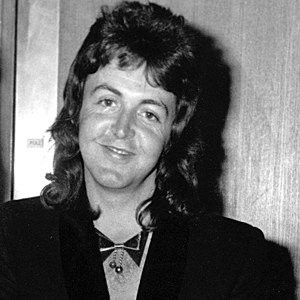
Macca's solo work is easy to malign as treacly and silly, but he put out a lot of good tunes in the seventies amidst the dross.  In the 80s, however, he became a complete and utter cheeseball.  The only misstep on Michael Jackson's Thriller album is his duet with McCartney on the ridiculously frivolous "The Girl Is Mine."  With Give My Regards to Broad Street he managed to produce a film even less inspired than The Magical Mystery Tour.  The soundtrack album contained "No More Lonely Nights," one of the eightiesist songs that ever eightesed.  That's not a compliment.  Through much of the decade he was sporting perhaps the most ridiculous mullet of the era, and that's saying something.

Saturday, September 8, 2012

Helpless


In the division of labor that my wife and I have worked out in re our twin babies, I feed them late at night on the weekends, when I don't have to get up at 5:30 AM, as I do on work days.  I've found that I can feed and burp a baby in about as much time as it takes for one side of a record to play.  For that reason, I will often play an LP during feeding time, usually something that soothes the babies.

For some reason early 1970s folk and folk-inflected music really pleases them.  My girls seem smitten by the likes of Gordon Lightfoot and Jim Croce.  In that spirit, this evening I put Crobsy, Stills, Nash and Young's 1970 disc Deja Vu on the turn-table.  While holding one of my girls against my chest hoping she would burp, the Neil Young-penned "Helpless" came on, and I found myself helpless to hold back a tide of emotion.

Much of this had to do with the fact that this summer (right before the girls came on the scene) I had a chance to see Journeys, the most recent Jonathan Demme-directed documentary about Neil Young.  Much of it involves Young going back to Omemee, his hometown in rural Ontario.  This is the place the songs sings of, a place that Young finds to have changed a lot since his youth.  Having grown up in a country town and then left it for distant lands, I hear this song as a desperate attempt to call back childhood memories rooted in a place you can never truly go back to anymore.  Whenever I visit my family in central Nebraska, I increasingly feel like a stranger in my own home town.

That wasn't the biggest reason the song got to me tonight with my child in my arms.  Holding this piece of new, vibrant life in my hands, I wondered what she would think of her childhood home when she got older, and whether she too would chase the horizon, becoming alien to the world and parents that nurtured her.  If she does, I only hope I can give her the kind of memories strong enough to inspire longing for home.