I just finished reading Peter Dogget's exhaustive analysis of David Bowie's work from 1969 to 1980, a period he calls "the long Seventies." Ending in 1980 is obvious in Bowie's case, since he output since Scary Monsters has a few bright spots, but none of it is as good or as innovative as what he did in his prime. That reminded me that in the 80s there were a lot of artists from the sixties and seventies that kept right on making music well past their expiration date. The audience goodwill they had amassed in their primes remained, and people would buy the records and go to the concerts to remember their own glory days. Since I grew up in the 80s I was unaware of their pasts, and didn't get why their videos were on MTV. I remember seeing the one for "We Are the World" and when Dylan sang I wondered who the hell that old weirdo with the awful voice was. (My opinions on the Bobfather have changed, obviously.)
It's strange to think that the forgettable stuff they produced in the 80s is now longer ago than the glory days these artists were still cashing in on back then. Here's some of the good, bad, and plain ugly of 1980s geezer rock.
The Rolling Stones
In the early 1980s the Rolling Stones had one last flash of brilliance, mostly because the Tattoo You album was made up of songs first essayed during the 70s. "Start Me Up" is one of their greatest grooves, and "Waiting On a Friend" perhaps their best ballad. After that, things went downhill fast. "Undercover of Night" tried to sound relevant with its New Wavey guitar and failed. That song's album of the same name and Dirty Work were are awful as the pastel suits worn by the band on the cover. When Steel Wheels came out at the end of the decade everyone acted like it was a return to form when it was in fact a boring piece of crap. That record was positively brilliant compared to Jagger's self-parodic solo work of the time.
Neil Young
Young put together an amazing run during the sixties and seventies with his solo work, as well as with CSNY and Buffalo Springfield. Then came the 80s. He made albums so odd and trading in so many styles (electronica on Trans, rockabilly on Everybody's Rocking, and country on Old Ways) that his record company sued him for not making Neil Young albums. Somehow Young broke out of his funk and managed to release the all-time great "Keep On Rockin' In the Free World" in 1989 and go on to put out some quality records in the early and mid-1990s.
Bob Dylan
Oh boy did Dylan fall off in the 80s. The album titles themselves betrayed a lack of vision: Knocked Out Loaded, Down In The Groove, Empire Burlesque, etc. He began the decade still in his evangelical Christian phase before being mired in a holding pattern in the mid-80s. He famously did not release the best songs he recorded in the era, like "Foot of Pride" and "Blind Willie McTell," as if he didn't want people to hear what he could really do. Finally, in 1989, he put out Oh Mercy, an inspired album that he says in his own memoir saved his interest in making music. "Ring Them Bells" never gets old.
David Bowie
As I mentioned above, Bowie started the decade with a bang, and then suddenly decided that he'd rather be a pop star than an art rocker. While "Let's Dance" is a great slice of 80s dance pop, his approach led to much diminishing returns, to the point that Never Let Me Down was the album I saw most often in used CD stores in the 1990s. On the Glass Spider Tour for that album he began each show by being lowered, you guessed it, out of a giant glass spider, which is as tacky as things got in the 1980s.
Rod Stewart
Rod the Mod has been the punchline to a joke for more most people my age, but his early 70s solo output and work with the Faces was truly fantastic, and if you don't agree I'll fight you. By the late seventies, however, he was cashing in with the endlessly silly "Do Ya Think I'm Sexy." His 80s output continued that trend, with utter dreck like "Love Touch." However, in the early 80s Stewart did manage to do a little good with the edgy pop of "Young Turks," which borrowed the New Wave sound without being derivative. It was the exception to prove the rule.
The Kinks
Of all the geezer bands, The Kinks probably produced the best music in the hairspray decade. They began in the mid-1960s with some rip-roaring proto-hard rock, and then from Face to Face in 1966 to Muswell Hillbillies in 1972, the Kinks had an amazing run of albums that did not fit any of the prevailing styles of the time. After that they got lost in a wilderness of lame concept albums before returning with some decent hard rock albums in the late 70s. In the early 80s they scored their biggest American hit with the fun nostalgia of "Come Dancing." "Don't Forget to Dance" and "Living on a Thin Line" are great songs. They ran out of gas afterwards, but it's always good to see a great band squeeze out one last hurrah.
Paul McCartney
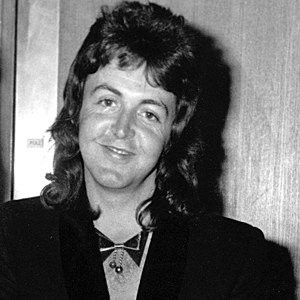
Macca's solo work is easy to malign as treacly and silly, but he put out a lot of good tunes in the seventies amidst the dross. In the 80s, however, he became a complete and utter cheeseball. The only misstep on Michael Jackson's Thriller album is his duet with McCartney on the ridiculously frivolous "The Girl Is Mine." With Give My Regards to Broad Street he managed to produce a film even less inspired than The Magical Mystery Tour. The soundtrack album contained "No More Lonely Nights," one of the eightiesist songs that ever eightesed. That's not a compliment. Through much of the decade he was sporting perhaps the most ridiculous mullet of the era, and that's saying something.
Showing posts with label Kinks. Show all posts
Wednesday, September 3, 2014
Geezer Rock of the 1980s
Labels:
80s,
bob dylan,
David Bowie,
geezer rock,
Kinks,
music,
neil young,
Rolling Stones
Friday, October 11, 2013
Classic Albums: The Kinks, The Kink Kronikles
Doing a profile of a compilation album seems to go against the raison d'etre of my Classic Albums series, since compilations are not usually artistic statements, but rather an agglomeration of recordings meant to make a buck or provide an easy entre for new listeners. There are some compilations, however, that really stand up on their own, and even enhance older material by placing it in a new context. The Kink Kronikles is just one of these albums.
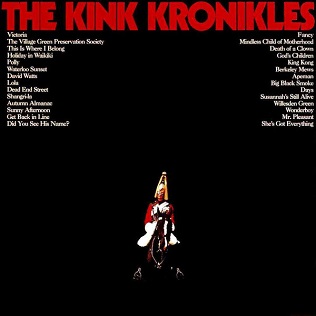
The title is a bit misleading, since it does not cover the band's famous, rip-roaring early singles like "You Really Got Me," "All Day And All Of The Night," and "I Need You." Instead, it chronicles the period between 1966 and 1970, when the Kinks made their best music while losing their stateside audience. During this period lead singer Ray Davies' gaze turned inward, his albums becoming sociological statements on contemporary British life. The music started borrowing heavily from English music hall traditions and referenced things like village greens and holidays in Blackpool, not exactly most accessible things for Americans. The pictures of the royal palace guards on the front and back may thus be taken as less quaint illustrations and more a statement of purpose.
Despite focusing on such a brief, obscure (for Americans) and popularly shunned period in the band's career, The Kink Kronikles is a double album, a kind of argument to take their music of that era seriously. It does not follow any kind of chronological order, and it does not simply collect the hits, mostly since there are so few to go around. There are singles, both from albums and stand alones, previously unreleased tracks, and B-sides. It misses many of the best Kinks songs of the era ("Some Mother's Son" is glaringly absent) but I can think of no better introduction to the Kinks' late sixties years.
Unlike many other compilations, great care seems to have been taken with the track sequencing. For ecample, the rollicking "Victoria" gets things started off right, and side one of the first record ends with "Waterloo Sunset," one of the most beatifically gorgeous ballands ever written. In between there are several previously unreleased tracks, but nothing feels forced or out of place. Flip that record over, and the much peppier "David Watts" raises the curtain on side two, providing a new arc that ends with the bouncily whimsical "Did You See His Name," an unreleased song that closes out the first record on an appropriately abrupt note The second record finishes with "Days," an elegiac song thankful for the days we have lived with loved ones gone, and just about the most perfect song you could ever choose to tie up a long collection of The Kinks' output. For these reasons, the first time I heard this album, I thought it sounded nothing like a compilation at all.
I keep returning to The Kink Kronikles during this time of year because it calls forth memories of my first autumn as a PhD student living in Urbana, Illinois. One day I went to a local, now sadly defunct bookstore, and picked the album up out of a desire to better acquaint myself with a band I'd only known from their Top 40 hits. I was looking for a copy of Something Else, since I'd heard it was their best, but couldn't find it there, and figured that a compilation would give me more bang for my buck. Whatever the reasons, I instantly fell in love, and listened to this album more than anything else for about a year. It was a good year spent basking in the glow of the scholarly mission, years before I was aware of the hardships of the academic job market. I met some wonderful friends and had some great times with them, and hearing these songs puts me back into those golden months more than anything else. Perhaps too it's Ray Davies' nostalgic tendencies, ones I continue to increasingly indulge in myself as I get older. Davies' waxes for the village green, I yearn for the innumerable backyard gatherings of friends, and I thank them for the days (and nights) they gave me.
Labels:
academia,
Kinks,
memory,
music,
track of the week
Saturday, September 28, 2013
Track of the Week: The Kinks, "Autumn Almanac"
As I have mentioned a few times before, I cherish the changes in the seasons, especially the transition from summer to autumn. When the night air gets a little chill and the leaves start to fall, I get a thrill. I've already been going back to my old seasonal rituals, including making giant pots of chili, drinking pumpkin beer, taking long walks, and watching hours of football. (Luckily having children works well with most of these activities.) Having the redhead's curse of weak skin, the summer sun is less a delight and more a painful annoyance, and so after months of suffering, I welcome days like this, when the sun shines, but a cool breeze blows.
The older I get, the more these seasonal rituals matter to me. They provide a kind continuity and security, and much comfort besides. My delight in the safety of repetition and routine is likely a sign of my descent into middle age, but with my back aching more and my metabolism slowing down rather alarmingly, I guess it's time to face facts. Ray Davies of the Kinks was an old soul himself at quite a young age, and thus the only rocker capable of penning a song like "Autumn Almanac," which is an ode to the same old simple seasonal pleasures. The character in the song opines about "football on Saturday, roast beef on Sunday" and how "this is my street, and I'm never gonna leave it, even if I live to be 99." It's one of the Kinks' jauntier tunes, clearly influenced by old music hall numbers and for that reason insanely catchy. I often find myself humming it while putting the cumin in the chili, kicking a pile of leaves, or strolling down to the Passaic River. And why not? Big things will always go wrong in our lives, it's the small things that sustain us.
Subscribe to:
Posts (Atom)