Showing posts with label seventies. Show all posts

Wednesday, August 12, 2020

Watching The Brady Bunch With My Kids


The world's most wholesome Zoom meeting

This week marks five months of quarantine and the most time I have ever spent with my children. It was been good to be with them so much, but at this point in the quarantine and summer my patience is completely shredded. I have so much work to do to prepare for school, and I can't work for more than ten minutes at a time without being interrupted. In past summers when this happened I would take a couple of hours and go to a coffee shop and bang out what I needed to do. Under covid, that's not an option. 

It's not just that I can't work on school stuff, reading for pleasure or doing my own writing is a constant exercise in stress and frustration. (Just now one of my daughters came to bother me about how long her pizza would take in the oven. And to ask what anchovies are. There are no anchovies on her pizza.) The only surefire way to get my children to leave me alone is to let them take their iPads to their rooms. (Between the last sentence and this one my kids got into a screaming fight with each other.) This strategy has a lot of problems, not least of which that my children will just watch YouTube videos that are essentially toy commercials, or play games that make them even more agitated. My wife and I eventually hid their iPads for a week and removed YouTube from our Roku.

The effect has been mostly positive. They no longer act like crazed junkies without their screens and have stopped constantly asking to look at toys online to buy with their allowance money. Desperate for distraction, we have also discovered that there's pretty much only one activity that soothes them and makes them less difficult: watching The Brady Bunch. One morning my wife put on the first episode for them, and they were completely hooked. It's a comforting nostalgia trip for me, since I used to watch The Brady Bunch every day in reruns after school when I was young. 

This is also why I was surprised that my kids like it so much. The 70s wood panelling and houndstooth pants in the Brady household looked old-fashioned to my eyes in the 80s, and the traditional family sit-com themes could not be more dated. My daughters love the overheated, self-consciously hip live action Disney TV shows full of obnoxious tweens and teens, which could not be further away from the earnest, unironic world of the Bradys. I expected my children to be even more put off by the show than I was as kid. I soon realized that while the show comforts me as nostalgia, it comforts my children in a different way. 

My daughters are more than aware of how the coronavirus has upended their lives. They know it's why they haven't been inside their school for five months. They know it's why we didn't have a vacation this year or see their grandparents in Nebraska. They know it's why we barely ever leave the house and haven't been able to do all kinds of things they love to do. They don't express a lot of outward emotional anguish about this, but I know it isn't easy on them, either.

One consistent theme on The Brady Bunch is that the children are always loved and cared for. There are problems, but they are always so small that they can be fixed. In a world that is so uncertain, that must be really comforting. As my wife told me, it's also a sign that my daughters have felt loved and protected in their own home during all of this. With everything going to hell around me and nothing being certain, that's pretty much the best I can hope for right now. I'll take it.

Wednesday, September 5, 2018

Old Dad's Records (The 1975 Episode)


The newest episode of my podcast Old Dad's Records is up this week. Since yesterday was my birthday, I talk about the year I was born: 1975. I start with the Isley Brothers' "Fight The Power," which I consider to be one of the last gasps of the long 1960s. After that I dig into the Bee Gees' Main Course album, which was on the charts the month I was born. That record was a transitional one, just the like the era that produced it. I finish by lauding the most recent Guided By Voices record, proof positive that aging doesn't have to suck.

Thursday, January 18, 2018

Why The Sweeney Is Still My Favorite Cop Show


Last night I watched an episode of The Sweeney for the first time in a bit, and remembered how much I love it. I have a strange obsession with the grimy, broke-down, grey world of 1970s Britain. It's a society in decline, like ours, but it's got more panache. Dingy pubs choked with tobacco smoke, boxy cars, and flared trousers paired with wide lapeled blazers and loud ties. It's a shitty world I like to spend time in to escape from the shitty world I live in now, which is a lot worse with a lot less character. As I was thinking about the show, I remembered that I had written a thing about it a few years back. So here's a goodie from the archive.

***
As those who read this blog should know by now, my pop culture interests are heavily Anglophilic and 1970s obsessed.  These two loves of mine come together quite nicely in one of my favorite television shows ever: The Sweeney.  A Brit former colleague of mine turned me on to it after I had discussed my affection for the UK version of Life on Mars, a show set in the 70s that often made implicit reference to the characters and style of The Sweeney, from two-fisted cops to Ford Grenadas driven with reckless abandon.  Imagine the Beastie Boys' video for Sabotage brought to life and transported to Blighty, and you pretty much get the picture.

It's a breath of fresh air today in a television world populated by incredibly lame and predictable police procedurals.  The only American cop show worth a damn in our time has been The Wire, and that's a show that's really more about Baltimore as a city than it is about police and crime fighting.  I know the current crop of crime shows well because my wife watches them obsessively.  I jokingly call her favorite programs "dead body shows," since they usually revolve around the solving of murder through the use of forensic evidence found on a corpse.  I find these shows -the various Law and Orders, Criminal Minds, the CSIs, etc- to be dreadfully boring and full of totally uninteresting characters.  It's hard to feel any emotional connection to the police figures, mostly because they so are so two-dimensional that they make Mitt Romney look human.   The criminals are very likely to be mentally deranged; they commit their crimes because they are psychopathic rather than opportunistic.  I find this convention, which is especially pronounced on Criminal Minds, to be incredibly tiresome.  If the criminals are just monsters and demons, they can never be interesting as characters, since their warped nature is their only motivation for their crimes.  I've noticed a strange phenomenon whereby the lovers of these shows are able to sit down and watch one after the other for hours, as if in some kind of trance.  The monochromatic and formulaic nature of these shows are what makes such marathon viewing possible.

The Sweeney is something else entirely.  The two main characters, detective Jack Regan and sergeant George Carter, are fully-fleshed out people with quirks, personal demons, and an ambiguous relationship with the audience.  This is especially the case with Regan, played outstandingly by John Thaw, who often comes across as crass and thuggish.  (Just watch him action, uttering the immortal line "Get your trousers on, you're nicked!")  He seethes with working class resentment, clashing with his superior Haskins in ways that betray his anger at having to be told what to do by one of his social betters.  Carter is less volatile, but after losing his wife in the second season, he begins to act more and more Regan-like.  He is a man caught in a tug of war between the better angels of his nature and Regan's willingness to do whatever it takes to get the job done.

One thing that contributes to the show's greatness is that dead bodies are few and far between.  Carter and Regan are members of the eponymous Sweeney, which is a Cockney rhyming slang term for the Flying Squad, the London police's armed robbery unit.  The criminals (called "villains" by the cops) are not obsessed with their mothers or looking to jizz on a corpse, but are practical-minded careerists who commit robberies to make money, and for their own personal enjoyment.  Among my favorite characters in the second season are Colin and Ray, two flamboyant Australians who enjoy living the high life and making fools out of the poms.  For the most part, the criminals on the show come from the same working class roots as Carter and Regan, and tend to take a practical, hard-nosed approach to their careers in crime.  The lines between their world and profession, and that of the police, blur considerably.  The cops know the world of the criminals well, and even consort with them to get information.  Sometimes you get the feeling that the roles of cops and criminals could be reversed, and that Regan could just as easily used his wits and fists to steal and thieve as to catch the crooks.

That ambiguity reflects a general realist feel to the whole enterprise.  The people on the show look and dress like regular people, right down to the flared trousers, brown color palette, and explosion of corduroy that one would expect to find among the less sartorially sophisticated gents of the polyester decade.  The grit of the streets coats the film, and you can practically smell the stale reek of ashtrays in the police office scenes.  Characters sport thick accents, bad haircuts, and look old for their age, ground down by life.  While there is the occasional bank hold-up hostage plot and take-down of terrorists episode, the ongoing struggle between professional criminals looking to make some quid and professional police trying to lock them up feels much more real to me than any serial killer plot.

Furthermore, like few other shows of its ilk, The Sweeney excels in the ancient and lost art of car chase scenes.  The modern cop shows betray their lack of excitement when an hour goes by without a single screeching tire or bent fender.  The beginning of the episode "Stoppo Driver" might be my favorite tv cop show car chase scene ever, not least because it looks like the chase is on real streets, and the action isn't hacked to bits by overactive editing, as is so often the case today.

Last but not least, The Sweeney has perhaps the best closing credits ever.  Whereas the opening theme pulsates with energy and a skanky beat, the closing is meditative, showing the detectives putting their coats on at the end of the working day, conscious that many more days of work lie ahead.  It's a world-weary close, and it never allows the show to end with cheap triumphalism or a totally happy ending.  Carter and Regan may have nicked some villains today, but more await tomorrow.  That sense of life as never-ending toil reflects the show's working class ethos, a voice sorely lacking in American popular culture these days.

Thursday, March 9, 2017

Billboard Top Ten March 13, 1976

It’s been way too long since I’ve done a top ten list. I choose this week pretty much at random, and liked what I saw. I tend to see 1976 as a big turning point in popular music, one where disco and punk were coming in and upending everything. The wildly different songs on this list are evidence of how unsettled things were getting. And now, on with the countdown!

10. Larry Groce, “Junk Food Junkie”

In 1976 silly novelty songs could still find their way into the top ten. This is a jokey folk song about a hippie who professes to love health food, but who secretly eats junk food like a drug addict. In a lot of ways it's a sign of the times, the earnest counterculture losing sight of its values and personal freedom devolving into the pure pleasure principle.

9. Rufus featuring Chaka Khan, “Sweet Thing”

This right here is some smoooooooooth music. 1976 was the opening year of the Yacht Rock genre, and I think this song definitely qualifies to come on the boat. Chaka Khan’s vocal work in the 1970s is highly underrated, and really helps sail this melodic ship out to sea.

8. Nazareth, “Love Hurts”


This is one of those songs for me that’s defined by a movie, namely the scene in Dazed and Confused when the eighth graders are slow-dancing at their last junior high dance. One of the characters is about to have a romantic moment, but his buddies drag him away, the girl looking hurt. It echoes the song, and also how its over-emoting is more fit for the Sturm und Drang of middle school rather than the more controlled, cool adolescence demanded by high school, which the characters in the film are anxious to participate in.

7. Rhythm Heritage, “Theme From SWAT”

In case you didn’t believe me already, now you’ve got proof that 1976 was the year that disco truly broke. And nothing is more disco than a discoed up version of a 70s cop show theme song. Those wonderful disco strings just swing away like nothing else. Disco in fact may have been the last genre of popular music to really utilize strings in an interesting way, before synthesizers replaced everything.

6. Captain and Tennille, “Lonely Night (angel face)”

A guy in a captain's hat playing piano for a toothy-smiled singer with a Dorothy Hamill haircut wearing disco dresses might be the most seventies thing ever. This song hit the top ten, but you never hear it nowadays. It's actually pretty musically complex, as if Darryl Dragon was trying to write a song for Steely Dan or imitate a deep cut on a 10cc record. There's twists and turns and weird doo-wop flourishes. It sounds very odd for a pop song, but when a group gets this popular, I guess they are able to get their stranger stuff on the charts.

5. Gary Wright, “Dream Weaver”


This is probably the only soft rock hit of the 70s that routinely finds its way onto classic rock radio playlists. Very catchy on the chorus, but the over the top studio effects are almost a parody of 1970s production techniques. The bass is pretty funky, though.

4. Eagles, “Take It To The Limit”

The Eagles suck.

Just wanted to get that out of the way, so you don’t take what I am about to say the wrong way. They were a band with several talented members, including original bassist Randy Meisner. I have a special affection for him, since he, like me, hails from the great state of Nebraska. This is a pretty little wistful song, so much less overwrought than the decadent tales like “Hotel California” and “Life in the Fast Lane” that came from the same album. They’re supposed to be edgy takes on life in 70s LA, but I find them to be hilariously silly.

3. The Miracles, “Love Machine”

Some great acts from the sixties managed to find a way back onto the charts this late in the seventies (more on that in the number one slot.) Known as the backing band for the great Smokey Robinson, the Miracles managed to put out this wonderful slab of discofied funk on their very own. It’s catchy, fun, and danceable, but the voices a little more weathered than the average disco tune, which gives it an air of authority.

2. Eric Carmen, “All By Myself”

The seventies was the golden age of mopey pop ballads. On this song Eric Carmen gives even Gilbert O'Sullivan a run for his money in the sad sack sweepstakes. In an era when the divorce rate was skyrocketing, I think this song must've really struck a nerve.

1. The 4 Seasons, “December 1963 (Oh, What a Night)”

The Miracles weren’t the only 60s act to ride the disco train in the spring of 1976. The 4 Seasons’ trademark harmonies of their heyday were very old fashioned already by the Bicentennial, so they smartly put them to the side on this track. It’s groovy and enjoyable, the nostalgia for the time right before the sixties exploded mixing uneasily with the very modern disco sounds underneath. Somehow the combination works, and this song never fails to get me moving.

Wednesday, September 21, 2016

Billboard Top 10 September 23, 1972

I have a theory that in terms of culture, the seventies don't really begun until sometime in late 1971, with 1972 the real first full year of the seventies. I decided to test that out with this month's flashback Top Ten from September of that year. The number one song definitely validates my thesis.

10. Gary Glitter, "Rock and Roll Part 2"


This has got to be one of the weirdest songs in the pop canon. It's hard for me to believe that it ever existed as anything other than something to be blasted over the speakers at sporting events. Now that Gary Glitter's sexual transgressions are known, it makes me feel icky to listen to it. Even without that knowledge, it's pretty damn weird. No lyrics except "hey" over a trashy glam rock riff and chunky handclaps, a sports cheer rather than a song that just needed a few years to find its true home at basketball games.

9. The Raspberries, "Go All The Way"


I loved Guardians of the Galaxy, not least of which for its use of this song. Coming years before the advent of New Wave, the Raspberries perfected the power pop sound. Killer riffs mesh beautifully with the soaring melodies, so much that I forget that the singer is merely begging his girlfriend to have sex with him.

8. Elton John, "Honky Cat"


Elton John ruled the charts in the early 70s, and I've always liked this song (and the album it came from), because it's got a little more bite and less balladry to it. There's a good little boogie piano beneath the usually on point melody here.

7. The Main Ingredient, "Everybody Plays The Fool"


This is a nice little slice of catchy, sweet soul music. I was just listening to Parliament's "Make My Funk The P-Funk," which name checks them, but puts them down as not being funky enough. Yes, this song is poppy with those flute touches, but it still definitely holds up today.

6. Michael Jackson, "Ben"


Michael Jackson's first solo number one hit was a ballad from a movie about killer rats. No, I am not joking. It's a tepid but sweet song that is redeemed by the bright light of Jackson's unique talent, evident even at this young age.

5. Gilbert O'Sullivan, "Alone Again (Naturally)"


Now this here is most definitely a prime specimen of early 1970s pop music. It's a melancholic song about heartbreak and contemplating suicide set to a jaunty tune, the singer resigned to his fate. The seventies malaise certainly made music like this seem relevant.

4. The O'Jays, "Backstabbers"


The mighty O'Jays cut the best examples of the Philadelphia soul sound, a sublime combination of funky rhythms and lush arrangements. Although the song is about a man whose friend is making moves on his lady, I've always thought it appropriate that this song came out on the eve of Richard Nixon's re-election. The feeling of paranoia that drenches the song is just about spot on for the times.

3. Chicago, "Saturday In The Park"


Before Peter Cetera showed them the way to 80s pop ballad nirvana, Chicago played horn-driven, jazzy tunes catchy enough to make the Top 40. I don't care much for their music from either era, but this one has a nice mellow feel, similar to, well, spending Saturday in the park.

2. Three Dog Night, "Black and White"

Of all the artists on the top ten this week, Three Dog Night is probably the one most trapped in the early 1970s, a poppier version of Grand Funk Railroad. This band had a metric ton of hits, eleven in the top ten from 1969 to 1974, and 21 Top 40 entries total from 1969 to 1975. They represented the mainstreaming of the sixties counterculture in the 70s in songs like this one, which expresses support for racial harmony in the blandest terms possible. "Ebony and Ivory" might be edgier.

1. Mac Davis, "Baby Don't Get Hooked On Me"


Hoo boy, this song is so seventies you can practically smell the polyester. Davis was a very 70s kind of performer, a songwriter who then started singing his own tunes, much like Carole King and Kris Kristofferson. Like Kristofferson he had one foot in country and one foot in the pop world. The theme of this song is about as seventies as it gets: a bored sounding man telling a young woman who he's boning not to get attached to him. It has lines like "You're a hot blooded woman child/ And it's warm where you're touching me." Eww. By the seventies the sexual revolution had become bland and banal, enough to make the top of the charts and not feel subversive in any way.

Thursday, June 23, 2016

Track of the Week: Ace Frehley, "New York Groove"


In 1978 Kiss was riding on top of the world. Their mix of catchy hard rock, shock horror/sci-fi tropes, theatricality, and clown makeup was like a tactical pop cultural ICBM aimed right at the sweet spot of suburban 70s adolescence. Late in 1978, perhaps consumed by hubris, each member of the band put out their own solo record simultaneously. If they had done a double album with each member getting a side it may have worked, but not too many people were going to plop down full price to hear a Peter Criss solo album.

While Gene Simmons and Paul Stanley have always been the core creative force of the band, the best song to come from those records by far was Ace Frehley's "New York Groove." In fact, I think I like it better than any of Kiss's songs. It has a glam rock stomp that betrays its origins: the song was originally performed by minor Brit glam band Hello in 1975. Frehley himself was the product of the Bronx, and he gives the song a bit more of the local swagger. It's skanky rhythm and funky feel instantly put me in the mind of New York City in the late 70s: a place simultaneously collapsing and acting as a cultural supernova. I'm not sure if I would have liked living there, but its contradictions and the amazing things it produced still fascinate me.

I hear in this song a kind of New York that's now been practically gentrified out of existence. "New York Groove" personifies the city as a swaggering street hustler with drugs and a roll of bills in his pockets and a bulge in his pants just living for today. A more accurate song today would personify the city as a financial analyst getting some cash from a Bank of America ATM and walking to get a cold brew at Starbucks while checking stock prices on his smartphone. I heard the song this week at a Mets game. The team broke a losing streak, and as fans filtered out of the stadium, the PA played "New York Groove," an almost perfect choice. New York doesn't have the same groove today, but this song still does.

Sunday, August 30, 2015

Track of the Week: Jefferson Starship "Miracles"


As I mentioned last week, I'm about to turn 40, and am picking some tracks of the week based on their proximity to when I was born in 1975.  I looked up the album charts and found out that Jefferson Starship's Red Octopus, which can readily be found for a buck or two today at innumerable used record stores, was #1 the week I was born.

Jefferson Starship are certainly of their time, a band forgotten and lesser known than the one from the 1960s it came out of (Jefferson Airplane) and the one it morphed into during the 1980s (Starship.)  In that respect Jefferson Starship is the perfect representative of the forgotten years of a much maligned decade.  The band included Airplane stalwarts Paul Kantner and Grace Slick, and Marty Balin rejoined for Red Octopus.  His smoother, more melodic stylings are in evidence on "Miracles" which has strings and an chiming electric piano that sounds straight out of a fern bedecked singles bar circa 1975.  This is a long, long way from the psychedelic rock of the Jefferson Airplane, and perhaps symbolic of what had happened to the spirit of the 60s.

The song has a whole tone of world-weariness about it, and Balin gives the line "If only you believed like I believe we'd get by" a real wistful sadness.  It perhaps tells the spiritual story of the band, which went from talking about revolution on songs like "Volunteers" in 1969 to crafting softsational smooth music in 1975 to being responsible for insanely cheesy fare like "Nothing's Gonna Stop Us Now." (Listening to Starship is akin to watching bad movies for the cheese contact high, the pop cultural equivalent of sniffing glue.)  In between the band would also craft some passable arena rock in the late 70s, going from a trendsetter to a savvy trend exploiter.  (They also appeared on the Star Wars Holiday Special, speaking of pop cultural glue sniffing.)

As I've been mentioning on here recently, the mid-1970s are the true heart of that decade's malaise, containing the triple shock of Watergate, the fall of Saigon, and the oil crisis and resulting recession.  "Miracles" is perfect malaise music, a harbinger of a specific genre of music I like to call "downer easy listening" or "Quaalude rock."  While this genre would find it's perfection in Gerry Rafferty's "Baker Street," Jefferson Starship can get some credit for capturing the Zeigeist a few years earlier.

Thursday, June 11, 2015

Reagan Dawn Culture

Over the past few weeks I've been finding myself obsessed with the period between 1979 to 1981, which I think of as "Reagan Dawn."  This was augmented by my recent reading of Split Season, a book about the 1981 baseball season and its attendant strike by Jeff Katz and today's rewatching of Wet Hot American Summer, which attempts to recreate the feel of the time.

Why Reagan Dawn?  A particularly bad set of circumstances (Iran hostage crisis, oil shock, inflation, Soviets invading Afghanistan reheating the Cold War) helped get a Right wing ideologue elected president only sixteen years after Barry Goldwater went down in flames.  This was a time of swift backlash against organized labor (in the form of Reagan's firing of the air traffic controllers), culture war fever (the Moral Majority was founded in 1979), and reheated nationalism (I'll get to that in a bit.)  It was a transitional period of time where the 70s malaise was at its worst, but the 80s neoliberal philosophy was coming into its own.

This time period also happens to be when I became aware of popular culture to the extent that I could participate in it.  I saw The Empire Strikes Back when it came out in 1980 and I remember a kid who wore a "I shot JR" t-shirt.  There were a lot of important cultural moments in that era, but here are few I'd like to comment on, given their links to the political culture of the Reagan Dawn.

Disco Demolition Night

Disco was the dominant music of the mid-to-late 70s, but it also engendered a "Disco Sucks" backlash by rock fans.  While their animus cannot simply be chalked up to racism and homophobia, a good deal of it can.  That backlash achieved its peak in the infamous Disco Demolition Night that took place between two games of a White Sox double-header at Comiskey Park.  The explosion and ensuing riotous behavior by attendees left the field too wrecked to host the second game, which was forfeited.  This moment sees the confluence of eras.  The chaotic dope smoking 70s is on display here, but those shaggy haired rockers are engaged in a reactionary action worthy of the Reagan years.

The "Miracle on Ice"

This is likely the King Daddy moment of the Reagan Dawn.  Most Americans are pretty indifferent to hockey, but they certainly tuned in to see the American national team defeat the Soviet Union.  Portraying the powerful United States as some kind of weak underdog was a common theme during the Reagan Dawn, and no event allowed that narrative to unfold better than the Miracle On Ice.  I am still convinced that this game was a factor in winning the presidency, since Reagan used the newly amped-up nationalism to appeal to voters who would later be eviscerated by his economic policies.

Rock n Roll High School, Over the Edge, and The Warriors

These films, all from 1979, give you an idea of why the Moral Majority was so incensed.  They all show youth gone wild, blowing up their high school, attacking their parents, and joining gangs, respectively.  All treat drug use and sex as wallpaper to teenage life without any punishment for those who engage in once immoral behavior, while mocking authority figures. I get a thrill seeing this stuff, mostly since my teen years were the era of DARE and AIDS, and I thought sex or drugs would kill me.

Absence of Malice

Seven years after Nixon resigned in the wake of Watergate, crusading journalists become the villains, rather than the heroes in this film.  It's a perfect curtain-raiser for the Reagan era, when all those who wish to decry its injustices would be marginalized and defamed.

Corporate Arena Rock

The great rock acts of the 1960s mostly seemed to run out of gas in the mid-1970s, part of what motivated the whole punk movement.  It's easy to forget now with the benefit of hindsight, but the punks were at the fringe of the rock world.  At the center were faceless bands who, like corporations, were easier to identify by their logos than by pictures of their band members: Foreigner, REO Speedwagon, Kansas, Journey, Styx, et al.  All played well-produced music made for the radio, but pretty forgettable compared to the stuff going on in the New Wave and punk world.  Some 60s veterans even managed to be reborn in this mold, like Jefferson Starship, which included members of the seminal psychedelic band Jefferson Airplane.  Their 1979 hit "Jane" dropped any pretense of art and revolution for some ass kicking corporate rock backed by piano triplets a la Toto (which, fitting the vibe of corporate rock, was made up of session musicians.)  During this same period, the once wild and wooly world of FM radio rock stations became corporatized and bureaucratized, leading to uniformity of playlists.

My Life In The Bush Of Ghosts

Beneath the Van Halen surface there was a lot of interesting music coming out during the Reagan Dawn, and much of it reflective of the era's changes.  This album, a one-off by David Byrne and Brian Eno, combined experimental music with field recordings of music and political and religious rants on AM radio.  The radio preachers are a sign of the Moral Majority times on songs like "Help Me Somebody," and the opening track "America Is Waiting" keeps repeating a newscaster's intonation of "America is waiting for a message of some sort or another," a mantra for the malaise of the late Carter years.

Kool and the Gang, "Celebration"

When I say "Reagan Era music" your mind might immediately jump to synthesizers and loud drum machines.  However, the first real specimen of Reagan music might very well be "Celebration" by a suddenly de-funkified Kool and the Gang.  It was #1 in February of 1981, right after Reagan's election and the return of the hostages from Iran.  It's the song that got played at every wedding and graduation and bar mitzvah in the 1980s, an empty, fun song about having a good time.  It's not a bad song, but a far cry from primal slabs of pure funk like "Jungle Boogie."  Like a lot of other people at the time, Kool and the Gang were wanting to put the past behind them and enjoy the present without thinking about the impact on the future.

Tuesday, January 20, 2015

Top Ten Albums of 1971, My Favorite Musical Year

Most fans of classic rock and soul music tend to think of the late sixties as the golden age of popular music, and there isn't much I can say to argue against that.  However, one's own personal sensibilities are not always completely tethered to objective, or at least accepted standards.  As much as I love the music of the late 1960s, I tend to think of 1971 as my favorite musical year.  It's the time that a lot artists who had begun in the sixties had enough experience under their belts to really put together some more mature, fully realized work before they ran out of gas.  I also tend to think of 1971 as the transitional point from the 1960s to the 1970s, when the social movements of the era lost their power and the Silent Majority triumphed.  The owl of Minerva flies at dusk, indeed.  Here are the ten albums from that year I would use to make my case that 1971 was the best year for popular music.  There were so many to choose from that the honorable mention list is quite long as well.  Is there any other year that can stack up to this?  (Please remind me of any omissions in the comments.)

1.  Marvin Gaye, What's Going On
An absolute masterpiece, and among the greatest albums ever made.  Gaye was finally set free from the Motown system to explore his more creative and artistic side, and the album allowed the Funk Brothers to really show their jazz chops.  Unlike the vast majority of political music, it is not heavy handed or didactic in any way.  I dare you to put this on and find anyone who doesn't like it.

2. Rolling Stones, Sticky Fingers
The Stones had been on a high, but this album I think is their apex.  The ballads are heart-breaking and lush, and the rocking tracks, like "Can You Hear Me Knocking" and "Bitch" have some truly wicked grooves.  

3. Led Zeppelin, Led Zeppelin IV
Zep's best record and one of the most influential ever recorded.  Even the less well-known tracks, like "Misty Mountain Hop," are absolutely stunning.  Even though it's maybe the most overplayed song of all time, "Stairway To Heaven" still packs a wallop when I listen to it.

4. The Who, Who's Next
The Who also reached their personal best in 1971.  Shuffling off the rock opera tendency between Tommy and Quadrophenia, The Who put together their best collection of songs ever.  "Getting In Tune," "Bargain," and "Behind Blue Eyes" still give me that teenage feeling when I listen to them.

5. Sly and the Family Stone, There's a Riot Goin' On
This might be the soundtrack to the death of the sixties.  The hopeful, inspirational Sly of the flower power years sounds depressed and doped up, but cooler than ever.  "Thank You For Talking To Me Africa" may very well be the funkiest song ever committed to wax.

6. Rod Stewart, Every Picture Tells A Story
Stewart betrayed his talent after the mid-70s and became a self-parody.  That's all that anyone these days seems to remember him for, but from 1968-1974 he cut a bunch of amazing records in The Faces, The Jeff Beck Group, and solo.  This is the best of his solo albums, full of some great songs that Stewart makes his own.

7.  The Allman Brothers, At Fillmore East
Perhaps the best live rock album ever, it features the band at the height of their powers before Duane Allman and Berry Oakley's tragic deaths.

8. Badfinger, Straight Up
This star-crossed band should have been one of the biggest ever.  The managed to channel the same spirit of The Beatles with songs to match, and this is the best that they ever managed to do.

9. Nilsson, Nilsson Schmilsson
Yet another personal best for yet another great artist in 1971.  Nilsson jumps from peak to peak, with barn burners like "Jump Into The Fire" rubbing shoulders with gorgeous ballads like "The Moonbeam Song."  All the potential he had to this point came into full flower, and yet never gelled the same way again.

10. Faces, A Nod Is As Good As A Wink To A Blind Horse
The Faces were too damn ragged and rough to ever put together a perfect album, but this is as close as they came.  "Debris" is a gorgeous ballad, and "Stay With Me" never fails to give me a shot of adrenalin.  

Honorable Mentions: Carole King Tapestry ("So Far Away" still makes me cry like a baby), David Bowie Hunky Dory (one of his absolute best), Traffic Low Spark of High Heeled Boys (best chill out rock album of the era), Paul McCartney Ram (Macca's best solo record), Black Sabbath Master of Reality (set the template for metal just as much as Paranoid), Can Tago Mago (amazing experimental record from Germany's best), John Lennon Imagine (his best solo record apart from The Plastic Ono Band), Faces Long Player (the point when they really came into their own), Flamin' Groovies Teenage Head (as if the Stones and Stooges had a baby), T Rex Electric Warrior (bang a gong, baby!), Pink Floyd Meddle (a truly beautiful album that I'll never stop returning to) Al Green Gets Next To You (does it get any smoother?).

Wednesday, November 19, 2014

The Ordinary Beauty of Seventies Film

I make no bones about my love of 1970s American film.  It was a short, blessed era (really over by the late 1970s, actually) where challenging, "small" films made by directors reared on world cinema got Hollywood backing. So many of these films were about regular people living in everyday, non-glamorous environments.  You can compare this to modern film, where everyone is attractive and no one is poor.  Most people's homes look spacious, stylish, and way too clean.  The exceptions, like the cluttered interiors in Nebraska, are notable for how much they stand out.  Although so many of them place in such everyday environments, seventies films are not a grim immersion in reality, but a kind of enhancement of it.  It's sad to say we live today in a world where we are afraid to have the world of our daily lives reflected back to us.  Here are some of my favorite examples of regular interiors in seventies film:

The Friends of Eddie Coyle

This crime flick featuring an aging but perfect Robert Mitchum spends a lot of time in antiquated working class kitchens with outmoded appliances, dusty dive bars, and low end diners.  That last is beautifully pictured in this clip.


The King of Marvin Gardens

This great overlooked classic mostly takes place in a down at heels Atlantic City, and director Bob Rafelson wrings maximum seediness out of the scenes shot in once grand hotels.


California Split

Robert Altman's unflinching look at gambling addiction is so much more real because it goes inside of smokey, divey Reno casinos and sticky-floored racetrack bathrooms full of desperate characters in cheap clothes.


The Long Good-Bye

Here's another Altman classic, which shows us our hero in a crummy, messy apartment, then going out to a flourescent-lighted, run of the mill supermarket for cat food.


Slap Shot

This is my favorite sports movie ever, partially because it recreates the atmosphere and broken-down daily landscape of the Rust Belt, all the way from dive bars to once beautiful train stations to streets full of brick rowhouses in the first light of dawn.


Thursday, August 21, 2014

Cinematic Subgenres: Star Wars Cash-Ins

I've had Star Wars on the brain a lot this summer.  I recently babysat a friend's son who happens to be a Star Wars fanatic, and we watched the original film together while he played with my old Star Wars toys, which I had dug out of the basement.  I also just saw Guardians of the Galaxy, which some have compared favorably to Star Wars (not I will not call it Episode IV: A New Hope, thank you very much.)  I've also written about it as part of my book project (which relates to the cultural history of the 1970s), and in doing so read some reviews of the film when it came out, as well as articles from the time about the growing Star Wars phenomenon.

It is interesting to view the 1977 film in its historical context, since it is very easy to forget just how new and revolutionary it felt at the time.  If you doubt me, compare it to other sci-fi films that came right before it, like Logan's Run, which looks positively cheap and antiquated by comparison.  (I still get a kick out of it, though.)   It also made a ton of money, and as critics and film historians have noted for decades, helped change the basic structure of how Hollywood works and what kinds of films it makes. A visit to the multiplex today, with its effects-driven and superhero/fantasy/adventure films dominating should make that pretty clear.

Looking back at the late 70s, the first attempts to recreate Star Wars' magic at the box office didn't exactly hit their marks.  Last night I was flipping channels and happened to come across The Black Hole, Disney's 1979 attempt to cash-in on the new interest in space movies sparked by Star Wars.  Watching I realized that I had spent the summer inadvertently watching other attempts to milk that cash cow in the late 1970s and early 1980s.  They were often maladroit, but make for interesting viewing, mostly because they were wild stabs in the dark before the blockbuster formula was established. Here are some essential cash-ins of varying quality:

Star Trek: The Motion Picture (1979)

I am not trolling Trekkers with this one (bless their hearts) but stating facts.  The old Star Trek series had maintained its cult following in the 1970s, and with the success of Star Wars, Paramount was ready to get in on the action with a proven property.  Unfortunately, STMP was long, slow, and turgid, even if it had some interesting elements.  It felt like the pilot to a TV show stretched too long but with better effects.  It does have Bones initially showing up with a hipster beard sporting a space age disco jumpsuit, so at least there's that.  Luckily for the franchise it would return in 1982 with Star Trek II: Wrath of Khan, a much superior film and one I still love to watch.

Alien (1979)

The post-Star Wars boom gave birth to another film franchise with Alien, one of the great all time horror movies.  It benefitted from having a stellar cast and following Star Wars' lead in showing a futuristic world that was battered, dusty, and lived in.  This is by far the best of the sci-fi films that followed Star Wars.

Battlestar Galactica (1978-9)


Some of the sci-fi boom came to TV, too.  Yes, kiddos, once upon a time, in the dark mysterious world known as the 1970s, there was an original Battlestar Galactica, not the one you've seen.  The effects budgets made it the most expensive thing on TV, perhaps why it only lasted one season.  George Lucas, showing early shades of his later control-freak tendencies, even sued the creators, accusing them of copying him.  That's a bit ridiculous, and even though the show is dated, it was a lot more interesting than the most of the rest of television at the time.  (And certainly better than the other TV cash-in, Buck Rogers in the 25th Century.)

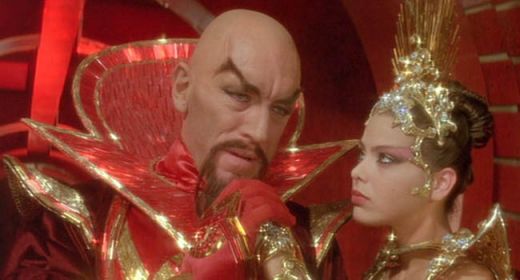
Flash Gordon (1980)

Words cannot express how much I love this movie.  It is insanely cheesy in ways other films can only dream of approaching, and combines the lavish, over the top look of a Dino DeLaurentis production (which it is) with the cardboard cutout characters and silliness of the old film serials that birthed Flash on screen in the first place.  Where else do you get to see acclaimed actors like Max von Snydow ham it up with full force?  I remember seeing the trailer for this when I saw The Empire Strikes Back in the theater, and was fully aware (despite my young age) that it was a knock-off.  But oh what a knock-off!

The Black Hole (1979)

Watching this last night, I was amazed at how odd this movie is.  In many respects it is incredibly anachronistic Disney fare, with dialogue and characters who seemed ripped out of 1950s Saturday matinee flicks.  At the same time, it's also very dark for a Disney film, with one of the robots looking trashed within an inch of the scrap heap before it dies and a self-destructive captain (played by Maximilian Schell) whose robot straight up murders Anthony Perkins (leading to the first PG rating for a Disney movie.)  The actors, like Schell, Perkins, and Ernest Borgnine, seem to belong to a different time, as do the silly moving camera effects. There are some surprising elements, though, from an overall dark tone to a surging, swirling score that I just found out was composed by the great John Barry.  In many respects, The Black Hole is old Hollywood trying to get hip to the new reality and failing.  That said, I liked it as a kid, mostly for the melancholy robots and the aforementioned score.

Battle Beyond the Stars (1980)

For some reason in the 1980s one of my local TV stations would run this one a lot on Saturday nights.  Unlike many of these other films here it does not pretend to be anything other than pure exploitation, since it comes from Roger Corman's New World Pictures.  It borrows the plot from The Magnificent Seven and The Seven Samurai, as Richard Thomas plays a very Skywalker-esque young man who assembles a rag-tag gang of seven to defend his home planet from destruction.  As a kid I loved the fact that one of the said seven was named Cowboy and played by George Peppard, who also played Hannibal on the A-Team at the time.  I also liked that Thomas' space ship was named Nell and talked with a sassy attitude.  Lame, cheap and cheesy, it'll give you plenty of silly entertainment, which is what I love about Corman films.  No Jedi knights or midochlorians here, just cheap thrills, and written by future auteur John Sayles to boot.

Thursday, June 5, 2014

TV Break: The Resonance of Taxi

I am a pathetic old man, since I primarily use my Hulu subscription to watch old reruns of 70s television shows rather than keeping up on the latest stuff.  I've recently grown partial to Taxi, a show I saw quite a lot as a child, even though it started airing before my time.  Back in the olden times before my family had cable, my TV options were rather limited, and certain hours of the day were very TV intensive.  We used to eat dinner early, about 5:30-6 o'clock, farmhand hours.  In the Central time zone back then networks would run a half-hour rerun after the local news and before the regular prime time schedule got started.  Three shows dominated the reruns in central Nebraska back then, Benson, The Muppet Show, and Taxi.

While I tended to watch the Muppets, I liked Taxi, too.  Living in such a rural place, I got a kick out of the whole notion of taxi cabs, much less the shot of the New York skyline refracted through the 59th Street Bridge in the opening credits.  (When my family crossed a tiny cantilevered bridge in Red Cloud, Nebraska, my sisters and I called it "the Taxi bridge."  Needless to say, we were unaware of the scale of the 59th Street Bridge.)  I loved Danny DeVito's wily and rascally Louie DePalma, and got a kick out of characters like Latka and Reverend Jim.

It was a very adult show, so nowadays I appreciate it on a whole other level.  Almost all of the characters were driving taxis because they were struggling to succeed in their chosen fields, or had failed out of them.  Many of the characters are lost souls, like 60s burnout Reverend Jim, and confused immigrant Latka.  It's a show born in the economic downturn of the late 1970s, and for that reason reflects our own economic hard times.  I have plenty of friends who have had to give up their old dreams for the reality of needing a steady gig.  What starts as a way to make money while searching for better opportunities becomes the only option left.

What Taxi shows is that while few of us ever realize our dreams, it is important to have the right kind of people around us in our day to day lives.  The cabbies form a kind of family, united in their affection for each other and their resistance to their tyrannical boss.  In a time when employers hold all the cards, and plenty of folks are working full time at was once supposed to be a transitional day job, it's a show that's more relevant than ever.

Wednesday, December 5, 2012

Why I Love The Rockford Files


Unlike a lot of people, I can't just sit down and burn through whole seasons of television in a day.  The repetition gets to me, plus I'd rather be reading.  However, there are some shows that I have slowly been working my way through over a matter of years, enjoying them like a fine aged whiskey rather than a case of Busch Light.  One of these shows is The Rockford Files, one I am a little embarrassed to love so much.  My requests to put an episode on usually results in a groan of pain from my wife, and my effusive praise of the show to friends and colleagues is normally met with a kind of exasperated silence.  I don't care what they say, I love it.

In case you don't know the show, it stars James Garner as Jim Rockford, a wrongly convicted ex-con who works as a private eye.  He lives in a trailer on the beach with his disapproving father Rocky, and usually ends up getting roughed up and not getting the girl or a big payday.  The supporting characters include Dennis, a grumpy cop who sometimes helps Rockford, Angel, a friend from prison with a knack for weaseling out of situations Rockford has to clean up, and Beth, his liberated woman lawyer and sometimes paramour.

As a fan of all things seventies, I love how the show (which ran from 1974 to 1980) epitomizes so much about the polyester decade.  Although Garner has a ruggedly handsome face, he is no traditional tough guy PI, and reflects the less orthodox masculinity of the time.  He keeps his revolver in the cookie jar, and rarely uses it.  He often gets beat up by roughnecks, harassed by the police, and harried by his dad.  Rockford is more likely to use his mouth and wits to get what he needs, rather than his fists or his gun.  Instead of working out of a fancy office, he takes calls in his trailer, and when he's not around, an answering machine, not a secretary, takes his calls.  The latter device is also used in the opening of every episode, where there's a different message on the machine each time, usually from a bill collector or Angel with a problem or wacky scheme.  Originally released in the midst of the mid-1970s stagflation, Rockford is a hard luck hero for people living through hard times.  Reflecting the Watergate era and general distrust in authority and elites, the villains are usually wealthy, connected types who the police have been unable or unwilling to bust.

All in all, Rockford is just a much more human hero than we're ever allowed to see.  The shots inside his trailer home show the faded wood paneling and the stains on his pot holders.  He inhabits a very unglamorous, low budget Los Angeles, full of strip malls and industrial parks.  The opening montage shows him fishing and buying groceries, fer Chrissakes!  Unlike with modern day shows, he's not laden down with all kinds of psychological or supernatural bullshit.  He is not a serial killer, does not suffer from a mental disorder, does not have a secret family, is not involved in organized crime, etc.  He's a likable guy, what's wrong with that?  Watching all these shows where I am supposed to have ambivalent feelings about the protagonist is just getting old.  It was an interesting twist back when Tony Soprano and Don Draper first went on the air, but enough already!  Can't I just watch someone I want to root for?

Beyond all that The Rockford Files gets all the small touches right.  Rockford drives a gloriously gold Pontiac Firebird, wears open collar shirts with sports jackets (my preferred professional look), and it's got an endlessly catchy theme song.  What's not to like?

Monday, July 23, 2012

Countdown to (Musical) Ecstasy: Learning to Love Steely Dan


As the years go by, my musical tastes have been changing about as dramatically as my life priorities.  Around the age of 19, I had immersed myself so fully into punk rock that I despised any music that smacked of smoothness and artifice.  (That punk rock isn't completely authentic and is also full of artifice was something I was too blind to see at the time.)  Similarly, there was a time in my early thirties when I thought I was going to live the rest of my days as a bohemian bachelor a la Charles Bukowski comforted only by wine, books, and old records.  The life changes are pretty obvious, since I am now happily married with two daughters and much less prone to flights of drunken depression.  My musical tastes have seen radical changes as well, as I am now much more likely to put Steely Dan's Pretzel Logic on the turntable than Never Mind the Bollocks It's the Sex Pistols.

I'd like to think this change has to do with broadening my tastes rather than going soft.  (My 19 year old self would have thought the latter.  I still remember when I was about that age, and a friend of my mom's asked if I listened to jazz, and I said, "no, but I probably will once I get old."  Man, young people can be obnoxious.)  I first got interested in Steely Dan during the fateful year I spent working as a librarian in Chicago between my master's degree and going on to a doctoral program.  It was the summer of 2000, and a new guy working in my department shared my obsessive love of music.  We traded some mix tapes (remember those?), which he used to preach the gospel of Steely Dan.  Since this guy really seemed to have good taste in music, I decided to give the Dan another shot, and eventually picked up a used copy of one of their compilations. A lot had changed since I was 19, namely that I had dove into the music of John Coltrane and Miles Davis, preparing me for the jazz-soaked Dan.

I dug the music on that CD alright, but the wheels really tumbled into place sometime in the next year, when I was driving around and the local classic rock station was playing album sides.  (Remember when classic rock radio was actually interesting?)  They put on side two of Pretzel Logic, and it really blew me away.  I had made the mistake of entering Steely Dan via a compilation, which was a huge mistake because their albums are such unitary, cohesive objects that the songs lose a lot of their power when ripped from their context.  That makes them a group profoundly unsuited to listening to music on an iPod, and for a blog post such as this.  Nevertheless, I'll give a shot, and provide some tracks that might make you think twice about an unfairly maligned band.

"Reeling in the Years"
Before I started listening to their albums, this is the one song I really associated in a positive way with Steely Dan.  Considering my musical tastes at the time, it's easy to understand, since this song has got badass guitars all the place.  The lyrics also contain some acidic put-downs of that kind appreciated by a young misanthrope such as myself in my earlier days.  After years in academia, the line "The things that pass for knowledge I can't understand" resonates with me now more than ever.

"Rikki, Don't Lose That Number"
This was the second song that drew me in, mostly because it's just a perfect little pop gem.  It also makes me picture a fern bar in the 1970s with dudes sporting fly collars displaying their chest hair on the prowl for young hotties in peasant dresses and oversize sunglasses.

"Peg"
Here's a classic example of the seediness of Steely Dan's lyrics and the darker meanings beneath the bright surfaces.  The singer is trying to dissuade the title character from appearing in a "foreign movie," which is a euphemism for a porno.  It's hard to figure out, considering that you're probably enraptured by the outtasite jazzy guitar solo and the multi-tracking of Michael McDonald's background vocals.  (When Becker and Fagen explained how this track came together for the Classic Albums series, I was pretty floored.)

"Boston Rag"
My Platonic ideals of Rock Guitar are the intro from "Voodoo Child (Slight Return)" by Jimi Hendrix and the solo on Television's "See No Evil."  Yes, they are pretty damn transcendent, but the finely textured guitar on this song throws me for a loop in a totally different way.

"My Old School"
Kiss offs don't get better than this tune, which references Walter Becker and Donald Fagen's alma mater of Bard College, and not in the kind of way that'll get mentioned in the alumni newsletter.  "When California tumbles into the sea/ that's when I'll go back to Annandale" is pretty much how I real about East Texas after leaving it.

"Any Major Dude Will Tell You"
Speaking of East Texas, it was there that I managed to find Pretzel Logic on vinyl in an antique store that had a bunch of unorganized but often fantastic records in the back.  (I guess the place wasn't all bad.)  On glum days "when the demon is at your door," of which there were many back then, I used to play this song for comfort.

"Any World (That I'm Welcome To)"
"Any world that I'm welcome to/ Is better than the one I come from."  Best description of growing up in a place you hate I've ever heard.  (More on that below.)  Or of the disgust of living in a world governed by such violence and stupidity as ours.

"Deacon Blues"
This song is by far my favorite, mostly for the lyrics.  Although I had always heard that Becker and Fagen were New York City guys who migrated to LA, I recently discovered that Fagen had been born and raised in postwar suburban New Jersey, which came as no surprise.  I know from personal experience that those who grow up in staid environments and feel like outcasts within them often go on to become fiercely bohemian in their attitude.  After a childhood of getting picked last in gym and not having friends who can appreciate avant-garde music, living an unconventional adulthood in a big city can be a very satisfying middle finger to years spent suffering in spiritual jail.  The narrator of this song is just one of these people, a jazz musician who does not cave into popular tastes but plays "just what I feel."  In a little jab to the squares who might look down on him, he says, "They got a name for the winners in the world/ I want a name when I lose/ They call Alabama the Crimson Tide/ Call me Deacon Blues."  It's a kind of celebration of being an outcast, an act of defiance that makes the narrator a "loser" in the eyes of others, but satisfied with the fact that he can play his music, drink his whiskey, and live an authentic life.  It's actually quite a punk rock statement, and one that my 19 year old self would have totally understood.

Thursday, July 12, 2012

Sheepish Musical Pleasures: Crosby, Stills, Nash, and Young, "Almost Cut My Hair"


There is very little music that sounds more dated today than post-sixties hippie rock in general, and Crobsy, Stills, Nash and (sometimes) Young in particular.  Don't get me wrong; I am a huge Neil Young fan, I love the Byrds, dig Buffalo Springfield, and have always enjoyed the classic pop of The Hollies.  However, when you take elements of all of these great things and form a kind of Frankenstein's monster of hubristic, narcissistic, affluent Boomer hippiedom, it adds up to a whole lot less than the sum of its parts, akin to avocado, bacon, and broccoli ice cream.  Sure, 1970's Deja Vu is a pretty good album, but I'd rather listen to Young's After the Gold Rush, (released in the same year) every time, if given the chance.

There are few groups this side of Rush who sing such daft lyrics with such unabashed conviction.  Over forty years on, a song called "Woodstock" with a refrain of "we are stardust/ we are golden/ and we've got to get ourselves/ back to the garden" seems more like a joke than a generational call to arms.  (In CSNY's defense, this song was written by Joni Mitchell, not them.)  These words seem positively level-headed compared to the David Crosby-penned "Almost Cut My Hair."  Growing up I knew a lot more about the man's epic substance abuse problems than his music, and a little of that drug casualty spirit is present in this song, which is an uproariously funny counterculture paranoid fantasy where Crosby declares "I feel like letting my freak flag fly."  That's not my favorite line of flower power doggerel, either.  Every time he says his paranoia is like "looking in the mirror/ and seeing a police car" I have a hard time not laughing audibly.

Hearing wealthy rock stars lament how hard it is to turn rebellion into money, as The Clash once said, is pretty damn chuckle worthy.  That being said, I can't stop going back to this song.  Like a prehistoric fly caught in amber, it preserves a particularly detailed relic of an interesting and increasingly incomprehensible past.  It's also one of the few times on a CSNY record that Stills and Young cut loose with their guitars with the same abandon that they showed on Buffalo Springfield chestnuts like "Mr. Soul."  With a little more dueling electric mayhem and a little less woodsy harmonizing they could've been a much cooler band.

Friday, April 6, 2012

Why More Cop Shows Should be Like The Sweeney


As those who read this blog should know by now, my pop culture interests are heavily Anglophilic and 1970s obsessed.  These two loves of mine come together quite nicely in one of my favorite television shows ever: The Sweeney.  A Brit former colleague of mine turned me on to it after I had discussed my affection for the UK version of Life on Mars, a show set in the 70s that often made implicit reference to the characters and style of The Sweeney, from two-fisted cops to Ford Grenadas driven with reckless abandon.  Imagine the Beastie Boys' video for Sabotage brought to life and transported to Blighty, and you pretty much get the picture.

It's a breath of fresh air today in a television world populated by incredibly lame and predictable police procedurals.  The only American cop show worth a damn in our time has been The Wire, and that's a show that's really more about Baltimore as a city than it is about police and crime fighting.  I know the current crop of crime shows well because my wife watches them obsessively.  I jokingly call her favorite programs "dead body shows," since they usually revolve around the solving of murder through the use of forensic evidence found on a corpse.  I find these shows -the various Law and Orders, Criminal Minds, the CSIs, etc- to be dreadfully boring and full of totally uninteresting characters.  It's hard to feel any emotional connection to the police figures, mostly because they so are so two-dimensional that they make Mitt Romney look human.   The criminals are very likely to be mentally deranged; they commit their crimes because they are psychopathic rather than opportunistic.  I find this convention, which is especially pronounced on Criminal Minds, to be incredibly tiresome.  If the criminals are just monsters and demons, they can never be interesting as characters, since their warped nature is their only motivation for their crimes.  I've noticed a strange phenomenon whereby the lovers of these shows are able to sit down and watch one after the other for hours, as if in some kind of trance.  The monochromatic and formulaic nature of these shows are what makes such marathon viewing possible.

The Sweeney is something else entirely.  The two main characters, detective Jack Regan and sergeant George Carter, are fully-fleshed out people with quirks, personal demons, and an ambiguous relationship with the audience.  This is especially the case with Regan, played outstandingly by John Thaw, who often comes across as crass and thuggish.  (Just watch him action, uttering the immortal line "Get your trousers on, you're nicked!")  He seethes with working class resentment, clashing with his superior Haskins in ways that betray his anger at having to be told what to do by one of his social betters.  Carter is less volatile, but after losing his wife in the second season, he begins to act more and more Regan-like.  He is a man caught in a tug of war between the better angels of his nature and Regan's willingness to do whatever it takes to get the job done.

One thing that contributes to the show's greatness is that dead bodies are few and far between.  Carter and Regan are members of the eponymous Sweeney, which is a Cockney rhyming slang term for the Flying Squad, the London police's armed robbery unit.  The criminals (called "villains" by the cops) are not obsessed with their mothers or looking to jizz on a corpse, but are practical-minded careerists who commit robberies to make money, and for their own personal enjoyment.  Among my favorite characters in the second season are Colin and Ray, two flamboyant Australians who enjoy living the high life and making fools out of the poms.  For the most part, the criminals on the show come from the same working class roots as Carter and Regan, and tend to take a practical, hard-nosed approach to their careers in crime.  The lines between their world and profession, and that of the police, blur considerably.  The cops know the world of the criminals well, and even consort with them to get information.  Sometimes you get the feeling that the roles of cops and criminals could be reversed, and that Regan could just as easily used his wits and fists to steal and thieve as to catch the crooks.

That ambiguity reflects a general realist feel to the whole enterprise.  The people on the show look and dress like regular people, right down to the flared trousers, brown color palette, and explosion of corduroy that one would expect to find among the less sartorially sophisticated gents of the polyester decade.  The grit of the streets coats the film, and you can practically smell the stale reek of ashtrays in the police office scenes.  Characters sport thick accents, bad haircuts, and look old for their age, ground down by life.  While there is the occasional bank hold-up hostage plot and take-down of terrorists episode, the ongoing struggle between professional criminals looking to make some quid and professional police trying to lock them up feels much more real to me than any serial killer plot.

Furthermore, like few other shows of its ilk, The Sweeney excels in the ancient and lost art of car chase scenes.  The modern cop shows betray their lack of excitement when an hour goes by without a single screeching tire or bent fender.  The beginning of the episode "Stoppo Driver" might be my favorite tv cop show car chase scene ever, not least because it looks like the chase is on real streets, and the action isn't hacked to bits by overactive editing, as is so often the case today.

Last but not least, The Sweeney has perhaps the best closing credits ever.  Whereas the opening theme pulsates with energy and a skanky beat, the closing is meditative, showing the detectives putting their coats on at the end of the working day, conscious that many more days of work lie ahead.  It's a world-weary close, and it never allows the show to end with cheap triumphalism or a totally happy ending.  Carter and Regan may have nicked some villains today, but more await tomorrow.  That sense of life as never-ending toil reflects the show's working class ethos, a voice sorely lacking in American popular culture these days.

Monday, April 2, 2012

Late 70s Malaise Rock

Ever since I finally broke down and bought a turntable a few years back, I have been delving deeply into the music of the 1970s.  Don't get me wrong, I'd always loved disco, funk, punk, classic rock and the like.   However, I had neglected the poppier regions of the musical landscape, perhaps out of an over-developed sense of musical snobbery masking itself as refinement.  Of the many sub-genres I've found lurking in the grooves of wax from the polyester decade, none interests me more than something I call "malaise rock."  The term, of course, alludes to president Jimmy Carter's famous speech in 1979, where he responded to the energy crisis by giving America a sermonizing speech on the need for a kind of political spiritual renewal.  Even though he never used the term "malaise" in the speech, that term stuck not only as the embodiment of Carter's presidency, but of America in the late 1970s more generally.

I have vague memories of this time of high inflation, scarce gas, and international tension.  While the hostage crisis in Iran did not register with me, I have a very vivid recollection of sitting in my parents' car while they physically pushed it to the gas station a couple of blocks away so as to avoid using gas to get there.  I had no way of understanding why they were doing that, or the financial struggles my parents did a fine job of hiding from me.  


The pop music of this era reflected a nation literally and figuratively running out of gas.  Written mostly by Baby Boomers, it also spoke to a sense that the hopes and dreams of the sixties had died for good.  I normally have little use for Jackson Browne, but "Running on Empty" eulogizes the loss of a generation's dreams rather well.

More literally, The Kinks' "Gallon of Gas" from 1979 commented on rising gas prices, fitting with the theme of economic decline voiced by the album Low Budget that it came from.


On my old blog I wrote a whole essay about this song, whose dark themes are somewhat hidden by the lush production and famous saxophone riff. It's a song about those nights after days of pursuing a dream that isn't coming true, living in a place you can't stand and getting drunk to forget about it all. Let's just say that my time in Texas attached me to this song in a way that others might find a little hokey for a piece of seventies AM radio pop. The sense of exhaustion in this song mirror's Browne's metaphor of "running on empty."


You may look askance at me for adding this disco party classic to a list of malaise music, but hear me out. I've always thought this song was meant to be a little ironic. It came out in 1979, during the middle of bad economic times, evidenced by the "leave your cares behind." The theme seems to be: "it's all going to shit, so you might as well party until the whole thing goes up in flames." The catchy riff has a robotic feel to it, as if having a good time has been drained of emotion to become an exercise in pure escapism.


Speaking of late-1970s decadence, no group exemplified that era's escape into empty pleasures than Fleetwood Mac. (The sub-genre of 70s California Cocaine Rock will most likely be the subject of a future post.) During the sixties, drugs held out the possibility of liberating the mind and expanding consciousness; now they were just a means to the end of getting loaded. No single album captures the feeling exhaustion brought on by overindulgence better than Fleetwood Mac's epic 1979 double album Tusk.  To me, "That's All For Everyone" sounds like the dizzy, drug-addled stumbling of someone about to pass out.  Other songs, especially Stevie Nicks tunes like "Angel" and "Storms" rue over lost love and missed opportunities.  These songs sound like drinking to forget distilled into the grooves of a record.

And sure, many folks wanted to forget the seventies as America passed into its neo-liberal redwhitenblue Reaganite capitalist wet dream in the 80s.  But guess what, the bill for thirty years of neo-Gilded Age economics has come due, and malaise is again the order of the day.  Too bad our current Top 40 offers little of the commiseration provided over the airwaves back in the late seventies.