Showing posts with label Star Wars. Show all posts

Monday, May 20, 2019

How The Phantom Menace Saved Me From Fandom


Yesterday marked the 20th anniversary of the release of The Phantom Menace, a film that in many respects marked the beginning of our current moviemaking culture. The heavy use of CGI and its role in extending a beloved franchise were harbingers of the future. It's a film that made over a billion dollars, but is one that no sane person thinks is a great movie. It's best known today as fodder for jokes and derision.

It is safe to say that there is no film I have ever seen or ever will see that filled me with such anticipation. I was one of the Star Wars firekeeper fans. The original films dominated the pop culture Zeitgeist in the late 70s and early 80s, but were very quickly thought of as passe. When my sixth grade class had to choose an end of school year movie in the spring of 1988 I lobbied for Return of the Jedi, and my teacher was shocked. "You still want to watch that kid stuff?" he asked. (The chosen film was Monster Squad. History has vindicated me.)

I stayed true to Star Wars, recording the movies off of network TV and practically wearing out the tapes. I devoured Timothy Zahn's Heir to Empire when it came out in 1991 and read the Dark Horse comics. In those pre-Amazon days my best friend in high school managed to cajole the manager of the local Ben Franklin variety store to order models of the old Star Wars ships for him. He spent a summer doing an epic detailing job on the Millennium Falcon.When I was in college I delighted in getting the remastered versions of the trilogy on VHS (not knowing this would be the last time they'd be available in their original form.)

Seeing the special edition of Star Wars in the theater in 1997 was absolutely thrilling, even if I was underwhelmed by the new additions. That night in the theater the mood was positively joyous. I made sure to see it at the now sadly defunct Indian Hills Theater in Omaha, which had a giant 60 foot concave Cinerama screen. Star Wars had never looked so good.

Two years later, I could barely contain my excitement at seeing The Phantom Menace. Part of me wondered if I would be capable of viewing the movie in any kind of objective light. If it was shit would I ever recognize the fact? I saw it at a much less exalted location, a junky movie theater on the South Side of Chicago. At one point a derelict the row in front of me was passed out, snoring.

The film perplexed me. I liked the lightsaber battles and the pod race, but so much of it just seemed off, and the dialogue just flat. I also didn't buy this budding relationship between a kid and a teenage girl much more mature than him. Of course, nothing bugged me more than Jar Jar. The comic relief in the original trilogy was so natural, here it was forced and grating. However, I thought the film looked visually stunning, and I'd never really seen CGI used so well before.

I left that first night telling myself that it was still a new Star Wars flick, and hey "Isn't this supposed to be kids' stuff?" I went again, and then realized that the movie actually kinda sucked. Soon The Matrix and The Fellowship Of The Ring would blow George Lucas' vision out of the water and The Phantom Menace would just seem lame. I hoped for better from Attack of the Clones, but that film was arguably worse.

The second film completed the shift in mentality that the first had begun. I didn't get mad at George Lucas or anything like that. I realized simply that I had probably invested too much of myself in Star Wars. If they were going to make shitty Star Wars movies, maybe I just didn't need to care about it so much. I remain a big fan of Star Wars, but that fandom in no way is fundamental to my identity. I would like to thank The Phantom Menace for that.

Fan culture has become so rotten and toxic. Fans expect fan service in their movies, and for the artists who make the film to only do what the fans demand. This of course is a recipe for really boring entertainment. Even worse, fans talk about box office receipts like they are some kind of personal validation. "Avengers made the most money, so that means I'm the best!" What kind of messed-up perspective on the world is that?

By all accounts George Lucas is a good boss who gives very generously to fine causes. He also jealously guards his independence to a fault. When there was no one who could say no to him, he was allowed to indulge his worst tendencies, and the prequels were the result. While those films were a letdown, I wish the "fans" had gotten the right message. As much as you care about this stuff, ultimately you don't own it. Lucas has made that clear through his impounding of the original version of Episode IV. As much as I am dying to see it again, I'm also pleased that his recalcitrance is angering the fans (including myself) so much.

So today I would like to thank George Lucas for making a bad movie and giving me a little perspective.

Thursday, May 25, 2017

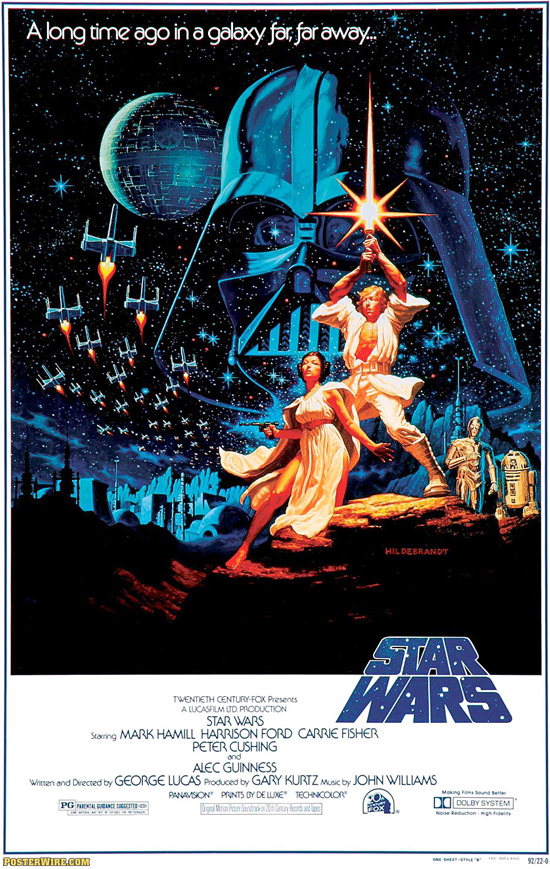
Stars Wars As 70s Cinema

Check out those sideburns!

[Editor's Note: Today is the 40th anniversary of the initial release of Star Wars, and keeping with tradition on this blog, I'm writing about it.]

For years there's been a narrative in film criticism that Star Wars was the death knell for the flowering of personal, edgy American cinema in the 1970s. After that point Hollywood would prize blockbusters more than small films by auteurs, seeing them as the key to big bucks after Star Wars' unprecedented success. This is all mostly true, of course, but it ignores one crucial factor: Star Wars itself was a product of the 70s cinema culture that it helped to destroy. Its roots in the auteur-driven, realist cinema of the polyester decade are in fact what made it so good and has helped it endure.

Let's first take the fact that 20th Century Fox was willing to give George Lucas millions of dollars to make a kind a movie with a plot and setting more commonly associated with B movies and 1940s serials. The freedom given to directors by studios is what enabled Lucas to even make this film in the first place. In today's environment there's no way a studio would allow a director the level of creative control Lucas had on Star Wars.

On the surface, the setting of Star Wars seems antithetical to the realist currents of 70s cinema. Watch a Robert Altman film of the era, for example, and you will go into people's cluttered living rooms in a way Hollywood films today never do. In Star Wars, we are sent off into a fantastical galaxy far, far away. But it still has the values of 70s cinema. As many before me have discussed, this is a "lived in" universe in ways that prior sci-fi and space fantasy never were. People usually talk about the beat up spaceships and dirty taverns, but there are even deeper examples. For example, when we go into the Lars homestead and see that bottle of blue milk and hear the hum of cooking machines, it reminds me of Elliot Gould's apartment in The Long Goodbye. The "lived in" world of Star Wars makes it so much more human and accessible than all of the space movies that came before and after. Luke Skywalker feels like a small town kid aching to get out, as much as Richard Dreyfus in American Graffiti.

Then, of course, there's Lucas himself. Like most of the other directors of New Hollywood, Lucas was of a generation that went to film school and was deeply influenced by foreign film. His first film, THX 1138, is both small and challenging, much like the films of other auteurs of his generation like Peter Bogdanovich, Martin Scorsese, and others. American Graffiti was a crowd-pleaser, but it really just shows a slice of life on one night in a small town. Star Wars was more ambitious, but was grounded heavily in his foreign film influences. As Lucas himself has been quick to point out, Star Wars owes a huge debt to Akira Kurosawa. The plot resembles that of Hidden Fortress, and R2D2 and C-3PO were directly inspired by characters in that film. That's only the beginning, obviously. You can add the samurai sword nature of lightsaber fights and the long shots of the droids traversing the Tatooine desert.

But hey, don't take my word for it. If you can, get your mitts on a despecialized edition of the film and see it was originally made without all the embellishments. What you will see is a gloriously shaggy 70s movie, from the sideburns all over the rebel pilots and imperial officers to the ratty cantina to the matte paintings to Luke's haircut. And yes, Lucas did a lot of things new, such as his much more rapid pace of editing and his pulpy subject matter. But as much as Star Wars heralded the changes to come in filmdom, it only got there because it incorporated so well the milieu it would ironically destroy.

Wednesday, May 25, 2016

My Star Wars Day Wish


Today is May the 25th, and every Star Wars fan worth their salt knows that today, not May the fourth, is the true Star Wars day. It was on this day in 1977 that Star Wars was first released to theaters, and the world has not been the same ever since.  Despite that fact, it is extremely difficult to obtain an official, legally distributed copy of that film, which seems mighty odd that the local Target's bins are practically bursting over with the likes of That's My Boy and Fantastic Four. The only version available is one altered in key respects by George Lucas after twenty years of tinkering.

The crime of this came back to me recently when I taught an intercession course at my school about Star Wars. One thing I wanted to bring across was how and why so many people were wowed so spectacularly when they first saw it in the theater. I set that up by showing parts of other sci-fi films that preceded it in the 1970s, like THX 1138, Silent Running, and Logan's Run as well as the Flash Gordon serials that had been a big influence on Lucas. I decided to show them only the first reel of the film (even though we were seeing it on DVD), and then for us to analyze it.  And while I knew that there were not the kinds of severe alterations in the first reel that so badly alter later scenes (especially in Mos Eisley), I knew that there were small changes, some barely detectable. That fact bugged me, since it was hard even for me to know what was there in 1977, and what was not.  I realized that my students could not actually see the thing in 1977 that had carried such a heavy impact.

Forget all the whining by Star Wars fans like myself upset over "ruined childhoods."  In the first place, my childhood was ruined a long time ago by an abusive kindergarten teacher. In the second place, it's what posterity has lost that is more important. I came to realize that the vast majority of my students had never actually seen the original Star Wars, only the special editions. The original had been disappeared before they were even born.  Considering the massive cultural importance of Star Wars, it is a crime against history to suppress or destroy such an important cultural artifact. It would be like painting a permanent mustache on the Mona Lisa, or putting a neon sign in the background of Starry Night. It is my most fervent Star Wars day wish that the powers that be release a remastered version of the original 1977 version of the film on blu-ray.  If they want to include it with the special editions, or versions with different sound mixes for the true obsessive, all the better.  Perhaps that way George Lucas' feelings can be spared. Hell, I'll even allow them to call the original version "bonus materials" if that makes him happy. I would pay a pretty penny for it, like a lot of other Star Wars fans, so Disney, 20th Century Fox (who still owns distribution rights to the first films), and Lucas will all benefit. Despite rumors that it's going to happen, for some reason I doubt it.

Above all, I wish for a remastered 70mm version of Star Wars released to the theaters. I first wrote about that last year at this time, and plan on making the same plea every Star Wars day to come.

***


The film podcast The Projection Booth is a must-listen for me, and they've termed this month "maudit May."  They have been discussing films so snakebitten or unfortunate that they cannot be seen, such as Orson Welles' The Other Side of the Wind, which the master never completed.  Imagine my surprise when I saw that Star Wars is their film this week.  Wasn't the world saturated with Star Wars, and DVD copies easy to find?  After that initial thought, I remembered the reason: Star Wars cannot be seen in its original 1977 version, which George Lucas has kept under lock and key, and which he has even claimed no longer exists.  (I call shenanigans on that one.)  Instead we are stuck with constant revisions of the original film, which I can only see now with cheesy add-ons made with low-grade 1990s CGI.  This great film now has a completely clunky, idiotic scene with Jabba the Hutt jammed in where Han is forced to step on Jabba's tail to account for the gratuitous retrofitting of a fake-looking CGI slug, in addition to all kinds of silly crap happening during the trip into Mos Eisley spaceport.

The new sequels make me mildly excited.  You know what would make me truly elated?  Seeing a restored, remastered, 70mm version of the 1977 original in stereo sound on the big screen.  This would still technically be a "special edition" because the original, first release of the film in May of 1977 had multiple sound mixes, both mono and stereo.  The stereo mix was a bit of a rush job, and Lucas actually preferred the mono mix because it was more refined.  (Little known fact, the sound mix was still being put together just days before the film hit theaters.)

Seeing the original film with cleaned up sound fit for modern theater speakers in glorious 70mm would truly be something else.  I saw the 1997 special edition at the now demolished Indian Hills theater in Omaha in 70mm on a towering, concave screen built for Cinerama.  Despite the annoying additions to the film, it was one of the most amazing cinematic experiences of my life.  Please Disney, get this right and give the people what they want: the movie they fell in love with (or at least the closest we can come to it) looking fantastic and sounding great in glorious analog film.  There are a lot of people who will put cash on the barrelhead for this.  If that isn't motivation enough, at least bring back one of the most culturally significant films ever made and stop allowing it to be suppressed in favor of a far inferior version.

Monday, January 11, 2016

Ranking The Star Wars Films After Re-Watching Them All

After re-watching the prequels I heartily endorse Patton Oswalt's assessment of them

I finally managed to see Star Wars: The Force Awakens the week after Christmas, and now, I am finally able to write about it.  There are enough takes flying around out there about the film, so I decline to add my own.  Instead, I'd like to discuss it in context with the other Star Wars films, because I sat down and rewatched them all before seeing Force Awakens.  Here's my annotated ranking of the films now that I've seen them all again back to back:

1.  Empire Strikes Back
This was number one for me before the great rewatch, and seeing it again in juxtaposition to all the others just solidified that position.  In the first place, it looks amazing.  Evidently there were cost overruns in making it, but it looks like it was money well spent.  The original looks a little chintzy in spots, and Jedi has parts that could have looked better, too.  Unlike all the other Star Wars films (except The Force Awakens), the human relationships feel real.  It's practically a flawless film, as far as I am concerned, except maybe for that bad line reading of "two fighters against a star destroyer?"  It is also telling that it is the film among the first six where George Lucas has the least involvement.  He came up with the story, but Lawrence Kasdan wrote the script, Irwin Kershner had a lot of leeway in directing it, and Gary Kurtz did most of the day to day production on set.  (This also led to those aforementioned cost overruns that also led to Kurtz not taking part in the next film.)  Lucas has a real talent for world building, creative scenarios, and drawing the broad outlines of mythical stories, but he needs other people to translate that story into script and to direct actors to say the lines. Five stars

2. Star Wars
(I categorically refuse to call this A New Hope.)  This film is very very close to being number one, but gets edged out due to the more fully human emotional landscape of Empire and the drama that comes with it.  In any case, it is a truly great film.  It blows me away that something made in 1977 holds up this well.  If not for the sideburns and haircuts, it looks almost contemporary.  It also may be the best edited film ever made, somehow propelling itself forward while leaving room for the extended and slower story of the droids landing on Tattooine.  The lived-in universe this films creates is so rich that we still want to return to it decades later, and it is left so open that so many stories can still be told there. It doesn't just build that world, it hits all the right notes and never fails to surprise.  Thinking about it from the perspective of my first viewing, its crescendo is breath-taking.  After blowing our minds for over an hour and a half, Lucas gives us the assault on the Death Star, which feels light years ahead of the film's beginning, which was light years ahead of 70s sci-fi cinema. Five stars

3. Return of the Jedi
When I was like ten or so, I probably would've put Jedi first.  Since the 80s it's come in for some abuse due to the Ewoks and other factors, but seeing it again it is obvious that this is a really good film.  The Jabba's palace adventure at the start and the three-way battle and duel in the throne room at the end are both fantastic.  Yes the Ewok stuff drags the movie down and slows it up, and Han's role seems weird and ambiguous, but that does not outweigh the greatness elsewhere.  I think Mark Hamill really outdoes himself in this movie, he seems to wear his burden to destroy his father on his face.  By ranking Jedi third, this is less by default and more just to say that while it is really good, it's not as good as the other films in the original trilogy.  Perhaps it gets underrated because after seeing the prequels, the seeds of Lucas' future wrong turns are evident.  The Ewok stuff comes across as silly and motivated more by marketing than by art, a harbinger of Jar Jar. Four and a half stars

4. The Force Awakens
Again, this ranking is based on the fact that films ahead of it are so good, not because this film is not good.  In fact, I think it is really, really good.  As I mentioned before, it is the one film other than Empire that really seems to have nailed human relationships.  I was at the edge of my seat several times in the theater.  Unlike the prequels, it seems to have figured out how to incorporate humor and to introduce new characters that the audience actually cares about.  Some touches, like Finn's origin story, are truly brilliant.  This film so good that I put it just about even with Jedi, in fact.  It doesn't quite make it for me, because some of the derivative elements mirror the 1977 original beyond a reasonable point.  Also, while it does a good job of keeping things mysterious and not over-expositioning, the First Order and its motivations, as well as the status of the Republic, are all murky to the point of distraction.  By trying hard not to make the mistakes of the prequels, TFA may have overreacted in this area. Four and a half stars

5. Revenge Of The Sith
Now here we have a change in one ranking slot, but a sheer cliff drop-off in quality.  When I first saw Sith I thought it flawed but as good or better than Jedi.  Now there is no way I would say anything so ridiculous, especially after rewatching Sith.  Ewan MacGregor gives it his all, and thus makes the final showdown with him and Anakin feel meaningful to the point that I get goosebumps for the only time in any of the prequels.  But my God, some things are just awful.  R2D2 is given ridiculous abilities.  The Jedi bodyguards for Mace Windu are all slayed in a matter of seconds by Palpatine in a way that defies belief.  Key dialogue and the reading of it are dreadful, especially Hayden Christensen's "From my point of view the Jedi are evil."  The "Padme died of a broken heart" thing is a stupid cop-out.  The mission to protect baby Luke and Leia could've been a great movie, and it lasts about five seconds with zero tension.  The destruction of the Jedi, supposedly the greatest warriors in the universe, ends up being as easy as microwaving a burrito.  Frankenvader.  Decades of anticipation went into the storyline of this film, it should have been a big fat pitch over the middle smacked for a home run, but instead it was mashed into the ground for a squeaker of an infield single. Three stars

6. Attack of the Clones
Before this set of rankings, I considered this one the worst, but now that title goes to Phantom Menace. Make no mistake, this is a bad movie.  The romance between Anakin and Padme simply does not work, the dialogue is rotten, and the bad delivery of said dialogue is probably down to the lack of proper direction of actors who have otherwise done well.  I should add that I am not as critical of Hayden Christensen's performance as others are, he's just not given much to work with.  His Anakin comes off as an edgy creep with violence lurking below the surface.  That's a good choice, but it's also very, very jarring after seeing the good-natured kid from the first film, who seems to have none of these characteristics.  Apart from the bad romance and bad direction, the film is bloated (the longest of all of them) and has massive set piece action sequences that don't quite work.  The whole droid factory sequence is useless, and C3PO's "humorous" experiences irritating in the extreme.  The CGI is not all that great and it is so ubiquitous that so many crucial scenes are distractingly fake looking. I give this film a reprieve from the bottom for a few reasons.  In the first place, I like the whole Obi-Wan as detective plot.  It's something a little new for Star Wars and interesting, even if I could do without the Boba Fett origin story.  Some of the design elements are also really cool, especially Coruscant.  Lucas never lost that ability to envision breath-taking worlds.  Last and certainly not least, Christopher Lee is in this and brings his wonderful glower.  Why couldn't he have been in the movie from the beginning, or at least halfway through? Two stars

7. The Phantom Menace
This movie is last because so many bad decisions were made in its conception that marred the prequel series as a whole.  Making Anakin a little boy (and thus making the romance with Amadala creepy.) Centering the plot around poorly explained trade routes that nobody can get into or care about. Midochlorians. Jar Jar. Giving the aliens ethnic stereotype accents. Taking the lived-in universe of the originals and making it all shiny, sheeny, and bland.  It's a shame because the lightsabers are so much cooler and the duels well-executed.  There's some great actors here (McGregor, Neeson, Portman, Jackson) but they look lost or like they are phoning it in, especially in Neeson's case.  This movie also has no real reason to exist, in terms of the larger plot. It is fun in places, but that doesn't come close to saving it.  Two stars

Tuesday, December 15, 2015

Holding On To That Star Wars Feeling

Title of this post inspired by "That Teenage Feeling" by Neko Case

Star Wars: The Force Awakens is coming out this week, and I will probably get around to seeing it on a weekday matinee with my wife in the week after Christmas on a day my children are in day care.  Ah, the glamour of parenting!

My feelings about seeing it are a little mixed, even if (or perhaps because) Star Wars has meant more to me than any other piece of culture.  When I first heard about it, I thought (rather boldly) that I would not see it, since it was just another Hollywood cash grab taking an old property to milk it for money.  I figured it would be just another boring product of the machine, only with "Star Wars" slapped on it.  Why bother?  After seeing the second trailer, I began to change my mind a little, and allowed that I would go see the film and have some fun.

Then my mind changed yet again.

I think the triggering incident was the new season of The Star Wars Minute, a podcast that breaks the Star Wars films down, minute by minute.  They finished all of the original trilogy this summer, and even though the hosts made their hate of the prequels known, they've decided to do them now, too.  The difference is striking, obviously.  The original Star Wars minutes were bursting with layer upon layer of interesting things, the individual minutes of the prequels hold no such bounty. Instead each one keeps asking the same question: how on earth did something so good go so bad?  It only reemphasizes how special those original films were, and that everything since has only diminished my great memories of them, submerging them under a tidal wave of cinematic sewage.  (I can't even rewatch the originals, since Lucas has fiddled with them so much that I can only watch a late 1990s version of them.)

The danger of this with the new film is even greater, considering that the original characters are going to be appearing again.  I want this movie to either be phenomenal, or to be a catastrophic disaster akin to the Star Wars Holiday Special. If the new films are so bad that they have to be seen to be believed, I will cherish them. Films like that are rare jewels.  On the other hand, the worst that could happen is that if the new films are mediocre, or competent but not great.  Why?  Because it would turn Star Wars into just another crummy Hollywood film franchise.  I need for Star Wars to be something more than that.

What perhaps disappointed me the most about the prequels was that they so rarely gave me what I can call "that old Star Wars feeling."  It's hard to clarify, but it's the feeling that welled up in me when I saw the originals and which sometimes comes back when I rewatch them.  It is a swelling in my soul, a kind of magic.  I think I felt it twice during the prequels.  The first came when the credits opened on The Phantom Menace with the John Williams score blaring.  That moment transported me back to my youth, and was so mystical that I didn't notice the inanity of the crawl at the beginning and its talk of trade federations.  The other came at the end of Revenge of the Sith.  Obi-Wan's impassioned speech to the now burnt and defeated Vader got that old feeling welling up from inside me again.  I felt like the seven year old who watched Vader take off his mask with wonder and dread.

That feeling came pretty late in the game, and probably had less to do with the movie and more to do with fulfilling thirty years of anticipation over the moment when Vader become more machine than man.  I wish I could believe that the new film will give me that old Star Wars feeling, but I am beginning to think that would be too much to hope for.  Looking at JJ Abrams' track record, he has talents but not genius.  I am sure that I will see a well made piece of Hollywood entertainment when I go to Force Awakens.  That would be fine if it was just another Marvel movie, but I am chasing a feeling that goes well beyond such crude matter, to quote master Yoda.  Is that fair to the movie? Probably not, but this is something that transcends fairness, whether that's realistic or not.

Wednesday, October 21, 2015

What The Makers Of The New Star Wars Can Learn From Nicholas Meyer


The last coupla days there's been people getting all excited about the new Star Wars: The Force Awakens trailer.  I have been reminding folks just how over the moon so many of us went in regards to the Phantom Menace trailer, and that so far I don't see any evidence that the new film won't just be another middle of the road, movie by committee Hollywood CGI action/adventure flick.  Hearing the sounds of TIE fighters and the John Williams score might stir something in the core of me, but if I'm being honest when I look at the trailer I don't see any evidence that this film isn't simply another Hollywood cash-in using an old property to make easy money.  But hey, I could be wrong, and I hope that I am.

I've been thinking a lot about what it would take to make a good sequel to such a beloved series, and my mind wandered over to Star Trek.  Nicholas Meyer is not a household name, but when he took the reins of the Star Trek franchise after 1979's Star Trek: The Motion Picture, it was make or break time.  Trek hit the big screen after a combination of fan effort and desire to cash in on Star Wars, but the first film in the series left a lot to be desired.  It was like an extended episode of the original series, but superlong and paced slower than a three toed sloth.

The next film in the series, The Wrath of Khan, on the other hand, is often considered the best Trek ever.  It was directed by Nicholas Meyer, who also went on to write the fourth Trek movie and and direct the sixth one, widely considered to be the other highlights in the series.  There is no way that this is coincidental.  The great film podcast The Projection Booth did an episode on Khan, where I discovered that Meyer and writer Harve Bennett were not all that familiar with Trek before taking on the project.  That ended up being a benefit, since they brought fresh eyes to the material.  The first film was much more the creation of Gene Roddenberry, the creator of the original Trek series.

The parallels to Star Wars are pretty obvious here.  The original films were beloved, but when original creator Lucas helmed the prequels later, the results were not good.  JJ Abrams, like Meyer, is now tasked with taking things in another direction.  In Khan Meyer shook up the staid, placid nature of Roddenberry's approach right from the get-go with the drama of the Kobayashi Maru simulation, which the viewer knows isn't real the first time they see it.  Most of the film is a kind of battle of wills between Kirk and Khan, with older-style Trek plots centered around encountering new planets absent.  It ends, of course, with the emotional punch of Spock dying in an act of supreme self sacrifice.  I remember seeing it for the first time as a wee lad and being shocked and deeply affected by it, and those scenes still pack a punch for me.  It is extremely gutsy to kill off one of your most beloved characters.  The film also exposes Kirk's vulnerability, making him a much more human character.  I doubt any of this would have happened had Meyer just tried to copy what worked best in the original series.

Star Trek IV and VI also benefit from daring choices that deviate from the original Trek template.  Star Trek IV is a time travel movie that mostly takes place in contemporary San Francisco.  VI is more a kind of murder mystery/political thriller taking place in the Trek universe.  Hollywood these days is nothing if not risk averse, and Star Wars is a much bigger property than Trek ever was.  I wonder how much freedom that JJ Abrams has had to send Star Wars on a different trajectory.  Nicholas Meyer ought to be an inspiration in how to take a great cultural institution and improve upon it by not simply doing everything by the numbers or the way it's always been done.

Friday, July 24, 2015

Star Wars Universe Movies I'd Like To See


I still can't get over the fact that Disney is going to be putting out a Star Wars film every year, mostly since it offers endless possibilities for playing around in that universe.  What I really want to see are films that deviate from conventional action/adventure tropes and use the Star Wars world as a place to tell new kinds of stories.  Here's a a few I would want to see.

The Eyes of Obi-Wan
The greatest failure of the prequels may actually be in their very conception.  Making the story about Anakin's turn to the dark side was a huge mistake, in that he is not an easy character to empathize with, and that his turn simply is not enough to drive a three-film series.  Going into the prequels, I was much more interested in Obi-Wan's role.  As I have written about before, he is an extremely compelling character, someone whose failures haunt him but at the end of his life sees a way to make it good again.  For that reason I would love to see a Bergman-esque art film along the lines of Wild Strawberries where the old Obi-Wan is living as a hermit on Tatooine, contemplating his past.  Most of the film would be flashbacks, which would be a great way to retell the story of the prequels from a much more interesting perspective.

Binary Souls
I would really love the new Star Wars films to stretch out when it comes to genre.  Why not a romantic comedy?  In the binary-sun based Tschugarin System a freighter pilot's ship breaks down, and he meets cute with the tough-talking proprietor of a cantina.  They fall in love and match wits, but will he stay on the planet, will she fly with him to new worlds, or will they go their separate ways?  (I see this as a bit of an intergalactic Before Sunrise.)

Many Bothans Died
I'd also love to see a Star Wars-based spy thriller.  This film would tell the story of intrigue and bravery around the Bothan spies who managed to infiltrate the inner sanctum of the Empire's bureaucracy and confiscate the plans to the second Death Star.  Intrigue abounds as the Bothans fear a double agent in their midst whose machinations lead to several of them dying.

White Helmet
The odd thing about the Star Wars films are that none of them are war movies, proper.  I would like to see an All Quiet on the Western Front-style anti-war film made in the Star Wars universe.  This one would follow a squad of storm troopers who become increasingly traumatized and embittered after years of fighting.  This would be a no-holds barred picture, portraying things like summary executions of Jawas and the Empire's "take no prisoners" policy in regards to irregular war against the Rebels.  It would also serve to humanize the storm troopers a bit, which would change the moral calculus of the original films in interesting ways.


Saturday, July 18, 2015

The Star Wars Films, Ranked

The Star Wars Minute podcast just recently finished their last episode on the original trilogy, and I am missing the hosts' daily dissection of the Star Wars films.  (In case you don't know, they went through the films one episode per minute each weekday.)  One question they ask all of their guest hosts is what order, best to worst, they put the six films in.  Here's my take with explanations, and I am sure my friends out there will have their own.

1.  The Empire Strikes Back

Deciding between number one and number two is incredibly difficult.  A friend in college used to always say that Star Wars (I will NOT refer to it as A New Hope) was the only one of the three films to be its own complete, self-contained story, and hence the best.  There are a lot of reasons I am putting Empire first, however, but the biggest ones are totally subjective and personal.  This was the first Star Wars film I saw, and one of the first films period that I saw in the theater.  It completely blew me away like no other film has since.  I spent the next three years of my life occupying its mental universe through toys and make-believe games with my friends, with coloring books and drawings.  It I was three years older, I guess Star Wars might well be number one for me.

Besides my personal attachment, Empire has many uniquely great elements.  The battle on Hoth with the AT-ATs is spectacular, Yoda is introduced, Luke and Vader's lightsaber duel is the best of them all, etc.  Beyond the spectacle, there is a much greater emotional pull with this film than with the others.  The romance between Han and Leia is affecting, Luke's struggles to learn the Force are fascinating, and Vader's revelation to him after cutting off his hand is probably the most visceral moment in any family-oriented blockbuster film ever made.  A great deal of this is down to the fact that while Lucas produced the film, he let others do the things he was not good at.  Irwin Kershner directed, and had a better talent for coaxing the actors than the infamously detached Lucas.  The dialogue was handled by Lawrence Kasdan, who could take the romantic elements and make them work.  (Contrast this with the dialogue in the prequels.)  Even much of the production was handled by Gary Kurtz.  Even though the film ends on a cliffhanger and isn't a full story, it's still my favorite.

2.  Star Wars

Star Wars is a very, very close second place.  For better or for worse, it will go down in history as one of the most influential films ever made.  I've been watching a lot of the sci-fi movies of the 70s that preceded it, and so I can't imagine how audiences reacted when they saw the first shots of the giant Star Destroyer coming across the screen.  Nothing like it had ever come before.  When I watch it now, after years of immersing myself in cinema, I am amazed at its editing and pacing.  It moves extremely quickly without feeling rushed in any way.  The film is just over two hours long, but you barely notice it.  As the Star Wars Minute hosts pointed out, the end attack on the Death Star is so suspenseful that even after having seen it innumerable times, I still wonder if Luke can pull it off.  I watched the de-specialized version of the film awhile back, and was amazed at how rooted in the 1970s it looked.  Something about it seems less timeless than Empire.

3.  Return of the Jedi

For awhile I tried to tell myself that Revenge of the Sith was better, then I recently rewatched Jedi and realized I was being crazy.  The Ewoks are actually in it a lot less than you would think, and three-sided ending (Endor battle, assault on Death Star, and Luke matching wits with the Emperor) is masterfully done.  Essentially, the beginning with Jabba's palace is great, and the ending inspiring, but a lot of what is in-between doesn't work as well.  It's telling that Gary Kurtz is not involved, since he had wanted to push this into the darker emotional territory of the preceding film.  Instead of Luke walking into the sunset while Leia tries to sort out the political aftermath, we get singing Ewoks, smiling Force ghosts, and Lando clapping off-beat.  Because of Lucas' spat with the Director's Guild, he was not able to hire Stephen Spielberg (holy shit that would have been amazing) but British TV director Richard Marquand instead.  The director was evidently a bit of a yes man, meaning that unlike with Empire, no one was there to put Lucas in check.  That said, the film is still a delight, and I still can't bear to watch when the Emperor is shooting force lightning at a pleading Luke, and I still get emotional when Vader takes his mask off.

4.  Revenge of the Sith

This is by far the best of the prequels, which is like saying that Coors is the best of the big three domestic brewers.  It's better than the competition, but it's still Coors.  I still remember seeing this in the theater, and during the last third I felt a feeling I had not felt years, something I'll call that Old Star Wars Magic.  I was briefly transported to being a child in the old downtown movie house seeing the originals for the first time.  There is real, actual emotion in places, especially in the duel between Obi-Wan and Vader, and in Vader's grotesque fate.  That said, other elements are just crap.  Anakin's transformation into Vader seems too abrupt.  Amidala's death by "broken heart" is silly.  What could have been an amazing adventure by Obi-Wan and Bail Organa to protect the Skywalker children lasts about one minute.  These were all moments I had been waiting to see on film since I was a child, and while they were done maladroitly, they were done well enough for me to get that special twinge again.

5.  The Phantom Menace

Deciding the worst of the six films is just as hard as deciding the best.  Phantom Menace and Attack of the Clones are both just bad movies, the only two in the bunch.  Again, my own personal sentiments sway things.  Seeing Menace in the theater in 1999 was a such a wonderfully collective experience, and even though the film wasn't that good, it felt great to see new Star Wars on the big screen again.  The pod race scene and the duel with Darth Maul were also exciting and well-executed.  Much of the rest is just crap, from the opaque plot to the clunky dialogue to riseable stuff like midochlorians and Jar Jar Binks.  The movie ends with Anakin Skywalker still as a kid, and at the time I scratched my head about that.  If this film did not exist it would not make a whit of difference in terms of establishing the story of Anakin or moving it forward.

6.  Attack of the Clones


I was willing to forgive the first film being a light, clunky bit of empty entertainment, but I had high expectations for Attack of the Clones.  Boy was I disappointed.  The first time I saw it in the theater I went with my dad, and getting to do that was such a happy thing that I was less distressed by the film's low quality.  The second time I went with a good friend and Star Wars head, and we were so let down by it that we spent hours afterward mocking it in Yoda reverse speak. ("Lucas a script writer he needs.")  I had a lot more fun doing that than seeing the film.  It is hopelessly jumbled, with laughably bad romance thrown in.  Even the presence of the great Christopher Lee and a lightsaber-wielding Yoda can't save it.  Whether it's the dialogue or acting, I came away from it just not giving a shit about Anakin's character, which is an absolute failure on the film's part.

Friday, May 22, 2015

The Star Wars Film I'd Like To See


The film podcast The Projection Booth is a must-listen for me, and they've termed this month "maudit May."  They have been discussing films so snakebitten or unfortunate that they cannot be seen, such as Orson Welles' The Other Side of the Wind, which the master never completed.  Imagine my surprise when I saw that Star Wars is their film this week.  Wasn't the world saturated with Star Wars, and DVD copies easy to find?  After that initial thought, I remembered the reason: Star Wars cannot be seen in its original 1977 version, which George Lucas has kept under lock and key, and which he has even claimed no longer exists.  (I call shenanigans on that one.)  Instead we are stuck with constant revisions of the original film, which I can only see now with cheesy add-ons made with low-grade 1990s CGI.  This great film now has a completely clunky, idiotic scene with Jabba the Hutt jammed in where Han is forced to step on Jabba's tail to account for the gratuitous retrofitting of a fake-looking CGI slug, in addition to all kinds of silly crap happening during the trip into Mos Eisley spaceport.

The new sequels make me mildly excited.  You know what would make me truly elated?  Seeing a restored, remastered, 70mm version of the 1977 original in stereo sound on the big screen.  This would still technically be a "special edition" because the original, first release of the film in May of 1977 had multiple sound mixes, both mono and stereo.  The stereo mix was a bit of a rush job, and Lucas actually preferred the mono mix because it was more refined.  (Little known fact, the sound mix was still being put together just days before the film hit theaters.)

Seeing the original film with cleaned up sound fit for modern theater speakers in glorious 70mm would truly be something else.  I saw the 1997 special edition at the now demolished Indian Hills theater in Omaha in 70mm on a towering, concave screen built for Cinerama.  Despite the annoying additions to the film, it was one of the most amazing cinematic experiences of my life.  Please Disney, get this right and give the people what they want: the movie they fell in love with (or at least the closest we can come to it) looking fantastic and sounding great in glorious analog film.  There are a lot of people who will put cash on the barrelhead for this.  If that isn't motivation enough, at least bring back one of the most culturally significant films ever made and stop allowing it to be suppressed in favor of a far inferior version.

Friday, April 24, 2015

Return Of The Jedi Is Both Underrated And A Missed Opportunity


I've had Star Wars on the brain a lot recently, in large part in response to the news and speculation about the newest installment coming this Christmas.  I've also been listening to the enjoyable Star Wars Minute podcast, and recently read Chris Taylor's stellar How Star Wars Conquered The Universe.  Both have got me thinking a lot about Return of the Jedi, the film in the series that most fans (including myself) see as the start of a drop-off in quality.  It's here where some of the bad tendencies began to express themselves: groan-inducing comic relief (Jar-Jar is the spiritual child of the Ewoks), uninteresting cinematography, recycled stories (second Death Star, anyone?), and immature, unconvincing handling of human emotions.

Of course, this is not what I thought when I saw the film on opening night in 1983 as an excited seven year old.  Empire was one of the first movies I can remember seeing, and I saw the re-release of Star Wars the next year, in 1981.  I was super-excited to know if Vader really was Luke's father, and whether he would finally be a Jedi.  Vader's turn to good and unmasking blew me away, Jabba's palace fascinated me, and for a seven year old, the Ewoks were basically the greatest thing that ever happened.  It is easy in hindsight to diss Jedi, but in its time it really gave the people what they wanted: a return to the fun and derring-do of the original film after the downer of Empire.  After all, it was the 80s, and just as the second film reflected well the national mood in the midst of Carter-era malaise, Jedi's flashiness and singing Ewoks triumphing over an evil empire was made for the Reagan years.  Too often people judge this film from the perspective of having watched it twenty times, rather than that first experience in the theater in '83 after so much anticipation.  When I remind myself of its context, I can enjoy it so much more.

Of course, that doesn't change the fact that Jedi could have been a whole helluva lot better.  You could start with the fact that Lucas' co-producer Gary Kurtz was gone for this installment.  Film is an inherently collaborative medium, and too many people buy into the notion of Star Wars as the singular product of George Lucas' genius.  A lot of other people made it what it was with their unique contributions, including composer John Williams, sound designer Ben Burtt, Kurtz, and a whole host of others.  According to Kurtz, Lucas had neglected story in favor of toys and spectacle, and after clashing over the shape of the film, Kurtz left.  His vision for the third film was darker and more emotionally sophisticated, with Han dying, Leia faced with political difficulties, and supposedly ending with a more ambiguous scene of Luke walking off into the sunset.  (Screenwriter Lawrence Kasdan, whose work helped make Empire the great film that it is, is also on record saying he tried and failed to get this version made.)  The Taylor book also implied earlier conflicts concerning cost overruns incurred by Kurtz in making Empire.

I don't get wistful about much, but when I think about the film that could have resulted from those ideas I wish that time travel was a reality and I could somehow go back and get Kurtz and Lucas to mend fences, and to somehow broker a deal between Lucas and the Director's Guild.  Richard Marquand helmed Jedi, and there's a reason that name isn't exactly familiar.  Because Lucas had not included an opening credits sequence to Empire, the Guild fined Lucas, who then quit, making it difficult for him to secure an American director for the film.  Before that point, both Steven Spielberg and David Lynch were possibilities, and my mind reels at what those directors could have done.  Instead we got Richard Marquand's unremarkable direction, compounded by (according to Taylor and Marquand) his tendency to go along with whatever an intrusive Lucas acting as uncredited co-director wanted.  Worst of all, the film looks a little cheap in comparison to Empire, something brought about by Lucas' desire not to repeat the budget issues of the prior film.

It's easy today for Star Wars nerds like yours truly to mock Jedi, but they ought to remember the space it occupied back in '83.  When today's adult nerds were little wee ones seeing this for the first time it was giving exactly them what they wanted.  This film shows how making blockbusters for the whims of contemporary audiences is not the path to lasting relevance for a film, and how film-making is inherently collaborative.  I really hope these lessons are being heeded by JJ Abrams and those others responsible for bringing Episode VII to the screen.

Wednesday, April 8, 2015

Can Star Wars Overcome Its Obsolescence?


I've had Star Wars on my brain a lot recently.  This is partially because of reading a recent book about the growth of the films into a major phenomenon, and also listening to episodes of The Star Wars Minute podcast.  I have also become a little more sanguine towards the upcoming sequels when my initial reaction was to refuse to see them.  I still doubt that they will be anything better than just okay or an exercise in nostalgia.  (I'm basing this on JJ Abrams' track record.)

There are a lot of narratives surrounding Star Wars, and people today act as if fans turned against the prequels with the release of The Phantom Menace in 1999.  I actually think this is a bit of revisionist history.  Plenty of fans had problems with Jar-Jar and other elements of the film, but the initial response was still largely enthusiastic despite acknowledged drawbacks.  Many thought it was a great leap forward in terms of special effects, and Roger Ebert gave it 3.5 stars.  A film that makes a billion dollars isn't exactly unpopular.  Sure it wasn't what the fans hoped it could truly be, but they could be reasonably satisfied with it, and plenty of kids enthusiastically got on board.

I really think the "it's not great, but it's good enough" mentality around Phantom Menace changed when The Matrix came out later in 1999.  The special effects were much more innovative, and the story line much more compelling (and I say this as someone who can take it or leave it.)  The complete failure of the prequels did not become truly apparent, however, until 2001 and the release of The Fellowship of the Ring.  That film (perhaps the best of the LOTR trilogy) blew Phantom Menace clean out of the water when it came to story, special effects, acting, dialogue, and direction.  When Attack of the Clones came out a year later, Star Wars looked obsolete, yesterday's news.  At that point, I didn't know a single sci-fi/fantasy fan who preferred the Star Wars prequels to the LOTR films, and with good reason.  Peter Jackson showed George Lucas up.

Of course, Peter Jackson appears to have suffered from the same affliction as George Lucas, using his prior success to make a second, mind-numbingly dull trilogy that has sapped any of his audience's goodwill away.  There are legions of Star Wars fans waiting for the new sequels, but the first one will be a major test.  It could end Star Wars' obsolescence, but more likely I figure it will either be a nostalgia moment (hence the involvement of the original cast) or an updating of an old property by making it just like all the current day blockbusters, which is what Abrams did to Star Trek.  Those films aren't bad, but they're hardly inspiring.  That'll be good enough for Disney, who can be content to sit back and watch the money roll in.

Thursday, August 21, 2014

Cinematic Subgenres: Star Wars Cash-Ins

I've had Star Wars on the brain a lot this summer.  I recently babysat a friend's son who happens to be a Star Wars fanatic, and we watched the original film together while he played with my old Star Wars toys, which I had dug out of the basement.  I also just saw Guardians of the Galaxy, which some have compared favorably to Star Wars (not I will not call it Episode IV: A New Hope, thank you very much.)  I've also written about it as part of my book project (which relates to the cultural history of the 1970s), and in doing so read some reviews of the film when it came out, as well as articles from the time about the growing Star Wars phenomenon.

It is interesting to view the 1977 film in its historical context, since it is very easy to forget just how new and revolutionary it felt at the time.  If you doubt me, compare it to other sci-fi films that came right before it, like Logan's Run, which looks positively cheap and antiquated by comparison.  (I still get a kick out of it, though.)   It also made a ton of money, and as critics and film historians have noted for decades, helped change the basic structure of how Hollywood works and what kinds of films it makes. A visit to the multiplex today, with its effects-driven and superhero/fantasy/adventure films dominating should make that pretty clear.

Looking back at the late 70s, the first attempts to recreate Star Wars' magic at the box office didn't exactly hit their marks.  Last night I was flipping channels and happened to come across The Black Hole, Disney's 1979 attempt to cash-in on the new interest in space movies sparked by Star Wars.  Watching I realized that I had spent the summer inadvertently watching other attempts to milk that cash cow in the late 1970s and early 1980s.  They were often maladroit, but make for interesting viewing, mostly because they were wild stabs in the dark before the blockbuster formula was established. Here are some essential cash-ins of varying quality:

Star Trek: The Motion Picture (1979)

I am not trolling Trekkers with this one (bless their hearts) but stating facts.  The old Star Trek series had maintained its cult following in the 1970s, and with the success of Star Wars, Paramount was ready to get in on the action with a proven property.  Unfortunately, STMP was long, slow, and turgid, even if it had some interesting elements.  It felt like the pilot to a TV show stretched too long but with better effects.  It does have Bones initially showing up with a hipster beard sporting a space age disco jumpsuit, so at least there's that.  Luckily for the franchise it would return in 1982 with Star Trek II: Wrath of Khan, a much superior film and one I still love to watch.

Alien (1979)

The post-Star Wars boom gave birth to another film franchise with Alien, one of the great all time horror movies.  It benefitted from having a stellar cast and following Star Wars' lead in showing a futuristic world that was battered, dusty, and lived in.  This is by far the best of the sci-fi films that followed Star Wars.

Battlestar Galactica (1978-9)


Some of the sci-fi boom came to TV, too.  Yes, kiddos, once upon a time, in the dark mysterious world known as the 1970s, there was an original Battlestar Galactica, not the one you've seen.  The effects budgets made it the most expensive thing on TV, perhaps why it only lasted one season.  George Lucas, showing early shades of his later control-freak tendencies, even sued the creators, accusing them of copying him.  That's a bit ridiculous, and even though the show is dated, it was a lot more interesting than the most of the rest of television at the time.  (And certainly better than the other TV cash-in, Buck Rogers in the 25th Century.)

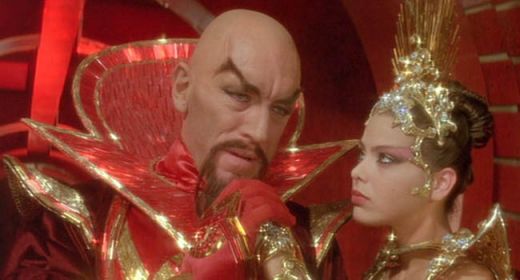
Flash Gordon (1980)

Words cannot express how much I love this movie.  It is insanely cheesy in ways other films can only dream of approaching, and combines the lavish, over the top look of a Dino DeLaurentis production (which it is) with the cardboard cutout characters and silliness of the old film serials that birthed Flash on screen in the first place.  Where else do you get to see acclaimed actors like Max von Snydow ham it up with full force?  I remember seeing the trailer for this when I saw The Empire Strikes Back in the theater, and was fully aware (despite my young age) that it was a knock-off.  But oh what a knock-off!

The Black Hole (1979)

Watching this last night, I was amazed at how odd this movie is.  In many respects it is incredibly anachronistic Disney fare, with dialogue and characters who seemed ripped out of 1950s Saturday matinee flicks.  At the same time, it's also very dark for a Disney film, with one of the robots looking trashed within an inch of the scrap heap before it dies and a self-destructive captain (played by Maximilian Schell) whose robot straight up murders Anthony Perkins (leading to the first PG rating for a Disney movie.)  The actors, like Schell, Perkins, and Ernest Borgnine, seem to belong to a different time, as do the silly moving camera effects. There are some surprising elements, though, from an overall dark tone to a surging, swirling score that I just found out was composed by the great John Barry.  In many respects, The Black Hole is old Hollywood trying to get hip to the new reality and failing.  That said, I liked it as a kid, mostly for the melancholy robots and the aforementioned score.

Battle Beyond the Stars (1980)

For some reason in the 1980s one of my local TV stations would run this one a lot on Saturday nights.  Unlike many of these other films here it does not pretend to be anything other than pure exploitation, since it comes from Roger Corman's New World Pictures.  It borrows the plot from The Magnificent Seven and The Seven Samurai, as Richard Thomas plays a very Skywalker-esque young man who assembles a rag-tag gang of seven to defend his home planet from destruction.  As a kid I loved the fact that one of the said seven was named Cowboy and played by George Peppard, who also played Hannibal on the A-Team at the time.  I also liked that Thomas' space ship was named Nell and talked with a sassy attitude.  Lame, cheap and cheesy, it'll give you plenty of silly entertainment, which is what I love about Corman films.  No Jedi knights or midochlorians here, just cheap thrills, and written by future auteur John Sayles to boot.

Monday, May 19, 2014

Obi-Wan Kenobi, Existential Postmodernist Hero


The other day I was listening to a particularly interesting episode of the Cracked podcast where the participants discussed the possibilities opened up by the new raft of Star Wars films awaiting us.  They argued that instead of doing regular sequels with the old, beloved characters, the Star Wars universe could be opened up with all kinds of films, from early tales of the Jedi to film noir in space.  Since the expanded universe has been expelled from the canon, why not create a new, cinematic expanded universe that moves into daring territory?

In my opinion, it would also be good for filling in plot points unaddressed by the prequels, but which I greatly care about.  Before the prequels came out, I assumed that Obi-Wan Kenobi's arc would be just as important as Annakin Skywalker's; I sort of figured that the three films would play out as a the story of their tangled relationship.  Instead, Skywalker is a little tot when they meet, and their relationship seems rather shallow.  Their lightsaber duel on the lava planet was epic, and Obi-Wan's bitter words for the burned up, defeated Skywalker provided maybe the one moment of true goosebumps in all of the prequels.  However, I had thought that this would come at the end of the second movie, and the third would be an adventure where Obi-Wan had to figure out how to protect the Skywalker twins while living with the horrible guilt of seeing his Jedi friends hunted down and murdered by the very man he had trained.  Instead that whole story is tossed off in about five minutes at the end of the third prequel.  I'd really love to see a Star Wars film about Obi-Wan's struggle to survive the Jedi massacres and come to grips with his own responsibility via his failure to keep Anakin on the right path.

From the earliest days I watched Star Wars flicks, I thought Kenobi was an extremely compelling and complex character.  In many respects he was a broken man, a once great person reduced to being a hermit on an isolated planet.  He obviously carried around a great deal of personal guilt, evident when he admits to Luke that he thought he could train his father as well as Yoda, and was wrong.  (He is still feeling this guilt in the afterlife!)  After all, his failure contributed to the destruction of the Jedi and the Old Republic.  He then had to spend years, alone, thinking about this.  I can't imagine what that does to a man's soul.

In the end, however, he redeems himself.  He manages to introduce Luke to the Force before sacrificing himself to save Luke's life.  He guides Luke to Yoda, and gives him the strength to confront the man he now knows is his own father.  For some reason, George Lucas became obsessed with making the Star Wars films into the redemption story of Darth Vader, when it is Obi-Wan who has a much more interesting path to redemption.  He is not some kind of prodigy or chosen one, he is a person who made bad decisions out of good intentions, and has to live with the pain and suffering those decisions have caused.  That's something a lot of us can relate to.

Perhaps it is this experience that makes him a bit of a moral relativist, especially for a supposedly pure Jedi.  For example, he tells Luke that Vader killed his father, and when Luke comes back to Dagobah to confront him, Kenobi tells him that what he had said before was true, "from a certain point of view." He goes further, and explains that "many of the truths that we cling to depend upon our point of view." Kenobi also chides Anakin during their duel, rebuking him by saying "only Sith deal in absolutes."  He has a remarkably postmodern perspective, considering the binary good vs. evil story told in the Star Wars films.  That perspective makes Kenobi much more relatable to us than any of the other Jedi.

What kinds of films about Obi-Wan from the time of Darth Vader's creation until his first meeting with Luke could be made?  How about My Dinner With Yoda, which follows a two-hour philosophical conversation between Kenobi and Yoda in the latter's Dagobah hovel?  Like the characters in My Dinner With Andre, they are on hard times, and are trying to figure out what life is all about.  Or perhaps the film could be Old Ben, a character study where Kenobi is known as the eccentric old man of Anchorhead while hiding his secret past that he must confront.  I know this all sounds silly, but if Disney is going to produce a film in the Star Wars universe every year, why not go for broke?  Why not make something arty?  At the very least, why not feature the character whose damaged soul most resembles our own?

Monday, January 13, 2014

An Appreciation of the Star Wars Expanded Universe


I was reading today that with Disney producing the new Star Wars sequels, the "expanded universe" of novels, comic books, and TV series in the Star Wars world has been declared non-canonical.  The new church hierarchy has spoken, and the likes of the Zahn novels and the Ewok Adventure are now the equivalent of the Gnostic gospels.

I feel highly ambivalent about this.  On the one hand, the new makers of the new movies need a free hand, and thus shouldn't have their plot ideas hemmed in by innumerable minor, and often low grade, things written under the Star Wars name.  I get it.  However, the expanded universe has an important place in my heart and in the hearts of other Star Wars fans, and it ought to be given its due credit.

I saw Empire Strikes Back in the theater at age four, and for my fifth birthday got a bevy of action figures.  After that point, I never looked back. Star Wars dominated my imagination as a young child, and my friends and I played with our action figures and took on the roles of the characters for hours.  (I was a good-goody, so I was Luke Skywalker, natch.  My more daring best friend Danny always took Han Solo.)

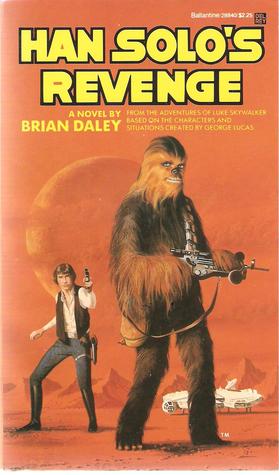
Problem was, I wanted more.  The three year gap between Empire and Jedi was unbearably long, and I savored every Star Wars-related piece of entertainment, especially the rare treat of seeing the re-run of Mark Hamill's appearance on the Muppet Show.  One day in the library, where I probably spent too much time even back then, I saw an orange-covered paperback with Han and Chewbacca on the shelving cart part of something called The Han Solo Adventures.  I was very intrigued, although too young to read something on that level.  (In high school I bought the reissue and ravenously devoured it.)  I instead dived in the Star Wars comic books owned by a friend's older brother, intrigued that the characters I loved could be involved in all sorts of stories I'd never heard about.

Once Jedi came and went, there was a period where I acted like I was too cool for Star Wars.  After years of it dominating popular culture, in the mid-1980s enough fatigue had built up that Star Wars stuff practically disappeared.  I remember in the sixth grade when we were telling our teacher ideas for what movie we'd watch in class on the last day of school, and I mentioned Return of the Jedi.  The teacher actually said, "aren't you guys getting a little old for that?"  (If I am not mistaken, we watched Monster Squad.)

Deep down, however, like a lot of other kids my age, I'd never really let Star Wars go.  I watched my VHS tapes of the original trilogy recorded off of network TV (commercials and all) over and over again.  During the beginning of my seventh grade year I sought out the novelization of the original Star Wars, and marveled at the differences between the book and the film.  Back in those days, though, there was no new Star Wars product.  No books, no films, no video games, no kids shows.  The role-playing game was just about the only new thing out there, but since my mother thought that such entertainments were Satanic, I never got to play it.  (I could only stare longingly at the ads for it in my contraband copies of Dragon magazine.)  I'd heard rumor that George Lucas was going to make prequels that would explain Annakin Skywalker's  fall, but with the passing of every year, that prospect seemed more remote.

Then, in the early 1990s, a miracle happened.  Lucasfilm authorized Timothy Zahn to write a trilogy of sequels.  I cannot express my level of anticipation for these books among my secret Star Wars nerd friends, or how happily surprised we were by how much we liked them.  A veritable floodgate seemed to open up after that.  I played Star Wars games on my Nintendo, Dark Horse comics put out new (and interesting) Star Wars series like the Dark Empire books, and the local Ben Franklin variety store started carrying Star Wars models again.  A friend of mine spent months creating a suitably battle-damaged and unique-looking Millennium Falcon.  Older expanded universe stuff like the aforementioned Han Solo Adventures came back into print.

None of this stuff was nearly as good as the original films, but it filled a hole.  It also worked because the Star Wars universe is such a well-drawn and interesting place, and always a fun location to park my imagination, especially at that age.  Things have probably gotten a little out of hand, but as hacky and mediocre as much of the expanded universe stuff can be, I'd be hard pressed to say it is of lower quality than the much anticipated prequels turned out to be.  Zahn's trilogy is workman-like, but he never released an atrocity like Jar Jar Binks upon the world.  It's safe to say there is more of the spirit and feeling of what keeps Star Wars geeks coming back in the humble, yellow-pulpy pages of my copy of The Han Solo Adventures than in the mega-pixeled spaceship battles in any of the cinematic prequels.  For that, the expanded universe deserves an appreciation.

Thursday, February 21, 2013

What JJ Abrams Should Retain, and Jettison, for the Star Wars Sequels

I am alternately elated and frightened regarding the announcement of upcoming Star Wars sequels directed by JJ Abrams.  The elation is easy to explain, of course.  I am a huge fan of the Star Wars films, and ever since I was a child I have been craving to know what happens to the galaxy once the emperor has been defeated.  Back in the early 1990s, I intently devoured the Timothy Zahn-authored sequel novels, and even constructed my own imagined plot for a sequel trilogy.

My trepidations, in light of the letdown occasioned by the Lucas-helmed prequels, should be equally easy to understand.  Of the three, only Revenge of the Sith was really worthy, with Phantom Menace lame and most of The Clone Wars all but unwatchable.  The mediocrity of these films damages the bright luster of the originals, and cheapens them to an extent.  (The fact that Lucas then put changes into the originals to make their plots more consistent with the prequels is even more galling.)

I do have some hope that JJ Abrams will do a good job.  Everyone wants to see harbingers of his approach to the new trilogy in his reboot of Star Trek, but I think the excellent Super 8 provides more clues.  I thought Super 8 was a highly underrated film, and that it combined art, pathos, adventure and comedy together in a masterful way.  That same combination of factors is what made the original Star Wars trilogy so great.  Here are some things from the prior Star Wars films that are kept, and some that ought to be let go.

Ambiguous Characters
People want to think of the Star Wars saga as a battle between good and evil, but many of the best characters are actually quite ambiguous, and they tend to keep proceedings from getting too moralistic and dour.  For instance, Han Solo is a cut-throat smuggler who initially refuses to assist the Rebel Alliance in their Death Star assault, and on Hoth decides to abandon the cause simply because he's welched on a bet.  Lando is extremely ambiguous, and the audience's trust and sympathy for him as a character swing wildly during his time in Empire.  Even Obi Wan is not to be trusted, since he intentionally hides the truth from Luke for his own purposes.  The new films need characters like these if they are to be interesting.

Non-Forced Comic Relief
Despite all the seriousness of The Force and Jedi training, many of the best moments in Star Wars films are the humoross kind, like Han being unfrozen at Jabba's palace, asking Luke how things are going, and Luke telling him just like the old times, and Han snarkily huffing, "that bad?"  Han and the Droids tended to provide the best comic moments, but Luke and Leia had their share as well.  The prequels suffered so much because the main characters had little sense of humor, and the comic relief was outsourced to the execrably unfunny Jar Jar Binks, whose brand of prat-falling physical humor went out with the Keystone Kops.

Droids
The droids added so much to the original sequel, and not just in terms of humor.  They often commented on the actions of the human characters, and allowed the audience to see things from multiple perspectives.  Much of the Ewok stuff in Jedi is completely tedious, but the elements involving C3PO are funny and endearing, especially in how his behavior does not always match wishes of his supposed human masters.

Grit
The Star Wars universe, as presented in the original sequel, grabs the viewer right away.  I feel this is the case in large part because unlike other science-fiction universes, it is a gritty place where things are dented, stained and used up.  It feels lived-in, and surprisingly organic.  Very early on in Star Wars, the viewers are taken inside the Jawa trawler, which is a kind of rolling junk shop full of second-hand droids.  The prequels, which I guess were supposed to reflect the galaxy before the destructive effects of war, showed a world that was glittery, gauzy, sparkly, and relatively clean.  It was not inviting or homey, it was sterile and lifeless, despite the color.  For the new sequels to work, they need the dirt, grit, dents, and wear and tear of the originals.

Dump Politics
I still don't understand the political plot of the prequels, beyond the fact that Palpatine takes power.  I do not give a damn about the Trade Federation, or understand the machinations of the Senate.  The original sequel contains just enough politics to drive the plot forward (Leia is on a "diplomatic mission" and the Senate's been dissolved) and that's it.  I'd say that's all you need, even if there is potential for a political plot based on the need for the heroes of the originals to establish a new government in the wake of the Empire's collapse.  The thing is, we go to Star Wars films for their epic mythos, not to contemplate the rigors of state building.

Dump Midochlorians
Making the Force a matter of biology enables an insidious, Social Darwinian view of society.  Perhaps Abrams can have a little aside where the viewers learn that the "science" surrounding midochlorians was actually proven to be false.

Tuesday, June 26, 2012

Parenting Dilemma: When and How Do I Introduce My Children to Star Wars?


Sometime in the next month, my wife will be giving birth to twin girls.  This event has forced us to consider all kinds of questions, from where we want to settle down to what kind of food we feed them.  Last evening my wife and I discussed a less pressing, but very difficult question: when and how will we introduce them to Star Wars?

I must say that I am amazed at the staying power of Star Wars amongst children born decades after its initial release.  I lived much of my early childhood totally immersed in the Star Wars universe, playing with the toys and acting out scenarios with my friends for hours on end.  Once we got a VCR in 1985 and they started showing the films on television, I managed to tape and watch them over and over again.  One of my sisters always recounted her favorite dream ever, which involved Han Solo landing the Millennium Falcon in our backyard and whisking her away with him.  I spent much of the summer of 1983 wearing two t-shirts: a black one that read "Beat It!" in large red letters, and a kind of powdery blue shirt with Luke Skywalker wielding a lightsaber.  The next year I gladly choked down the vile concoction that was C-3PO breakfast serial and jumped for joy when I got the Ewok village toy set for Christmas.

 I never would have thought that Star Wars toys would be just as common a quarter of a century later.  This weekend my in-laws had a backyard party at their house, and I was amazed to see one little tyke wearing shoes with C-3PO and R2-D2 on them, and another with a t-shirt depicting Yoda wearing sunglasses.  These boys seemed to love Star Wars just as much as I did when I was younger.  I once worried that my kids would think of the things I love as outdated or lame, but it looks like Star Wars is something that we could share together.  However, I am not sure how to bring it into their lives.

The question of when and how to introduce Star Wars came up after we watched Revenge of the Sith (the third prequel, for the uninitiated) last night, which my wife hadn't ever seen, despite (or perhaps because) her love of the original trilogy.  It seems she stopped watching Attack of the Clones after about fifteen minutes, thinking it to be a steaming pile of crap (can't say I disagree) and gave up on the prequels.  Conversely, both she and I like Revenge of the Sith, which I consider to be at least the equal of Return of the Jedi (perhaps that is damning with faint praise.)  I asked her whether we would introduce the prequels to our twin daughters, start with the original trilogy, or simply pretend that the prequels never existed.

From a chronological, story-arc perspective, it makes sense to start with prequel number one, The Phantom Menace.  It's not just the well-documented lameness of this flick that bugs me; however, but the knowledge that kids love Jar Jar.  I am so afraid that if I start with this film, my girls will think Jar Jar is the coolest and funniest, with his slapstick antics and muppet-like voice.  If that happens I just might have to put myself in exile in Dagobah.


My wife and I have agreed to start them with the original Star Wars (I refuse on general principle to call it A New Hope.)  It's an obvious choice, considering it's the first made, etc., but we are also especially keen on starting here because Princess Leia is such a badass in this flick.  I am already having to contend with the fact that social norms are molding my daughters into objectified beauty objects, at least based on the fact that we've been gifted all kinds of frilly pink baby clothes.  They'll need some role models, and in this movie Leia will provide a good example.  It is she who leads the rebel forces and manages to keep the Death Star plans safe.  She manages to withstand torture without betraying her people.  She refuses to play the damsel in distress, shooting storm troopers and repeatedly telling off her would be captors.  ("Into the garbage shoot flyboy," "Will someone please get this walking carpet out of my way," and "Aren't you a little short for a storm trooper?" are particular favorite lines in this regard.)  You can easily contrast Leia's toughness with the simpering antics of Padme/Amidalla from the prequels.  In the third installment she seems to spend most of her time doing her hair.

At this point I figure I will introduce Star Wars around age four (I really can't wait for this moment), and pretend the prequels don't exist until they ask questions or their friends say something about it.  I like the third enough to maybe make an exception.  The other thing to consider, of course, is which version of the original trilogy to show my daughters.  I only have the "special editions" version on DVD (I've got the remastered originals from the 1990s on VHS), so I should probably go out and get the non-gussied up versions on DVD, which you have to buy separately, at a premium, and which come with the special edition discs that I already had to pay for.  I rented the DVD version of the unaltered Star Wars a couple of years ago, and was blown away at how much it looked like the mid-budget 1970s film that it was.  It was liberating and glorious, and it made what Lucas accomplished in 1977 with mostly unknown actors and little studio support that much more of a creative triumph.  Of course, my daughters probably will find the CGI Jabba the Hutt more interesting.  But damn it, there are sacred things in this world, and my daughters should not live in a world where Greedo shot first.  

Children are unpredictable, and my two girls might not care about the differences between the originals and special editions, or even have any interest in watching Star Wars at all.  I'll be happiest if they can explore their own interests, whether or not I share them.  That said, I will feel a little secret sorrow if they don't like Star Wars, akin to the anguish I felt when I first saw Han Solo frozen in carbonate as a five year old.  After all, I first saw Attack of the Clones with my pops, and it was a great emotional moment for us to return to very same theater where he'd taken me to see The Empire Strikes Back those many years ago. The new film might've been shitty, but walking out of the theater with such warm memories rekindled, I don't think we really cared.