Showing posts with label literature. Show all posts

Sunday, January 22, 2023

Getting Through the Winter Doldrums

It's late January, the grimmest part of the year, a stretch that will last about a month. It's cold and dark. The weather tends to make commutes hellish. The holidays are over and the decorations stripped. Lunar new year came early this year and is now over and marred by tragedy. There's little to do and the only real "event" is the consumer orgy of the Super Bowl, which mostly just makes me feel ill. 

It's Sunday night now, which means facing another work week after a weekend spent in the fog of this winter malaise. The end of the last year brought reflect, as the end of the year always does, and that reflection in middle age typically leads one to contemplate how dreams hoped for in youth are just never going to come true. 

If I had been wiser in my youth, I'd have gone to law school instead of grad school and now I'd be making enough money to go on a vacation somewhere warm and sunny to get away from all of this. I foolishly chose to pursue knowledge rather than lucre in a society that worships the latter and despises the former. Sometimes I can be comforted in the knowledge that my work actually has meaning but this time of year the old narratives don't work their magic like they usually do. 

I am willing to bet a lot of you are feeling the same way right now. So how do we get through this? Sometimes the only way out is through.

I lean into despair with my trusty friends music, books, and movies. Here's some recs if you are looking for them. 

Jackson Frank's "Blues Run the Game" just totally embodies that feeling that winter is never going to end and life is pretty hopeless. He also talks about sending out for whiskey and gin, which are my preferred tipples this time of year. 

Robert Altman's anti-Western McCabe & Mrs Miller is suitably bleak and gloomy. The dark rainy Pacific Northwest setting perfectly frames a story where love and passion are ultimately futile. Sometimes the bastards win and the hero doesn't ride into the sunset. 

Sad folk music is my preferred soundtrack this time of year, and no one did it better than Nick Drake. All three of his albums are superlative, but Pink Moon gets busted out on many a winter night in my house. It's eerie and dark but weirdly comforting, too. 

Sometimes a little anger helps, too. January in an odd-numbered year means a brand new Congress and brand new state legislatures. It does not exactly help my mood to read about Republicans trying to hold the country hostage with the debt ceiling or finding new and unique ways to persecute trans people and target my fellow educators. It's even worse when the people who ought to be fighting back are AWOL. That's when I put on Neil Young's "Ambulance Blues." "You're all just pissing in the wind."      

In terms of books, last year at this time I decided to reread le Carre's "Karla Trilogy." I won't do the same thing this year, but I might just give Tinker Tailor Soldier Spy another spin. Gloomy 70s London combined with Cold War intrigue is perfect for this time of year. It's also the kind of story where the "good guys" have to make moral compromises in order to win, compromises that undermine their "good guy status."

****

These are the winter days of out discontent. I'm too pessimistic to think they can be avoided, but I at least I hope we can get through them with some splendid wallowing. 

Sunday, March 20, 2022

Reading Tinker Tailor Soldier Spy During a Hot War

As I continue along my life path of being an aging dad I have picked up various aging dad habits. I give over too much effort to yard work and try to deliberately embarrass my children. Most of all, I have become addiction to spy novels and history, some of the daddest dad lit of all time.

This addiction has grown so powerful that I am re-reading spy novels I have already read. This is strange considering that I pretty much stopped re-reading books once I got to grad school and realized there were too many damn books out there that needed reading. Re-reading was a luxury I could no longer afford.

Yet here I am, having just completed a second read of John Le Carre's Tinker Tailor Soldier Spy on my way to a re-read of the whole Karla Trilogy. (I also admit to viewing the film version at least a dozen times.) The current war has had me thinking about the legacy of the Cold War and diving back into it. This book in particular speaks to the current moment in unexpected ways.

One of my other obsessions is the 1970s, and TTSP came out in 1974, during the brutal mid-decade malaise. The "Circus" spies have gone from Bond allure to begging a cash-strapped government for funding. In the period of Detente the Cold War continues on a lower boil, but outside of the "secret world" few seem to care all that much. The UK is no longer a world power, its spies must wonder what the point is, anyway.

(BEWARE, SPOILERS BE HERE)

A lot goes on in the novel, but something I noticed this time is how the hunt for the mole in the Circus (as Le Carre called MI6) reinvigorated the aging and prematurely retired George Smiley. Just when he and the service he worked for seemed completely cooked, the mole was found and Karla and his Soviet agents put on the back foot. At the same time, when the mole is finally caught, George Smiley's victory is bittersweet. When he interviews the traitor Bill Haydon he finds himself agreeing with much of the substance of his critique of the West and particularly of the United States. However, Smiley notes that while he enjoys the "music" he cannot abide the "tone." Deep down, despite his reservations about America and the Cold War, Smiley knows the USSR represents something even worse. 

This got me thinking about the war in Ukraine. For the past few years the West has appeared to be as decadent and crumbling as Bill Haydon claimed. Brexit and the election of Trump were omens of a new age of decline, or at least that's what we fought. When faced with the Ukraine crisis, the West is suddenly showing cohesion and backbone again. Beneath the ratty, disorganized surface the West still persisted, it just needed a cause to rally behind. Despite this country's manifest failures and injustices, Vladimir Putin has come along to remind us all of how there are far worse things that can exist in this world. If anything I hope this moment provides some missing clarity in the public discourse. 

Like Smiley however, I hope in our fever to support Ukraine in the current war, we don't lose sight of our own manifest flaws. If not we will be back in crisis mode sooner or later.

Saturday, January 22, 2022

Reading War and Peace in the Time of COVID

This Charlie Brown special was how I first learned of Tolstoy

When quarantine began in the middle of March, 2020, I decided to order a couple of long nineteenth century novels I had been meaning to read for years. I love those old classic doorstops, which considering their serialized nature are like literary versions of a Netflix series. The more characters, the more side plots, the more philosophizing, the better. The two novels in question were Middlemarch and War and Peace. I started on the former and got over two hundred pages in, mostly because the start of quarantine coincided with my spring break. Then came the transition to fully remote teaching, which was so taxing and brutal that I could not spare the mental capacity for Middlemarch.

Months later, in the summer of 2020, I dug out War and Peace from my bedside book stack, and couldn't get into it. The same thing happened the next summer. It begins in the world of noble salons and drawing rooms, not exactly the most engrossing thing for me.

Fast forward to last week. My wife gave me a bunch of great books for Christmas, including Ruth Scurr's recent book about Napoleon telling his life through his experience with gardens (trust me, it really works!) I got into a serious Napoleonic mood after reading it, and the only relevant book readily available to me was Tolstoy's tome. 

This time it clicked with me, and after three days I am 150 pages in, despite my tired old eyes straining to read the small print of the footnotes whenever the French dialogue is being translated. This was partly because my mind was in the right Napoleonic frame to appreciate the world Tolstoy was recreating. However, it was mostly because I saw a connection between that once foreign salon world and myself.

As the two year anniversary of quarantine approaches, I have been getting extremely vivid flashbacks to the earlier days of the pandemic. I am especially remembering its strange mesh of emotions. I was scared and mentally dislocated, but I was also optimistic and energized by the challenge ahead. I had no clue, of course, what really laid in store for me. I had no conception that the pandemic would still be affecting my life two years later, one year post vaccine. 

That's what Tolstoy is showing us with the salons and all their partying and gossip as war with Napoleon commences. The characters are preparing themselves for something they think is important, but they have no way of understanding just how momentous and life-altering the coming changes will be. They can only talk about it in the abstract before the brutal reality smacks them in the face. It feels good to dip into the past and find people like me being tossed on the waves of history desperately looking for a lifeboat. 

It's a shame that the epic social novel is a relic of the nineteenth century. I sometimes feel like the United States of the past six years would be great fodder for such a thing. While I know the present will always soon be the past, the recent years have felt more like living through history than any time in my life, including during the end of the Cold War and the years of the War on Terror. All that is solid melts into air nowadays, as a wise man of the nineteenth century once said. I increasingly feel like my individual will has zero bearing on my fate in a world being shaken by forces well beyond my control. Reading a masterful epic novel of the past makes those feelings more bearable. Maybe I will get to Middlemarch, too.


Monday, March 16, 2020

Virus Journal, 3-16-2020

Today was quite a day. In terms of my personal life, it was my first day teaching the kids at home. My wife is one of the tech coaches for her district, so she spent all day triaging the online transition. I luckily have two weeks off, and so can be there for the kids. With their help I drew up a schedule for the day, and we actually did a lot. I started teaching them piano, we read, did math, talked about writing poetry over Skype with their auntie, made art, and wrote. After the "school day" ended we've had their friends who live next door over. I don't know if that's kosher under the current rules, but I want their parents to be able to mentally survive this, and we spend so much time together we might as well live in the same house anyway.

Having the "school day" so organized was a good idea. It's kept me busy and given order to my day. I actually look forward to tomorrow, which will have a St. Patrick's Day theme. The only issue is that my kids have a lot of energy and so do their friends and I am feeling drained while they run wild. I will probably have to get less ambitious.

In terms of the broader world, the last two days have given me whiplash. Yesterday I took the kids to the playground when no other kids were there, today the town has shut down all the playgrounds. New Jersey, along with New York and Connecticut, has said restaurants (apart from takeout), bars and theaters are all to be shuttered. A week ago today I was teaching and we were preparing to go remote, but after spring break. Events are moving fast.

This has given me insight into past events. I think particularly about the summer of 1914. The death of Franz Ferdinand happened in late June, and so many Europeans spent their July frolicking, the rumors of war just background noise. (Even Kaiser Wilhelm was at his spa!) All of a sudden, the war hit. The memoir The Burning of the World by Hungarian writer Bela Zombory-Moldovan describes it so evocatively. He learned he had to mobilize while on a seaside vacation.

I also have whiplash because the president seems to be changing his tune. Yesterday he spent his press briefing reading tweets off of paper meant to defend himself from the evil news media. Today he said nice things about that same media while, for the first time, offering concrete recommendations to restrict the transmission of the virus. Of course, he tweeted tonight about the "China Virus." This after I have heard about people I know being harassed or micro-aggressed for being Asian.

The distancing and online teaching had for days given me a feeling of purpose that sustained me. Today I started feeling dread again. I really and truly wonder just how long these measures can be sustained. Right now I do not think it will be sustainable to have all of our education to be moved online and huge swaths of our economy go dormant. The only way disaster could have been avoided would have been with swift action months ago. Now we are going to have to live with the consequences, which will be terrible no matter how much distancing we do.

Books

I am also planning on logging all the books I am reading in this time. I plan on using books as an anchor, and now that I am getting old I forget books pretty quickly after I read them any more.

John Thorn, Baseball in the Garden of Eden
I started this book years ago and didn't finish it. I am craving baseball and sad without it, so I turned to the only unread baseball book on my shelf. It's the story of the early days of baseball, from its origins to around 1900. Thorn likes to include the entire text of documents within his text, which is really distracting. While it was interesting to know that modern baseball evolved out of a number of games (and thus has no fixed origin) some of the details needed streamlining. At the same time, his look into the mythology of baseball's origins was fascinating. Albert Goodwill Spalding, who founded the National League in addition to a sports equipment empire, was a Theosophist. So was Abner Doubleday, and a big part of the reason for the myth pushed by Spalding and others that Doubleday invented the rules of baseball in Cooperstown, New York. (No such thing ever happened.) Truth is stranger than fiction.

George Eliot, Middlemarch
These days I tend to have one fiction and one non-fiction book on my reading stove with one pot simmering and the other really cooking. During my train commutes I had been reading the Library of America edition of John Cheever's collected stories. I am really loving them, but they are such fine-tuned and realistic vignettes of everyday suburban commuting life that is hard to read them under quarantine. I am saving that book for when I get to ride the train again. I love a good doorstop 19th century novel, but I tend to save those for summer when I have more time to read. A good long novel also helps time slow down. In that spirit I purchased both Middlemarch and War and Peace. I went with the former first because I am in a strangely English mood these days and I've never read Eliot before. I hate to say this, but so far it's been tough going. Her prose style thus far is as dry as church dinner chicken. Maybe my problem was that I started reading it around a bunch of insane, screaming children. In any case I love 19th century social novels. I wish we had their equivalent today. You could certainly write a good one about our current situation.

Tuesday, February 13, 2018

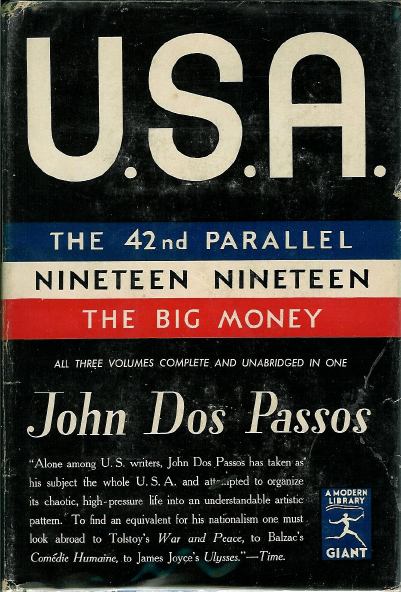
Thoughts Provoked By Reading John Dos Passos' USA Trilogy


World War I was the event that first got me interested in history. I have maintained that interest, an interest so pure an abiding that I have never wanted to sully it by formally researching and writing about it. (Yeah, I'm a weird guy) This means that I occasionally fall down a Great War rabbit hole and have to keep digging until I come out on the other side.

Recently my interest in that conflict combined with my love of modernist fiction, and I picked up John Dos Passos' USA trilogy. So far, I have not been able to put it down. The forty minutes in the morning and afternoon I spend reading it while riding my New Jersey Transit commuter train to and from New York City have become cherished to me. It tops out at well over a thousand pages, and I am already half-way through.

It is a book famous for its devices, including stream of consciousness "Camera Eye" interludes, several interlocking narratives from the points of view of a broad range of characters, "Newsreels" os scraps from actual newspapers, and best of all, impressionistic biographies of key figures of the age.

I love this aspect of the book because what I call the "contemporary historical novel" is one of my favorite genres. These are typically novels where the author is recounting a recent past that the audience has lived through, and attempts to make sense of it. Dos Passos wrote the three novels (The 42nd Parallel, 1919, and The Big Money) in the 1930s, but wrote them about America right before, during, and after World War I. We get an amazing sweeping view of a certain time and place, and it's the kind of thing we had in the 21st century about our own recent past. If I had the time, talent, and inclination, it's what I'd write. Alas, I am no one's idea of a novelist.

Reading the trilogy I have been struck by how the modernist art of the early 20th century has maintained its power to provoke. When I show my students early abstract paintings they still get shocked or put off by them. It is great and a little sad that writers and artists so long ago can be so fresh. It says a lot about how timid and safe so much of what we consume today can be. Relatedly, I am flummoxed at how these books these days are not rated much, and have become an afterthought. call me crazy, but I'd put them above what Hemingway and Fitzgerald and Sinclair Lewis were writing at the time, and I like all of those authors.

In terms of the content of the books, I have made another sad realization. It used to be when I read novels written in the early 20th century that the chasms of class differences between some of the characters seemed quite alien to me. Nowadays those differences feel all too relatable. After four decades of neoliberalism American society has practically gone back to its New Deal self, a small band of affluence sitting above the toiling masses. At least Dos Passos is deeply concerned with those disparities and revolutionary ideas. Few writers today seem to be.

One of Dos Passos' motifs is the larger story of America's rise to global political and economic power. His trilogy is partly a meditation on the start of the so-called American Century. It is interesting to read it when we are now in that century's twilight. I only hope that there is a historian or novelist or film-maker out there who can document this era in all its tragedy and messiness the way that Dos Passos rendered his.

Saturday, January 28, 2017

On Reading Klemperer's Diary In These Times

Soon after the election I decided to spend more time reading things from the past that could give me insight into our current situation. One of those books was I Will Bear Witness, the diaries of Victor Klemperer from the years 1933 through 1941. When I read it in December it was a shocking wake-up call, thinking about it now after a week of Trump in office it seems five times as relevant.

Klemperer was a professor of languages living in Dresden. He was a Jew by birth, but converted to Christianity and married a Christian woman. He had served in the German army in World War I, and had a deep devotion to the German nation. His conversion, marriage, and war service would all shield him from deportation, and the day he was supposed to report to the authorities was the day of the infamous Allied firebombing of Dresden. That gruesome act actually saved his life.

Two things struck me most about the diary, and I cannot stop thinking about them. The first is the initial reaction, for about a year or so, to the seemingly chaotic and extremist rule of the Hitler regime. Klemperer records political discussions with his friends, many of whom think Hitler will just be a flash in the pan. Klemperer himself thinks for awhile that the military will step in and put a stop to the madness. That never happened, of course. After that initial confidence that the nation will not tolerate a man like Hitler, Klemperer then slides into despair over this regime becoming permanent.

I am seeing variations of what Klemperer wrote about. Plenty of smart folks seem to think that this chaos will bring down the Trump regime in short order. They predict that since Trump is an unhinged madman, he will eventually bring about his own destruction. If only that were so. When power-hungry, paranoid madmen take power they don't just give up when they fail, they hold onto power that much harder. Only other people can step in and put a stop to it. We can't just sit on the sidelines and expect the autocrat to topple without anyone doing the pushing. That mistake was already made by too many people in the election.

The second thing that struck me in Klemperer's diary was the reaction of ordinary Germans to the situation. To be sure, many tried to help him out, but he ended up losing his job pretty quickly without a protest by his "Aryan" colleagues. One scene stuck with me especially. Klemperer lost his job just as he and his wife were building a house, and thus had to pay for everything from his pension, accrued both from his university and from his veteran status. One day his pension check was significantly lower, and he went to the government office to settle the matter. He discovered that his pension had been cut because up to that point he had not been listed as a Jew in his pension paperwork. Once his Jewish status was discovered, his pension was cut.  Klemperer was so upset by this that he related the story to a German stranger, something he normally would not do.

The man had two responses. The first was one of ignorance: "I didn't know things like that were being done to the Jews!" But soon after expressing sympathy he sort of just shrugged his shoulders, feeling that the government must have had its reasons for doing what it was doing. That willful blocking of empathy for the victims of an autocrat that bystanders to oppression support is something I have been seeing plenty of today. There are lots of "good Germans" out there in America. They might even feel something for the families broken apart and refugees sent to their doom. But they will shrug their shoulders and turn their backs and plug their ears so that the cries of the drowning don't disturb them. All we can do is to fight and scream loud enough that they can't pretend that they can do that.

Unless we truly take responsibility for what happens in our society instead of waiting for someone else to, our future is darkest midnight.

Saturday, December 7, 2013

The Continued Political Relevance of Dickens' A Christmas Carol


My first brush with Dickens did not impress me.  We read A Tale of Two Cities in my tenth grade English class, and I came away turned off by his anti-revolutionary politics, sugary sentimentality, and ridiculous plot devices.  (How many Dickens novels are there that don't feature crazy coincidences or orphans with mysterious parents?)  Around that same time I started reading serious literature on my own, not just Stephen King novels and the Dragonlance series, but didn't pick up a Dickens novel again for about a quarter century.  Having grown many years older and more open minded about my reading choices, a close friend during my Michigan days convinced me to pick up Bleak House, saying it would change my opinion of Dickens, and he was right.

Three Christmases ago, when I was still deep in my Dickens phase (I read Little Dorrit, for cryin' out loud), I decided to finally read A Christmas Carol.  I was well familiar with it, of course, through countless reinterpretations and retellings, from the Disney version to the movie Scrooged, which was a particular holiday favorite in my family.   Reading it I fell in love, and also soon realized that Dickens' highly political message had been drained from the various adaptations.  A Christmas Carol is not just about Scrooge's redemption, but is also a critique of greed and laissez-faire capitalism.  That critique is just as relevant now as it was then, in the midst of Britain's rough transformation into an industrial society.

Near the beginning, when he is asked to give money to assist the poor, Scrooge famously roars "are there no prisons?" and notes that workhouses, the treadmill, and the Poor Law are all in full effect.  When those asking for a donation note that many would rather die than subject themselves to such cruel institutions Scrooge replies: "If they would rather die...they had better do it, and decrease the surplus population."  As a historian of the 19th century I knew when I read those words that Dickens was calling out the cruel economic philosophy behind what Pope Francis has recently deemed "unfettered capitalism."  Through Scrooge Dickens was trying to expose a hard-hearted way of thinking that was only increasing the sufferings of the poor.

These days our conservative politicians are not so brazen as to openly call for the poor to be killed off for the good of society, but as my friend Chauncey DeVega has theorized, that thought may very well lay behind the recent attacks on Food Stamps and other aspects of the welfare state.  These same modern Scrooges are more than happy to spend money profusely on prisons while they slash school funding, and those of Newt Gingrich's ilk have even openly called for disadvantaged children to clean toilets.  More than one Republican has likened welfare recipients to animals.  Just as in Dickens' time, these apologists for the status quo think that all poverty is deserved, and that those who profit handsomely from the system do not owe anyone else anything.  Scrooge's rants about the surplus population have come down to us in Margaret Thatcher's infamous dictum. "there is no such thing as society."

Scrooge's attitude toward the poor is echoed in his treatment of his employee, Bob Cratchit.  Cratchit is given hardly enough coal to warm himself in a cold office, is paid the absolute minimum, and has to beg to get Christmas off.  Scrooge gives him the holiday, but only after grumbling that providing a Christmas holiday is "a poor excuse for picking a man's pocket every twenty-fifth of December."  Reading these words I cannot help but think of the retail workers who are now being forced to give up their Thanksgiving holidays, or the companies that are chiseling their minimum wage employees further through fee-laden debit card payments.

As the story goes on, Scrooge learns the error of his ways.  As the ghost of Christmas future reminds him, the wages of sin is death.  Make no mistake, Dickens judges Scrooge to be a sinner, and his mistreatment of his employee and his cruel attitude towards the poor to be great sins deserving of damnation.  That is essentially the same moral framework that Pope Francis has been advocating recently.  When he wrote that a two point drop in the stock market was news, but a homeless person dying of cold on the street wasn't, I heard in those words the spirit of A Christmas Story.

As in Dickens' time, we live in a society where wealth is being generated on a massive scale but is going into the hands of fewer and fewer people who have abdicated any sense of social responsibility.  Their arrogant disregard for the sufferings of those below them -the surplus population- is trumpeted throughout our public discourse under the guise of conventional wisdom.  It is time we follow the lead of A Christmas Carol, and shame those who so easily deny the needs of those less fortunate than them.

Sunday, June 10, 2012

Top Five "Dick Lit" Novels of All Time


Awhile back I was browsing a used bookstore, where I happened to see that it had a separate section dubbed "Chick Lit." I've heard the term used many a time to describe works like Eat Pray Love and Prep, but thought that ghetto-izing these books within a bookstore was a little silly. After all, the patriarchy being what it is, there are many "classics" of literature that speak almost exclusively to men. There's nothing wrong with books that explore the male psyche, but they ought to have their own label, too. That then got me thinking about the best Dick Lit tomes, and since I just love top five lists, here they are.

1. Frederick Exley, A Fan's Notes.
It's hard to put my thought about this book into words, since it shook me like no other. The main character, essentially a stand-in for the author, is a creative yet fucked-up alcoholic obsessed with women and the New York Giants. This book is a rumination on failure, perhaps the thing that men dread more than any other (and probably why it shook me so much.) Exley lives with the knowledge that he is not the great player on the field, but a mere fan, a schlemiel, a loser whose life is of little import or significance. That's the realization that a majority of men are forced to confront at some point in their lives, and Exley does it with brutal honesty.

2. Charles Bukowski, Ham on Rye.
Although Exley wrote the ultimate Dick Lit tract, Bukowski is without a doubt the king of Dick Lit authors. His ouvre routinely celebrates the kind of boozy, unfettered, fornicating lifestyle that many men who have given up their rough and rowdy ways fantasize of returning to. Ham on Rye makes the Dick Lit list because it articulates the raw realities and unpleasantness of adolescent masculinity in its unrestrained lust, constant confusion, and ever-present violence. On top of all that, it deals with the dickiest of Dick Lit subjects, a son's hatred for his father.

3. John Updike, The Rabbit Series.
This is cheating a bit, but the Rabbit books need to be dealt with as a whole. No matter what anyone says, Harry "Rabbit" Angstrom is not a "typical" person; his infant child drowns in a bathtub (partly due to his negligence), he lucks into a lucrative business career, his teenage girlfriend is burnt alive in a fire, and he even has sex with his own daughter in law. That's not the point, really. Even if he's an outlier, Updike uses Rabbit to explore the destructive nature of male lust, male jealousy at its ugliest, the difficulties of fathers in relating to their sons, and what passes for "success" in the eyes of postwar white suburban American males. There is no character in literature who I have despised and loved so fervently in equal measure, mostly since his mind is rendered so vividly real and believable, misogyny and all.

4. Philip Roth, Portnoy's Complaint.
Roth is another king of the Dick Lit genre, and there are a whole gaggle of novels that could have made the list. I choose Portnoy's Complaint because it deals so frankly and at times disturbingly with the sexual fantasy lives of men and a taboo topic related closely to it: masturbation.
5. Nick Hornby, High Fidelity.

Unlike the American, middle-aged male angst voiced by the above authors, Hornby takes a gentler yet no less accurate approach to the modern man and his foibles. Protagonist Rob Fleming runs a record store in north London, but is still heir to the male pathologies of Rabbit and Portnoy, although to a less icky extent. He obsesses over his former loves, always makes himself out to be a victim, and engages in the ur-masculine pursuit of record collecting. The novel even more than the film embodies the perspective of the thirtysomething hipsterish man trying to figure out how to commit himself to a woman he loves without losing the freedom he prizes. Gee, I wonder why this book appealed to me so much when I first read it....

Friday, March 9, 2012

Top Five Academic Satire Novels


Back when I still worked in academia, I would relieve the tension and absurdity of my life by curling up with a good academic novel, preferably a satire.  During the short period of time I spent as a "visiting" and assistant professor, I read quite a few.

Let's face it, academics make easy pickings for satirists.  They often pretend to be smarter, more judicious, and just plain better than the schlubs who must toil outside of the groves of academe, but rarely ever prove  themselves worthy of such boasts. In reality, the ivory tower is a snakepit of petty resentments governed by an intricate hierarchy that runs more on sycophancy than talent.  The profession welcomes and even celebrates men and women too eccentric and socially awkward to make it in any other walk of life, a motley crew of misfits that equals comedy gold.  Here are five novels that helped me laugh at it all when it started to get to make me crazy.

1. James Hynes, The Lecturer's Tale. Anyone who has suffered through the horrors of adjunct and "visiting" professorships MUST read this book. It concerns a lecturer at an elite university who is given magical powers which he uses to save his job and become master of his department before it all goes to his head. I've never read anything that so ably dissects the ugliness of departmental politics, the insanity of job searches, and the arrogance of tenured professors who never consider the grunt classroom laborers who make their caviar and 2/2 teaching load lifestyles possible. A friend recommended this to me after my first year as a "visitor," and this fun novel gave me the courage to endure another year of humiliation.

2. David Lodge, Small World. Lodge's book may soon become a relic, since it concerns a group of scholars who constantly keep running into each other at academic conferences. The jet-setting, ocean-hopping lifestyle depicted by Lodge is fast becoming a thing of the past. In any case, he manages to totally capture the power politics, cruddy scholarship, and yes, romance, always on display when intellectuals get together.

3. Kingsley Amis, Lucky Jim. For obvious reasons, almost every academic satire is set in an English department. Part of the reason I like Amis' 1950s novel so much is that it takes place in a history department. Better yet, the title character, Jim Dixon, feels the resentments of classism that commonly afflict scholars (like yours truly) who were not to the manner born in a world dominated by the children of the bourgeoisie. And even better still, it has perhaps the greatest literary description of a hangover that I've ever read.

4. Richard Russo, Straight Man. I love Russo's stuff in general, but this is by far his funniest book, and perhaps his best. It is set at a fictional school called "West Central Pennsylvania University," and accurately captures the lowered standards and laziness of the mediocre tenured faculty that reign at second-tier public universities in this country. (It's a world I know well and am glad to have escaped from.)

5. Don DeLillo, White Noise. This book isn't a straight academic satire per se, but it's damn good and wickedly funny. The main character is a scholarly opportunist of the worst sort in the field of "Hitler studies" who doesn't even know German. DeLillo makes the general phoniness of consumer culture and American life his primary target, but ivory tower has hardly been immune to these social sicknesses.