Showing posts with label new jersey. Show all posts

Thursday, June 25, 2020

Letter on Local Housing Segregation

I live in a suburb of New Jersey that sees itself as a progressive paragon, but which has also been the subject of reports about its racial segregation. It's a place that has "Black Lives Matter" signs everywhere, but also resists any attempt to build denser housing. This contradiction inspired me to write a letter to the Village Green, which is the local news resource. In case you don't want to click on the link, here's what I wrote below.

******

Last year the New York Times stirred up the town when it published an article about segregation in Maplewood’s public schools. That article highlighted a dirty not-so-little secret about this place, which prides itself on its progressive nature. A year later, the same town maintains that self-image and is conspicuously involved in protests against racist policing. Signs reading “Black Lives Matter” can be seen all over. However, the deeper structural racism behind the town’s segregated schools has not gone away.

Maplewood’s elementary schools are segregated because Maplewood’s neighborhoods are segregated. In fact, some of the neighborhoods with the thickest presence of the aforementioned Black Lives Matter signs are almost exclusively white. At a time when so many are rightly speaking out against institutional racism, Maplewood needs to examine how its zoning and land use policies reinforce segregation. 

Like suburban New Jersey more broadly, Maplewood’s segregation is rooted in older racist policies intended to make the suburbs white. Redlining established through the post-New Deal FHA’s programs made it so any neighborhood that wasn’t exclusively white lost access to subsidized mortgages. Other policies, like exclusionary zoning, are less obvious but just as important. Whole areas are zoned exclusively for single family homes, shutting out the less affluent (who are disproportionately people of color in New Jersey) by limiting the building of more affordable apartments. These policies in Maplewood and elsewhere contribute to residential segregation. Combined with the neighborhood school model, that residential segregation has major consequences.

Tight zoning rules make it difficult for developers to build and easy for those inclined to stop multi-family dwellings. Developers thus must request variances to get things built, making it easy for all kinds of ridiculous roadblocks to be put in place. If you don’t believe me, come to a public meeting sometime to hear the often Byzantine legal challenges to proposed apartment complexes. The firepower behind these NIMBY (Not In My Backyard) challenges is stronger in whiter, more affluent neighborhoods. Good urbanist policy says that we should have dense housing near transit hubs like the train station, but every time any multi-family development is proposed in the Village, the disproportionately white residents of the neighborhood fiercely resist it. 

For that reason new multi-family dwellings are invariably built in areas of town that are less white. The challenges and hurdles to getting apartments built also ends up making them more expensive, since developers need to build luxury apartments to make up for the expense of getting something built under these circumstances. The artificial housing scarcity also drives up home values in Maplewood and New Jersey more broadly, allowing the disproportionately white group of homeowners relative to renters in this town and in this country to profit off of a racist housing system. 

This has all been going on for decades. The racial segregation that maps onto these housing disparities should be no surprise to us. Yet despite the Black Lives Matter signs on the lawns of Maplewoodians, it’s still just as hard to get multi-unit buildings constructed in the Village as it ever was. 

A great many of the people who make NIMBY arguments may see themselves as anti-racist, or think this is about preserving “neighborhood character” and not systemic racism. However, intentions have little to do with it. To be more blunt, systemic racism, like the coronavirus, doesn’t care about our feelings. 

The way forward should not just include the school district’s integration plan. It should also challenge the zoning and land use restrictions that contribute to the underlying segregation. Other cities have been putting an end to exclusionary zoning, it’s high time that Maplewood did too. The town can do more to support the building of more affordable housing, but the big change needs to happen in the mentalities of Maplewood residents. Those who genuinely care about institutional racism need to be attuned to how exclusionary zoning contributes to it, and stop resisting the building of a town that is more affordable and inclusive. If your opposition to denser housing is framed as “saving the neighborhood” take a moment to think long and hard about the deeper implications of that statement. They might not be as noble as you think. 

Monday, November 4, 2019

A Contentious School Board Election In My Divided New Jersey Town

I live in Maplewood, New Jersey. My family moved here from the Ironbound section of Newark after our apartment got too small i.e. the kids started to be able to walk. We were attracted by the relatively low home prices in a town that had a rail connection to the city (necessary for my job) that was also more walkable and less auto-focused than other suburbs. It was also more racially and socio-economically diverse and politically progressive than other towns in the region.

When we moved in I slowly started noticing the fault lines in Maplewood. Our neighborhood near the Irvington border is very mixed by race and class, but that's an anomaly. One neighborhood to the south of us is predominately African American and poorer than the rest of the town. Another, on the other side of the train station, is very white and full of massive million dollar homes. There is a mix of people, for sure, but only if you look at the aggregate numbers. The town itself is pretty segregated. This has inevitably led to de facto segregation in the schools. One of the elementary schools is majority black, and all the others are majority white. As more white families like mine have moved into town the school my daughters go to has gone from being very mixed to much more white than ten years ago. The situation was so stark in an ostensibly "progressive" town that the New York Times wrote an article about it.

The issues go beyond the segregation of different schools, they also extend to the combined high school (which also includes South Orange.) Tracking, as in many other places, has been applied in ways that benefit white students and hurt black students. There have also been claims of harsher discipline being applied to black students than white students. The new superintendent is advocating for an integration plan that will be implemented next year. There's a school board election on Tuesday, and as you would imagine with this background, it's very contentious.

There are seven candidates running for three seats. Five of the candidates are black (four of them women) and two are white (one of them a woman.) On the surface it's the kind of thing the town likes to talk up about itself. Beneath the surface, however, this is by far the nastiest local election I've ever witnessed. The fuel for the fire is social media and the many local Facebook groups in this town.

On these groups I have witnessed a constant, daily stream of invective directed not only one of the candidates, but also against other Facebook groups, especially a social justice group called SOMa Justice I am a member of (full disclosure.) Any candidate affiliated with that group is attacked as representing a "special interest." Every election a parents association dedicated to racial equity asks candidates to fill out a questionnaire which is then used to give the candidates ratings on a scorecard. This year a majority of the candidates flat out declined to do so. The questionnaire and its scorecard were both vehemently attacked online by the same people attacking SOMa Justice. In so doing advocates for equity just lost one of their biggest tools to hold candidates accountable.

A lot of these attacks are coming from a splinter group from the main local group, SOMa Lounge. (The acronym is for South Orange-Maplewood.) The splinter group is called SOMa Lounge Uncensored, touting its lack of moderation. As you can imagine, this has led to a kind of local version of 4chan. I know this because particularly outrageous comments have been screenshot and shared with other groups.

In the big picture there is a school board election in a town with a serious racial equity problem, but many of the candidates have been remarkably quiet about their opinions on this issue. Their silence, rightly or wrongly, has been taken as a sign by a brigade of internet trolls who are trying to tear down organizations fighting for racial justice in this community. I used to find the drama level of our local school board elections amusing but now I find it frightening. The Trumpist politics of destruction and resentment are everywhere in this country, including in this supposedly progressive, diverse town in New Jersey. Next year the integration plan is going to be launched. I need to get ready to get out there and fight.

Sunday, September 22, 2019

Existential Dread on a New Jersey Sunday Drive

The radio can strike fear sometimes

My children were bouncing off the walls and my spouse needed a break so I took the kids out of the house in that aimless Sunday afternoon kind of way. Today was one of those visually stunning days that also happened to be too damn hot, when the world looks best from inside of an air conditioned car.

This was a tradition back when my kids were toddlers and needed to take a nap and the gentle rocking of the road would lull them to sleep. Now they stay awake, but quietly read books in the back while I listen to my favorite shows on WFMU (that part has stayed the same.)

Today, in honor of the death of Ric Ocasek, the DJ spun "Drive" by The Cars. A chill came over me as I drove the winding Morris Avenue as it wended its way from Summit to Millburn. It's not just that this is one of the most profoundly sad songs allowed on the charts in the dayglo lobotomy of Reagan era America. I had a slight real life connection to Ocasek (not worth discussing here), but also got news that a friend from my time in Texas died suddenly on Friday morning.

For some reason that feeling of dread drifted to thinking about Friday's climate strike. Driving through the sprawl I looked out at the way of life destroying life on earth. What will future generations think of our Sunday drives? Of our pop music reveries while the tailpipe belches poison into the air? I get the feeling that the suburbs of New Jersey will be like Nineveh and Tyre for future generations.

On the way home we ran into a traffic jam at a bridge over the freeway. Evidently a horrible crash left a truck overturned and a car on fire. People from the neighborhood were gathered on the bridge looking at the wreckage below. It seems to have barely made it into the local news. Just another day in our way of being, I guess.

In any case, my kids and I went to the Dairy Queen and enjoyed some ice cream. That made me forget this doomed world and all the people I've lost in recent years for a bit.

Tuesday, May 7, 2019

The Pleasures and Despair of Driving in Suburban New Jersey


New Jersey. “The Garden State if you’re growing smokestacks” as a friend from Trenton used to say. New Jersey, butt of jokes from New Yorkers who can barely see across the Hudson River to find targets for their derision. New Jersey, immortalized in The Sopranos as the land where the American dream’s degeneration is on full display. New Jersey, the state Bruce Springsteen elevated on thousands of concert stages, but also as a place to be “born to run” from.

New Jersey also happens to be the most suburban state in the country. Nine million people live here, but proud Newark, our largest city, has fewer than 300,000. New Jersey’s image is what it is in part because it maps so well onto ideas people have about suburbs, especially citified, educated people (many of whom grew up in the suburbs themselves.)

I am a reluctant suburbanite and accidental New Jerseyan, both of those things being connected. I grew up in rural Nebraska, and later spent time living in big cities like Chicago and Berlin, and college towns like Champaign and Nacogdoches, and mid-sized cities like Omaha and Grand Rapids. After I fell in love with a Jersey girl I left my old life behind and moved to Newark’s Ironbound neighborhood, as densely populated as any New York City neighborhood, and at least as diverse and interesting. (I know this may come as a shock to some New Yorkers.)

Then came the familiar story, and not one of pride and glory. We had twins, our apartment could barely hold us, and so we ventured out to suburbia, where we could find an affordable home.

I miss being able to walk a block to the Portuguese bakery with the big pot of caldo verde behind the counter. I miss grabbing some fruit at the street market on my walk back from the train station. I miss going to Brazilian barbecues and stuffing my face with marinated meat on skewers. I miss the little kids running up with smiles on their faces asking to pet my dog when I walked her. While the increased space in our home is nice and the local schools are well-supported, plenty has been lost. Along with the schools and space there is an ambivalent thing I have gained: the suburban drive.

Driving is the quintessential suburban activity. The car is king, and the entire human environment here is crafted to best serve that sovereign. I learned to enjoy the suburban drive as a leisure activity by happenstance. When we first moved here my daughters still required naps but were reluctant to take them, so I would just put them in the backseat and drive around until they fell asleep.

One of my favorite places to drive was on Pleasant Valley Way in West Orange, since it was a long straight road with few stoplights, all factors in helping my daughters drift off to sleep. The road follows said valley, right beneath the steep hills that mark the furthest eastern march of the Appalachians. It also happens to be the namesake of the 1967 Monkees hit “Pleasant Valley Sunday,” written by Gerry Goffin and Carole King while they lived in the area after moving from New York City. The song’s sarcastic take on suburbia reflected their unhappiness there. The
original demo ends more ominously than the recorded hit with the line “I don’t ever want to see another Pleasant Valley Sunday.”

But the New Jersey suburbs, despite their best efforts, contain multitudes.

I always think that when I drive into Summit, New Jersey, from my town of Maplewood. I exit off of highway 24 onto Broad Street, which ascends the town’s titular summit beneath a gorgeous grove of sycamore trees. Its sublimity was revealed to me one bright June afternoon while I was listening to Belle and Sebastian’s “I Know Where The Summer Goes” in my car, the sunlight through the leaves dappling my windshield. Summit’s existence predates the postwar suburban explosion. Its downtown park contains a reverent art nouveau monument to the World War I dead of Summit, unaware that their sacrifice merely paved the way for a newer, bigger, deadlier war. Today thousands drive by without even noticing it.

At the time of the war the town’s most famous resident was Anthony Comstock, he of the infamous “Comstock Laws.” A former postal inspector, Comstock successfully lobbied for restrictions on “obscene materials” being sent through the mail, including information about birth control. In that era’s twilight of Victorian values his name was synonymous with moral probity or busy-body prudishness, depending on who you were.

But New Jersey indeed contains multitudes, because the same sleepy Summit where Comstock lived, now a haven for Wall Street commuter types, is also important in the The Velvet Underground’s story. That band, associated so heavily with New York, decadence, experimentation and the dark side of life played their first show at Summit High. I can imagine that the sound of songs about sado-masochism and heroin addiction may well have roused poor Anthony Comstock from his grave.

My drives into Summit and West Orange are a pleasure in themselves. Most, however, are merely utilitarian in purpose and grueling in execution. Just going about the daily business of life requires a lot of driving, and when it comes to shopping especially, those drives are grueling.

Just as Pleasant Valley Way and Broad Street have a curving, languid ease to them surrounded by trees and hills, other roads are jarring in their ugliness. I often find myself on Route 10 in East Hanover, which is a jumble of box stores and strip malls alongside what fifty years ago was a farm road dating to colonial times. Today Route 10 possesses a startling inhumanity, a space made for cars and stores and fast food restaurants and devoid of life and charm. It is proof that American capitalism can in fact create even more grotesque public spaces than what Soviet planners were able to manage.

 Route 10’s ebbs and flows are also a good marker of America’s economic boom and bust cycle over the past twenty years. For a long time after the 2008 crash, coming into East Hanover from neighboring Livingston lied a space I called the “dead zone.” Empty car dealerships with weed-cracked parking lots sat by a sign for a strip mall complex that was almost barren. It had been anchored by a Borders, and the other stores there met a similar fate. Now life has returned to that complex and the dead zone, where I used to joke as I drove with my wife that we had to “look out for chuds and zombies.” Fittingly, however, the now defunct Toys R Us was located too in that tidewater of capitalism. When the next bust comes and the tides recede, I am sure it will empty out again.

Further up the road, where business was always booming, traffic has become atrocious. Hulking SUVs belching exhaust line up to go to Costco and fill up on massive quantities of consumer goods, cars snake around Starbuck’s to get a cold brew, and the Bed Bath and Beyond parking lot is almost always full. It is not a space I enjoy being in, but my suburban home most be fed. Suburban drives like this tend to shock me out of my thinking that this way of living was ever a good idea.

Driving on route 22 in Union is even worse. This is a road that I assume was created as a grand experiment in psychological terror. It is a divided highway without stoplights. There are chain stores and fast food restaurants on both sides of the highway, as well as in an island full of strip malls in the middle. If you are traveling westbound but need to go to a store on the eastbound side this means finding a little u-turn whiparound and trying to merge into traffic that’s going fifty or sixty miles an hour from a dead stop on the left side with limited visibility. Every time I drive there I do so in mortal terror.

I am shocked that this road is not a daily scene of carnage. I brave it because it contains one of those suburban amenities that’s a saving grace to parents of young children: a McDonald’s with a play area. So much suburban public space is privatized, and when winter comes and I desperately need to get my children out of the house I end up at the mall and McDonald’s far more often than I’d like.

If there is a suburban drive that is the antithesis to the anxiety-creating worlds of route 10 and route 22, it’s the drive on Cherry Lane and Brookside Drive through South Mountain Reservation. In the 1890s, as my corner of New Jersey was first sprouting suburban towns connected to New York City by railroad, Essex County bought up over 2,000 acres to be preserved, under the guidance of Central Park architect Frederick Law Olmsted. It is still a wonderful place to go for a hike, and while in the woods it is possible to totally lose one’s sense that they are living in the most densely populated state in the country, with highways and Jamba Juice just over the horizon. Deep in the woods the sound of the wind rustling the trees even drowns out the faint hum of cars on the highway.

That feeling of being transported by natural beauty comes as the road winds through the thick forests, with little ponds by the side of the road. Every time I drive through the Reservation I look at the hills and trees and think of a time when the entire area looked like this. Not so long ago the little hill in Maplewood where my house sits probably looked exactly the same.

When I can envision what my neighborhood once was, I think a lot about the suburban way of life and how it is destined to be a fleeting moment in world history. Sprawling populations using fossil fuel-powered automobiles to do everything from getting the groceries to going to spin class are simultaneously killing the earth. This Shangri-La is built on a slaughterhouse. For all the beauties of the suburban drive, our descendants will probably shake their heads in judgment and confusion that we destroyed the world so that something like the commercial strip on route 22 could exist. They will not see such things with the same mixture of contempt and awe we have for the palaces of Louis XIV or the Tsar’s Fabrege eggs. That would require any redeeming ounce of beauty amidst the senseless waste and indulgence.

So suburban New Jersey contains multitudes indeed. The apex of 20th century America’s broad prosperity and stark reminders of its capacity for wholesale destruction sit side by side. Just take a New Jersey suburban drive through Essex County and witness it yourself.

Sunday, March 25, 2018

What I Saw At The March For Our Lives In Newark

Yesterday I was one of the millions who turned out for March for Our Lives events in the United States and the world. I attended the one in Newark, partly because it was the closest one, but also because I'm a former resident of Brick City, a place I hold close to my heart. (I made sure to go back to my old neighborhood afterward and get a giant plate of Portuguese food and a big bag of stuff from one of the bakeries.)

I was not anticipating a huge turnout, mostly because people around here tend to go to marches like this in New York City to be a part of the bigger, more noteworthy event. I was happily surprised to see a very large crowd at Military Park in downtown Newark when I arrived, and by the time things got kicked off, it doubled in size. The event started with a half hour of speeches and performances, then we marched over to Washington Park and snaked around it to go back to Military Park to hear speeches by the big shots in attendance. I knew we were a big congregation because I was near the front, and once we got around Washington Park we had to stop because the people in the back third were blocking our way because they were still coming.

One thing I was very glad to see that while this event drew a lot of people from suburban New Jersey, it still put a lot of focus on Newark. Students from Newark schools performed music and dance, and they gave speeches that talked about gun violence more broadly. They spoke not just about school shootings, but also of the day to day gun violence in the streets of Newark, domestic violence, and police shootings like the recent tragedy in Sacramento. I came away from the event thinking that many of the white, suburban attendees might also see the issue of gun violence with a broader lens. That's necessary, and also an important rebuttal to naysayers who refuse to participate in this movement because they think it doesn't check all of their woke checkboxes.

While the students may have stumbled a little over their speeches or not have been completely polished, those things only served to highlight their courage. I did speech and debate in high school, but I could not have imagined giving a speech in front of thousands of people with the governor and my Congressman sitting in the wings. The politicians in attendance did a good job motivating the crowd and keeping things brief, at least. My representative in the House, Donald Payne Jr, has actually been out front on this issue and has crafted a bill for gun buybacks. He kept things fiery, and connected the march with the need to vote in the upcoming election. (A lot of the people there hail from purple districts currently represented by Republicans.) New governor Phil Murphy gave a very short, to the point speech emphasizing efforts on the state level. I even cut state senator (and charter school supporter) Teresa Ruiz some slack because her comments were pretty effective.

This event gave me hope because the main reason gun control has failed to be passed at the national level has less to do with the NRA itself and more to do with the extreme pro-gun minority. These people have always cared a LOT more about guns than the people who wanted to limit them. Guns for them are closely tied to their deepest identities, and so like Prohibition gun control is really an argument over what kind of country this is. Opponents of gun control have been acting desperate and attacking teenage survivors of mass shootings because they know they have been in the minority for years and have been getting by on complacency. Will this actually lead to meaningful change? I do not know, but I get the feeling that outside of deep red areas politicians who are highly rated by the NRA are going to be forced to answer for that.

On an unrelated sidenote, I briefly talked yesterday with Essex County Executive Joseph DiVincenzo yesterday, but only realized it after he walked away. "Joe D" is one of the big political fixers in the state, with rumors of corruption swirling about him. Despite that, Chris Christie never prosecuted him during his stint as state's attorney, when he went after several corrupt politicians. Joe D paid him back by supporting Christie's re-election, despite the fact that he was a conservative Republican and DiVincenzo is a Democrat in a a county that is deep blue.Yesterday, as we were stopped on the march route, a distinguished gentleman struck up a conversation with me, and his face looked strangely familiar. I made a little friendly small talk, and when the march ended he squeezed my arm and thanked me for showing up. At that moment I realized it was indeed Joe D, but it was too late. I was going to ask him why if he cared about gun control so much he supported a governor who vetoed new gun legislation.

My hope is that Democrats like Joe D saw what was happening yesterday and got a little scared for themselves. Machines like his rely on political complacency, a complacency which has made it possible for a blue state like New Jersey has been living under austerity for the past eight years. Even if gun control does not get passed in the short term, we are perhaps seeing a political awakening from the left that will not only get Republicans tossed out of office. Just as importantly, it could also give us better Democrats. One can only hope.

Tuesday, January 16, 2018

My Letter To Phil Murphy

Today was Chris Christie's last day in office, a true cause for celebration. I was going to write an angry, schadenfreude-laden epitaph for that bastard, but I think I will leave that for later this week. Instead, I decided to keep it positive, and to write a letter to the new governor, Phil Murphy. Here's what I sent him:

******

Dear Governor Murphy:

Just writing the phrase “Governor Murphy” after the last eight years brings me a tremendous amount of happiness. I am a daily commuter to New York City, and my wife is a public school teacher. Needless to say, my family has not fared well under the leadership of the last eight years.

I was glad to vote for you in the election, and your sign was the first one I ever put on my lawn for a state-level race. You have promised a great deal, and I now ask that you do everything possible to come through on those promises. I especially want to see my wife’s pension protected, improved mass transit, less test-driven education for my children, and access to reasonably priced state university tuition when they graduate high school. I’d like those things for all children in New Jersey, which has some amazing public schools but also horrific levels of racial and economic segregation. I hope you can address that, too.

My parents’ stories are very much like your own. They were both the first people in their families to go to college, and they came of age at a time when our society offered working people a hand up instead of cutting them down at the knees. I look at my two daughters and fear that they are entering a world where opportunities are more and more scarce. I often wonder if my own family’s journey into the middle class will be a temporary blip in a longer history of emiseration. You have the power to do so much to keep opportunities open, I ask you please to follow up on these promises.

Like you, I made the choice to live in New Jersey. I grew up in Nebraska, and bounced around the country, from Chicago to Texas and points in-between. Lucky for me, I fell in love with a Jersey girl and have finally put down my roots in the Garden State. For that reason it is a very important place to me, because I am here to stay.  I am well aware from my years here of the difficulties of New Jersey’s politics.

For that reason, I ask you to be bold. It is obvious to me at least that if we want to provide high quality public services while not adding too much to the tax burden that New Jersey needs consolidation. Our state’s patchwork of tiny clusters of towns is the result of a bad policy from the 1890s. Consolidating school systems, fire departments, police, and other public services has the potential to ease the tax burden without punishing the poor or the rank and file public workers. We should also, as you have proposed, increase taxation on the wealthy.

You will also need to do your best to fight the machine. Little has disheartened me more than seeing bosses like Norcross and DiVincenzo put their support behind Christie in a corrupt bargain. Their graft has been bad for the state and only helped their cronies. Instead of making deals with them I would like to be part of a movement to get them voted out and their power broken so that our state works for the people and not for the machine. Make deals with them if you must in the short term, but in the long term please do not accept the status quo.

I also ask you to be bold in promoting New Jersey. The ridiculous rent prices in New York City ought to be a boon to our state. Yet, as you know, our transit infrastructure hampers our ability to exploit the desire by so many in New York to find a better place to live. New Jersey has so much to offer, and instead of having an inferiority complex (as so many in this state sadly do) you should project what is great about this state. We have high performing schools, wonderful diversity, amazing food resulting from that diversity, mountains and the glittering sea shore. I truly feel that this state is one of America’s best-kept secrets, and we ought to be proud of what we have here.  You can be this state’s ambassador and cheerleader, and hopefully project a far more positive image than the last occupant of the governor’s mansion.

Of course, I am well aware of how the recent tax legislation in Washington will make it hard to fulfill the promises you have made. At the same time, if we are to defeat the president and his Republican minions, we have to show the people a better alternative. The best way to do that is to make positive changes in people’s lives, and the only way to do that is to be bold. As you have said, I think that we need to get down to work on that right here in New Jersey. If you do your part, I pledge to do mine.

Sincerely,

Dr. Werner Herzog's Bear


Thursday, January 11, 2018

A Winter Dream Of The Jersey Shore

We are now in what is indisputably the worst time of the year. The holidays are over, it is ass-cold, and the days are still short. When it gets cold, New Jersey Transit trains start breaking down. Two days this week I have had to stand the whole way to New York because of shortened trains and having to take on passengers from other broken trains. Stepping into that hell after waiting on a freezing platform is a wretched way to start the day. Today it was packed to the gills on a broken down old train short two cars on my way back home from the city. That's a rotten way to end a day. (Also was pleasant to brown bag a beer standing up. It's been that kind of week.)

Some winter days, to dispel the tired and angry thoughts in my head, I dream a dream of the boardwalk on the Jersey Shore in the summer time. I sit (or stand) on the train, imagining I can smell the salt air, that I can feel that combination of warm sun and cool breeze, and hear the gulls calling out. 

In fact, that's what I am doing tonight, in the midst of my fatigue and seasonal depression. Last night I was feeling so angry about so many things that I worried that I was in danger of just not giving a damn anymore as a defense mechanism. Today that level of anger went off the charts. I found out that one of my sister's former students, who came here from El Salvador as a toddler, is now in danger of deportation. I read the president's "shithole countries" comment. I was once again overwhelmed with nausea thinking about all the people I know who voted for this.

To keep my thoughts from killing my will to resist, I dream again of the Jersey Shore to soothe and distract me. Here's some Shore artifacts that can help you do the same.


Here's a video of Bruce Springsteen performing "4th of July, Asbury Park (Sandy)" from about ten years ago. To me it is the greatest poem ever written to the Shore, the place where the Boss first launched his career. The accordion makes it, played by Danny Federici, the E Street Band's organist. This was actually his last performance, and evidently the song he chose to go out on. Listen, and you will understand why. The longing is almost unbearable, much like my current longing for spring.


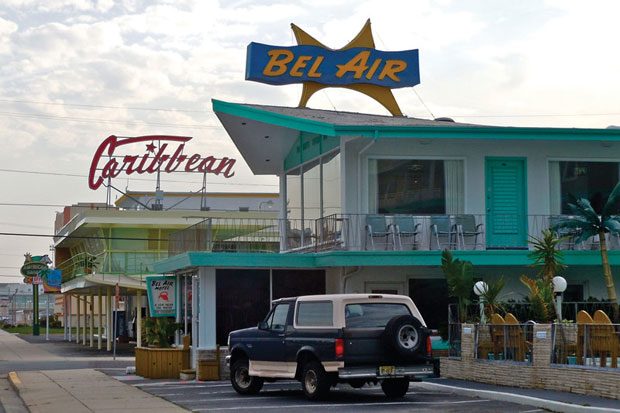
I am a fan of Shore towns that are hip (like Asbury Park) or quiet and quaint (like Ocean Grove and Cape May.) However, when I want to have the true Shore Experience of deep fried oreos and t-shirts with vulgar slogans, I go to Wildwood. I also love the town for its beautifully tacky mid-century commercial architecture.


Philly teen idol rocker Bobby Rydell was one of the many musical artists who played the Wildwood region of the Shore, and this song, "Wildwood Days," is a fun ode to the town.


The King of Marvin Gardens is one of my favorite obscure 1970s movies. It shows Atlantic City, the land of Monopoly, in all its brokedown glory before the casinos came. It also explores the Shore as a site of the death of the American dream.


1980's Atlantic City looked at that town after the casinos came. It is a great portrait of America as it entered the Reagan years, with its casinoization of the American economy. Desperate dreamers always seem to find a way to the Shore, one thing that makes it irresistible to me.


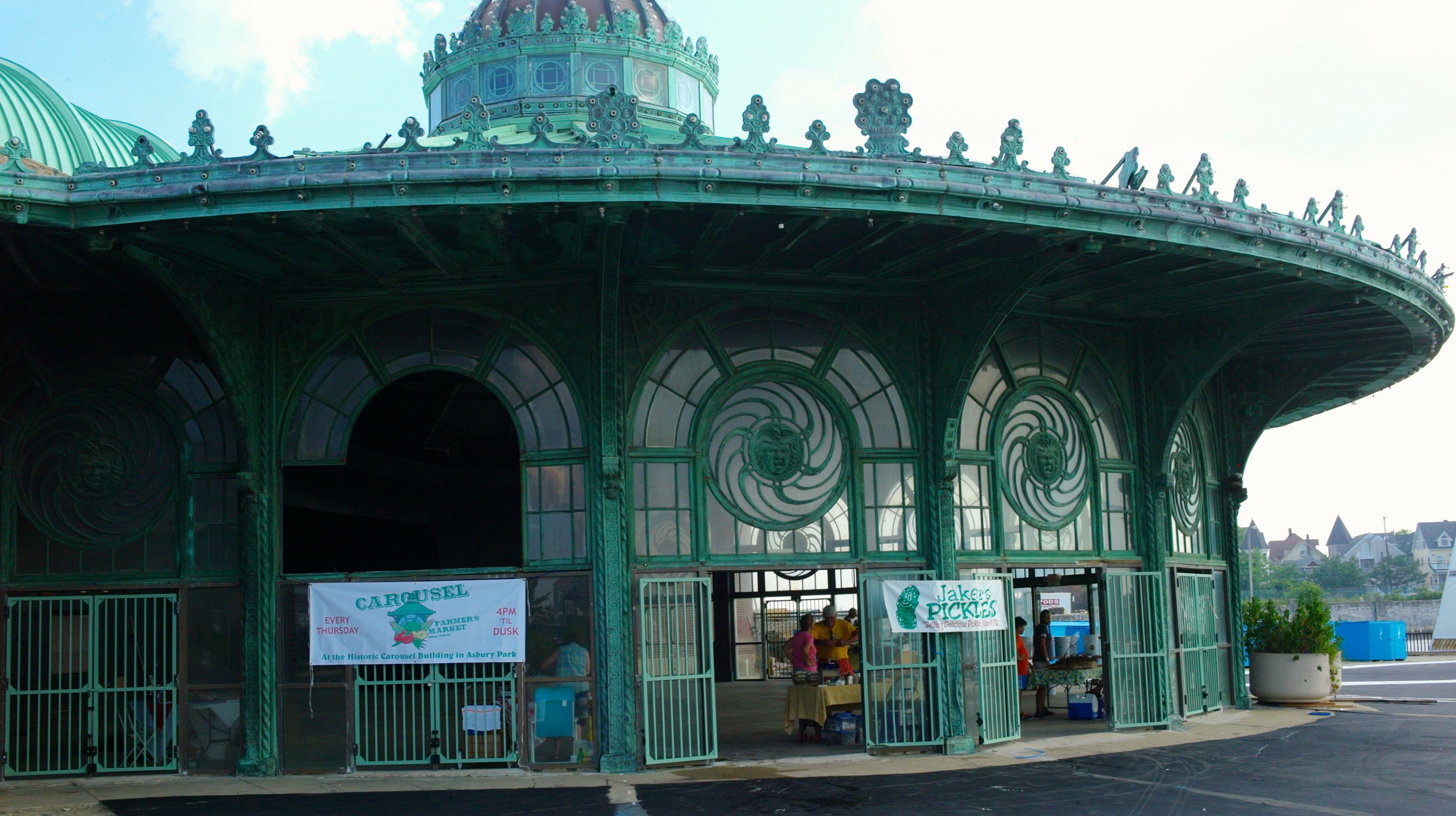
Asbury Park has a beautiful carousel house, but the carousel itself got sold off to someone in South Carolina when the town hit hard times. Not sure what exactly the metaphor is, but it perfectly matches the faded glory that is Asbury Park.


Here's another Springsteen song, "Tunnel of Love," which uses a cheap boardwalk ride as a metaphor for a troubled relationship. His music on the album of the same way was an interesting left turn from the arena sound he had embraced in the mid-80s. It is more personal and introspective, like the Shore-based music of his first two albums. There are also some great shots in the video of the Shore in 80s, when it was rougher than it is now. The song has a kind of melancholy edge to it, which makes it the right place to end.

Friday, December 8, 2017

Ruminations on Internal Exile

A sight from my homeland that never fails to stir my heart (or my stomach)

We tend to think of exile in terms of national boundaries, but in an America that is increasingly divided, exile can be internal, too. I live 1500 miles from my hometown in rural Nebraska, and when I am in New York City every day for work, I might as well be on a different planet. I never planned it this way, it just kind of happened.

I am going to be returning to my homeland with a heavy heart in a couple of days to attend the funeral of my aunt. I say the word "homeland" in the German sense, an analog of the German word "Heimat." This means a kind of regional home, as opposed to a national one. The region I come from certainly has its own distinct culture and ways as notable as a peasant's lederhosen or dirndl.

My relationship to it is complicated. I cannot abide its bad politics of its bad food, but when I look around the supposedly sophisticated East Coast I find it wanting. People in this part of the country are high on their own bullshit. They are much more status and wealth obsessed, and much more likely to think "rules are for suckers." Of course, I don't dare say that out loud here, where people use the term "Midwestern" as an implied insult. For that reason I can find my homeland irritating but my adopted home exasperating.

My aunt exemplified many of the aspects of my homeland that I miss. She was a gentle, kind person uninterested in material things. Her life was humble, but she was okay with that. That's a quality I find admirable when in the snake pit of Manhattan and all of its neuroses, resentments, and social hierarchy. I will admit, I get sick and tired of Manhattan's bullshit quite a lot.

I know at the same time that my homeland's knee-jerk conservatism, nativist tendencies, and fear of anything new helped drive me out of there in the first place. It is an almost impossible place to be a thoughtful young person. I enjoy visiting, but never feel much like staying. Yet when I come back to the Northeast, I feel something missing. For better or for worse, my homeland is something I still carry around in my heart, and it has placed an indelible stamp on me, even if I have broken with some of its values.

Some internal exiles I've met in these parts seem embarrassed of their origins, constantly running down the homeland of their births in order to get approval of the Northeasterners who see everything between the Hudson and the Pacific as easily dismissed "flyover country." Others seem to cling to their regional chauvinism as much as possible, constantly finding their new surroundings wanting. Despite my frustrations with not feeling comfortable in either the homeland of my birth or my adopted one, I am at least glad that I can see the good in both.

Sunday, July 2, 2017

A Letter To Governor Christie


I am writing this letter from a hotel room in Kansas City. I am currently on a family vacation with my wife and two daughters, on our way to visit my family in Nebraska. This is just as well, since if I was in New Jersey for the holiday I would be unable to enjoy many of the great places in the Garden State that my fellow New Jerseyans love to visit this time of year. Of course, that has not stopped you from enjoying a beach that you have effectively banned the rest of the state from due to your obnoxious stubbornness over the state budget, specifically trying to shake Horizon down for money.

My spouse is a public school teacher in New Jersey, which means we will see yet another health insurance premium burden caused directly by one of your decisions. For some reason you have vilified teachers throughout your time as governor. This obsession with attacking people who are building the future while being paid far less than the value of what they are worth has been sickening me for the last eight years. It has been personally painful to watch the woman I love work twelve-hour days trying to teach her students the best she can only to have her treated like dirt by the governor of the state she works for.

It goes beyond that, however. I have lived in many states, but never have I lived in a place where the governor had so directly and negatively impacted my life. My family now pays thousands of dollars a year more in health care premiums because of you. I commute into New York City with New Jersey Transit to work, and every time I have been stuck in yet another delay I immediately think of how you killed a second and much needed train tunnel. I use the Morris-Essex Line to get to the city, and now this summer I will have to find alternate means of transportation, because of you.
This has meant many days getting home later than planned, exhausted from a hard day of work and maddening delays on top of it. Those delays mean even less time spent with my four year old daughters. Not all of us get to take a helicopter home from work.

I have held off on telling you what I think of you because for a long time I legitimately thought that you loved the state of New Jersey, despite your misguided policies. Your behavior over the past two years has disabused me of that naïve notion. Instead of leaving the governorship while you ran for president you stayed in office, neglecting your duties and letting the state’s many problems fester. You did this all for a ridiculously failed campaign that did not garner a single delegate, a truly pathetic performance. After the state of New Jersey had long figured it out, the rest of the country finally caught on to what a terrible leader you are.

Of course, you ended your campaign by pulling a hit on Marco Rubio in a presidential debate on behalf of your new buddy, Donald Trump. At a time when many other Republicans were repulsed by his open calls to violence and racism, you embraced them. You and him are really two peas in a pod after all: lawbreakers with an authoritarian streak who are wholly incompetent leaders, burdened by emotional immaturity on a truly frightening scale. I have to say I had a good laugh when fellow scoundrel Jared Kushner pushed you aside because of your prosecution of his corrupt father. Karma can be tough.

So now here you are, despised in your home state, sitting there at Island Beach State Park in a spectacle of absolute contempt for the people that you are supposed to serve. You have given the people of this state the middle finger one more time.  I sure hope it is the last. I cannot wait for the day when you finally leave office and the man who has been a scourge on my state and my family finally moves aside.

That said, I am sure you will find work on Fox News or as a well-paid consultant and lobbyist. You probably will not face any real consequences for your many misdeeds. This is why I am writing you. I want you to know that you will have a legacy, and that legacy is being hated by the state of New Jersey more than any other state politician has ever been hated. Any contempt you show for us we feel for you ten fold. Despite all of your bluster, your governorship has been a complete and utter failure. If history remembers you at all, it will be as a footnote or a punch-line. If there is any justice in the universe, your name will remain spoken as a curse on the lips of the people of New Jersey for decades to come.

However, I do believe in the capacity for people to change. I do hope that in the fullness of time that you change your ways, and apologize to the people of this state for how you have grievously wronged them.

Saturday, February 18, 2017

Episode 4 of the Old Dad's Records Podcast

Episode 4 of my podcast, Old Dad's Records, is now up. In this episode I took the theme of "bridge and tunnel," and looked at artists from the fringes of the New York City metropolis. The song of the week is "Two Tickets To Paradise" by Eddie Money of Long Island. The album I focused on is the debut of The Roches from right here in New Jersey. That record even features a song about riding a commuter train! Last but not least I discuss Steel Mill, Bruce Springsteen's early 70s band before he was famous. As someone who's moved to bridge and tunnel territory and commutes to Manhattan every day, I feel a kinship with this music.

https://soundcloud.com/jason-tebbe/old-dads-records-episode-5-two-tickets-to-paradise

Friday, July 29, 2016

Vote (And Run) Local


While listening to president Obama's stirring speech on Wednesday, I could also not help thinking of how much more his eight years in office could have been. I am not talking here at all of things he could have done, but rather what his party and its supporters could have done. Obama's biggest legislative accomplishments, health care and the stimulus, came when Democrats controlled Congress. They controlled Congress because of the massive backlash to the failure and ineptitude of the Bush administration, not because of a great progressive movement. In 2010 conservatives astroturfed the Tea Party into existence, and used to win the midterm elections, and destroy much chance Obama had of advancing new legislative initiatives.

Because of that failure, each mass shooting is met with indifference by a Congress in the pay of the NRA. Because of that failure, Obamacare has to be constantly defended against challenges, rather than expanded and improved. As I have discussed before, and as the recent email revelations have shown, the Democratic party is ineptly run and far too beholden to corporate interests.

I would like to see that changed, but that change has to start from the ground up. Many American progressives buy into a facile cult of personality, whereby they put all their hopes into a particular politician who will become president and magically fix everything. I've seen that messianism among Bernie supporters, but there was also a hefty dose of it back in 2008, too. 

Seeing the Bernie hard liners boo at the convention initially irritated me, then just made me sad. It reminded me of when one of my students asked if Mets fans should boo Chase Utley hard after his first game back in New York this season after having taking a Mets player out in the playoffs last year with a dirty slide. No, I told him. Booing and clinging to past slights are what losers do. Winners go out and win. If they don't win, they try to figure out how to win next time.

I do not want to be a Bernie booer, but I do want to be part of a movement to build up much stronger local political power on the left, power that can then be used to push up higher on the chain. The right is decades ahead on this. We keep hearing about right wing nuts getting on school boards in elections where a few ideologically-charged voters can decide things. Why doesn't the left take the same opportunities? Furthermore, in areas where only Republicans run, why aren't we challenging them? I used to live in Louie Gohmert's old district in Texas, and in some elections he runs unopposed, even though a sizable number of people there are embarrassed by him. If I had stayed there I would've seriously tried to get involved in local Democratic Party politics.

Here in New Jersey it would be harder to make an impact in local politics, but something needs to happen. The Democratic Party here in Essex County is run by a machine that helps its friends and unlike Tammany Hall, very little trickles down. Its boss, Joe DiVincenzo, actually supported Christie in the last election. Party affiliation mattered not, Christie was the boss of bosses. Meanwhile Christie advocates policies that seriously screw over Essex County, which contains Newark. Thus the Democratic Party in this area effectively supports actions harmful to the people it's supposed to represent. That has to stop. I am not sure how I can participate in that change, but I desperately want to.

The issue of racist law enforcement is one that can be especially altered by local action. Mayors have a great deal of control over police forces. In Newark, for example, recently elected Ras Baraka has aided the federal government in its probes into brutality, rather than hindering them. County sheriff is an elected post. Voters can get county prosecutors elected who will bring killer cops to justice. 

Getting involved only every four years in the presidential election is clearly not enough, and the Democratic Party itself seems unable or unwilling to do much else. It's time for activists, progressives, and leftists to get organized, and to vote (and run) local. 

Monday, June 27, 2016

A Jersey Shore Playlist

Clip from a doc about the Shore from the 90s, during the Shore's scuzzier days

Tomorrow I'm heading off to the Jersey Shore with my family, including my parents, who are in town this week. I am relishing turning my parents on to the magic place that is the Jersey shore, a place that makes me inexplicably happy. As a child of the Great Plains, nothing consoles my soul like wide vistas, whether they be the ocean or the broad expanses of the prairies. But on the Shore I also get a sea breeze, cool water, and the carnival atmosphere of the boardwalk. I have assimilated myself to New Jersey in so many ways, and not just out of the need to make peace with the fact that this is the place I have chosen to settle down. I do love so much about this wrongly maligned place, and the Shore is near the top of the list.

Driving down to the Shore is an experience in itself. There's the beauty of the Parkway once you cross the Perth Amboy bridge and the industrial grit gives way to trees that become increasingly pinier and more foreign as you keep moving south. There's also the anticipation of soon being able to bask in a summer that is more summer. (It's the only way I can explain the Shore this time of year.) Key to relishing that anticipation is a good soundtrack. Here's some of my favorite Shore songs.

Bruce Springsteen, "4th of July, Asbury Park (Sandy)"
Okay, I am going to get the obvious pick out of the way first. Not only is The Boss from Jersey, he cut his teeth as a musician in Asbury Park, a shore city that had fallen on hard times in the 1960s and 1970s. When you go there, you immediately understand his early sensibility. It is a ragtag place with a few monuments to its faded glory, a visible symbol of the realities beneath the shining, false propaganda of the American Dream, perhaps Springsteen's most potent theme. This song is the most direct one of his about The Shore, describing bands playing at the Casino (not a gambling casino, btw) on Asbury Park's boardwalk. It is an unjustly forgotten song of longing from The Wild, The Innocent, and the E Street Shuffle, perhaps his most Shore-centric album. (His previous record may have been called Greetings From Asbury Park, NJ, but more of the songs seem to be about New York City.)

Tom Waits, "Jersey Girl"

Tom Waits has different modes, from the weirdo street poet to the cracked bluesman, to the wacko mad scientist of odd sounds. It's easy to forget his skills as a balladeer, and this song is probably his greatest ballad. It's about falling in love with a Jersey girl, something both he and I did in real life. It expresses so well the feelings of newfound love, the ecstasy that almost seems too good to be true, along with the anguish about being separated from the person that makes you so happy. The key line for our purposes here is how he expresses the ecstasy "Down the Shore everything's all right/Just you and your baby on a Saturday night."

Journey, "Don't Stop Believin'"


Don't judge me. On the Shore some things have never gone out of style, and that includes the big hair and big music of the 1980s. Folks there sorta decided around 1989 that they liked things how they were and were not too keen on changing it all that much. This song, as cheesy as it is, represents the kind of chance romantic meeting between two lost people that the Shore was made for. Also it doesn't hurt that it's associated so strongly with The Sopranos.

The Drifters, "Under The Boardwalk"


Wildwood, New Jersey, had its heyday as a Shore town in the 1950s and early 60s, when folks could motor on over from Philly for some fun in the sun. The amazing number of tacky mid-century motels in the town are called "doo-wop architecture," in honor of the music that dominated the Shore at the time. The Drifters sang the ultimate song about romance on the beach, about making out under the boardwalk. It's been covered many times, but nothing beats the original.

The Shirelles, "Dedicated To The One I Love"

And of course, some of the great vocal R&B music being played on the boardwalks during the Shore's boom times came from right within the Garden State. The mighty Shirelles hailed from Passaic, and pioneered the "girl group" sound well before Phil Spector came around. There's the boardwalk and all that on the Shore, but sometimes it's good just to relax and let the beauty of the ocean wash over you, just as these harmonies do.

Bruce Springsteen, "I'm A Rocker"


Okay, I just couldn't help myself with a second helping of The Boss. This is not one of his more famous songs, but just you see if you can find a better one to blast from your car as you shoot down the Garden State Parkway into the heart of summer on the Shore.

Southside Johnny and the Asbury Dukes, "The Fever"

Not all of the Shore musicians got as famous as Springsteen, but many still cut some great tracks mining the same shaft of rocking riffs mixed with old-school R&B grooves. It's a sound that fits the Shore's imperative to dance and let the good times roll. I still want to see Southside Johnny play a show.

Monday, June 6, 2016

At Long Last Voting

New Jersey finally votes tomorrow, bringing up the rear in a interminable primary election process. Two months ago I hoped that the election would go down to the wire, so that the politicians would come to the Garden State on their grubby knees and beg folks from Cape May to Hoboken for their votes. I also really wanted to protest a Donald Trump rally and tell my governor what an ass he is. Alas, I would not get the chance.

My enthusiasm passed a long long time ago. I started off firmly behind Sanders. I would call myself a social democrat, and Sanders might be the running the most powerful social democratic candidacy since Ted Kennedy in 1980. At the same time, I was glad to see that Hillary Clinton had moved to the left, and would've been fine with her as the nominee, despite her past history. As I've detailed here, the Sanders campaign lost me once it stopped reigning in its worst supporters and started threatening to disrupt the summer convention. To not admit defeat (which was crystal clear) and keep dividing the left in the face of a fascist threat got me over any Bern I was once feeling.

If New Jersey had its primary in March or April, I would've gladly voted for Sanders, Now that he still has refused to call off his campaign before the convention, I'm with her, as they say. I am feeling a lot of ambivalence about this, though. I respect Clinton for her intelligence, political savvy, and experience. However, I am not too happy with her hawkish foreign policy or past history of support for the war in Iraq. At least she's proposing a major program to help pay for day care, something that would help me and a whole lot of other people. I am trying to think of those things as I vote tomorrow. I am also feeling a little bit of a thrill, as New Jersey will likely be the state to put Clinton over the top as the first woman to get the presidential nomination from a major party.

Part of me can't escape the feeling that I've spent most of my time as a voter not enthusiastically casting my vote, but to support an underwhelming option that's not conservative extremism. When I voted for Obama in 2008 and 2012, I did feel real pride and enthusiasm. Now I am just hoping to hold off the Trumpocalypse. I just tell myself that the way for progressives to push Clinton to the left is not to vote for Sanders, but to give Clinton the vote with the understanding that it will be withheld in the future if she follows the triangulating path of her husband.

Sunday, March 27, 2016

Track of the Week: Bruce Springsteen "Atlantic City"


It's not making too many headlines outside of the Garden State, but Atlantic City is in trouble again. The collapse of the casino industry there, hampered by new competition, is driving the city to bankruptcy. Governor Christie is exploiting the situation, withholding aid unless the city puts itself under state control, the kind of thing that has led to poisoned water in Flint and uninhabitable schools in Detroit. Like in the casinos themselves, in modern American life the house always wins, and the regular palooka always loses. Donald Trump famously invested huge in Atlantic City and helped build the reputation he is using to run for president, all the while the people of Atlantic City are seeing their lives fall apart.

The casinos came in the 1970s in an attempt to save a once bustling resort centered around a famous boardwalk. Generations of American families had grown up battling for supremacy over its streets in countless games of Monopoly, perhaps never aware that these were real places. By the early seventies, as the stellar film The King of Marvin Gardens illustrates, Atlantic City had died off as a tourist mecca in the age of interstates and airports. When the casinos came to Atlantic City, gambling was really only legal there and in Nevada. As other, more convenient places closer to the homes of the marks have built casinos, Atlantic City has suffered.

Back in 1982, when Bruce Springsteen recorded his austere Nebraska album, he seemed to grasp the dark lie behind the supposed salvation. The whole record is a document of the harsh reality underneath the "shining city on a hill" rhetoric of the early Reagan years, stories of people on the margins who are losing out. "Atlantic City" hits the listener right away with the lines "Well they blew up the chicken man in Philly last night/ They blew up his house too." This world of casinos and the hopes of easy money is infused with organized crime and assassinations. The character singing the song is desperate, he talks of having "debts that no honest man can pay." As he sings to his lady, he promises her a romantic night out in Atlantic City, and lets her know ominously that he's "met a man and I'm gonna do a little favor for him." It's implied that this desperate character has found his way out by killing someone else for money.

It is a beautiful, dark, haunting song. The harmonica cuts like a cold wind coming in off the ocean whipping the boardwalk, and the mandolin echoes spookily. The key, cryptic lines of the song have always stuck with me "Everything dies baby/ That's a fact/ But maybe everything that dies/ Someday comes back." It could be a cheap justification by this newly minted killer for hire about what he's about to do. It could be fatalism about chucking his soul in the garbage can to do it. Or it could be a comment on the once beautiful city fallen into disrepair hoping to make a comeback. Today it looks like Atlantic City is never coming back. Like the character in the song, it made a dirty deal to save itself, but the bill for that deal has come due.

The leading candidate in one of the major party's for president made so much of his money off of a town that's broke, desperate, and having to beg for mercy from one of his political lackeys. As "Atlantic City" tells us abundantly, that town is a window into the dark heart of the American Dream, and the human cost of its illusions.

Tuesday, February 2, 2016

A Modest Proposal To Make New Jersey The First Primary State


During last night's Iowa caucuses I got some cool Facebook updates from my friends who live there.  They take Iowa's first in the nation status very seriously, and I wished I could join in on the fun.  Only problem is, I live in New Jersey which will be holding its primary on June 7 with some other states on the last full primary day on the calendar.  (The Democrats but not Republicans will go a week later in DC.)  By that time I am sure that my vote will be irrelevant.

Every presidential election year, there are the same complaints about the disproportionate influence that small, mostly white states like Iowa and New Hampshire have on the process.  Their position also gets these states special treatment, such as the ethanol subsidy, a boon to Iowa farmers.  The primary system is completely ridiculous, but this seems particularly unfair.  

If I were in charge I'd scrap the current system altogether and replace it with all states voting on the same day, about a month before the conventions, thus cutting the length of the campaign in half and saving us all a lot of aggravation in the process.  Since I am not in charge of things, I have a modest proposal: reverse the order of the primaries in 2020, switching back and forth with each election.  This way no one state gets a permanent advantage.

Furthermore, I would like to see New Jersey separated out from the other states at the tail end (like California), and for first in 2020.  I would also like to see, as part of this change, New Jersey switch to a caucus system.  There are many, many reasons to do this.  

First, New Jersey is much more representative of the country as a whole.  It is much bigger than Iowa and New Hampshire, with almost nine million residents.  Its population is 73% white, as opposed to 77% for the country as a whole, making it much more in line with the country's racial demographics.  African-Americans, Asians, and Latinos all make up a larger percentage of the population of New Jersey than they do of the nation as a whole, but not a whole lot more so.  New Jersey has cities, suburbs, and small towns, but no one city dominates the state.  One area where New Jersey is an outlier should also qualify it for first: New Jerseyans are more highly educated than the rest of the country.  Shouldn't that allow us in the Garden State to get bumped up?  New Jersey is also a moderate state politically.  The radical nature of conservative politics in a place like Iowa gives extra power to loonies like Ted Cruz, who wouldn't stand much of a chance in Jersey.  Considering that radical conservatism is currently the most disruptive force in our political life today, tamping it down would be great for everyone but the wingnuts.  The anti-immigrant rhetoric would also be very hard to sustain on the campaign trail in this state.  Simply put, if presidential candidates are force to pander to New Jersey, the whole country wins.

Second, New Jersey deserves to go first because the people of New Jersey contribute disproportionately to the rest of the country.  The Garden State consistently gets the lowest or near the lowest return of any state on its federal tax dollars, only getting back 48 cents for each dollar it contributes, making it by one measure the state least dependent on the federal government.  We've been paying the way for other states, but also having to live with the moron candidates that they vote for.  Enough is enough.  If states like Nevada and South Carolina want our money they've got to listen to our wishes, dammit. Having Jersey go first will rectify this situation, since politicians will scramble to promise the pork.  If New Jersey went first, I imagine that the train tunnel we need to connect to New York would suddenly appear.  The pock-marked, pot-holed roads would suddenly be as smooth as a baby's butt. You might call that unfair as the ethanal subsidy, but those roads are necessary to maintain the transportation network of America's biggest and most important city.

So yes, for reasons of representation and fairness, Jersey deserves to go first in 2020.  However, if justice doesn't sway you, maybe entertainment value will.  We see footage of the Iowa caucuses, and hear the announcers and commentators gush as they put their hands on their hearts about the wonderful nature of true democracy blah blah blah.  That's because Iowans are nice.  By contrast, I would imagine that a caucus system in New Jersey would lead to fisticuffs, salty language, and perhaps a knife fight or two, which would both be entertaining and provide a less sanctimonious and more real image of what pure democracy looks like.  Real politics is not a bunch of friendly Iowans in a room, but a bunch of sharp-elbowed New Jerseyans with bad attitudes and malign dispositions.

I can think of a bunch of bonus reasons, too.  New Jersey is small in size and has the densest population of any state, making it easier for upstart candidates to get a foothold here.  Instead of that godawful Pizza Ranch shite, the candidates could actually get to eat some real pizza for a change.

New Jersey is the nation's tugboat.  We may not look pretty, but we are the little state with a lot of strength that's been selflessly helping to push the nation along.  Can't we, even if just once, actually get a say in the primaries?  

Thursday, May 28, 2015

A Commuter's Eye View Of The Politics of Mass Transit


If you want to feel embarrassed to live in America, take a trip to Germany and ride its rail system.  The trains are clean, safe, speedy, efficient, timely, and go to just about anywhere you would want to be.  Contrast that with the American train system.  Regular delays, train cars left over from the 1970s, limited options, and periodic crashes and accidents that could be easily preventable.  Instead of subsidizing mass transit, Congress has gutted it. 

Things aren’t any better on the state level.  I rely on New Jersey Transit to get to work in New York City every day, like hundreds of thousands of others who will now be facing major fare hikes brought by Chris Christie, the same man who squashed a second tunnel beneath the Hudson. Now I hear that tracks in the main tunnel will have to be shut down to repair Sandy damage, meaning that I will soon be paying more money for a much shittier service. 

This is all happening despite the fact that New Jersey’s economy is dependent on its  transit links to New York, and also that the state has the second lowest gas tax in the country.  Just like on the national level, mass transit is neglected in favor of the automobile.  This is being done despite the contributions of cars to the greenhouse effect, the cost of expanding highways, and the high number of traffic fatalities.

I am increasingly convinced that our mass transit policy is the result of a kind of social insanity.  Conservative politicians want to privatize Amtrak, effectively stripping it of all subsidies, saying that its cross country rail service does not “turn a profit.”  That is an absurd statement when made in context of the billions and billions of dollars spent every year on highway construction and maintenance.  Those highways have gutted neighborhoods in our cities, spew pollution, and see thousands die each year in automotive carnage.  On what planet is the war on mass transit not a horribly stupid thing?

There are a lot explanations for “American exceptionalism” when it comes to our nation’s failure to maintain a proper passenger rail system.  On some level I don’t this has anything to do with a cultural preference for cars over trains, since trains keep places like New York City viable, cultural preferences or not.  No, this is the result of our nation’s tragic adherence to an outmoded federalist constitutional model.  Having a robust train system, especially in the Northeast, is very much in the national interest.  However, it is not in the interest of a great number of the states.  There are over ten million people who live in the New York City area, but states like Wyoming, Nevada, Alaska, the Dakotas, Montana, and a few others could all be added up and still not equal the Tri-State Area’s population.  All of those states each get two Senators, despite that discrepancy.  That’s the reason why New Jersey’s tax dollars go to fund highways through the middle of nowhere, but not improved rail connections to America’s biggest metropolis and the world’s economic capital.  I doubt that the situation will change, since this country is devoted to its original flawed, outdated Constitution, no matter how badly it fails.