[Editor's Note: this is the next installment of my continuing series on the year 1971.]
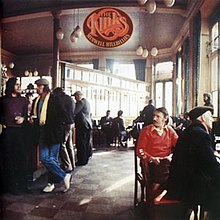
The Kinks had an amazing run from 1966 to 1971 where their sound matured and Ray Davies' eye for the subtleties of postwar British society got ever keener. Their last album in that run in Muswell Hillbillies, which happened to be their first for new label RCA. (Unfortunately for their new label, they would go on a string of ill-advised concept albums after this point.)
The album is a return to the band's roots, name-checking their London neighborhood of Muswell Hill. The music is rootsier too, much like the rocking folk style that Rod Stewart was popularizing at the time. The best song by far is the opener, "20th Century Man," a rip-roaring lament about the bland, standardized modern world. At the start it sounds like something being played on someone's back porch before the drums and slide guitar kick in to give it an edge. The lyrics are a cross between Davies' nostalgia for a different time and punk rock disregard: "Ain't got no ambition/ I'm just disillusioned."
The song keeps driving, with organ coming in to give it extra heft, the faster tempo ever increasing. The whole thing is a rollicking rave-up concealing a social critique. It is a song deeply suited to the 1971 project due to its themes. The optimism and sense of utopia of the sixties are gone here. All of the attempts to change the social order appear to have come to naught. All that's left is a feeling of alienation and paranoia. It's a very typical feeling for 1971, and one that feels pretty familiar to me.
The trailer makes the film seem a lot more action-packed than it is
I'd like to start off the 1971 Project with a cultural artifact that is highly emblematic of that year, Monte Hellman's film Two-Lane Blacktop. It came in that truly glorious early 1970s period when Hollywood, desperate to cash in on the success of Easy Rider and to appeal to the younger generation, gave a bunch of aspiring filmmakers money to make low-budget movies that did not fit the norm. It was something that hasn't really happened before or since, and for my money 1971 is among the most fertile years in cinema history.
The film's story is barebones. The Driver and the The Mechanic take their souped-up and stripped down 1955 Chevy across the country engaging in drag races, with very little to be said between them. Along the way they meet The Girl, a young woman who seems similarly lost and looking for meaning, trying to carry on conversation with men who only seem interested in their mission. They also encounter GTO, a middle-aged man driver the car of the same name, who engages them in a race across the country, each betting their car on the outcome. The Driver and The Mechanic were played by neophytes James Taylor (the folksinger) and Dennis Wilson (of the Beach Boys), and their acting, as wooden as the HMS Bounty, somehow works in this understated film. Laurie Bird, who would die tragically young, has a real naturalism about her. Warren Oates, a great character actor of the 1960s and 1970s, plays GTO with a cocky bravado that barely masks his deep well of sadness.
It is a deeply introspective film. As someone who has driven 800 miles at a time, I feel it captures that Zen-like feeling of relaxed concentration that one gets behind the wheel on long road trips. In Two-Lane Blacktop, that feeling of concentration also feels a lot like ennui, and ennui embedded in the world of 1971.
As I mentioned in the post kicking off this series, 1971 to me feels like the true sunset of the 60s counterculture. In this film The Driver and The Mechanic are still devoted to living outside of society, but they seem tired, and a little broken. The Girl has an air of desperation about her. None of these characters seems like they will last too long in the harsh reality of 1970s America. While they represent the counterculture, with their single-minded dedication to outfitting their own car and living outside of society, GTO is the avatar of American consumer society. He seems affluent, though we don't learn where the money comes from. Instead of putting his soul into outfitting a car of his own, he has merely bought the GTO, a mass-produced status symbol. While the trio of youngsters seems spent or lost, GTO seems spiritually adrift, and aware of the emptiness of his lifestyle but without a clue about what else to do.
Hellman seems to imply (at least to me) that America's soul in the early 1970s is empty. The old consumer values are rubbish, but those that oppose them seem headed for a dead end. Appropriately, the movie ends abruptly during a drag race, suddenly cutting out while the last frames of the film appear to burn up. The road goes on forever, as The Allman Brothers once said. Befitting a time of transition and confusion, there's no resolution in Two-Lane Blacktop, and it would feel completely false if there was.
It's been awhile since I've started a new running series on this blog, which is a shame since I tend to write better when I am thinking about a bigger topic than just responding to the events of the day.
I am a sucker for a lot of genres I should not be a sucker for, and one of them is the "The World In Year X" genre. After all, I am a sophisticated historian, and understand that historical events and trends very rarely conform to arbitrary dates on the calendar. That said, I find something satisfying about books that deal with a calendar year, especially baseball books. (At least a sports season puts greater ontological weight on viewing things by year.)
I am currently reading Heather Ann Thompson's deservedly lauded history of the Attica Prison uprising in 1971, and that triggered in me a long-held notion about that particular year. I now see it as the apotheosis of the 1960s in many respects. Not just the sixties as the time of radical protest and social change, but also the sixties as a time of resentment, backlash, and rise of the modern conservative movement. The brutally violent suppression of the Attica uprising, perhaps more than the Kent State shooting the year before, showed the willingness of authority to use its full power to destroy the voices of dissent. After all, it was in 1971 that activists broke into government offices and revealed the machinations of COINTELPRO.
On reason why I keep writing on this blog is that I lack the expertise, talent, and time to write books, but something in me compels me to keep writing. So instead of the book about 1971 I wish I could write, I'll be giving y'all a bunch of blog posts.
So I will leave this one off with "Can't You Hear My Knocking" by the Rolling Stones. It has an air of desperation mixed subtle violence that seems so fitting for the times. There's also an extended solo section in the middle, a sign of changing musical times for a band once known for its compact, explosive singles.