Showing posts with label nineties. Show all posts

Saturday, July 30, 2022

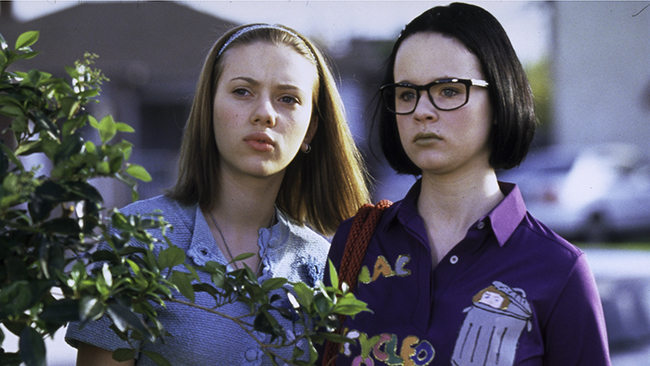
Ghost World, The Last Nineties Movie


Decades are notoriously inelegant ways of periodizing popular culture but impossible to resist. "The sixties" obviously did not start in 1960, or really by at least 1964 for that matter. Chuck Klosterman's recent book The Nineties argued for it as a "last decade" in this regard, and I tend to agree with him. When we say "nineties" in terms of popular culture we still have a notion of what that means in the way we just don't for the 2000s or 2010s. 

I recently rewatched Ghost World, and even though it came out in 2001 (just ten days after the 9/11 attacks), it feels like the last nineties movie. Like many indie films of that decade, it prioritizes an outsider perspective and the whole slacker mentality. It disdains politics as a waste of time, an annoyance that has little meaning for daily life. That's a perspective that's impossible to imagine in this day and age.

The main characters, Enid, Rebecca, and Seymour, are out of step with the consumer world of late capitalism. Since there's no political way to counter it in a world of "there is no alternative," resistance takes the form of slackerdom. Gen Xers who grew up with the Reagan delusion of "morning in America" did not have many productive ways to reject it. Being one of those young people, I longed to be a part of political movements for change that didn't exist yet. Instead, I abandoned the profit motive by going to grad school (lol). 

Enid and Rebecca are two high school grads with no clear ideas about the future and brimming with loathing over their surroundings. Seymour is an adult with the same mentality who lives a monk-like existence, driving a broken down car and living in a crappy apartment while putting his money and passion into collecting old blues records. Rebecca starts to make peace with the world, but Enid and Seymour never will, and they can't even maintain a connection with each other despite having so much in common.

Nowadays, the characters' obsession with authenticity feels quaint. Everybody sells out. Indie rock bands license their music for car ads and social media has turned everyone into a PR flack for themselves. Plenty of prominent socialists spend their days on Twitter hustling to get more followers. 

The film also has a very 90s attitude towards politics. The two parties both bought fully into neoliberalism and neither seemed all that appealing. The whole Lewinsky thing summed it up. Clinton was a slimey liar, but Newt Gingrich and Ken Starr were reactionary liars trying to gain power in skeevy ways. The serious problems the country faced weren't being addressed at all, either by politicians or the media. There did not seem to be much point in engaging with such a completely hopeless political world. 

This stance comes across in Enid's art class. Her teacher seems to think that art can only be "serious" if it specifically topical. She therefore touts her own bad video art and praises a student in class who constructs pieces that are very heavy handed allegories for abortion rights. The film treats this as unbelievable cringy and lame. When Enid tries to get her teacher's approval by doing a "found art" piece using a nasty old racist caricature to point out modern hypocrisies over race, she ends up getting in trouble at the exhibition. The film treats the reaction as an example of what today gets called "cancel culture." The lesson seems to be that political engagement is ultimately futile, a common understanding of the time.

Back in the 90s using blatantly offensive language and imagery to critique bigotry was far more accepted than it is today. It was also striking to hear characters throw the word "retarded" around so much and to use "gay' as an insult. Modern day Enids would probably be put off by that kind of thing. 

In smaller ways the film reflects the 90s in a positive fashion. Enid and Rebecca both work low wage jobs, but can also rent a decent apartment together on that money in the LA area. That's pretty much impossible today. The scenes where Enid fails to catch on doing crumby service work at a movie theater reflects 90s tropes in movies like Clerks and books like Generation X. The reality of low wage service labor has pretty much disappeared from film nowadays apart from a few exceptions.

It might be a cliche that the nineties ended on 9/11, but things become cliches for a reason. The problem of the nineties, of how to find meaning in a postmodern world devoid of anything real, got replaced by the war on terror, and that was replaced by battle over the country's very soul. Nostalgia is stupid, but I do have nostalgia for a time when the stakes were lower and the problems more quaint. When I feel that way I can always pop on Ghost World. 

Wednesday, July 1, 2015

Some Thoughts On VIsiting The Clinton Presidential Library

I remember reading this issue of Rolling Stone in 1992 and getting excited about a Clinton presidency. 

I am currently on a long and extended road trip between New Jersey and Nebraska, with the ultimate goal of arriving at my parents' house in time for my daughters' birthdays on July 4th.  We decided to take a long detour through the South in order to visit friends and family, which has been a great experience.  Today we were just concerned with getting down the road, and stopped in Little Rock.  In the spirit of seeing things along the way, we decided to go down to Bill Clinton's Presidential Library.

I was more interested in examining its narratives and approach than anything, especially having visited the museums for Truman, Eisenhower, Ford, and Carter, had plenty of things to compare it to.  It was hard to do this, mostly because two toddlers are not the best people to take to a museum when you want to linger over exhibits.  It ended up not being too hard, because the narrative of the museum was about as subtle as Rip Taylor.  There was almost nothing about Clinton the person or the usual array of presidential paraphernalia, and a whole lot about his policies and legislative accomplishments.  It basically boiled down to "look what a great job Clinton did as president!" but in the kind of overly extensive, policy wonk overkill way that Clinton himself was often criticized for.

The tone was very different in the introductory film, which we saw last because, again, traveling with toddlers means having to bend a bit to their iron wills.  Clinton himself narrated a magnificently corny piece of agitprop showing leaders like King Hussein of Jordan and Nelson Mandela praising him.  Clinton himself lays it on thick, using the same effortless, charismatic appeal that allowed him to survive scandals and gain a high level of popularity by the end of his term in office.  It was the kind of thing meant to have you standing up, shouting "four more years! four more years!"

I even got enthusiastic, but just for a second or two.  I then remembered how his administration had pushed through NAFTA, cut the social safety net, signed the Defense of Marriage Act, gutted banking regulation, and supported mass incarceration policies.  Clinton's cynical triangulation strategy after the 1994 GOP takeover of Congress meant that actual progressive legislation became a dead letter from that point onward.

Despite those sour feelings, I also felt a wave of nostalgia for the time between 1993 and 2001, when I went from being a high schooler to a grad student and passed through the young adulthood's ring of fire.  That kind of thing is probably inevitable with a early-middle aged guy like myself, but there was something a little deeper there, I think.  The exhibits threw me back into the world of the 1990s, and reminded me what a feeling of hope I had for the future back then.  The Cold War was over, and democracy appeared to be advancing all over the world, including the former Soviet Union.  When America exercised its power abroad, it was often in positive ways, such as ending genocide in the former Yugoslavia.  Perpetual war, as we have experienced for the past 14 years, was barely conceivable.  The economy was not showering its benefits equally, but it was growing in a big way.  Gun control was actually possible, both in the form of the Brady Bill and in the assault weapons ban.  The Oslo Accords created hope for a path to long lasting peace in Palestine.  I thought a lot about the long, post-Cold War peace that could have been, and the last fourteen years of war and paranoia.

I see little in the high political world today that gives me much hope for the future.  At least more people are taking to the streets these days, but those controlling the levers of power are deaf to their cries.