Showing posts with label nationalism. Show all posts

Saturday, November 9, 2019

30 Years From The Wall's Fall and 3 Years From Trump's Rise

Happier days

This morning one of those Facebook memories reminded me that it's been three years since November 9, 2016. (They rarely remind me of happy things.) The 8th was election day, but the 9th was the day that the reality of what had happened set in. A little while later I realized that today is also the thirtieth anniversary of the fall of the Berlin Wall.

In Germany this day is called "Schicksalstag" (Day of Fate) because it was on November 9, 1918, that a revolution toppled the Kaiser and on November 9, 1938, that the Nazis perpetuated the pogroms of the Night of Broken Glass. It is a reminder of the unpredictable careening of history and its utter lack of permanence. In that light it's appropriate that we think of Trump's rise and the Wall's fall on the same day.

The Soviet bloc's demise inspired Francis Fukuyama's now infamous theory about the "end of history" (which must be said was much disputed even at the time.) With Leninism in the grave there was supposedly no other game in town other than liberal capitalist democracy.

The Islamic revolution ten years before in Iran ought to have been a clue of how limited such a thesis was, but I digress.

Pretty immediately after the fall of the Wall it was apparent that nationalism was stepping back into the political vacuum. Czechoslovakia broke up in the Velvet Divorce, Yugoslavia broke up in a civil war that included genocide in Bosnia and Kosovo. Right wing violence against immigrants spiked in Germany, and Le Pen came in second place in the French presidential election of 2002. Events like 9/11 put nationalism off the radar of international observers, however. It was still gaining strength, of course. The new Putin regime, founded at the start of the new century, showed the effectiveness of a marriage between authoritarianism and nationalism, especially in countries with new democracies. After the economic collapse of 2008, a bunch of other nations started down this road. From Poland to Hungary to India to China an anti-democratic, anti-pluralist populist nationalism is the globe's most disruptive political force. It's hardly a mistake that Russia is the world's foremost exporter of nationalist authoritarianism. It pioneered this political form and is a nation run by former intelligence operatives who understand the importance of misinformation and soft power.

History is made up of trends and events, and while the trends are like tides, events have much more contingency attached to them. The fall of the Wall was haphazard and unexpected because the East German official who announced the opening of the border to the West did not reckon that crowds of East Germans would flood the Wall. If he had known that, he would have been more clear and the scenes that are so famous likely would not have happened. The same goes for the election of Donald Trump. The man himself was not expecting to get elected! He lost by three million votes, but the Electoral College, James Comey, Wikileaks, a tepid HRC campaign, and other factors helped put him into power.

He was in a position to benefit from these accidents because the Fall of the Wall did not bring about an end to history. Instead, it brought complacency. Even if you didn't buy into Fukuyama, it was still very tempting to see democracy in America at least as permanent. Unfortunately, the end of the Cold War did not bring a peace dividend for America. Soon enough there would be more war. In 1989 public discourse was alarmed at social inequality, that problem only got worse and worse. In the moment of triumph any real attempt at self-reflection was completely avoided. At around the same time, conservatives decided to embark on a scorched earth political agenda.

Now we find ourselves in a situation where an authoritarian nationalist rules America. He puts immigrant children in camps. He bans Muslims from entering the country. He fills the courts with reactionaries who despise reproductive and civil rights. In many states Republicans are limiting the vote, preventing Democratic governors from ruling, and challenging the results of legitimate elections.

The Cold War is over, but both sides lost. The Soviet Union's defeat was made manifest on November 9, 1989, America's on November 9, 2016. The movement of history's tides today is clear, but we need to swim against the current one even if it exhausts us. The post-1989 complacency cannot be repeated if democracy is going to live.

Monday, May 28, 2018

Memorial Day Thoughts

Will the sacrifice of the 54th Massachusetts have been in vain?

No one I know who has seen combat has much good to say about war. A Desert Storm vet friend said on Facebook today that he hopes war ends so that we won't need any more days of remembrance. My World War II vet grandfather told my cousin to not sign up for the military because they would throw his life away without a second thought.

Sometimes wars are regrettably necessary. Sometimes they are the most disgusting thing perpetuated by humanity. When I went to the Vietnam Memorial in DC I felt nothing but pure rage. None of the people named on that wall needed to die in that stupid conflict.

Even when wars are necessary, the sacrifice involved should give us pause. Today I am feeling especially sad. I am thinking of the African American soldiers who saved the Union in the Civil War and died for a country that still refuses to treat their descendants as equals. I am thinking of the thousands of immigrants who died for a country that now treats immigrants with contempt. I am thinking of the soldiers of all backgrounds who died to defeat Nazism in World War II. The country they died for now has a leader who is beloved by Nazis, and who has called them "very fine people."

Those dead should not have died in vain. To quote Lincoln at Gettysburg, our nation needs a new birth of freedom. I am beginning to think that the stakes are almost as high now as in 1863.

Thursday, December 1, 2016

The New Age of Nationalism


“They’re painting the passports brown.” Bob Dylan, “Desolation Row”

I had a sinking suspicion this summer that we were indeed entering into a new global age of nationalism. Brexit seemed to confirm this, and Trump’s election has cemented it. The walls are going up around the world, and the gates are crashing down. In China Xi Jinping has used nationalist rhetoric to bolster his role, and to claim more power. Putin’s brand of nationalism has been the basis of his autocracy.  This week comes the news from India that the supreme court has decreed the national anthem to be played before all movies. I am reminded of Sir Edward Grey's line in 1914 as World War I began and young men were sent to war: “The lamps are going out all across Europe. We won’t see them lit again in our lifetime.”

All of this reminded me too of my first trip outside of North America at the age of 18. My senior German class spent a month with students from our sister school in June of 1994. The school was the Yuri Gargarin Schule (named for the Soviet cosmonaut) in Schwerin. We were well behind what five years before had been the Iron Curtain. The students had already come to visit us in the preceding autumn, and we were fast friends. Of course, we had all grown up thinking the others were our enemy. Had the Iron Curtain remained and World War III broken out in the 1990s, we would have been shooting at each other. Well, that’s being optimistic. It’s more likely that missiles launched from my Great Plains stomping grounds would have been vaporizing the wonderful, generous people I met.

My visit to the former East was one of the most important experiences of my life. It made me realize the folly of national borders and the absolute ridiculousness of national hatreds. In the mid-1990s, befriending the former enemy in the forbidden zone, I had the feeling that the world was changing. We were entering into a more connected world, one where we would find understanding, not conflict. The Cold War fears of nuclear annihilation were over. Going to see Checkpoint Charlie, now a museum piece, felt exhilarating. The bad old days were over!


Of course, I was being hopelessly naïve. Now the borders are being tightened. Fewer people reach out to others for understanding, and instead retreat inside of their own borders. We are entering a time of closed borders, closed minds, and closed hearts. We see it in the chants of “Build the Wall!” and in the indifference to the suffering of Syrian refugees, whose need is met with fear rather than understanding. And so we learn to fear and hate once again, and to forget that our counterparts out there are just as kind and noble as we are. It is their leaders, and ours, who we have to watch out for, as well as the fear that can eat our souls and rob us of our humanity.

Wednesday, November 9, 2016

Nationalism Nationalism Nationalism (redux)

For a long time now I've been saying that Trump owes his rise to nationalism, a political force that has long been significant in American life, and is usually ignored by the punditocracy. Nationalism is powerful because it cuts across class lines, and because it cuts across ideological divides. We are now witnessing a global tidal wave of nationalism, from China to Russia to India to the UK to the United States.

Some people like to theorize that this is somehow a cry against globalist neoliberalism, but Trump will most certainly enact tax cuts and deregulation when he's president. Nationalism is also running high in China, which has perhaps benefited from globalization more than any other country. I simply do not buy the thesis that nationalism comes from economic anxiety, though I will accept that it can be a mitigating factor. The economic anxiety thesis is a kind of comfort to the Left, who can think that a leftist politics will somehow drain away nationalist agitation by improving the lives of those hurt by globalization. It won't.

American nationalism of the sort peddled by Trump is deeply rooted in white supremacy. Historically a lot of working class whites have violently enforced the color line as a way of ensuring a superior economic position. A large number of working class whites will never, ever, join in solidarity with their black or brown brethren, sad to say. They love their skin privilege way too much. When someone comes along with a leftist program, that means lifting up the black and brown poor, and white workers will not that.

Not only does nationalism elide class differences, it is endlessly self-perpetuating. There are always enemies to the nation, external and internal, that any failures can be blamed on. Any disloyalty to the Trump regime then becomes disloyalty to the nation itself. I remember after the invasion of Iraq how any criticism of the Bush administration was treated as treason. The notion that criticizing the president in time of was unseemly also helped Bush win a second term. Every time Trump will fail he will blame people in this country who are not sufficiently "American."

We are in an epoch of nationalism. Of closed minds and closed borders. Of hate and suspicion. I see America becoming much like Putin's Russia, where an already servile media will polish the image of the Great Leader. Dissenters will live in fear or exile. Criticism of the president will become criticism of the nation, and that won't be tolerated.

The Republican leadership sees Trump as the demagogue front man that will allow all of their free market wet dreams come true. He has lied and dissembled so much that I cannot even tell what he's going to do, whether he just wants to hold power or whether he has any firm beliefs about what to do with it. I do know that holding and wielding power for its own sake is at the top of his list. Woe unto us.

Tuesday, August 30, 2016

Takeaways From The Kaepernick Affair

I don't want to write yet another hot take on a subject that a lot of other people are hot taking. Instead, I'd like to analyze Colin Kaepernick's protest and the reactions to it, and what they say. Here are some simple observations.

The Inability Of White America To Acknowledge Racism Is On Display (again)
I mean, we already knew this, but the reaction to Kaepernick's very silent, unobtrusive protest has touched off a firestorm among white people. The folks upset about his refusal to stand for the national anthem are also the type who never seemed to have a problem with the police murder of African Americans. His protest is meant to address systemic injustice, a thing that the vast majority of white Americans actively or tacitly or implicitly support. The fact is, a very large chunk of white America, probably the majority, cares more about the national anthem than it does about the lives of black people.

Nationalism Is A Very Powerful Force In American Life
This is a drum I keep beating, and I am going to keep banging on it until people listen. In America we coerce children to say a secular prayer to the flag in school every morning with words they don't even understand. At every sporting event we play the national anthem. The flag saturates our clothing, and politicians are expected to wear flag pins on their clothing. Hell, even many sportscasters do it. This behavior is highly unusual in a country that purports to be a democracy. When someone challenges these practices, just watch the lizard brains of so many people in this country go into rage spasms, as we're seeing now.

It's Okay For Athletes To Beat Their Spouses But Not To Engage In Critical Politics
One of the times this year that I've felt the sickest happened at a Mets game. The team had brought back Jose Reyes, who in the off season brutally battered his spouse. While Reyes served out a suspension, the crowd cheered him lustily. If Kaepernick showed up to CitiField, however, I would fear for his safety. Other players have also abused women, such as Aroldis Chapman, and their careers are going just fine. Contrast this to Kaepernick, or even Michael Vick. In our misogynistic society flags and dogs rate higher than women for some people. Athletes are allowed to do a great many terrible things, but for them to be politically critical of this country opens them up for attack. Little has changed since the days of Muhammad Ali.

American Nationalism Is Militarist In Nature
Those who are critical of Kaepernick often say that he is somehow disrespecting veterans and "the troops" who fought and are fighting for "freedom." I find this disturbing on many levels. That so many so easily conflate the nation's symbols with the military's symbols makes me think a military coup could be successful in this country. It also shows tremendous ignorance about what Kaepernick his doing. His protest has fuck all to do with the military; it's about the police and the justice system. Some seem to see the conflate the police with the military, which says a lot about the militarization of the police, and how they are perceived as fighting an internal enemy. (That might explain the willingness in white America to let the murder of black people at the hands of the police slide.) The stuff about the flag being connected to the military as a freedom fighting force not only shows a lack of understanding of American history, but a disturbing tendency to view the military as infallible. Most American wars have had little to do with freedom, from the empire building of the Spanish-American War to the empire building of the Mexican-American War to the empire building of the war in Iraq, and many other in between.

The farcical view of American history as a story of freedom also contributes to the inability of white Americans to see how they have and continue to profit from racism. I salute Colin Kaepernick for jolting those people.

Tuesday, August 16, 2016

Nationalism Nationalism Nationalism

I am going to start sounding like a broken record here, but I am going to keep delivering my message until people more important than me hear it. So here I go again.

Nationalism has been a crucial force in American political history, and it has been THE major factor in the rise of Trump, much more so than "trade" or "jobs," which he is merely using to talk about the nation.

There, I said it.

I feel prompted to make this statement after listening to the 538 Elections Podcast yesterday, which as always was full of smart, analytical commentary. Towards the end they discussed the recent Gallup survey of Trump supporters that showed that these people are not the economically downtrodden white working class they have been portrayed as in the media. They do not live in areas with lots of immigration, either. The hosts discussed these findings, and some did discuss the obvious appeals to cultural and racial resentment in all this. They talked about anxiety over the old America going away. But they also weren't sure of what the glue was tying all this together, and to why people who aren't hurting economically are responding to Trump's talk on trade issues, which they don't seem to have much knowledge of.

The answer is, of course, nationalism. Nationalism nationalism nationalism. Say it with me folks, don't be shy. Trump's entire message this whole campaign has been, essentially, that America is headed in the wrong direction, is "losing," and needs to be turned around. Hence his ubiquitous slogan. Nationalism is such a dangerous political force because it can bring in and subsume a variety of things at once. Trump's trade talk, for example, isn't being bought by people because they know anything about trade (they don't), but because of the promise of building the nation's industrial power back. His hate directed and immigrants and Muslims is grounded in a racist version of nationalism that sees the white nation threatened by "others" coming in from outside. His foreign policy, which amounts to telling international institutions like NATO to fuck off and to engage in wars of plunder ("take their oil"), is as nationalist as it gets.

The people in places who are most likely to consider their ancestry "American" (as opposed to English, German, African, etc.) are the ones most likely to vote for Trump. Why? Because they are the people most invested in a particular version of American national identity. The people in those places think of themselves as the "real Americans." Back in 2010 they got motivated to "take our country back!" during the birth of the Tea Party, Trumpism is just that on steroids. They think this is "their" country, and after eight years of a black college professor from Chicago with a Kenyan father in the White House they are foaming at the mouth. Trump was smart enough to understand that it was this white nationalist resentment that drove the base of the Republican Party, not tax policy or government regulation.

The Democrats as well as the Trumpists have been engaged in nation talk, but we don't call it that. The Democratic convention was notable for the number of generals who spoke, and became most dramatic when the Khans took the stage. Khizr Khan very passionately argued for an alternative version of American nationalism, one where America was defined by its diversity and a commitment to equal rights. There has been little policy discussion in this election, it has essentially boiled down to what version of the nation voters identify with more strongly.

This all begs the question of why so few people are talking about nationalism in this election. Part of it has to do with the strange American denial that nationalism exists in this country. We talk about "patriotism," not nationalism, in another manifestation of a bogus assumed American exceptionalism. This even extends to professional historians of the US, who haven't really done much to address it. Our political commentators tend to want to look at very surface level factors in politics ("blue collar anger") and thus consistently downplay how racism and nationalism are such titanic forces in the American body politic.

C'mon people, stop ignoring what's staring you right in the face. We've been lucky this time that the man stirring up the forces of nationalism has sabotaged himself. We might not be so lucky next time.

Monday, August 1, 2016

The Contemporary Relevance Of The Dreyfus Affair

Back in the spring of 2010, amidst the Tea Party onslaught, I wrote something on my old blog about the parallels I was seeing in the United States and fin-de-siecle France. The last six years, especially the Trump phenomenon, have only strengthened my belief in this comparison. The current political scene in America is a conflict between two vastly different and mutually irreconcilable understandings of the nation. One a pluralistic collection of people with complex identities, the other a closed circle delineated by blood and soil. Khizr Khan's rousing rebuke of Trump and the response to it have put those different visions in high relief. Below is my original post. You can replace "Tea Party" with "Trump Supporters" and it will fit right in with today.

****

As I've said before, the current American political scene reminds me very powerfully of Third Republic France. Recently I've given a lot of thought to the Third Republic's greatest drama, the Dreyfus Affair. My students are reading an excellent documentary history by Michael Burns about the Affair, and in reviewing the text I found some eerie echoes of contemporary America.

First, for those of you who don't know, Alfred Dreyfus was a French army officer convicted of espionage and treason in 1894 based on faulty (and later fabricated) evidence largely because of the fact that he was Jewish. His trial unleashed a wave of latent anti-Semitism, including mobs chanting "death to the Jews" in the streets of Paris. After tireless work by his brother Mathieu and prominent figures like Emile Zola, the true culprits were uncovered and Dreyfus was exonerated. The entire ordeal was marked by political violence (including assassination attempts on Dreyfus and one of his lawyers) and exposed the deep division between those who supported the legacy of the French Revolution and those who rejected it.

The Dreyfus Affair appears to be relevant to me today for a host of reasons, not least of which being the issue of national identity. The Dreyfusards and anti-Dreyfusards were both motivated by their own particular ideas of France. Those who fought to destroy Dreyfus thought of the French nation as a community of blood, faith, and soil, whereas his supporters rallied behind the revolutionary principles of citizenship, liberty, equality, and fraternity. The anti-Dreyfusards thought of themselves as the representatives of the "true" France, and anyone who Jewish, Protestant, Socialist, or a Mason constituted the "anti-France." This phrase was used by Charles Maurras, one of the intellectual leading lights of France's radical right in the first half of the twentieth century and a rabid anti-Dreyfusard.

Need I even connect the dots for you? The Palin/Teabagger/Oath Keepers gang constantly talk of themselves as the "real America," and are quick to doubt Barack Obama's birth and to question whether he is really "like us." Nativism, long a scourge in American life, has come back with a vengeance, and the likes of Pat Buchanan using phrases like "national suicide" (i.e. "race suicide"). Just as the anti-Dreyfusards contended that France was a Catholic nation and that Jews and Protestants could not truly be French, the radical right in America has been insistent in claiming that America is a "Christian nation." This blood/soil/faith perspective is exactly the one that the Texas Board of Education recently imposed on the state's history curriculum: it omitted as many Latinos as it could, cut deists like Thomas Jefferson out, and brought in John Calvin and Thomas Aquinas. I truly think that we today are confronted with a question similar to that raised by the Dreyfus Affair: is America a diverse agglomeration of equal citizens, or is it a mystical community tied together by race and religion? By declaring this month Confederate History Month, Bob McDonnell gave his own answer to this question. If I may draw the metaphor out, the Civil War is our French Revolution, and its principles are still being fought over today.

Not only does our unspoken conflict over national identity resemble that of the Dreyfus Affair, so does our current political style. The right-wing press in France fanned the flames of hatred and termed Jews and Dreyfus' supporters to be an enemy within, destroying "true" France. Although our current talk radio hosts are not quite as ugly as the likes of Maurras, the basic accusation remains the same. Glenn Beck talks of progressives as a "disease" and a "cancer" and Michelle Bachmann wants to root out those she considers "un-American." Furthermore, anti-Dreyfusards committed mob violence. As I mentioned before, they screamed "death to the Jews" as Dreyfus left the courtroom. At a steeplechase race an angry mob surrounded and shouted threats at president Loubet before a reactionary nobleman knocked his hat off of his head. An angry mob showed up and hurled abuse at the burial of Emile Zola, the great writer and passionate defender of Dreyfus. Reading of these incidents reminds me of nothing more than the teabagger mobs who have screamed at town halls and spat on American Congressmen.

Although the Dreyfusards and their vision of France won the day, French politics remained bitterly divided, and those who thought of their nation as an entity of blood, soil, and faith found their salvation in 1940 via the collaborationist Vichy regime. Nevertheless, we ought to remember Emile Zola's slogan during the Affair, words that ought to give us hope and motivation today: "truth is on the march!"

Saturday, June 25, 2016

The Age Of Resentment

I rarely tweet anything that more than two people retweet, so I was glad to see a bigger group of people respond to this tweet:
I was referring to the now deceased historian's four books on modern world history, The Age of Revolution, The Age of Capital, The Age of Empire, and The Age of Extremes. Broad based synthesizing histories are not in vogue anymore, but I love them for their sweeping scopes and big ideas. I was being a bit flippant, but I do think that resentment is currently an overwhelming force in world affairs.

That resentment has expressed itself in nationalist terms. Putin has harnessed the resentment over Russia's fall from superpower status to burnish his authority and invade Georgia and the Ukraine. Dating to Sarah Palin in 2008, America's hard right wing has put all of its money on the resentment-fueled "take our country back" meme, culminating in the rise of Trump. And a slim majority of British voters opted to leave the EU in a campaign driven by fear of immigrants and promises of restored national prestige.

How to explain these resentments? One response is what I call the "blame it on neoliberalism" school. They see Trump and Brexit as reactions by the economically dispossessed who relish the opportunity to smack down the elites. I find that this explanation has limited power. In the first place, the arguments for Brexit were made in explicitly neoliberal terms: less money being redistributed and fewer regulations will make the economy grow!  Just because a group of people is economically hurting, that doesn't mean that its political choices are all a direct response to that fact. That's a fallacy that a lot of people are falling into, partially due to their own life experiences. It always makes me chuckle when bougie Vassar grads lecture others for "punching down" on the Archie Bunker types. Coming from a lower-middle class background in rural red state America, I can tell you that a lot of these people are just narrow minded bigots, pure and simple. There is no great mystery to solve there, especially when white supremacy gets threatened.

It would be terribly short-sighted, of course, to just blame the Age of Resentment exclusively on racial fear, even if it is a key element. What appears to be happening is that larger resentments brought on by the forty year contraction of the middle class in the wake of neoliberal globalization are being channeled towards nationalism, which is inherently populist. This has happened in large part due to the weakness of the left. In Europe, the old social democratic and socialist parties have been in retreat. In France, with Francois Hollande in power, the socialists have been forced to compromise.  Across Latin America left-oriented governments have fallen, as in Argentina and Brazil, or are in serious trouble, as in Venezuela and Bolivia. In America the radical left has become so intertwined with academia that the people who claim to be pushing for popular revolution are incapable of making a political statement devoid of grad student jargon. That'll get the working class fired up!

With the left unable to properly harness resentment (partially due to the siren call of white supremacy), the radical right has had a field day. Anger and resentment at globalization is not being directed at multinational corporations, but at immigrants. As far as America is concerned, the Occupy Movement and the Sanders campaign certainly show the presence of left wing populism, but both tend to skew towards the young and the more educated, and both have had problems with attracting people of color. The right wing variety is much more robust, and it has a secret weapon in its media presence. In Britain, the Sun and other tabloids gushed out geysers of misinformation. In America talk radio and Fox News not only reach millions, but they crucially influence their outlooks. I still remember a relative one day who started railing about how "America is a republic, not a democracy," then realized they had been watching Glenn Beck.

What I would like to see coming out of this is a left self-critical enough to understand its shortcomings. I see so much leftist vitriol directed at liberals, for instance, without any analysis of why leftist ideas are not gaining traction. I see so many Bernie supporters wailing about a "rigged" system rather than thinking long and hard about how and why they could attract more voters of color. There is a lot of resentment out there, and it runs especially high in the white working and middle classes of this country, where it feeds on the power and attraction of nationalism and white supremacy. Combatting it will require a lot of hard work, as well as some political hard-nosedness. No more beautiful losers. No more elevating a single person in messianic status. No more blaming the right whenever the left fails. No more empty self-righteousness. In this Age of Resentment, it is time to put away childish things, and it is time to roll up our sleeves and give the fight of our lives. The loss will not be a noble defeat, it will be unthinkable.

Thursday, May 5, 2016

Trump And The Nationalist Moment

These last two days I have been profoundly depressed by the fact that Donald Trump is now the presumptive nominee of the Republican Party, and that many members of that party are falling in behind him. Of course there are the usual academic leftists trolling that both sides are neoliberalism blah blah blah, but they are missing the point and the threat. As anyone could have predicted, the news media have also missed his fundamental nature, speaking of "blue collar anger" and "people left behind" without stating the obvious: Trump is an ethno-nationalist and that's why people vote for him. 
These groups, and so many others, act is if nationalism is not a vital force in American politics, when it has traditionally played a profoundly powerful role. Trump's brand of ethno-nationalism can be traced back to Andrew Jackson, the Know Nothings, Madison Grant, George Wallace, and Pat Buchanan. Like Jackson, he has managed to make that appeal broad enough to push close to the apex of power.  By getting the nomination, and even if he loses in a landslide, Trump has effectively legitimized this hateful brand of nationalism. Once a candidate, any candidate, gets a major party nod the media acts as if directly confronting them, rather than reporting "he said-she said" is beyond the pale.  

Just chew on that for a moment. A man who has called on a ban on all Muslims into this country (an unprecedented act of religious discrimination in this nation's history), a man who has demonized immigrants and called for a wall to be built with Mexico, a man who has called for an invasion of Iraq to confiscate its oil, a man who has made overtures to Vladimir Putin, a man who has called to murder the families of those deemed terrorists, will not be treated as a crackpot or bigot, but as a legitimate politician with ideas deserving respect and consideration. 

I don't think Trump is going to win, but I said the same thing months ago, and so can no longer be so sure of myself on this count. Any candidate with major party backing and a compliant media facing off against an opponent with potential scandals over her head still has a chance. Trump is also following a worldwide trend. Nationalism is on the march across the globe, evidence that the new globalist millennium predicted in the years after the fall of the Berlin Wall was merely a temporary condition. Heck, I would date its end in 2001, giving that global world a maximum of twelve years.

In Europe the nationalist Freedom Party came in first place in the recent first round of presidential elections in Austria. In Germany, a country where nationalism was once considered outside the pale, the Alternative for Germany Party is gaining ground. In Britain a coming referendum may take the UK out of the EU, and Scotland narrowly decided against secession last year. In Eastern Europe Hungary and Poland have moved in a hard right nationalist direction. Most menacingly, Vladimir Putin has maintained power through claims of a return to nationalist greatness and the retaking of territory in the Ukraine.

A similar nationalist orientation is very apparent in other parts of the world, too. This is especially the case in Asia's two most populous nations. The BJP in India is an explicitly Hindu nationalist organization. Chinese leader Xi Jingping has emphasized Chinese nationalism. Heck, ISIS might be an international movement, but its goal is the creation of a new nation state.

I recently read a book about the creation of the post-WWI world order.  Those behind it really thought that they had created lasting peace in the world. It's something we can mock today, but in say 1927 it wouldn't have been so far-fetched. The major powers were limiting their arms and Germany appeared to have transformed itself into an economically healthy democracy. Of course, that all changed in the 1930s, and nations like Germany, Japan, and Italy decided that they had no use for the spirit of Locarno.  I fear in our own uncertain economic times with demagogues on the loose and nationalism rising that we are living in a similar era.

Monday, March 14, 2016

Reports Of The Nation State's Demise Have Been Greatly Exaggerated

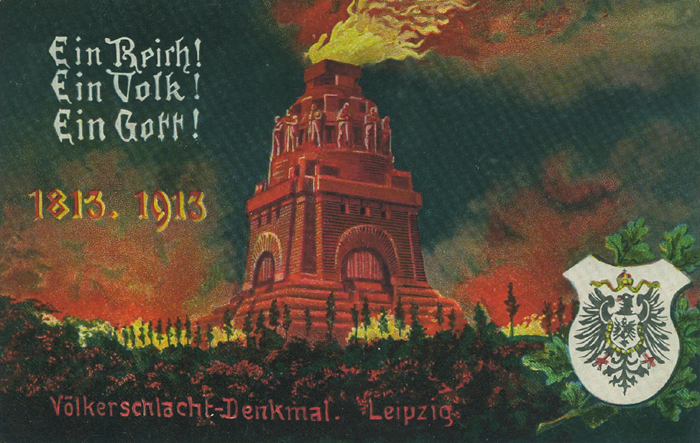
In 1913 world trade was at an all time high and Germany exported to the world. It also completed this massive nationalist monument. Globalization and nationalism coexisted then, and appear to still coexist now

I've spent a lot of time talking about Donald Trump in historical terms, but it's probably better to ground him in a present day, international context.  As I have been saying on repeat, Donald Trump's rise has to do with the power of American nationalism. I will add today that his appeal to nationalism is indicative of a rise in nationalism's impact worldwide. This I feel has caught a lot of people off guard, since globalization seemed to be bringing about the weakening of nation states. Of course, as any student of the past well knows, history does not move in a straight line. In 1913 the world looked as if it were globalizing, but after the bloody events spawned by 1914 levels of world trade would not return to 1913 levels until the late 20th century. Nothing guarantees that a similar shift is impossible today.

It already seems to be happening. Nationalism is on the march all over the world. In Europe anti-immigrant parties have gone from fringe elements to major political forces. Witness the National Front in France, UKIP in Britain, and Alternative for Germany, which won big in local elections recently. In Eastern Europe full on nationalists have won in Hungary and Poland, and Vladimir Putin has pitched his appeal in terms of national renewal. In India the Hindu nationalist BJP is in power. In China Xi Jinping has made nationalism a hallmark of his time in power. Even the famous non-state actors like Islamist terrorists have gotten in on the act, as ISIS strives (as its name suggests) to build a new nation-state.

We should not be surprised, then, that a politician like Trump has come around to exploit American nationalism, in yet another riposte to the silly notion that America is an exceptional nation. Based on what's happening in Europe, we should also not be surprised by who supports him. In both Europe and America nationalist politicians draw from working and lower-middle class voters anxious about their status. In Europe the traditional parties of the working class, like the SPD in Germany and the Socialists in France, were successful in setting up a robust welfare state, union recognition, and hybrid economy. Those ideas are now the political consensus, meaning that it is hard for those parties of the left to have much political ground to stand on. The nationalists offer a new scapegoat for their uneasy voters, and profit. In America the dynamics are a little different, as a combination of racist resentment by whites and the Democratic party's adherence to pro-corporate policies makes it hard for them to appeal to the white working class.

The nationalist wave in the West at least has everything to do with the consequences of the last four decades of neoliberal globalization. It created a new global elite, but also a system that shut out a lot of people who had been conditioned to prosperity in the immediate postwar period. The nationalists in Europe and America are not neoliberals in economics. They want to maintain a robust social state, but to do it for people "like us." The Left is in tatters and the progressive parties are often run by privileged members of the global elite, making so many voters easy pickings for nationalists. Part of the reason that Bernie Sanders has energized so many despite being a 74 year old with one real issue is that he is actually speaking to the discontents of globalization from the Left side.

The rise is nationalism is disturbing because I find it to be such a noxious, anti-humanist ideology. You could argue that it is the "ism" that killed to most people in the 20th century, responsible for the First World War and countless others, and the biggest ingredient in Fascism. It is crucial for the Left to reconstitute itself, because it is the one force capable of breaking the nationalist wave. Instead of hate and tribalism, the Left needs to once again preach the message of solidarity and humanity. Failing to do so will have disastrous consequences, I fear. Nationalists are never happy until they destroy the "enemies within" and start invading other peoples' countries.

Wednesday, March 2, 2016

It's The Nation, Stupid

I am going to repeat myself, but I am saying something I have been saying for years and it bears repeating: nationalism is an extremely powerful force in American politics and Trump is exploiting it.  Most Americans are under the self-serving delusion that Americans are "patriotic" and not "nationalistic," which is just not true.  Scholars of American history are surprisingly susceptible to the soft-pedaling of nationalism as a force in American life.  On top of that, so many scholars in the humanities have been talking about diasporas and the declining power of the nation-state, as if it were an inevitability.  While we have experienced a great deal of globalization over the last three decades, those forces have done much to stoke the flames of nationalist resentment. Look no further than Trump.  He is using global trade and immigration to throw gasoline on those nationalist fires.

The lack of an understanding of the centrality of nationalism in American history and politics is causing many pundits to just miss the boat.  They scratch their heads and say "Trump is getting support from across class and regional and religious lines, how is he doing this?" He's doing it because nationalism is a force that has the ability to transcend other identities and bring people together who might not normally see themselves on the same team.  It is a force that can whip up the masses in a frothy frenzy to be channeled by demagogues.

Because let's be clear here.  The vast majority of Republicans probably don't give a flying fuck about the capital gains tax or the estate tax.  Unless you are a millionaire, those taxes are pretty irrelevant to your life.  Most Republicans probably don't even really care all that much about supply side economics.  That's for the small number of people who read National Review.

They do, however, invest a lot of themselves in their national identity.  When someone comes along and tells them that the nation has been brought low, and that he can bring it back, that message will resonate with them.  When he is able to finger scapegoats and blame them for all the troubles of the nation, heads will nod in agreement.  Because of all of the bullshit drilled into us in our youth, appeals to nationalism hit most people right at their emotional core.  While Republicans got emphatic about the tax code but only gave their supporters dog whistles when it came to immigration and Islam, Trump started throwing out the red meat, and the hounds of the Right leaped on it.

Until the pundits seriously try to understand American nationalism, they will fail to understand Trump.  If the Left does not gain an appreciation of how nationalism feeds Trump's popular appeal, they may well lose to him.  That can't happen, so I am going to repeat this message over and over and over again.

Tuesday, August 18, 2015

Nationalism and the 14th Amendment

The diverse nation envisioned by Thomas Nast in the late 1860s after the passage of the 14th Amendment. Today's Republicans aren't in favor of it.

I wrote last week about how Donald Trump, like Ronald Reagan before him, has managed to harness the power of political nationalism, a force that Americans refuse to name, but which has had major effects on the political order throughout this country's history.  Predictably, now that Trump has shot to the front of the ranks by espousing nativism and ginning the dark forces of white racial resentment, the lesser lights competing against him have followed suit.

Scott Walker and Chris Christie, both corporate conservatives who appeal to the Koch brothers rather than the talk radio crowd, have questioned birthright citizenship.  In case you didn't know, that principle is enshrined in the 14th Amendment of the Constitution, a document that conservatives love to use as a defense of their policies, whether it agrees with them or not.  That amendment is perhaps the most radical in the Constitution.  Unlike the original Bill of Rights, it was not derived from pre-existing traditions in English common law.  As radical as abolition of slavery was, by the time the 13th Amendment was passed, it was already a fact on the ground.  The 15th is very radical in granting universal male suffrage, regardless of color or race, but it is merely following in the spirit of the 14th.

The 14th Amendment essentially says that all people born in America are citizens (regardless of race or color,) and that their citizenship is universal and may not be violated.  By "universal" I mean that they maintain the same rights no matter what state that they live in.  Those who crow about "states rights" essentially want to have the power to violate the rights of people they don't like in the areas that they control.  Conservatives in many states have been fighting hard in recent years to do this, from strict voter ID laws to "show me your papers laws" to refusing to comply with the SCOTUS decision on gay marriage.  As we all should know, the 14th Amendment was not used to maintain universal citizenship after Reconstruction, when the imposition of Jim and Jane Crow was given the blessing of the Supreme Court.  It has only really held force, like the 15th Amendment, in the last fifty years or so, and has been the key factor in the victory of so many civil rights cases.

As it was originally constructed, the 14th Amendment's universal citizenship was a radical break from pre-Civil War America, and motivated by a kind of nationalism.  It was a progressive nationalism, one that gave all Americans, regardless to what state they lived in, equal citizenship.  The nationalism of the Republican party today could not be more different from the one that animated the likes of Lincoln, Thaddeus Stevens, and Charles Sumner.  It is at base a racialized nationalism whereby whites are to maintain a privileged position with the help of the state.  (It is ironic that the party of Union has become the party of Confederate values.)  By ending birthright citizenship, the Republicans would effectively be creating different legal categories of people, some enfranchised, others not.  This certainly fits with their support of harsh voter ID laws and tendency to support state-level laws that keep former felons from ever voting again.

The fact that business-oriented conservatives like Christie and Walker are going down this road is a sign that Republican party is increasingly a vehicle for Herrenvolk nationalism, and is no longer bothering to hide it.  This strategy will either result in a victory too terrible to contemplate, or political suicide in a changing nation.

Friday, August 14, 2015

Reagan, Trump And The Persistence of American Nationalism

Reagan's appeal to nationalism in 1980 was key to his success, but little talked about since

As someone who has studied German history for many years, I've developed an interest in political nationalism.  I've always found it a bit odd that it is a topic discussed so little in the American context by either historians or political analysts.  Much of this oversight has to do with how Americans define their nationalism as "patriotism," a word with a more positive connotation.

Nationalism, of course, has been a powerful force in America from the beginning.  The revolutionaries of 1776 fit the literal definition of nationalists perfectly.  Nativism and the Know-Nothing agitators of the 19th century were an outgrowth of a particular strand of nationalism, and the the Civil War and Reconstruction were, from a Northern perspective, an attempt to reforge the nation, whereas the Confederacy tried and failed to construct a new one.

More recently, nationalism has been the great secret force in American politics, one that derives its power from the fact that no one ever says its name.  I think Ronald Reagan is the best example of how nationalism can propel those politicians capable of using it.  Back in 1976, when he almost successfully challenged incumbent Gerald Ford for the Republican nomination, he managed to boost his moribund campaign by going after the treaty to give the Panamanian government control over the Panama Canal.  In 1980 his supply-side economic ideas were well out of the political mainstream, and yet he managed to win labor-heavy states like Michigan, where they would have been abhorrent.  Certainly much of his success can be chalked up to economic crisis and lack of confidence in Carter's leadership, but those factors alone can't account for Reagan's success.

He was also campaigning in the midst of the Iranian hostage crisis, and five years after the fall of Saigon.  A great many Americans felt that the United States was losing its place in the world, and Reagan, with his hawkish Cold War stance and promise to "make America great again" spoke to that nationalist resentment.  If you doubt the power and force of that nationalism, just look at how crazy people in this country went when the United States defeated the USSR in hockey in the 1980 Olympics.  In terms of the hostage crisis, he claimed that he would "get tough" and scare the Ayatollah into sending those Americans back home.  (Never mind the arms deals that Reagan later made.)  He was going to show the Soviets, who had just invaded Afghanistan, who was boss.  I have not done the research to verify this, but my gut and reasoned intuition tell me that more "Reagan Democrats" went for the Gipper because of nationalism than the Laffer Curve.

Fast forward to today, where Donald Trump is confounding critics with his place atop the GOP polls.  Not coincidentally, he has also used the slogan "make America great again," while in true Donald fashion claiming that it was all his idea.  Pundits who talk about him being "the first post-policy candidate" have it all wrong.  He is getting support through naked appeals to narrow, militant nationalism and is fully aware of this.  His slogan, his nativist attacks on immigrants, his militaristic statements about the Middle East, and his laments that America is losing ground to China are all grounded in nationalist resentment, as is a great deal of his success.  He doesn't need policies, "make America great again" is all he has to say and he will get support.  He says it with great charisma, more than the likes that his sorry-ass opponents can do.  (Ted Cruz has to be fuming that Trump is stealing his voters because Trump is saying much the same but he isn't a weak-chinned, insufferably priggish know-it-all. )

Trump may be a boorish, bigoted, ignorant jerk, but he is not stupid.  It is obvious that he has seen how the Tea Party has driven the Republican Party, and that the Tea Party's battle cry of "take our country back!" is pure, unfiltered nationalism.  That (white) nationalism is at the heart of birtherism and why Trump's birther past has not been a hindrance to him.  Among the highly nationalistic Tea Party crowd, that stance is to be commended.  Call Trump dumb all you want, but he seems much more aware of the presence and power of nationalism in American life than all of the mainstream pundits put together.  That's also why the Trump campaign is a joke I'm not laughing at, because nationalism is a force with the potential to do so much harm, especially when those guarding against it don't take it seriously.

Tuesday, July 22, 2014

The Return of Nationalism and A Multi-Polar World

The past weeks have been pretty dramatic when it comes to world affairs: ISIS threatening the Iraqi government, increased bloodshed in Afghanistan, Germany catching an American spy, Ukrainian separatists shooting down a Malaysian airliner, and the Israeli invasion of Gaza.  Beyond the surface headlines, there are bigger trends afoot.

One of those trends is the obvious loss of American hegemony.  Iraq and Afghanistan are American imperial adventures that have completely backfired, and there is little that can be done about it.  Despite Russia's erratic and violent behavior, the US is having a hard time convincing Europe to take action against Putin.

In fact, for the first time since the end of World War II, we are seeing the emergence of a multi-polar world.  Russia is reasserting its power, and rising China has been flexing its muscles with its southern Vietnamese neighbor and traditional rival Japan.  Ironically, this process was abetted by the administration of George W. Bush, which claimed to be making America stronger than ever before.  The failed operations in Iraq and Afghanistan exposed America's weaknesses, damaged its credibility, and have reduced the American public's support for aggressive foreign policy.  One of the great "what ifs" that will be discussed by future historians will be "what if Al Gore had not been cheated out of the presidency," not least because he likely would have continued the safer, multilateral foreign policy of George HW Bush and Bill Clinton.

While I am not a cheerleader for American hegemony, I do not look optimistically at the emerging multi-polar system either.  A multi-polar world lends itself to conflict, a fact scary to contemplate one hundred years to the month after the "July Crisis" of 1914 that led to worldwide war.  Nationalism provides the fuel for such fires, and gives the masses reason to cheer their troops on the road to the slaughterhouse.  After years of talk of globalization many observers have been acting as if nations are a thing of the past.  Russia and China put lie to that belief, as the Chinese government has whipped up anti-Japanese sentiment, and Putin is pursuing an ultra-nationalist foreign policy that calls for all Russians to be united, regardless of borders.

That kind of nationalism might seem paradoxical in a world of greater and greater global economic convergence, but it shouldn't.  After all, in 1913, on the edge of World War I, global trade reached new heights despite the rabid nationalism that would send the world into conflict.  Nationalism is an incredibly potent force, since it gives legitimacy to autocratic and undemocratic regimes, by riling up the masses and giving them a feeling of having a stake in the state.  While it is not the only game in town (just look at ISIS and its idea of Sunni state), it's still really, really important, and has been fatally ignored for too long.