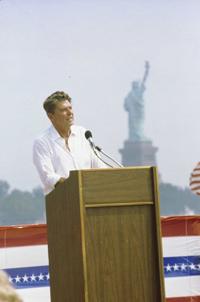
First off, I want to acknowledge that I have not been writing in this space. I have been focusing my efforts on my Substack (where I tend to do more political stuff) and on a couple of research projects. Come autumn I am planning on doing one of my patented "listen throughs" on Richard Thompson. In the meantime, I am re-reading a book that has me thinking again about what I call the "Reagan Dawn."
Tuesday, August 20, 2024
Tom Wolfe's The Right Stuff as "Reagan Dawn" Artifact
First off, I want to acknowledge that I have not been writing in this space. I have been focusing my efforts on my Substack (where I tend to do more political stuff) and on a couple of research projects. Come autumn I am planning on doing one of my patented "listen throughs" on Richard Thompson. In the meantime, I am re-reading a book that has me thinking again about what I call the "Reagan Dawn."
Sunday, August 7, 2022
Bob Dylan in the Reagan Dawn
Thursday, October 8, 2020
Thoughts on Reaganland
Rick Perlstein's fourth volume of his epic history of the conservative movement filled me with more anticipation than anything I've waited for since Return of the Jedi when I was seven. After a month of savoring it, I finished the book last night. As is usually the case when I complete a very long but very good book, I am feeling a sense of loss.
Reaganland lived up to my expectations, even if the end felt less grand than it deserved and less impactful than Perlstein is capable of. Still, he showed how sixteen years after Barry Goldwater went down in flames, one of his disciples would be elected president.
I knew a lot of the story already (I have been working on a project related to the 1970s for almost ten years now), but certain things brought new light to the narrative. Perstein's focus on what he calls the "boardroom Jacobins" illuminates how the popular push for consumer reform spurred by Ralph Nader ended in corporate regulatory capture. To understand Reagan's rise to power, he dug into his columns, radio spots, and speeches on the "mashed potato circuit." This compelling analysis showed how Reagan honed his abilities as a speaker and built a strong base well before running for president.
Although Perlstein is a leftist, he is more than willing to credit Reagan's rhetorical gifts. What kept coming through, more than I had thought already, was Reagan's ignorance and penchant for fabulism, as well as his ability as a speaker. As Perlstein shows, he often improved upon the work of his speechwriters. At the same time, Reagan came across as an exceptionally shallow person uninterested in knowing much of the world. He struck me as having George W Bush's lack of curiosity, but far more adroit at communicating. Reagan likewise had Trump's obsession with nationalism, but a flair that broadened his coalition instead of narrowed it.
Perlstein gets at something that I have been harping about for years: nationalism is an exceptionally strong force in American politics. Most Americans did not and still do not buy into supply side economics, no matter what the conservative movement types say. Reagan was able to tap into nationalist resentments post Vietnam, such as in his opposition to the Panama Canal treaty. The Iran Hostage Crisis also helped him in this regard. He sold national renewal, and many people were buying, including traditional Democrats. Barack Obama rose to power by projecting a positive kind of nationalism, and woe to Democrats and others on the left if that can't construct a narrative of the nation.
It wasn't just nationalist resentment driving Reagan, however. He tapped into racial resentment as well. Often Perlstein quietly comments on how much Reagan and other conservatives praised apartheid South Africa and white-ruled Rhodesia. Reagan's "welfare queen" stuff is well known, but Perlstein ties it into a general growing wave of white grievance at the time. The economic downturn of late 70s made it even less likely for the white middle class to support sharing more of the pie, and Reagan's "anti-government" rhetoric implied that "the government" was anything that helped Black people.
Despite this, Reagan managed to build a broader coalition. He said kind things about undocumented immigrants, and sought to bring people of color into the tent. His promise of national renewal drew in plenty of Democrats. Modern day Republicans could learn a thing or two from this approach.
There's a lot that modern Democrats can learn as well. Carter suffered because he became obsessed with austerity and inflation, allowing Reagan to play "Santa Claus" with tax cuts. He was right that the country needed to wean itself off of fossil fuels, but clothing that mission in language of limits and privations made it political unpalatable. His moralism and his technocracy were his undoing. Democrats trying to get ahead by making concessions to conservative austerity only destroy their chances.
Last but not least, I loved how Perlstein weaved in references to Joe Biden in his narrative. Even then he occupied the dead center of the Democratic Party. Time will tell if he is capable of moving in a more progressive direction.
Sunday, April 9, 2017
Old Dad's Records 8: Bette Davis Eyes
Episode number eight of my podcast has finally dropped! The theme for this one is "Reagan Dawn," a concept I have discussed on this blog before. Basically, this is the period from 1979 to 1981, where popular culture has a foot in the seventies, but is looking to the eighties. I discuss "Bette Davis Eyes," Genesis' Duke album, and Tim Curry's "I Do The Rock," a forgotten artifact of that time.
https://soundcloud.com/jason-tebbe/old-dads-records-episode-8-bette-davis-eyes
Tuesday, March 28, 2017
Billboard Top Ten March 28, 1981
10. Barbara Steisand and Barry Gibb, "What Kind Of Fool"
Speaking of vestiges of the 70s....Barry Gibb and his disco mane are still going strong as Reagan's America is dawning, although without his brothers. People forget that during the late 70s and early 80s Barry Gibb was a world conquering songwriter and producer. This song is soft rock at its most languid, more sugary than a Peep sandwich. By 1981 the survivors of the 60s wanted to mellow out, but without a trace of the stems and seeds of even milquetoast acts like Crosby, Stills, and Nash. The Me Decade of the the 70s began the inward retreat, the greed of the Reagan years would complete it.
9. Hall and Oates, "Kiss On My List"
Hall and Oates are very much the emblematic artists of the Reagan Dawn. Their music bridges the gap between the decades, maintaining a 70s groove but definitely locked into 80s pop modes. By 1984, when Reagan had his landslide, they went all in on the 80s with big gated snare drums and metronomic beats as on hits like "Out Of Touch." I much prefer them at this moment. This song is super catchy, and it also has one of Hall's most affecting vocal performances. It still has soul, which would be drained out of Top 40 music in the decade to come.
8. Grover Washington Jr. (with Bill Withers) "Just The Two Of Us"
Smooth jazz was a perfect genre of music for the Reagan Dawn. The tumult of the sixties over, this was a million miles away from Coltrane or Bitches Brew. Now I am a big fan of both Bill Withers and the saxophone, so this song isn't all bad. Withers gives it his always wonderfully warm and intimate vocal style, but the whole thing is just so light and lacking in any kind of immediacy. It's not jazz so much as relaxation music, ideally suited for shopping malls and dentists offices.
7. Dolly Parton, "9 To 5"
This is a fantastic song from a timely movie. Parton sings it with her country affectations, but the backing is decidedly pop, even soul, rather than country. She way she sings "pour myself a cup of ambition" is just perfect. The song and the film it comes from reflect the growing number of women in the workforce, as well as their marginalized position. Of course, in typical 80s fashion the focus is on individual struggle, rather than collective action. Before I get too "woke" I will say that unlike a lot of music on this countdown, "9 to 5" holds up really well.
6. Neil Diamond, "Hello Again"
In the early 1980s, the Jewish Elvis reached his apotheosis with The Jazz Singer. The soundtrack album was his biggest hit, but the movie is wretched as all hell, including Diamond in blackface in an entirely unneeded call back to the Al Jolson original. I like Neil Diamond's early stuff a great deal, but by this point he was just getting cheesy. On an early tune like "Solitary Man" you believe his lonesomeness, but not on this overwrought number. The Reagan Dawn period was the last gasp of relevance for a lot of artists from the 60s and 70s, Diamond included.
5. Don McLean, "Crying"
Speaking of last gasps, I had no clue that the author of "American Pie" scored another top ten hit, much less one a decade after his signature tune. It's a cover of the Roy Orbison song, perhaps his most impressively operatic. ( I LOVE Orbison, but that's a conversation from another time.) This is an okay cover I guess, but doesn't add anything or offer any kind of interesting take on the original. I've detected a lot of schmaltz on this countdown so far, a musical mode I have theorized coincides with periods of political reaction.
4. REO Speedwagon, "Keep On Loving You"
REO Speedwagon managed to craft the first truly great power ballad with this song, and it made them huge after a decade of woodshedding. They started in the early 70s doing Camaro rock that was a mix of Humble Pie and Deep Purple, but never had a hit album until they popped up their sound a bit in the late 70s with tunes like "Roll With The Changes" and "Time For Me To Fly." This song is a truly brilliant example of fire and ice, Kevin Cronin's lover's lament running smack into Gary Richrath's soaring, shredding guitar solo. (He was one of the most underrated guitarists of his generation.) This was a song that you could both slow dance and pump your fist to. It's a song that launched a thousand fumblings in the back seats of cars in high school parking lots across the nation. I don't think any other power ballad ever managed to top it.
3. Styx, "The Best Of Times"
Coincidentally, "Lady" by Styx could lay claim to being the first power ballad (though it was not nearly a hit on the scale of "Keep On Loving You.") "Best Of Times" comes from the Paradise Theater concept album, one that spoke to a sense of decline in the midst of the shock of deindustrialization. (Remember, Styx are working class guys from the South Side of Chicago.) Styx started off doing an amalgam of hard rock and prog, but this time Dennis DeYoung's songs were getting more theatrical and ballady. This isn't a great song in my book, but the chorus is a nice pop sugar rush and Tommy Shaw and James "JY" Young can play a mean guitar. At the same time, I'm skeptical of the nostalgia undergirding this song, as it fed into the "Let's Make America Great Again" slogan of the Reagan campaign.
2. John Lennon, "Woman"
Lennon was murdered a month after Reagan's election, which I think may have put the death of the 60s in even higher relief. Double Fantasy had a lot of solid songs on it, including "Watching The Wheels," which is one of the great commentaries on middle age to ever hit the charts. "Woman" isn't bad but is, dare I say, schmaltzy. I have the feeling that 1966 Lennon would've mocked this song if he'd heard it. But hey, I do like the sentiment in this sentimental song, and I even believe it.
1. Blondie, "Rapture"
With the number one song, we have the ultimate example on the countdown of the decades being bridged. The backing is disco funky, all mirror balls and mirrors with lines of cocaine on them. However, Debbie Harry attempts a "rap" in the middle of song. It sounds pretty lame by today's standards, but was one of the first examples of rapping on a big hit. When I hear this song I hear New York at the turn of the decade, a city full of grime and crime in the 70s, but also home to amazing music and art. It was about to be swept away by a wave of big money, AIDS, and gentrification. Fitting with the time, Debbie Harry's singing never sounded more decadent, a kind of Weimar moment in a sense. Blondie had eight top 40 hits in America, all in the period between 1979 and 1982, making them perhaps the quintessential Reagan Dawn band. Their arch knowingness, New York sophistication, and genre-bending fit the mood of growing cynicism and general exhaustion, but once the Reagan years' day-glo dreams of shining cities on the hill took shape, there was no place for a band like Blondie.