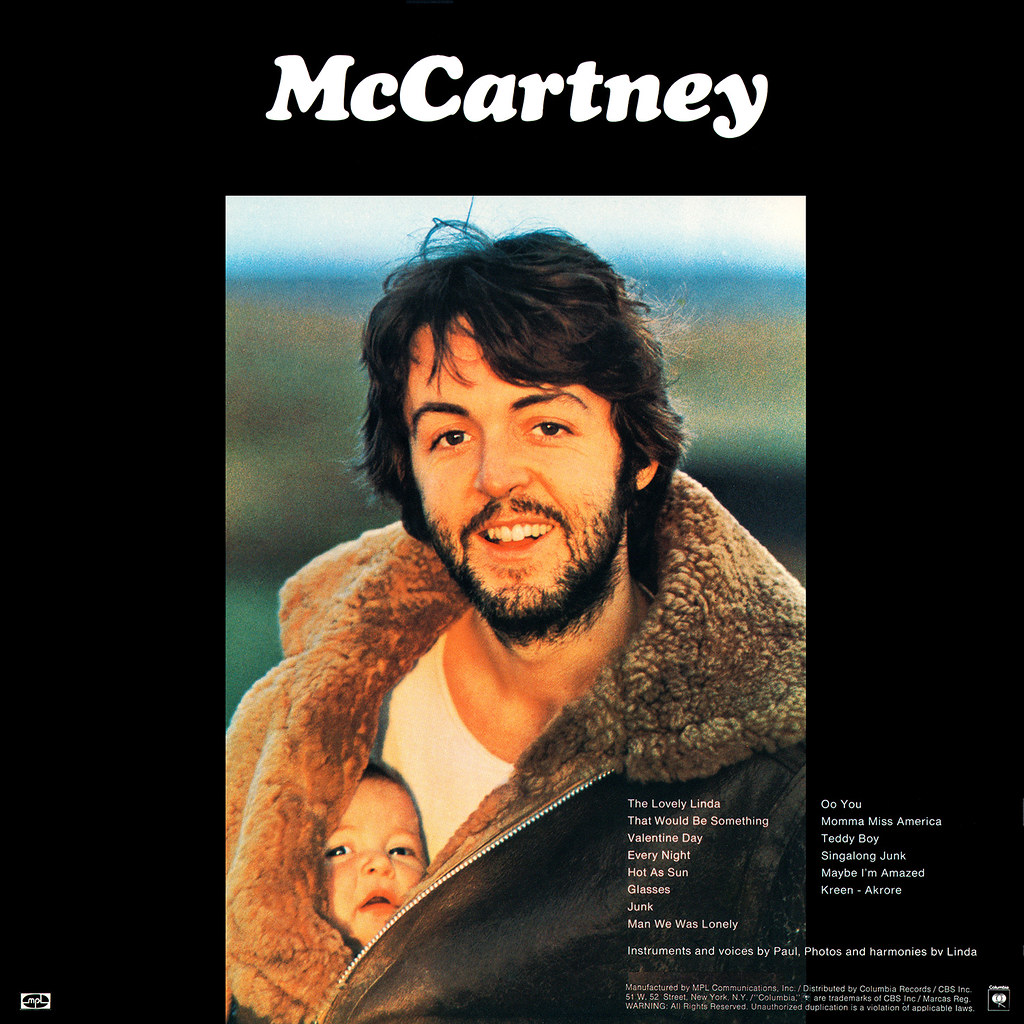
Around this time of year I invariably dig into the early solo albums from the Beatles. I am not sure where this comes from. Is it because I played All Things Must Pass to death in that dreadful post-9/11 autumn of 2001? Or is the feeling of tough transitions evoked by these albums as summer turns to winter and the sunny past fades to an uncertain future? Probably a bit of both.
Paul McCartney has churned out his fair share of dross and laughably cringey music in his solo career, but he will surprise you out of nowhere with that old magic. His last album, for example, is pretty damn great and the man is almost 80. Like that album his early albums were one man band affairs, proto-versions of indie bedroom rock.
A recent New Yorker profile revealed that Paul still really isn't over the breakup of the Beatles. It seems he took it the hardest at the time, retreating to a farm in Scotland and turning to drink. He was slowly able to get back on his feet due to his family, especially Linda. "Every Night" is the story of that recovery. He describes being lost, wanting to go out and "get out of my head," to drink and forget. Soon he discovers it's best to stay at home with his wife, who is the only person who can make him happy.
Like the other songs on his first solo album it is sparse and sounds a little dark. This is a million miles away from the layered sounds and baroque arrangements McCartney had recorded the year before for Abbey Road. The themes are also a million miles away from being at the epicenter of the 20th century's biggest pop cultural phenomenon.
It's easy to mock Paul's songs as treacly, as John Lennon himself often did. However, this song of marital devotion is rooted in the darkness of depression. It's love as a kind of grace, there to save you when everything seems to be going wrong. I don't begrudge the cheeseball Paul that followed because that cheesiness was enabled by his personal happiness. There are things in this life more important than being cool.
I had a great day today. My wife and I took our kids into the city. We had a wonderful meal in Koreatown then went to Broadway to see Wicked, the first Broadway show for my kids. We were masked the whole time but it was still a sublime slice of "normal" fun after a year and a half of COVID. These are the kinds of days one cherishes.
This week also brought yet another release of The Beatles' Let It Be, a taste of the coming Peter Jackson doc. I put it on tonight after everyone else went to bed and the first song, "Two Of Us," resonated like never before. When it came out people thought it was about John and Paul, but it really describes a fun day Paul and Linda had together. It's a song about the quiet joy one gets when you've finally found the person you want to share your life with. Today for me was certainly a "four of us" version of that.
Back in my teens and twenties John was my favorite Beatle. I admired his rebellion and wit, but later learned he could be an abusive drunk. My belief in the Lennon myth had been punctured, and so I gravitated to George. In my tumultuous thirties I admired George's deadpan taking the piss attitude. As I struggled to find a way post grad school and eventually left academia I identified with George's frustrations in the band. His first album, All Things Must Pass, is loaded with amazing songs and proof that his talents were not being fully recognized. Laboring in the halls of academe as tirelessly as I did with so little reward made this something I could understand so well.
Strangely enough, I have elevated Paul to favorite Beatle status in my 40s. This was mostly due to becoming a family man and learning about how much Paul prioritized his wife and children. Linda got horribly mocked for her amateur musicianship but I still find it touching that Paul always had her by his side on the road. This is a man who had his priorities straight. Family was always more important than rock star decadence. (It has also become clear to me that Paul was both the best musician and song writer in the band.)
"Two of Us" also reflected Paul's correct instincts that the Beatles needed to get back to basics in order to stay relevant. Dylan's Basement Tapes and the first Band album were signs that psychedelia had played itself out and there was a need to "get back." The song is stripped down, driven by acoustic guitar and Paul's always supple bass playing. In sound and attitude it's a million miles from the likes of "I am the Walrus." Lyrically it's just a plain ode to having a great fun day with the ones you love. We have so few such days in our short lives of toil that we have to cherish the sublime ones we do get on occasion.
It has the repeated assertion "we're on our way home." My God it feels so good to have a home in this world. The biggest reason I left academia was the physical distance it put between my wife and I. Being together and starting a family was what I chose and I will never regret that. Days like today are why.
Yesterday Paul McCartney came out with a quarantine album of his own, McCartney III. It's a successor to his earlier self-titled albums, which are one man band lo-fi experiments. There are many reasons why the stereotype of Paul as the poppy, conventional Beatle are wrong, but these albums are the strongest. I find the most recent one inspiring because McCartney is 78 and still trying new things and putting out good music.
As I have gotten older I have begun to appreciate Paul a lot more, not least because he's a family man with a grounded sense of priorities. And, unlike other Boomer rock stars, he hasn't become some reactionary troglodyte denouncing lockdowns. I wrote the following four years ago, and it still holds true today.
Dr Sillylovesongs: Or, How I Stopped Worrying and Learned to Love Paul McCartney
*****
Contrary to stereotype, Paul McCartney can make dark, introspective lo-fi music
Anyone who gets into the Beatles at a young age decides which Beatle is their favorite. This choice is not merely an aesthetic one, but also is meant to reflect the personality and values of the fan. In my teens, John was far and away my favorite. To me he was the rebel Beatle, the one who stood up for peace and was not afraid to speak his mind. I also valued his musical contributions more, seeing him as the true artist in the group. The Revolver album, my fave Beatles record, seemed to make the choice pretty clear. The John songs on that record are searing and full of all kinds of spiritual angst, perfect fodder for an adolescent. What teen hasn't just wanted to not get out of bed, as in "I'm Only Sleeping"? The real kicker, however, was "Tomorrow Never Knows," which still sounds amazing and different fifty years later. It was almost impossible to think that the band responsible for "Love Me Do" had created it. Paul had some fine songs on that record ("Yellow Submarine," "Good Day Sunshine," Got To Get You Into My Life," Eleanor Rigby" etc.) but they tended to be less rockish and more poppy.
As my twenties progressed, I started gravitating towards George, rather than John. Much of this had to do with my friends Debbie and Brian, who were big George fans. I had also loved his wry perspective in the Beatles Anthology interviews. The more I read about the Beatles, the more I liked George and felt less of a connection to John. While John finally seemed to be getting it sorted out at the end of his tragically short life, he could be a mean drunk who neglected his first child and treated his first wife, Cynthia, poorly. I empathized with his bouts of depression, but he began to strike me as a rather unpleasant person. On the positive side, I finally heard Harrison's All Things Must Pass, and I still believe that it's by far the best Beatles solo album.
Ringo was never a candidate for favorite Beatle for me, but I've always loved him. I think his drumming is very underrated, and it pisses me off when people put his musical ability down. (Harrison and Lennon could have had anyone drum on their first solo records, but they chose Ringo.) Paul, of course, was the one I had the most mixed feelings about. The more I learned about the breakup of the Beatles, the more I realized that those who blamed Yoko Ono were completely wrong. Of course, the four men growing up and developing their own separate personalities and interests was the root cause of the break up, which I now take to be a good thing, since it saved us from terrible reunion tours and the kind of mediocre music we've been getting from the Stones in the last thirty years. The Beatles break-up had its immediate origins in the death of manager Brian Epstein, which left a huge vacuum. Paul tried to step in and be the leader of the band, and to have his brother in law manage. I attributed this to Paul being a control freak, something I saw first hand in his unbearable antics in the studio in Let It Be. I'd also heard the story that he had forced the band to record eighty takes of the mediocre "Ob La Di Ob La Da," which is enough to make anyone quit any band, including the Beatles.
I also generally thought of Paul as "the cute one" who made, in his own words, "silly love songs." Could I really rate the guy responsible for "Honey Pie" above the man who wrote "Tomorrow Never Knows"? Plus, as a child of the 80s and 90s, I thought of Paul as a guy with a terrible mullet wearing fashion-victim vests touring the world playing his hits. This to me, in my punk rock phase, was the height of uncool.
In recent years, however, my attitude has been changing. Paul is most definitely a control freak, of course. In the Wingspan documentary his own daughter seems a bit exasperated at all of the lineup changes in Wings brought on by that tendency. At the same time, aren't a lot of great artists control freaks? Paul isn't someone I'd want to work with, but his exacting standards are probably responsible for the timeless nature of his best songs. I also came to realize that while his attempt to take a controlling interest in the Beatles after Epstein's death backfired, it might have been the right way to go. They ended up hiring the infamous Allen Klein over Paul's objections, who, as he often did with the artists he represented, ripped them off. At that point in the late 60s John, who had been the leader of the group early on, was beginning to check out and act more erratically. Somebody had to step in and do something. Paul did it maladroitly, but he intentions were in the right place.
Paul's iron will to keep things together is also what gave us Abbey Road, which next to Revolver is my fave Beatles record. Even though the band was falling apart, they managed to end on an extremely high note. Paul was chiefly responsible for the second side's pastiche of song fragments. I think that medley might be my favorite thing that the Beatles ever did. (George also has some fantastic songs on that record. John's are good, but not at the same level.)
Over the years I also came to realize that while John got the credit for being experimental and George for bringing in Indian music, Paul was not just the guy who wrote silly love songs. Imagine my surprise when I learned that "Helter Skelter" was a Paul song, since that totally went against narrative. While may have penned some schmaltzy numbers, he had a well-documented interest in experimental music, as well as decidedly non-schmaltzy sleaze like "Why Don't We Do It In The Road." On top of all of that, he was definitely the best musician in the Beatles. His melodic bass lines are really miles ahead of what most rock bassists were doing at the time. What really put me over the top musically with Paul were his first two solo albums, which I didn't hear until a few years ago, mostly due to my old prejudices. He recorded the first one completely by himself, and the second with only some background vocals from Linda. They are idiosyncratic albums with a great amount of looseness to them. Hearing them now, they sound like the earliest antecedents of lo-fi indie rock. They also happen to be really good, and daring in their own way. The fan reaction was not greatly positive, and McCartney would find great solo success after creating Wings and going for a big 70s pop-rock sound.
Beyond the music, I really started empathizing with Paul after reading the book Man on the Run, about his career in the 70s. He fell into a deep depression after the breakup of the Beatles (which he had worked hard to avoid), complete with overconsumption of alcohol. His relationship with Linda and the loose experimentation of those early records are what helped him cope and recover. (I myself could certainly understand the difficulties that come with having to make a major career change in your thirties against your will.) I always get irritated when people mock Linda and her presence in Wings. Paul brought her and their children on tour as a way of keeping the family together, rather than indulging in the rock and roll party lifestyle. Learning this now that I am a parent made me respect him even more. (Not to be petty, but compare this to John's treatment of Julian.)
I am not sure who my favorite Beatle is anymore, probably because I'm no longer young enough for that to be meaningful. I can say that time and wisdom have made me appreciate Paul McCartney much more than before. And hey, if some people want to fill the world with silly love songs, what's wrong with that? I'd like to know.
Beatlemania was hitting America 55 years ago this month. It's been on my brain because my daughters are suddenly digging the Beatles, and I have been revisiting their early stuff for the first time in awhile. I thought it would be interesting to listen to that music in the context of what it emerged into. There are competing narratives about this. One is that pop music was super lame, then the Beatles came in and added a lot of excitement and pushed things in a totally new direction. The other, more recent revisionist take is that Beatlemania killed older ways of making music that were more heterodox than what came after. I am not sure where I stand on this, other than to say that I really love early 60s R&B (so did the Beatles), to the point where I don't buy the narrative about the Beatles filling a vacuum. Anyway, let's get on with the countdown!
This song is the kind of thing people think of when they consider the early 60s to be a musical wasteland. This is basically bargain-basement Lesley Gore, lacking her pathos with a far too cheery arrangement. I do like the weird organ sound, at least.
This is a fairly typical early 60s doo-wop style song, but it's got that weird flute behind it, which gives it a little something extra. There's also a member of the group jumping in with a deep bass voice on the chorus, which is something I loved about those records. The thing is, by the standards of the time I think this one is kind of weak and lacking in the punch of other doo-wop records. It has a kind of vague "beach" feel to it, which was certainly all the rage in those pre-Beatles years.
Speaking of beach music, here's a classic example of the genre. According to my dad this was one of the few 45s he and his brothers had growing up. It speaks of the glorification of California in 60s music and 60s culture more generally. The pull of that kind of music, which I heard a lot at home and on oldies radio as a kid, made my first visit to the Golden State truly special. The song itself has a great little organ line, but the vocals are tepid. This song would be properly covered by The Ramones, who gave it needed bite.
Man, this is just a straight-up ripoff of the Beach Boys. It's also an example of the car song, directly adjacent to surf music. When future societies look back on our catastrophic dependence on fossil fuels they will make songs like this the subjects of their cultural histories.
Like the Tams, here's another local soul music artist. The beat has a cool mambo flavor and the "um um um" chorus is pretty catchy. As much as I like music like this, it sounds pretty dry compared to what Motown was about to unleash.
Now this right here is a million miles from stuff like "It's My Party And I Can Cry If I Want To." An early pop music feminist message that Gore delivers with utter confidence. The strings and her voice are a perfect trebly combo for coming out of an AM radio on an old car. Just compare this to the Diane Renay song at number 10 for an example of how disposable teen music at the time could actually be interesting.
Again, near the top of the countdown we are in serious territory, and this time it's social class, not gender. This is a song sung by working class Jersey Italian guys aware that no matter what they say, love is not blind. It's particularly sad, since the singer is telling Dawn to leave him because their infatuation can't break down social barriers. It gets at something that has long saddened me, namely that growing up working class means internalizing the idea that you do not deserve to have what you want and that you need to learn to resign yourself to it. It's a survival strategy, obviously, but it eats at the soul. Maybe Dawn wanted to cross the tracks! The singer can't let her because he doesn't think he's worth it.
There is no song that better embodies Beatlemania than this one, which is the first Beatles song I can remember hearing. Is it cheesy? Yes. Is the "yeah yeah yeah" too simple? Yes. Is it pure pop sugar rush? You bet. And listening to the other songs on the countdown, I agree a little with the old narrative about the Beatles reviving a moribund popular music world. This song MOVES and PUSHES like the others on the countdown don't. Ringo's drums never sounded more powerful, the harmonies more chiming. Resistance is futile.
This is the song that broke the Beatles in America, and like "She Loves You" it has a kind of giddy abandon to it. It puts in song form that indescribable rush of young love, that feeling that some folks spend the rest of their life chasing. As a kid I thought they were saying "I get high" instead of "I can't hide," and so evidently too did Bob Dylan. It works better musically, because the song is describing that love high when you hold a crush's hand for the first time. Listening to this you can hear the harmonies that I think really put the Beatles over the top. When a group has great harmonies it is a kind of magic, and the Beatles paired those harmonies with some all-time melodies. The secret to their success is pretty simple.
After a long hiatus brought on by an insane workload, illness, travel and a death in the family the Old Dad's Records Podcast is back! My inspiration came from a recent episode of the podcast The Projection Booth on The Rutles, the wonderful late 70s spoof on the Beatles. I'd already had Beatles on the brain due to talk around Peter Jackson restoring the old Let It Be documentary. On the pod I start with "Pleasant Valley Sunday" by the Monkees, the original Beatles imitators. After that I pull a vinyl copy of The Rutles soundtrack off my stack of old records. I end with a discussion of the new Guided By Voices album, showing that band has managed to stay interesting after all these years.
I've been kinda shocked at all the media hype over the 50th anniversary of the of the Beatles' Sgt Pepper album. I first remember this nostalgia being hyped all the way back in 1987, when I was first getting into the Beatles. That was during a time of intense 1960s nostalgia. We are now three decades removed from that moment, meaning we are now much further away from 1987 than 1987 was from 1967. (I feel so old writing that.)
This has inspired some "Sgt Pepper isn't that good takes" where the writers think they're original or something. In the last thirty years the critical feeling about that album has tended to put it below other Beatles output of the era, so downgrading it is following rather than bucking the critical consensus.
For that reason I think the hype has little to do with the record itself, and more to do with it as a cultural moment when it was released, a sign of the counterculture breaking into the broader mainstream and defining generational values. It was supposedly the soundtrack to "The Summer of Love," a moment I've had to take other people's words for. (My people were on the farm, in 'Nam, or in the seminary in the summer of 1967.) That's why the Boomers -or at least those who are editors at publications- are still fawning over it.
And hey, I get it. I listened to "Smells Like Teen Spirit" for the first time in years recently and felt a chill go down my spine. For a Gen Xer like me it is not a song, it is a powerful memory. I would just like to say that my generation has not been so egregious in inflicting our nostalgia on those younger than us.
And when I get down to it, part of the reason that I resent Boomer nostalgia is that it had such a powerful effect on my own outlook at a formative moment in my life. I kept thinking that nothing in the present could ever be as good as things were in the 1960s. And honestly, hearing that message amidst the vapid cultural and political black hole that was the later Reagan years, it seemed pretty convincing. While I've mostly shaken it off, the notion that I am living in a less interesting time than my forbears will still pop in my head.
My millennial brothers and sisters appear to be much more immune to the disease of Boomer nostalgia. That at least gives me hope.
Postscript: Sgt Pepper is alright, but if you want a truly great symphonic sixties album, go with Pet Sounds.
This week brought the sad news of the passing of Sir George Martin, the man who signed the Beatles to their first record contract and produced all but one of their albums. He always seemed such a contrast to the band, especially in their psychedelic period when their long locks, facial hair, and love beads clashed with his suit and tie wardrobe and Brylcreemed hair. Despite those differences, Martin continued to make his mark on the Beatles' music.
I am of the adamant belief that creativity is an inherently collaborative thing. We have become overly enamored with the cult of the genius, forgetting that even the greatest geniuses had help along the way. George Martin's brilliance was that he was able to take the visions of Lennon and McCartney and help make them real. This was no small feat at a time when recording technology was pretty primitive by modern standards, and the studios at Abbey Road could only record on four tracks. In 1966-1967, the Beatles really began to broaden their horizons and revolutionize their approach, and maybe no one song is more emblematic of that change than "Strawberry Fields Forever."
It famously underwent drastic changes in its history, going from a quiet folkie song to the final product, which is heavy, mysterious, and off-putting as it is beautiful. It sounds absolutely nothing like the Beatles had written before, and certainly like nothing else on the radio in February of 1967. I remember hearing it for the first time as a child, and its difference from the likes of "Love Me Do" shocked me. While the song is ostensibly a longing for childhood, it seemed to me an uncanny sonic evocation of the dream world.
Perhaps its mysteriousness had to do with its genesis. The final song is actually two different takes spliced together, even though they were recorded in different keys. The slight change in speed (necessary to change the pitch) adds greatly to its unreal feeling. Without Martin's efforts, this song would not exist in its current form. May he rest in peace.
Yesterday my buddy and erstwhile friend of the blog Brian I. posed an interesting question on his Facebook page, inspired by a conversation on another feed. If there was a theoretical extra Beatles album made up of songs recorded by the members solo in 1970-1971, what would the track listing be? It's a fascinating question, not least because those years saw a pretty impressive amount of material from the former Fab Four, even including Ringo's hit "It Don't Come Easy." (Starr also played drums on George and John's records, and his distinctive sound is all over them.)
Of all the Beatles, George Harrison put out the best album with All Things Must Pass, a triple disc wonder full of great songs that Lennon and McCartney had not allowed on the later Beatles records. As with Lennon and McCartney, he also used his first solo album to comment on the rather acrimonious breakup of the band. (If you're interested and don't mind getting depressed and having your illusions shattered, check out Peter Doggett's You Never Give Me Your Money.) Harrison's frustrations with being put in the corner were public by this point, made famous by a testy studio exchange with McCartney captured on the dreary Let It Be documentary.
Lennon was pretty savage about all of this on "How Do You Sleep," and McCartney was a bit more veiled, but no less vicious on "Dear Boy" and "Smile Away." The bitterness in these songs drags them down, Harrison used his ill will to craft a song that sounds joyous: "Wah-Wah." It starts with an amazing, swirling psychedelic guitar figure before percussive piano and one of Ringo's best "funny fills" slams in and a mesmerizing wall of sound bursts forth. It rushes along irresistibly with some absolutely searing guitar leads, making it one of my favorite songs for driving on the highway. You'd never guess it's about getting a headache from dealing with Paul McCartney.
I think that makes sense, since Harrison used his first album as a kind of declaration of artistic independence, and the sheer awesomeness (in both senses of the word) of the song itself sends a message: "listen to this, and realize I don't need you anymore." After all, Harrison declares "I don't need your wah-wah," which also makes this song a good one to blast while you're quitting a crummy job of your own.
My memories and music consumption are equally sensitive to the change in seasons. This Sunday, walking with my girls in the park on a beautiful, mild September day, I recalled high school marching band competitions, 9/11, and seeing my first Nebraska football game at Memorial Stadium. There are certain albums that also have seasonal associations for me, and among the most cherished is George Harrison's magnum opus, All Things Must Pass. Fall is my favorite season by far, and a time that never fails to lift my spirits even as the leaves fall and the ground hardens. All Things Must Pass's intense spirituality compliments my feelings during this time of year pretty well.
It is by far the best of all the Beatles solo records, a statement of artistic purpose and unloading of suppressed creativity that is absolutely stunning in its breadth. While Lennon and McCartney were the principal songwriters in the Beatles, George really developed his chops over time, but was not allowed to get many of his songs on the Fab Four's records. Considering that All Things Must Pass has at least twice as many great songs as the first solo records by Lennon and McCartney combined, I think George was in the right. The fact that it's a triple album seems to send a message to his peers about how much he had been forced to hold back.
Harrison throws down the gauntlet on disc one, side one, which if released by itself would have been a major accomplishment. He starts with the gorgeous "I'd Have You Anytime," which dives into "My Sweet Lord," a fervent prayer masquerading as a pop song. Like many of the songs on this record, Harrison is not singing to a lover or his audience, but to God in devotional terms as beautiful as any piece composed by Bach. On the next driving number, "Wah-Wah," the spiritual takes a back-seat as Harrison sings directly about the frustrations he had with the Beatles over a mighty wall of sound courtesy of famed producer Phil Spector. (Here's an infamous clip of George snipping at Paul during the making of Let It Be to illustrate his irritation.) He ends the side with "Isn't It a Pity," the call for peace and understanding that Lennon wishes he had written. ("Imagine" is good but overrated, and glosses over the difficult questions George asks in this song.)
After all that, side two of disc one opens with "What Is Life," a song I love so much that my wife and I had it play as our arrival music at our wedding reception, and one that we still think of as "our song." Perhaps he's singing to God, perhaps he's singing to Patti Harrison, either way it's a sublime expression of love. After this string of show stoppers, the rest of the album is more varied but still as strong. There's lighter stuff like "Apple Scruffs," lovingly dedicated to the Beatles fans who would wait for glimpses of them outside of the Apple offices, as well as "Beware of Darkness," a deeply spiritual, heavy song that I have long used as musical therapy in my own darker moments. On lesser known songs like this, the too pretty for words "Behind That Locked Door," the moody "Ballad of Sir Frankie Crisp (Let it Roll)" and the positively joyous "Awaiting on You All," Harrison subtly obliterates the notion that the Beatles' greatness was down to McCartney and Lennon alone.
George never matched this album, but he never had to. His former bandmates may have had many more hit records as solo artists, but none of them painted a masterpiece, and George did. Isn't that the real goal of a true artist anyway?