Sunday, June 28, 2015

Track of the Week: Elvis Presley "Promised Land"


I am on the road right now, my family and I taking an extended road trip out to my home state of Nebraska, with several stops in between to visit friends and family and to see new things.  There is little I love more than a road trip, and I have a few songs that always find their way onto the playlists I make for my trips.

Elvis Presley's cover of Chuck Berry's "Promised Land" is one of them.  It's a song written while Berry was in prison on a Mann Act charge, describing a journey from Norfolk, Virginia, to Los Angeles, with stops in Birmingham, New Orleans, and Houston.  Berry is one of the great American exponents of the open road, and this song is especially poignant considering his yearning for the freedom of travel while behind bars.  Berry's version very much fits with his usual tried and true formula and is one of the better executed examples.

Elvis, of course, never wrote his own songs, but was masterful at interpreting other people's songs, with "Promised Land" no exception.  The song came out in 1974, and the album of the same title in 1975, perhaps the last really good one that Presley made before his death in 1977.  Elvis' version is updated for the 1970s with a funky feel and wah-wah guitar effects.  The studio musicians, recording at the great Stax studios really give it their all as they drive it on home.  Elvis also bends the words in interesting ways, I can never get over his clipped drawl when pronouncing "Los Angeles."  In Presley's version, the "poor boy" of the song is calling home to Virginia with some swagger.

I used to think of Elvis in his white jumpsuit years as a complete joke, turns out I was wrong.  The man sounds like he's having a blast with good material and crack musicians, it's a shame that he spent so many prime years of his career churning out godawful film soundtracks full of tunes written by low rent hacks.  Even in the mid-70s, when his powers had dimmed, he was still capable of something like this.  I'll be sure to put it on tomorrow as we drive over the Appalachians.

Friday, June 26, 2015

So Much Depends On a Green Ice Chest


The picture above is of a retro green Coleman ice chest (this is no mere cooler, folks) that my wife and I purchased right after our wedding.  I bought it in emulation of the one my family had going back to my earliest memories, a wonder of high-quality engineering that lasted my parents from the early 1970s into the 21st century.  When my father would take it out of the garage and hose it clean in the driveway I knew we were about to take a road trip.

Those road trips and vacations were some of the biggest highlights of my childhood.  My father especially cherished them as an escape from work and a chance to enjoy the open road and great outdoors, the two places he'd most like to be.  No matter how tight money was or how many balls my dad had to juggle at work, my parents made sure that each summer we took a bona fide vacation.  Since we lived in the middle of rural Nebraska and were heading for the mountains or desert anyways, we always drove and never flew.

My parents could be called cheap, but they would prefer "thrifty."  For example, we almost never ate out for lunch on vacations, but went to a park, rest area, or picnic area and ate lunch out of the big green ice chest.  This usually meant one slice of Oscar Meyer bologna with store brand mayo on supermarket bread so thin and light you could ball of a whole loaf in your fist.  Sometimes even the evening meal would be improvised in this fashion.  One of my earliest memories is of being in a motel room in Colorado Springs with my dad using a camp stove to warm up a can of pork and beans.  (Sounds like something out of a Tom Waits song, doesn't it?)

Now that I am older I realize that cutting corners like this allowed my family to afford to go to some beautiful destinations, from the mountains of Colorado to the wide visas of the Grand Canyon to the breezy shores of Lake Winnipeg.  I'm a little freer in my spending, so we won't be staying at dingy motels with shag carpeting full of toast crumbs from 1974, nor will I bar my children from drinking anything but tap water when we eat out.  When we do eat sandwiches they'll be with bread from an Italian bakery and top shelf lunch meat.  They'll still come out of a big green ice chest, though.

Wednesday, June 24, 2015

The Need For A Civil War Memory Offensive

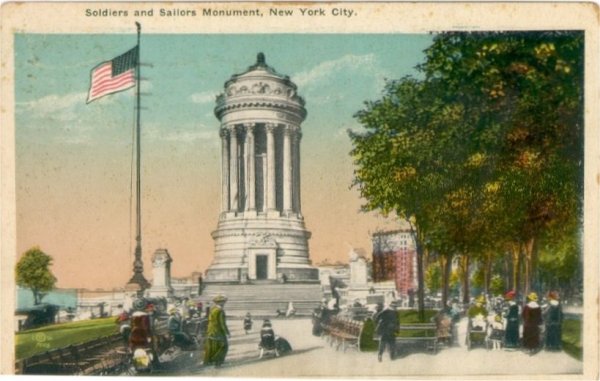
New York's Soldiers and Sailors Monument back when the living memory of the Civil War could visit it

If you travel to the Upper West Side of Manhattan and stroll along the paths in Riverside Park, you might come across two massive monuments to the Civil War: the Soldiers and Sailors Monument, and Grant's Tomb.  The former is a towering structure honoring the Union troops who served in the war, a Beaux Arts beauty in its time that now looks awful today with cracks, weeds, and poorly covered-up graffiti.  Grant's Tomb has been cleaned up, but this gorgeous monument (built with the help of fund raising by the grateful African American community in New York City) is barely kept open by the National Park Service.  If you travel to the South, you'll notice that similar monuments to the Confederacy are kept in gleaming shape, and even battlefields managed by the National Park Service will have museums that include varieties of reunionist and even Lost Cause ideology.  (Surprisingly enough, the museum in Vicksburg is not like this at all.)

There has been a lot of needed discussion in the aftermath of the Charleston terror attack about the Confederate battle flag.  I think that discussion needs to be converted into a Civil War memory offensive.  Ignorant people have been free to believe that the flag is a benign symbol of "southern pride" because those who sympathize with the Confederacy have had an inordinate influence on public memory of the Civil War.  Just witness Shelby Foote's heavy presence in the Ken Burns Civil War documentary, where he gave great praise to slave trader, war criminal, and Klan founder Nathan Bedford Forrest.  It has been so from the beginning, where 1915's infamous A Birth of a Nation presented a racist interpretation of the war and Reconstruction, and 1939's Gone with the Wind valorized slave-owners.

Those who rightfully sympathize with the Union cause (or more appropriately, the American cause) need to amplify their voices.  Many historians of the Civil War (rather than reenactor hobbyists) have been engaging with the public, more need to follow their example.  Teachers need to teach not just the battles, but the larger political and social aspects of the Civil War, and ground its causes without any doubt in slavery.  (Historians should assist in making materials that do this that teachers can use.)  Modern day Unionists need to do more to honor their own monuments, memorials, and heroes.  (I'm a fan of Ta-Nehisi Coates for many reasons, not least of which that he uses a photo of Grant as his Twitter avatar.)  Monuments like the Soldiers and Sailors Monument need to be repaired and used ceremonially.  (New York should also more formally memorialize the Draft Riots, but that's a whole other issue.)  In general, Reconstruction needs to be made much more legible to the public.  This crucial time in American history has been largely forgotten, and the few public narratives that exist still parrot a paler version of Birth of a Nation.

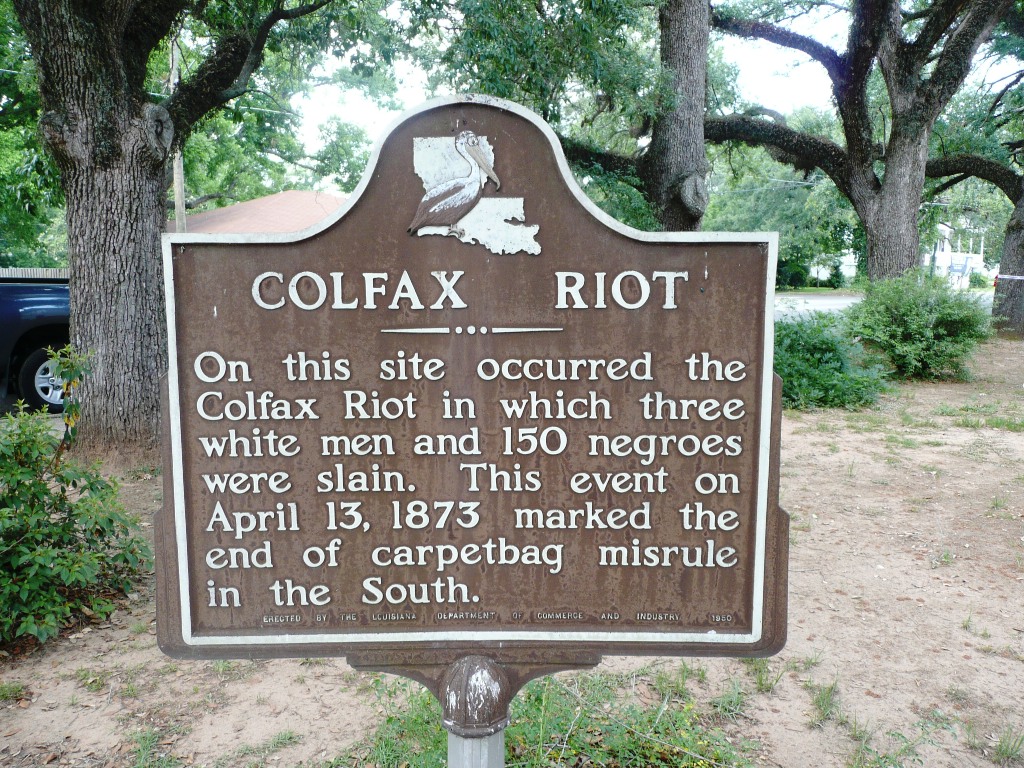
More importantly, many existing memorial sites related to Reconstruction and the Civil War need to be changed, and contemporary Unionists ought to fight for those changes.  For example, a friend of mine recently visited the site of the Colfax Massacre, a horrific act of violence perpetrated in 1873 by white supremacists against former slaves to destroy their political power.  This is what the state of Louisiana's official plaque looks like:


That's right, one of the worst incidents of lawless violence in this country's history is presented as a victory against tyranny.  It is absolutely disgusting that an event like Colfax is honored in this way.  This marker is only one of many valorizing white supremacy and its accompanying violence.  Yes, take down that traitorous, blood-soaked flag and burn it.  But also rip the historical narratives rooting that flag right out of the damn ground.

Monday, June 22, 2015

Has The GOP's Deal With The Devil Come Due?

Back when the Tea Party winds stared blowing back in the early parts of this decade, I wondered whether the Republican Party had signed a devil's bargain.  It was encouraging the support of fringe elements that had long been outside of the mainstream of American politics, all in order to benefit politically from the rising feelings of resentment among white people.

One such example is the Republican eagerness to put the grievances of the "open carry" movement into law, as just recently happened in Texas.  This is a movement that worships guns and views the Second Amendment as a protection against tyranny, as if the only thing standing between the status quo and a dictatorship is a bunch of dudes carrying AR-15's into the local Chipotle.  Voters who vote on gun issues tend to be highly motivated, so the Republicans are willing to break bread with armed vigilantes if it means electoral success.

The same goes for white nationalism, although the connections have been blurred more.  The continued Republican support for the official use of the Confederate flag (which was only shaken after the terror attack in Charleston), is a case in point.  The same goes for the lip service paid by Rick Perry and others to Texas nationalism, which in my experience is an idea limited almost completely to white Texans.  The anti-immigrant rhetoric and "show me your papers" laws in states like Arizona are based in a conception of the United States as a white man's country.  Sometimes the links between the "secure our borders" rhetoric and the ugly truth beneath those words gets exposed.  For example, it came out today that that Earl Holt III, the leader of Council of Conservative Citizens, has given campaign donations to multiple Republican presidential candidates.  In case you don't know, this organization was cited directly by terrorist Dylann Roof in his manifesto as instrumental in affecting his worldview.

Now this is not necessarily a case of Republicans actively seeking out the support of extremists.  Rather, they have been more subtle, in that they will take their money and promote policy positions that make those extremists happy.  Anti-immigrant legislation, voter suppression of people of color, and slashing programs that help Latinos and African Americans in poverty might be called "securing our borders, combating voter fraud, and welfare reform" officially, but everyone with eyes who can see understands that they are all policies that further white supremacy.  (Hence their popularity in large sectors of white America.)  The horrors of the Charleston killing, as well as the almost comical responses by many conservatives that downplayed any discussion of race, have highlighted just how beholden the Republican Party is to extremist elements.  In the wake of a racist terror shooting it must figure out how to spin its long-standing policies of no gun control and defending the flying of the Confederate flag.  It was easy to court extremist elements when no one was watching, now it will be much harder to hide.  Time will tell if this will actually result in any electoral change.

Saturday, June 20, 2015

Track of the Week: Randy Newman "Short People"


Randy Newman seems to have a particular genius for writing two types of songs: warm catchy ballads for Pixar films and wickedly satirical songs sung from the point of view of horrible people.  The awful opinions expressed in order to be mocked are still bathed in the same exquisite melodies as in the Pixar tunes, making it hard for the casual listener to get the joke sometimes.  And occasionally the melody is so catchy, as with "Short People," that Newman could score a big hit with it.

The narrator of the song is obviously deranged in his hate of short people, mumbling about their "dirty little hands and dirty little minds."  This is similar to Newman's earlier "Political Science," where the narrator fantasizes about nuking the world and turning it into "one big American town" in a biting parody of American nationalism.  The earlier song was just as catchy as "Short People," but the lyrics were perhaps easier to decipher, which kept it from getting played on the radio.

I wonder if anyone got Newman's point when he released "Short People" in 1977.  While Newman likes to skewer bigots in this fashion, he also presents them as everyday people, wandering around the same world as you and I.  I've been thinking a lot about that in the aftermath of the Charleston shooting, whose perpetrator has been revealed to be the kind of deranged bigot that Newman often sang about.  According to news reports, others knew about Roof's violent hatred and even his plans to act on it, and did nothing.  That tells me that they were either sympathetic to his general viewpoint, or that such feelings were so common as to not cause alarm.

As far as the latter goes, I have heard, when in "white spaces" some horrifically, violently hateful things over the years, and I am not talking about your garden variety prejudice.  I am talking about eliminationist sentiments, like the kid in high school who wanted to nuke Mexico, the bartender who wanted to "send them all back to Africa," and so many others.  The events in Charleston are proof that these hateful souls are not a joke, they have the potential to do truly terrible things.  While it can be satisfying to disarm bigots by laughing at them, we should never stop taking them seriously.

Thursday, June 18, 2015

We STILL Need To Talk About White Male Pathology

I woke up this morning to the horrific news of the terrorist shooting in Charleston.  Following the story today, I have seen yet again how the killer/terrorist is presented as an "isolated case" detached from larger society.  This is the way it tends to be with white men when they commit these acts.  The folks at Fox News are even spinning this as some kind of anti-Christian thing, despite the fact that the terrorist liked to sport apartheid symbols and justified his attack to one of the victims with noxious racism.  Many white people in this country are so afraid to admit the persistence of racism even when it has manifested itself in the most violent way possible.  If this is not an act of racist terrorism, what on earth is?

In the aftermath of the horror of the Newtown shooting I wrote about how America needed to confront the pathologies of white masculinity, and returned to the topic multiple times afterward.  A Slate article today provides a list of the many, many terrorist acts committed by racist white men in the last twenty years, a truly scary litany of murder and hate that most white people refuse to see as anything more than a set of unconnected "isolated incidents" with "lone wolf" perpetrators.  They will also likely blame "mental illness." as if someone cannot be both mentally disturbed and a terrorist.  Furthermore, they will not wonder why mentally ill white men often respond to their illness by murdering other people (often people of color) in large numbers, when other types of people don't.

For an illustration, take a foreign example, that of the xenophobic Norwegian terrorist Anders Breivik (the president exaggerated today a little about the uniquely American nature of mass shootings.)  He murdered 77 people in a highly planned bombing and shooting spree all on political grounds as an enemy of the Left.  (He targeted a social democratic youth camp for reasons similar to Roof's targeting of a prominent and politically powerful African American church.)  Beyond his politics, Breivik fit the stereotype of the maladjusted, aggrieved loner.  The American media does not have a problem characterizing Breivik as a politically motivated actor.  Why then the reluctance to do so with Dylann Roof?  The answer is pretty simple, namely that it would raise all kinds of uncomfortable questions.

The fact that Roof presented himself online wearing patches of the apartheid regime flags of Rhodesia and South Africa is telling.  He was obviously "radicalized" at some point, since knowledge of those regimes' symbols isn't common among most American 21 year olds.  He didn't commit his act in just any predominately African American church, either.  He chose the church founded by black freedom fighter Denmark Vesey and pastored by Clementa Pinckney, an elected official who had called for mandatory police body cameras.  It is the first AME church founded in the south, and due to its history is a national landmark, official or not.  I can't imagine that a person who was aware of Rhodesia's history would not have been aware of the significance of this particular church.

Will the government start entrapping fellow white supremacists to pre-emptively get them in prison, just as they have with followers of radical Islam?  Will the government be committing psy-ops on white supremacist web pages and forums, as they do with Islamist ones?  Don't hold your breath.  The hatred Roof expressed to justify his shooting is very extreme, but sadly it is not rare.  Go to practically any traditional white barber shop in large swaths of this country for a day and you will likely hear a variation of it.  God knows I have.  It is an everyday hatred that is not taken seriously by many whites, just listen to Roof's roommate.  But don't worry folks, it's just an isolated incident by a quiet loner.  Move along, move along, and don't forget to keep buying stuff.

****

Here's what I wrote in 2012, most of it still sadly relevant:

Whenever a horrible event like the massacre in Newtown takes place, we try to find ways to explain it. This is often a futile exercise, because many people merely superimpose their larger beefs with society onto these events, rather than examining them with any real analytical and factual framework.  Hence, we have people like Louie Gohmert saying the teacher should have had her own assault weapon, or Mike Huckabee lamenting the loss of God in public schools.  We should be very careful of monocausal explanations that oversimplify things.  There are a lot of factors at play in the Newtown massacre, from the perpetrator's mental state to the availability of semi-automatic weapons.  However, I would like to echo others out there in the blogosphere who want to examine the role of white masculinity in all of this.
Of course, there have been other mass shootings in other countries, and the worst such shooting in this country was perpetrated by a Korean student.  That being said, this country has witnessed the lion's share of mass shootings, and disproportionate seventy percent of the shooters have been white men.  I hardly think the connection is coincidental.  Ever since the Aurora tragedy this summer, I have been contemplating this issue, trying to connect the dots to explain the connection between white masculinity and mass shootings.  I finally feel like I have some speculations worth sharing.
Masculinity more generally in this society is defined to a great extent by violence and control, and violence used as a means of maintaining control.  I have long been amazed and appalled by how many public figures in this country who have abused their wives and girlfriends have been allowed to stay on the pedestal.  That sad fact is to me evidence that masculine control through violence is implicitly accepted as legitimate in America.  Action movies predominate at the box office, and the orchestrated violence of the NFL is America's most popular sport.
Furthermore, white men in this country are taught that they are the masters of their own destiny, and are usually not confronted with the same limitations of possibility that men of color are.  When white men fail, an experience our society gives them few resources to confront,  they often lash out at those they hold responsible, or turn inward and commit suicide.  Most mass shooters seem to want to do both, as Adam Lanza did.
The completely atomized nature of white middle class society contributes as well.  Shooters are usually described as "loners," men disconnected from others and hence unable to empathize with the human beings they kill.  We are an increasingly individualized society, which means that those mentally unstable, frustrated white men with access to deadly weapons are so rarely stopped before they kill.  They sit on the margins, alone, without any kind of cohesive social structure to bring them in.  Adam Lanza had stopped going to school and interacted with few outside his home, Eric Harris was able to plan his rampage in a home where his parents took evidently little interest in his doings, James Holmes had been expelled from his university and lived alone in a city far from home.  While atomization is occurring in all groups of American society today, in middle class, white culture it has probably been the most egregious and damaging.
We have a situation where white men are socialized to be the masters of their fate and able to use violence to maintain control over their lives.  These same men lack the tools to handle adversity, and are often left to their individual resources, even if they are mentally disturbed.  When some of the most mentally unstable of these men experience soul-shattering setbacks and are given access to semi-automatic weapons, we can only expect the worst.  We need to educate young men (especially white men) to not see violence as the answer to their problems, or to phantasize violent solutions.  We need to equip them with the tools to withstand failure, and to keep the more troubled of their number from slipping through the cracks.  Last, we need to talk seriously and openly about the nature of American white masculinity, and stop pretending that it isn't problematic.

Tuesday, June 16, 2015

2016 Will Be A Turnout War (And What That Will Mean)

Voters in long lines in Ohio in 2012.  Efforts to keep them from voting will only be more intense next year.

It's one of my great flaws, but I just can't get enough of the presidential election horserace, it's my favorite reality TV show.  Based on recent events, I am getting more and more of a sense of what the 2016 election will be, and know that no matter who gets the nominations, it will be a hard, brutal fight.

Hillary Clinton's launch speech made it clear that she is making major moves to attract the base of the party, distancing herself from the triangulation of the Clinton presidency.  She has made voter suppression an issue, and has proposed the bold idea of universal, automatic registration.  She has talked openly about income inequality in ways more reminiscent of the Democratic old time religion of FDR and LBJ.  I don't just think that this is a ploy to keep from getting outflanked on the left by Sanders in the primaries.  This is intended to get Democratic voters excited early so that they will be ready get out the vote in November of 2016.

Clinton has been criticized for following what looks like a targeted strategy to concentrate on swing states and not on "switching" red states.  This is another clue to her intention to win by getting Democrats to the polls.  It's the smart move, and while I have been long skeptical of Clinton's motives, she's always been smart.  In a polarized electorate, the only thing in the middle of the road is a dead skunk.  With "culture war" issues like weed and gay marriage trending more liberal, and public alarm over economic inequality rising, Clinton is looking to win voters with bread and butter progressive issues, rather than presenting herself as a moderate there to keep the extremes on both sides at bay.

While we can pretty much assume that the Democrats are going to nominate Clinton, but the Republican field is less clear.  If Jeb gets the nomination, turnout will really be key, because the Bush vs. Clinton matchup will not attract a lot of voters. Low turnout has been a benefit for Republicans in midterm elections, but that dynamic might not work with this matchup, since a lot of this low turnout will be due to conservatives staying home.  A Bush-Clinton redux, which no one wants, will be absolutely brutal.  It will lead to increased voter suppression efforts by Republicans, who are well aware of how they benefit by driving down turnout via voter ID laws and taking advantage of the kind of shenanigans we saw back in 2000 in Florida.  Keep in mind, Florida and Ohio have Republican governors who will ensure that voter lines are long in neighborhoods with lots of Democrats.

The money men who pull the strings for the GOP might just throw their chips behind Scott Walker, both because of his anti-unionism, but also due to his ability to attract evangelicals and Tea Party types.  If this election is about getting out the base without totally alienating the center, he might be their man.

It does seem useless to speculate about who the eventual Republican nominee will be.  Regardless of who it is, the 2016 election will be a desperate fight by the two parties to get their base to the polls, and one by Republicans to prevent as many Democrats from voting as possible.  2000 is looking less and less like an anomaly, and more and more like the new normal.