Showing posts with label election 2016. Show all posts

Sunday, November 20, 2016

Is The Second Reconstruction Over?

In 1869, at the height of Reconstruction, Thomas Nast imagined an America where people of all races and ethnicities were free and equal. That dream would soon be destroyed.

As the election neared its end, in my dark times I thought a lot about the history of Reconstruction, which proved that history does not automatically move in a straight line towards progress. A breath-taking attempt at creating a multiracial democracy ended in violence, white backlash, and indifference from whites who had once supported Reconstruction. The 1876 election drove a nail in the coffin of Reconstruction, and the Democratic Party's slogan that year was "This Is A White Man's Country: Let The White Men Rule." An eleven year window of rights and opportunities for African-Americans was slammed shut, and legal equality would not be established again until the 1960s, almost a hundred years later.

Of course, we are only talking here about equality under the law, economic and social equality have proved much harder to secure. The last few years have seen a lot of activity pushing against structural racism, and I think it's hardly incidental that this happened with a black man in the White House. As during the original Reconstruction, when black men served in the House and Senate, having people of color in high positions was the most potent symbol of change.

What we see now looks like a backlash against it, and in my darker moments makes me think that the period from 1965 to 2016 may to future generations be akin to that of 1865 to 1877. The parallels are getting too clear for me not to see it. During the 1870s, the Supreme Court whittled away at the 14th Amendment, and when the black defenders of Colfax, Louisiana, were massacred by a white militia, the Court ruled that 14th Amendment protections did not apply, since it was a mob and not the state that had done it. (Even though the mob basically grabbed power in the state through their actions.) This makes me think of the Supreme Court's ruling in the Shelby case, which gutted the Voting Rights Act, and then unleashed a wave of suppression aimed at voters of color.

Leading the charge in the 1870s were the deplorables who called themselves "redeeemers": the KKK and white militias. These days we have our own deplorables, operating with impunity online and one of their leaders is poised to be the chief advisor to the president of the United States. They made themselves known after the election in a campaign of harassment intended to make people of color understand that this is a white man's country.

Those deplorables were always around though, then and now. In the original Reconstruction there was a time when the government stepped in and used the military to suppress the Klan. The Klan was there, but it was being fought and defeated. After 9/11 the deplorables attacked mosques and murdered Sikh men because they assumed their turbans meant that they were Muslim. Anyone who's spent any amount of time on the internet knows that racist trolls have been roaming cyberspace for quite some time. New social media platforms have basically let them run amok and made them so much more powerful.

However, back in the 1870s the issue was not just the "redeemers," but the politicians in the North, who began to back off their commitment to racial equality. They began to see the whole thing as a folly, and in any case, were too invested in white supremacy to be willing to fight to the death against it. They made the decision, consciously or unconsciously, to ignore racial inequality and the fate of freedmen and freedwomen. I am beginning to see the same thing happen right now among white liberals, who have got it in their heads that it is somehow impossible to appeal to the economic anxiety of working class whites while simultaneously advocating for diversity and equality. Exhibit A is Mark Lilla's piece in the Times today. They say "identity politics has failed" when it was a white identity movement that beat them! Not only is their perspective grounded in a massive misunderstanding, it also tends to act as if the concerns of people of color ought to be forever secondary to those of white people. Pieces like Lilla's basically amount to" "Shut up about being shot by the police, there's a mom from Altoona here who doesn't like talking about race!"

We are going to see a lot of this from white liberals in the coming years, I fear. This is why we need people in the streets holding their feet to the fire and holding them accountable. We want to think that there's no going back to pre-1965 America, but that's only because so many of us accept the myth of progress. It's exactly then that most Trump supporters thought that America was "great." The fact that birthright citizenship, guaranteed by the 14th Amendment, is under assault today should be a big tell. Don't get complacent. Don't assume we've just progressed beyond the evil past. Don't let there be another ninety years of darkness. Don't let history repeat itself.

Wednesday, November 16, 2016

Take It From A Bubble Jumper

I've been hearing a lot about "bubbles" in regards to the election, much as the discourse of "red vs blue America" dominated the post-2000 election landscape. Right after the election there was this surge of writing about how coastal "elites" needed to be able to talk with rural white conservatives. Of course, most of this stuff was written by coastal liberals. I'm also hearing a lot of "your reluctance to talk to your family about politics got us into this mess."

Both of these perspectives have kernels of wisdom in them, but are both fundamentally misguided. I say this as what I would call a "bubble jumper." I grew up in rural Nebraska, a red state that hasn't gone for a Democrat since LBJ in 1964. My family members were pretty much all conservative and religious. In 1992, when my junior year history class did a mock election, I was the only student in the room to vote for Bill Clinton. I have since moved on to different bubbles, living in Chicago, spending time in academia, and now in the NYC area working at a very progressive school. In between I also lived in some very conservative parts of the country, including west Michigan and east Texas.

I know very well multiple parts of the country that progressive folks like myself are supposed to evangelize in. As all arrogant inhabitants of the metropole do, plenty of folks around here engage in gross generalizations, grouping everything in the interior of the country together. Some places in this country are simply beyond political redemption. A pig will fly and land on the moon before a Democrat carries east Texas, for example. A lot of rural areas of this country are literally dying, so when I hear this talk of young progressives who grow up there needing to stay I just laugh my ass off. Stay and do what, exactly? There's little to no opportunity, and why on earth would you choose to live in a place where people constantly treat you as weird or different, or if you are gay or trans, a reprobate?

As a former bubble dweller my goal is not to convince the person with a Texas secession bumper sticker to vote for Hillary Clinton, but to protect and support those folks out there fighting the good fight against long odds. (This is why the DNC needs to run candidates in districts they know they have little chance of winning.) In the town where I used to live in Texas a city worker unleashed a fire hydrant on protestors as Trump supporters in trucks blasted black clouds of smoke from their trucks at them by "rolling coal." A friend and former colleague there got a harassing email sent to her by a Trump-supporting former student. Forgive me if I'm not leaping to sympathize with Trump supporters. Progressives in other places should be focused on helping their brethren facing this kind of hate.

It is pretty much impossible to have a political dialogue with people who spend hours of their day listening to talk radio and watching Fox News. In East Texas I remember being inundated by it every time I went to the doctor, the bank, or even my favorite burger joint. Other places, however, are more purple and have Trump voters who voted for Obama in the past (crazy, I know) or have a good number of Trump voters of the anti-establishment stripe. Many of these people can be talked to, but it takes someone with knowledge of the area and the people to do the talking. For instance, Obama won an electoral vote in Nebraska in 2008 by winning Omaha and the surrounding area. That's where the focus ought to be, not on the whole state of Nebraska. I can say much the same thing about western Michigan. This year Clinton lost Kent county, where Grand Rapids is located. Obama just managed to win it in 2008. Having lived there I know that there are both a lot of blue collar voters and conservative evangelicals. It's mostly a matter of appealing to those white blue collar voters and the white moderate middle class suburbanites in that place.

I know I am rambling a bit here, but I think that attempts to win back states like Michigan have to be focused, and that focus can be molded by the progressives who already live there. I'd wager that about of 80% of Trump voters are completely irredeemable. The other 20% are actually willing to live in a multiracial democracy, and thus are persuadable. Just ask my fellow bubble jumpers, and those progressives living in places where they don't have the privilege of having a bubble. Ask, but also be prepared to listen, because if knowledge of red states was TNT, most coastal pundits couldn't blow their noses.

Friday, November 11, 2016

Iggy Pop, "Sister Midnight"


This has been a hard week. I feel like I have lived a lifetime since Monday. Music has been one of the few things capable of me getting through my days, and I have been leaning hard on some old chestnuts. Today I listened to a ton of Berlin-era Bowie and Iggy Pop, my mourning for the nation intertwined with my mourning for Bowie. This music has always been perfect for me in my dark times past, since it comes from Bowie and Pop both recovering from addiction and getting their lives on track after some years in the spiritual wilderness.

"Sister Midnight" is the first song on The Idiot, the first of the Berlin albums (the others being Pop's Lust for Life and Bowie's trilogy of Low, "Heroes," and Lodger.)  It sets the tone perfectly with a rigid, robotically tight groove, an inspired combination of Kraftwerk and Funkadelic. The guitar, as on the rest of the album, buzzes with dread and fear. I imagine its otherworldly hum being the constant background noise in the heads of the replicants from Blade Runner. Iggy intones with his deep voice, "Calling sister midnight," which I interpret as a call for spiritual help in the midst of being consumed by darkness.

Iggy tells of his disturbing, Oedipal nightmares, asking Sister Midnight for help. He confesses that "I am a breakage inside." This is someone at the end of his tether, but oddly calm about it, as if he cannot imagine what it was ever like to be happy and normal. This is what it is like at the very pit of despair, abandoned by everyone.

Sometimes it feels good when I'm down to wallow a little in that feeling, to look into the abyss. So many dark cold nights I've spent with this song, and when those first spooky chords hit I'm able to turn inward and let get at the core of ill feelings. Tonight is no exception.

Monday, November 7, 2016

The 16 Years (and counting) War

So tomorrow the election ends. Or at least I hope that it does. It has held a mirror up to this country, a mirror that reveals some pretty nasty things. Whoever wins, it will not break our national political deadlock, which has been in place at least ever since November 7, 2000.

That was the night that it looked like Gore edged Bush, then lost to him, and then ended with the outcome up in the air, to be decided by the Supreme Court. Up until that year someone could say there was little difference between the parties, and I would nod my head. I voted third party in both 1996 and 2000, disgusted by the Clinton administration's triangulation and its conservatism lite policies on incarceration, education, marriage equality, and the welfare state. The Bush administration would soon make it difficult to conflate the two parties.

After the 2000 election, in his only worthwhile contribution to world civilization, David Brooks talked of two Americas, one "red" and one "blue." Being a pundit, he missed (like most of his brethren) the deeper, and more disturbing reality. America, like France at the turn of the last century, was divided between those embracing modernity and those wishing to reinstall traditional society, and the reactionaries then and now would easily sacrifice democracy to get what they wanted.

Those who call themselves "real Americans" really do think that they represent the "real" country and that their opponents -enemies within- are out to destroy it. To protect the nation anything is permitted in their minds. Hence Bush won in 2000 after 1. Getting a fewer votes 2. Having a mob of Republicans shut down the recount in Florida 3. Benefitting from the Supreme Court ending the recount. In more recent years they have destroyed the Voting Rights Act and have actively worked to suppress the vote.

On the fringes the alt-right mushrooms have sprouted in the dank corners of the internet, feeding off of rhetorical feces. In an almost unbelievable coup, this faction has captured the nominee of the Republican Party. The militias, which once flourished under Clinton, vanished under Bush. Now, they are back, bigger than ever under Obama. After failing to hold the White House, the "real Americans" are even more inflamed than before, and increasingly impatient. Their allies in the Deep State have evidently tried to undermine Hillary Clinton via the FBI.

If Clinton wins, which looks likely, the 16 Years War will just keep going. The Democrats have failed and will continue to fail to gain control of the Congress and state governments. The reactionaries, seeing themselves as "real America" will man every battle station in their obstructionist fortresses. There is no end in sight, and if this election has proven anything, it is that an authoritarian demagogue is capable of subverting our system of government. Trump has been calling for voter intimidation, he has shown himself more than capable of inciting violence, and he has the police and elements of the Deep State on his side. If the election was as close as it was in 2000, I could easily see Trump as the caudillo, riding into DC on horseback/luxury jet, while law enforcement and military pave the way. Our militarized police would be more than capable of suppressing rebellion in the streets of America's cities. If Trump wins, the 16 Year War may likely end, with his opponents locked up in jail.

As I sit by the river of history tonight, watching its dark waters flow, I am having a hard time figuring out which way it is bending. We seem to be stuck in a permanent state of political war, and demographic replacement will not move fast enough to end it soon. In fact, it is the very changing demographics which are enraging the reactionaries and making them feel backed into a corner. It has to end, because the country cannot endure too much longer in this state. I fear that it may well end with a bang, and not with a whimper.

Saturday, November 5, 2016

A Plea To My Republican Friends And Family (updated)

I understand that we differ in our politics. I understand that you may really dislike Hillary Clinton. But I beg and implore you NOT to vote for Donald Trump on Tuesday.

Although I voted for Obama in 2008 and 2012, I never would have asked you not to vote for McCain or Romney because as much as I disagreed with them, I at least thought they were legitimate candidates for the presidency.  Look, you don't have to vote for Clinton, you can go third party if you wish. Heck, I did that in 1996 and 2000 after being disgusted by the equivocating and conservatism lite of the Clinton-Gore administration. And I am not asking you not to vote for Republicans further down the ballot, as much as I may dislike them.

Trump is a special case. This is a man who has openly inflamed hatred against immigrants and Muslims. He has introduced notions once considered outside of the pale in our politics to the mainstream. The Klan, America's oldest terrorist organization, has endorsed him, and his campaign has attracted flagrant white supremacists. He is instinctively authoritarian, and doesn't seem to have much interest in the First Amendment or the judiciary if those things can be used against him. He does not appear to have even the most basic understanding of the law and constitution. For that reason he is also massively unqualified to be president, from his childish temper tantrums to his complete lack of experience in public office to his complete ignorance and lack of intellectual curiosity. He represents a danger to this country.

Although I disagree with your politics, I know you, my Republican friends and family, to be decent people. Why give your vote to a man of such indecency? Many of you are devout Christians, but here is a man who is as opposite of Christ as you could find, from his spewing of hate to his celebration of crass materialism to his bragging of sexually assaulting women. If he was just a random someone who lived in your town you'd probably really dislike him, and judge him negatively for his two divorces to boot. Anything he has said about religion and "values" has been lip service, anyway. Do you really want to be played like that? You might think that he will give you a Supreme Court justice who is anti-abortion, but he has broken every promise he has ever made. He's also floated Peter Thiel's name as a potential justice, and Thiel is someone whose moral worldview is the opposite of yours.

Some of you are in the business world. I've heard you complain of companies that use the justice system in frivolous lawsuits to shake you down for money, something Trump is known for.  Would you do business with someone who has such a rash of bankruptcies?  I even know one of you specifically has had business dealings with Trump and you have spoken negatively about it in years past. Are you now going to give your vote to a man that you would not trust enough to do business with? You pay your taxes, are you going to vote for a man who has skipped on his taxes, and thinks he's better than you for it?

A lot of you are women. Are you really going to go out and give your vote to a man who has a long history of treating women with disrespect? A man who seems to regard women as some lesser form of life? A man who has been credibly accused by several women of sexual assault? I know you see yourselves as strong women, why would you openly support a man who seems to have an insane hatred of strong women?

Knowing that many of you might be willing to vote for a man who appears to be against who you are as people and what you stand for, I am sad and disturbed. Just because he is the nominee of the party you vote for doesn't mean that he should automatically get your vote.  Just because the likes of Rubio and Ryan have shown themselves to be abject cowards does not mean that you ought to follow their path.

You should know, last of all, that if you do vote for this man next Tuesday, I will indeed question my assumptions of your decency, morality, and strong womanhood. None of those qualities are consistent with support of Donald Trump.

Sunday, October 30, 2016

The Real Meaning Of "Drain The Swamp"

Let's take a break from speculating about Hillary Clinton's emails, shall we? I'd like to talk about the latest Trumpist meme: "drain the swamp." This slogan is meant to emphasize Trump's promise to go to Washington and change "politics as usual" with a slightly menacing overtone.

I hear it and get anxious. In the 1970s the German scholar Klaus Theweleit wrote a long examination of the writings of German proto-fascists, psychoanalyzing the authors. He found that they tended to subconsciously associate the leftists they hated with women, and for both used metaphors of rising tides to express their fears. The enemy was damp, wet, and threatened to drown out the "real men" of the Freikorps, who were hard and dry. It is fitting then that as David Blackbourn has shown in his research on environmental history, the Nazi occupying regime in Poland hoped to show German racial superiority over the Slavs by draining the swamps there. When I hear the cry of "drain the swamp" I hear echoes of fascist yearnings, to purge the society of all of those people deemed pollutants.

That has been at the core of the Trumpist message from day one. The Orange One started his campaign by calling for millions of people to be deported from this country. Since then he has also called for banning Muslims, who he discusses as a kind of infestation. (Disease metaphors, like swamp metaphors, set off alarm bells for me.) That depiction of Muslims as virus fits with the oldest tropes of anti-Semitism, an ideology that seems to have found a safe home in the fringes of Trumpdom. "Drain the swamp" also fits with Trump's well-known germophobia, which draws from his manifest disgust with bodily functions, especially those of women.

When attacking Megyn Kelly he famously decried "blood pouring from her whatever," obviously disgusted by menstruation. He had a similar disgusted reaction to Hillary Clinton taking a bathroom debate in one of the Democratic presidential debates. That disgust with women's bodies coupled with the desire to control and own them (which Trump most definitely has) is pretty much how Theweleit defined his subjects' outlook.

"Drain the swamp" is thus no mere slogan, it is the outward manifestation of a diseased and toxic form of fascist masculinity.

Monday, October 24, 2016

Rigged

Over the past two weeks the Trump campaign has been pivoting, but not to the middle. He has made claims of a “rigged” election the centerpiece of his campaign. These assertions reflect a dangerous tendency among Republicans to use false rumors of voter fraud to disenfranchise people of color and to delegitimize Democratic officials. Sainted John McCain, supposedly a representative of a less vicious GOP, claimed that ACORN was going to engage in election fraud back in 2008. In the years since, those accusations have led to increased voter requirements and a pliant Supreme Court has gutted the Voting Rights Act.

One thing that has bugged me about the reaction to Trump’s execrable comments is the assertion that "America has always had free and fair elections.”

Nope.

Until 1968, there was not a single election where everyone could vote. There was a brief period in Reconstruction where black men could vote, but women still could not. Until 1920, women could not vote. Until 1965, voting rights were still contingent on race. Considering that African American voter registration rates in the South were disproportionately low in 1968, even that election might not be able to be classified as the first free and fair presidential election in American history. But for the sake of argument, I’ll say that there were merely twelve presidential elections in this country’s history, from 1968 to 2012, that count. That’s out of 58 total.


It is the rule, not the exception, for the vote to be limited in American history. And since the Shelby decision, it looks like we are turning back the clock to before 1965. And yet the candidates were not asked about voting rights during the presidential debates. It is a vital problem that isn’t being dealt with by the political media, who cannot cram it into their fatuous “both sides do it” narrative. This is a case where Republicans are just blatantly trying to deny the vote to groups of people who tend to vote against them. The stenographers then report the "voter fraud" rationale and refuse to call voter suppression what it really is, since that would be taking sides.

A big part of the reason for this suppression, and for Trump's "rigged" rhetoric, is that a whole lot of Republicans simply will not accept the legitimacy of any Democrat in the White House. We saw this with Bill Clinton and Barack Obama, and we will certainly see it with Hillary Clinton, too. They assume that they are the "real Americans," and that if their preferred candidate is not elected, it must be due to chicanery on the part of the left, particularly with voters of color.

As I mentioned, the Voting Rights Act only held sway over the presidential elections from 1968 to 2012. During that time each Democrat elected president has done so without a majority of the white vote. The attempts to limit the vote seemed rooted to me in an assumption as old as the "Redeemers" who violently ended Reconstruction: a government without the support of a majority of whites is de facto illegitimate. This year Trump has merely made the subtext into text. Time will tell if this energizes white supremacy or if it helps expose its machinations to those previously blind to them.

Wednesday, October 19, 2016

How Long Will Our Legitimacy Crisis Last?


This has been a dark week in American politics. John McCain basically said that Republicans, who have blocked president Obama's Supreme Court nominee, would also block any nominee put forward by Hillary Clinton. Donald Trump and many of his surrogates have proclaimed that this is a "rigged" election, and are calling on their minions to take action.

I believe what we are seeing is the latest chapter in a legitimacy crisis that stretches back to the 1990s. Republicans since the Clinton administration have decided that any Democrat in the White House is de facto illegitimate. They impeached Bill Clinton over a hummer after years of obstruction. The levels of obstruction got even worse under Obama, with the debt ceiling used as a hostage taking device on more than one occasion. Worse than that, Congress has refused to act on Merrick Garland's nomination, something that in a normal year would be considered a constitutional crisis.

Why do Republicans assume that every Democratic president is illegitimate? It's a matter of ethno-nationalism, really. Republicans see themselves as the "real Americans," and thus if they lose, it must be the fault of anti-Americans, or a nefarious plot to subvert the will of the true majority. Keep in mind, no Democrat for president has carried a majority of the white vote since LBJ. Deep down a lot of Republicans feel in their guts (they probably don't even consciously think this) that a president not approved by a majority of white men or white people generally is not legitimate.

How much more of this can our nation endure? The weakness of the Republican Party in presidential elections means that they are likely locked out of the White House for the foreseeable future. If Clinton wins, they will have lost the popular vote in six out of the last seven elections. This era may soon resemble the period between 1860 and 1908, when Democrats won only two presidential elections over a 48 year period, with the parties reversed.  The "real Americans" will not stand for such an outcome.

If Democrats keep the White House, the paramilitary organizations (which is what militias are) will only get stronger. The white nationalists, who have used this election to grab a place in the political mainstream, will only have more and more disaffected white voters available to sway to their side. Above all, the Republicans, as long as they can keep winning off-year elections, will just obstruct obstruct obstruct, and get their way by refusing to cooperate. They will also deny the legitimacy of the other party's presidents, and keep ratcheting up the "rigged election" rhetoric and the fear of people of color, all while the folks on the fringe are oiling up their guns.

This state of affairs cannot last forever. A house divided against itself cannot stand. It must become either all one thing, or all the other.

Saturday, October 15, 2016

Clinton Voters

Clinton voters.

That's a phrase we haven't heard much in this election cycle. Harry Enten of 538 likes to point out that never before has a voting bloc this big been so -under-analyzed. I keep hearing story after story after story about "Trump voters" in this election. They have become about the most tiresome thing around. A reporter goes to northeast Ohio or western Pennsylvania and interviews a resentful white person with a blue collar background and talks about economic anxiety and never racism or culture. With very, very, few exceptions, Trump voters are just Republicans. I find the Republicans who aren't voting for Trump a much more revealing and interesting group to examine, since they might be the fulcrum that future elections turn on.

But what about Hillary Clinton's voters? They gave her many more votes than any candidate in the primaries, including both Sanders and Trump. They are also poised to put her in the White House. We may be witnessing the creation of a new New Deal coalition, and instead we're spending our time hanging on every word from racist retired steelworkers from Youngstown. Reporters should be talking to politically moderate Asian and Latino voters, since they are the ones who will be putting Hillary over the top.

Here's a little secret: historically party affiliation in America has had as much or more to do with identity than with political ideology. Both parties are broad coalitions of different groups with a lot of ideas and interests in common, but also some cleavages. The party that builds a coalition of groups that are bigger than the groups of their opponents wins. This is what happened with the Democrats for decades after 1932. The New Deal brought together the traditional party constituencies of southern whites and northern urban immigrants with African Americans, blue collar workers more broadly, and educated liberals. Of course, the party could not maintain such a coalition, as African Americans had a much different agenda than the southern Democrats still pining for the Confederacy and violently defending Jim Crow.

What is the new Democratic coalition? African Americans, gays,  organized labor, educated white liberals, coastal city dwellers more broadly, Latinos, Asians, and perhaps now white suburban women. (White women went for Romney, it looks like Clinton will get them.) Asians and Latinos used to split their vote less decisively, but now that the Republican brand is tinged with white nationalism, the Democrats have been able to increase their advantage with those groups. While I am not happy with the party's economic centrism since the time of Bill Clinton, it has meant not scaring off middle class voters who might have gone Republican, and has allowed the Democrats to capture voters repelled by the conservative culture war.

The primaries this year showed the challenge of keeping this coalition together. Younger voters within the party are further to the left and not as committed to the party. Progressives generally are tired of New Democrat centrism. Either the voters on the left or the moderates could get alienated. However, these are small concerns next to what Republicans are facing. Trump has mobilized a lot their voters, but Mormons, some evangelicals, Republicans of color, women generally, and highly educated conservatives have been repelled by him. While the Democrats had a contentious primary and convention, the Bernie or Bust folks are not disrupting the party the way that the Never Trump faction has done on the other side.

So please, let's analyze "Clinton voters." They're the coalition saving us from the Trumpist nightmare.

Tuesday, October 11, 2016

Why Now, More Than Ever, We Need To Talk About Reconstruction

Reconstruction: America's greatest missed opportunity and proof that history does not move in a straight line

Today the ever-perceptive Jelani Cobb tweeted about how our history classes in school tend to tell the tale of progress over time and increasing democracy. This narrative, of course, leaves out a whole host of times when democracy has been shattered. He called for educators to show the fragility of American democracy.

However, due to the dominant historical narrative and many other reasons, Reconstruction is probably the event in American history least studied in proportion to its importance. Whereas schoolchildren used to get a version of the Dunning School's racist interpretation that it was an experiment bound to fail because only whites were fit to govern, now they get little to nothing at all. As I like to remind my students, Reconstruction is a depressing example of how history does not move in a straight line. The attempt to build a multi-racial democracy in the South ended in an orgy of white supremacist violence among former Confederates, and white supremacist indifference in the North.

The actions of many of the so-called "Redeemers" in putting an end to Reconstruction amounted to military coups, political terror, and violent counterrevolution. The Klan was America's first political terror organization, acting to specifically intimidate Republican voters. Armed white militias took power by force, including in Colfax, Louisiana, where dozens of black defenders of the town were massacred in 1873. The Grant administration did nothing to retaliate, and the Supreme Court later ruled that the victims did not have their 14th Amendment rights violated in the attack, since it was not carried out by the state of Louisiana. That response betrayed the unwillingness of white politicians in the North, including in the Republican party, to stick their necks out on behalf of African American rights. The moral failure of Northern politicians was sealed with the noxious deal struck after the election of 1876, where Republican Rutherford Hayes resolved a contested presidential election by promising southern Democrats "home rule" and an end to Reconstruction. In return he got the White House, and the federal government essentially stopped intervening to protect civil rights in the South until the mid-20th century.

It is a sordid tale that seldom gets told, in popular culture or in classrooms. When I look at the political mess of the last year and a half, I am reminded of the arrogance that so many in this country have in assuming that history moves in a straight line. When Trump showed up on the scene last year, he was treated as an amusing sideshow. Huffington Post famously said they would put his campaign news in the entertainment section. Even though he was engaging in noxious nativism and mobilizing white supremacists, the media seemed to treat him as a funny distraction who drove the ratings sky high. There was a tacit understanding that we as a nation were beyond the kind of open racism that Trump was spouting, that it was all a relic of the past, and that we shouldn't really take anything he said seriously anyway.

Sunday's debate showed how dangerous those assumptions turned out to be. Everything that happened in that debate should be overshadowed by the fact Trump directly threatened his opponent with being thrown in jail should he win the election. This is naked authoritarianism. Today Paul LePage, the openly racist Tea Party governor of Maine, said that the nation needed Trump's authoritarianism. This is what so many of Trump's supporters want, and what draws them to him. It is not an unfortunate drawback to his appeal for these people, it is essential to their devotion to this demagogue. Their hate of "political correctness" is just a fig leaf for their desire to protect white, male, hetero, and cis advantage, even if doing so violates the Constitutional rights of others, such as in voter suppression. The Democratic Party's slogan in 1876 was "This Is A White Man's Country," which is pretty consistent with Trumpism. When push comes to shove, a large proportion of white Americans are willing to trade democracy for white supremacy. That's one of the lessons of Reconstruction, and one that we should never forget.

Saturday, October 8, 2016

The Trump Monster Is Strangling The GOP Mad Scientist


In keeping with the spirit of the season, I've been watching lots of old Frankenstein movies this week, and so I've had mad scientists and monsters on my brain. Watching the aftermath of the release of the Trump tape yesterday made me realize that the monster, long having been on a rampage, is now choking its supposed mad scientist master.

The monster here isn't Trump, or even Trumpism, but a certain kind of populist conservative politics propagated, encouraged, and nurtured by both the Republican Party and conservative media over the past fifty years. It doesn't matter if the candidates are "big government conservatives" like Nixon and Dubya, or more laissez-faire types like Romney and Reagan. Almost every candidate the GOP has put out in the general election since Goldwater (save for Gerald Ford and Bob Dole, to their credit) has tried to divide the country in order to win by taking the bigger half. These divisions have often been made on consciously racial fault lines in order to pander to the white majority's baser instincts. In other cases, they exploited cultural fault lines, be they generational or religious.

I'll just give you a greatest hits highlight reel: Goldwater opposing the Civil Rights Act, Nixon's appeals to "law and order" and "the silent majority," Nixon's terming of his opponent in 1972 as the candidate of "acid, amnesty, and abortion," Reagan's talk of "welfare queens" and "young bucks" and "states rights," George HW Bush's Willie Horton ad, Dubya's "with us or against us" and turning out Bible thumpers to attack gay marriage in '04, McCain's harping on Bill Ayers and Palin's "real Americans" rhetoric (the beginning of the Tea Party), Romney's 47% "makers and takers" schtick, and just about everything out of Donald Trump's mouth.

In recent years this kind of conservative populism was given a massive shot in the arm, Steve Rogers-style. After losing both the White House and Congress in 2008, many wondered if the conservative movement had met its Waterloo. Instead, conservative media went on the offensive, most famously in the guise of Glenn Beck, an old school paranoid ranter who would have embarrassed the editors of Red Channels. The Tea Party was soon unleashed, and by appealing to the most rabid portion of its base, the GOP managed to thunder back. Of course, to do this they had to let the monster of its leash. And the monster started getting so confident that it was not afraid of fire or the whip wielded by its master anymore. It decided it would not be quiet and go back into its hole.

And so the monster found a new master: Donald Trump. This master told the monster exactly what it wanted to hear, got it angry and smashy to wild effect. The mad scientist tried to ignore this at first. Then, afraid that the monster would be lost forever and the scientist's powers destroyed, decided to chicken out, cross its fingers, and just let Trump do his thing. Now the scientist is paying the price for his cowardice and craven cynicism, and is being strangled by the monster. My only hope is that the monster finishes its task right before the angry peasants show up with torches and pitchfork to destroy the awful beast.

Thursday, October 6, 2016

The Berlin Wall and Trump's Wall

Yesterday Fox New personality Monica Crowley tweeted a picture of herself standing in front of one of the remnants of the Berlin with the caption "At the Berlin Wall last week. Walls work." 

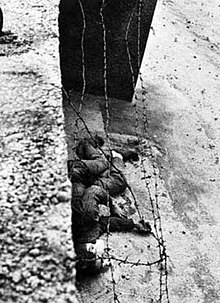
I saw this on the commuter train on my way home and almost started screaming. The Berlin Wall worked for almost forty years, if by "worked" you mean killed people, broke apart families, and assisted in stabilizing a horribly repressive police state. As Crowley showed her smug picture, she probably wasn't thinking of the photo below:


This is Peter Fechter, an 18 year old East German shot trying to climb the wall in 1962, and left bleeding on the ground for almost an hour by the DDR's border police. He died, all for the crime of wanting a better life. At least 137 others did, too. To speak of this monument to oppression positively is truly, truly disgusting.

Of course, being a Fox News personality, Crowley's problem might be just as much pig ignorant stupidity as lacking a soul. She might not be aware that the Wall was built to keep people in, not keep them out. She just might be stupid enough that she thinks the Wall was built by the West to hold off the Communist menace or something. 

But now that I think about it, I'm not so sure. By using the Berlin Wall so maladroitly, I think she may have admitted something I've long suspected: many Trump supporters want to see Mexican immigrants shot and bleeding out in front of their beloved wall. These are the same people, after all, who defend the police ever time an unarmed person of color gets shot to death by them. These are the same people who took George Zimmerman's side. These are the same people who live behind the suburban walls of redlining and school districting. (Or in the case of suburban Detroit, an actual wall.) They want walls, both corporeal and legal, between them and people of color, and they want men with guns prepared to shoot anyone who might cross over. This basic fact lies at the center of the dark heart of Trumpism, not trade, not globalization, not nostalgia. Don't forget it.

Wednesday, September 28, 2016

How Trump Could Actually Win The Next Debate (But Probably Won't)

Monday's presidential debate was perhaps the most interesting I've ever seen, in that no candidate has ever failed so spectacularly. Clinton played a very smart rope-a-dope strategy, provoking Trump to overpunch, then to leave himself open for some vicious right crosses at the end of the debate. Some have criticized Clinton for not seizing on certain moments, but I saw a canny pugilist who knew to wait until later in the debate, when Trump was woozy and unable to effectively counterpunch. As in all things, Clinton is smart, cautious, and has checked out all the angles. (Of course, this means that she can at times be unoriginal or suffer from hubris.)

However, while Trump was talking with a fifth grade vocabulary at the beginning of the debate, a few of his jabs landed and some of his defenses were effective. He also played it smart when Clinton talked about subsidized child care, and pretended that his plan was very similar, even though it's not, because he knows he loses white women's votes on that issue. While his understanding of trade is weak, he pushed Clinton pretty effectively on it. Her worst moment of the night was responding to his comments on NAFTA with "that's your opinion," forgetting that it's an opinion shared by a lot of Democrats. Clinton then deftly started poking the Donald on personal issues, and that's when his tightly-wound mask of civility at the start of the debate completely fell off, revealing the petulant, self-absorbed, angry child beneath.

Trump has two weeks to lick his wounds and to figure out how to fight next time. It is obvious from the NAFTA exchange that Clinton has a weakness: she tries to bat away attacks on issues where she is vulnerable with pat remarks. (She did the same thing with the email issue.) If Trump can consistently hammer away on these issues, those responses can look dishonest or arrogant, reinforcing the qualities people like least about her.

Trump needs to develop enough discipline to stay focused on those two issues, and to not get derailed by birtherism, lying about his record on the Iraq War, or his sexism. He needs his own pat answers to quell conversation on those issues so that he can get on to harping on trade and emails. If the debate ground is shifted to be about those issues, Trump wins. As any experienced debater knows, establishing the ground practically determines the outcome. The best debaters win by dragging their opponents onto their own ground, which is something Clinton did very well.

Here's the thing, though: I don't think Trump will be able to pull it off. Doing so would require a lot of hard work, practice, and discipline, things he is totally averse to. He lost bad on Monday in large part because Hillary was training like a champion and he was fucking around like a feckless frat boy. Even if he tries practicing, his personality is immutable. He is incredibly impulsive, incapable of controlling himself and his big dumb mouth. Clinton will keep jabbing him on his personal life and business dealings, and his little misogynist manboy lizard brain will start going into rage spasms. He is more likely to go into the next debate ready to dredge up Bill Clinton's affairs, which I think will backfire big time, since I assume Clinton has some flamethrower-hot responses to that line of attack waiting to be unleashed.

Coming into the debates, I think people overestimated Trump's ability because of his manifest mastery of television as a medium. The problem for him is that presidential debates in the general election are a throwback to a pre-TV era where two people have to make substantive arguments, not just provide entertainment. Trump's entertainer approach worked in the circus-like atmosphere of the GOP debates, not so well in the much more serious and more reality-grounded realm of the general election debate. It is simply a test that this con artist is not intellectually or emotionally equipped to pass, and thank God for that.

Sunday, September 25, 2016

Some Advice For The Clinton Campaign

The Clinton campaign has had a rocky couple of weeks, to be sure. What once looked like a path to a blowout now looks close. In looking at the Clinton campaign, it's fundamental problem is obvious: it can convince people not to vote for Trump, but that doesn't mean those same people will vote for Clinton. To put it bluntly, she has been hoping so hard for Trump to self-destruct that she has failed to make a case for herself. With the first debate tomorrow, Clinton has the perfect opportunity.

That case has to be made, especially with voters who ought to be friendly to her. While Clinton has managed to get the support of some prominent high level Republicans, that will only repel elements of the Democratic base, who worry about her commitment to progressive politics. Many voters who ought to be voting for Clinton are opting for Stein or Johnson, especially among younger voters.

She needs to cultivate that potential base, and can easily do so by promoting policies that she has already championed. For instance, she supports subsidized day care, a major boon to young parents and especially to women. When Trump rolled out his own bullshit plan based in tax breaks that would mostly help those who don't need it, I was amazed at how little discussion Clinton's much more generous proposal had received. In fact, Trump was allowed to claim that Clinton has yet to propose anything at all. Unlike Trump she also has a plan for college debt relief, another issue dear to young voters, but one that might actually be less galvanizing than day care. Clinton needs to be flogging those issues big time.

She especially needs to reach out to African American millennials, who support her at a much lower level than blacks of older generations. There is plenty of justified skepticism, based on her demonization of "superpredators" in the 90s in support of incarceration legislation. With Black Lives Matter protestors ought in the streets in the wake of multiple, prominent killings of African Americans at the hands of the police, she needs to strongly register her support.

What I think she needs to do is to repudiate the triangulation strategy perfected by her husband, because it is destroying the Democratic party. The moderate "soccer mom" types only vote in the presidential elections, leaving the disaffected base to save the midterms after years of neglect. This meant massive blowout losses in 2010 and 2014, maintaining a radically conservative Congress. If Clinton does not motivate the party's base to support her, she might as well not even be president, because she will be hamstrung by a Congress out to destroy her. There is a younger generation that is much more receptive to social democratic ideas, it must be cultivated and listened to. The Democrats keep disrespecting their base, and then wonder why they can't sustain its support. Maybe, instead of bowing and scraping to draw the dwindling number of suburban voters who show up to the polls but are too confused to know what side they are, the Democrats should mobilize the people who actually put them in office.

Last, but not least, Clinton needs to do something that major party candidates rarely do: confront third party candidates. Stein and Johnson are siphoning votes away, and guilt-tripping voters won't work. For those Sandersnistas saying they'll vote for Johnson, the answer is pretty clear. Clinton needs to let voters know the reality of libertarianism, and that it is mainly focused on funneling money to the wealthy, not on legal weed. There are a lot of voters who know they could never cast a ballot for Trump, Clinton cannot take for granted that she will automatically get their votes.

Sunday, September 18, 2016

Republic Of Fear (Redux)

We are a nation governed by fear. I try to resist it, but I too can get dragged down into its morass. Yesterday I was out and about with my family, and we decided to stop into a mall to kill some time before an event we were attending was starting. Why a mall? Because of the indoor play area, which is a perfect place to take toddlers if you want them to run around while getting out of the sun. There was a boy with a toy gun there who kept shooting it at other kids, something I would barely have noticed in my childhood, but which filled my with almost unbearable anxiety and dread. All the news of mass shootings had clearly had an effect on me.

Soon after that I heard reports of a pipe bomb that had been planted near the finish line of a run in New Jersey, which was thankfully discovered before it exploded. Later that day came the explosion in Chelsea. Soon on my social media feed the massive reservoir of fearful magma beneath America came bursting forth in the hot lava. And, of course, before hardly anything was known, Trump was trying to exploit it.

Fear has historically been a powerful force in American political history, but since 9/11, it has been given a massive steroid injection. Historically, this fear usually means rights are taken away, and people die. Fear of Native Americans led to the Trail of Tears, fear of white supremacy being compromised contributing to lynchings, fear of communism destroyed the lives of those targeted, fear of poor young people of color resulted in mass incarceration. The list goes on. The fear spiral in our case has lasted so long because politicians have failed so spectacularly to deliver a better world, and so must instead base their legitimacy on "protecting" the public from violence. (That's the thesis of the BBC's amazing The Power of Nightmares, which I consider to be the most important documentary of the post-9/11 world.)

Donald Trump has been so successful because he is the fear candidate. He has perfectly channeled the fears of white middle America, from a fear of Muslims to fears of African Americans, to fears of immigration, and to fears of national decline. He appeals to the white people who live in suburbs founded and based in fear, from their segregated housing to the local police forces who pull over any black people who dare surpass its borders. He certainly must have remembered how back in 2003 Dubya managed to use that fear to get broad public support for an invasion of a country that had nothing to do with 9/11.

And in the midst of this orgy of fear, others are given much more to fear. Muslims have to fear being targeted by a growing wave of hate crimes. African Americans have to fear being murdered by the police in the routine course of their daily lives. Immigrants have to fear deportation or having their families ripped apart.

I do not see any horizon for the Republic of Fear. That too fills me with fear, because I am not sure how long a society can function or even exist in a state like this.

Friday, September 16, 2016

The Strange Absence Of "Generation X" From The Political Discourse

We are hearing a lot of generational analysis when it comes to the election, especially in regards to Millennials. This fits with broader cultural discourses that are sometimes comically maladroit in determining what Millennials are all about. We can all certainly acknowledge that generational thinking is problematic because talking about people across race, class, gender, regional, and sexual lines as if they share the same mentality because they were born around the same time is rather specious. Articles about “the millennials” are thus preferred by hack journalists who need to get something in before deadline.

At the same time, generational thinking can help explain some things, because those born around the same time grow up consuming the same popular culture, living under the same government policies, etc. I recently finally read Ta-Nehisi Coates’ Between the World and Me, and although we grew up in radically different places, we are about the same age, and I noticed a definite Generation X feeling to his insights that really spoke to me. (The growth of politically conscious hip-hop and interest in Malcolm X had managed to reach me out on the Nebraska plains.)

So it is with a little trepidation that I am embarking on a little discussion on an analysis of Generation X in the current political landscape. There’s a lot of talk about how Millennials are more likely to vote third party in this election, as well as the longings by white Boomers for a past that never existed. What about my generation, stuck in the middle, the product of a historically steep drop in the birth rate?

The first thing to note is that it now looks likely that much like the Silent Generation, there will never be a Gen X president. While Barack Obama has a certain Xer quality about him, he is still a Late Boomer. (They came of age after the 60s but before the Reagan era had completely settled in.) All four candidates for president are Boomers, and there does not seem to be a Gen Xer out there able to rise to the top anytime soon. This is especially the case on the Democratic side, where the failure to win local elections means that they are not developing the next generation of politicians. On the Republican side there are many Xers, but they are the simpering contrarian Young Republican types that I encountered in college in the 90s, like Scott Walker, Paul Ryan, and Ted Cruz. Coming up at the height of Ayn Rand’s influence, they are too trollish to make it on the presidential stage, even if they’ve had some political success. They are the product of the supercharged post-Reagan conservative movement, and have succeeded within the party for that reason, but with the rise of Trumpism the days of their power might be few.

So what about the voters? Part of the problem is that pollsters don’t really use Generation X as a category, because when they organize the data they may talk about voters under thirty or voters aged 30-55, but not the parameters of Gen X (which I would define as those between roughly 35 and 50 years of age.) This is part of the larger trend of pretending that my generation doesn’t really exist as a distinct entity. I think some of this is rooted in the reality that the mentality of my generation is even more disunited than that of others, especially the generation after mine. The War on Drugs and mass incarceration raged during my coming of age, and the increase in de facto segregation means that the experiences of white and black Gen Xers are often completely foreign to each other, perhaps even more so than for other generations.

Another difference has to do with religion. My generation is less churched than our elders, but more churched than the Millennials.  Lots of people my age rejected organized religion, but we were also the guinea pigs for the revival of the Religious Right, and many folks my age were subjected to extreme indoctrination. Many rejected it, but a large number also embraced it. Gen Xers seem to be more broad minded when it comes to gay marriage and transgender rights, but not as much as the younger generation.

Generation X is, in many respects, a transitional generation. The Boomers were established before the late 20th century neoliberal onslaught; that’s the world we came of age in. The middle class members of my generation were the ones to finally be able to buy their first homes at inflated prices in the bubble, and then were thrust underwater by the financial crisis. Contrast this with the Millennials, who have had our economic difficulties growing up in a time of expensive college loans and casualized labor, but even worse. They just aren't buying homes, period. We were the canaries in the coal mine, but when we were transitioning into this new economy, there weren’t any sympathetic think pieces. Things hadn’t gotten so bad that elite journalists bothered to pay attention.


Since generational thinking is so inherently troubled, I do wonder if Gen Xers aren’t part of the discourse simply because it is too difficult to cram us into an easy narrative. In my youth I remember all kinds of concern pieces about how we were a “nation at risk” in schools full of “super predators” and “slackers.” Perhaps generational political thinking then and now was just a reflection of anxieties about the younger generation, and in ten years as Millenials hit middle age they won't be invoked much anymore. Now that our youth is no longer a flashpoint of anxiety amidst moral panics (as it was in the Reagan era), “Gen X” might as well be another relic of the nineties, like grunge and MC Hammer. Perhaps journalists should drop the facile generational analysis and talk more about the broader changes -secularization, lowered economic security, etc- that are leading to the generation gap between Millennials and Boomers.

Monday, September 5, 2016

The Bircher Long March


For a long time there was an established narrative, both within and without the conservative movement, that in the early 1960s William F Buckley and his allies banished the John Birch Society and other fringe elements from the conservative movement, paving the way for the more economically-focused John the Baptist Goldwater and redeemer Reagan. Conservatives have been very invested in this narrative, and defend it vigorously. Allan J Lichtman has questioned this view, and thus entitled his stellar history of the conservative movement White Protestant Nation, drawing a rebuke from David Frum in his book review. He saw movement conservatism as a repository of noble ideas, not resentments aimed at preserving a certain kind of country and social order.

This election year, however, appears to have proven Lichtman's thesis. It seems that, contrary to the old narrative, that the Birchers and assorted right wing practitioners of what Richard Hofstadter called the "paranoid style" never went away at all. The so-called "alt-right," inheritors of the racist and xenophobic traditions in conservatism dating to the 1920s, now have more pull with the Republican nominee than the free marketeers who think they represent conservatism. That candidate has built his campaign on whites resentful over losing "their" country, exactly the kind of thing that Lichtman saw as the core of conservatism.

Like most funguses, the nationalist right has flourished in darkness on a diet of eating shit. For years it lurked in the background, finding an airing in the less savory corners of the talk radio world apart from the Hannitys and Limbaughs. Those who fancied themselves the leaders of the conservative movement looked up to economists like Hayek and Friedman, and writers like Ayn Rand. They really thought that their movement was united by notions of limited government and cultural restoration.

Like Mao's army during the Long March or Castro's guerillas up in the Cuban mountains, the Birchers bided their time in the boondocks, gathering strength and ready to strike at the movement's rulers, who were losing legitimacy faster than they realized. Sarah Palin's vice presidential candidacy was like the attack on the Moncada barracks: a failure in the short term, but galvanizing. Soon came Glenn Beck and the Tea Party and the cries of "take our country back," the phrase that encapsulates the true heart of modern conservatism. The election of a black liberal president tipped the balance in favor of the Birchers. They had the power of the conservative lizard brain's revulsion on their side, which wipes the floor with the intellectual conservatism of the likes of Frum, David Brooks, and George Will.

The average conservative foot soldier has no clue who the Cato Institute or Friedrich von Hayek or Milton Friedman or Arthur Laffer are. They are much more likely to know Alex Jones, who is the most listened-to practitioner of the paranoid style in many decades. The average conservative is not a college young Republican with a copy of The Fountainhead on their nightstand. It's an exurban talk radio fan driving a pick up truck to their lower middle class job while listening to Michael Savage. Instead of being defeated in the early 1960s, the Birchers have played the long game, and are now running the show. The Frums, Brookses, and Wills of the world are modern day Alexander Kerenskys, victims of the revolution they were foolish enough to think they were in control of.