Showing posts with label conservatives. Show all posts

Tuesday, March 7, 2017

On Trump's 91% Approval Rating Among Republicans


There's a Quinnipiac poll today that confirms something I've long thought: Republicans are still devoted to Trump. In fact, 91%, according to the poll, approve of his performance in office.

On the surface, this ought to be perplexing He has failed to pass any meaningful legislation thus far. His attempt at a travel ban was a complete shitshow. His National Security Advisor had to resign, and his Attorney General has also been implicated in the Russia scandal. Every day brings a new scandal for an administration that has failed to fill key government positions. He is shitting the bed worse than any president at the beginning of his term I've ever seen. He is shitting the bed so thoroughly that it ought to be a matter of simply observed objective reality.

But it apparently is not. Republicans so far are very pleased, and that is something worth examining. The main factor here, of course, is partisanship. We've seen this already in Kansas, where Brownback has been driving the state into the ground, but Republicans would rather cut off their left arms than vote for a Democrat, even if their Republican governor is breaking their state.  However, I do not think partisanship accounts for everything here. The vast majority of conservatives consume news from right wing organs. Anyone who has spent a lot of time dipping their toes into Fox News or talk radio soon feels as if they have entered some kind of alternate reality. Not only is this world a topsy-turvy place where Trump's failure turds are polished and the level of opposition to him downplayed, it is one that many conservatives see as part of their identity.

They feel that these organs are giving them the truth, and that the "mainstream media" is the enemy. Trump is feeding them the raw chum of resentment, and they are eating it up in a frenzy. Here's what Quinnipiac found:

"American voters disagree 58 - 39 percent with Trump's claim that certain news organizations are "the enemy of the American people." Disagreement is 86 - 10 percent among Democrats and 60 - 38 percent among independent voters. Republicans agree 81 - 17 percent."

That's right, 81% of Republicans buy his "enemy of the people" schtick. Unlike previous Republican presidents, he has fully embraced the fever swamps of right wing media. His main adviser is Steve Bannon, after all, former mastermind of Breitbart. The vast majority of Republicans are excited because they see Trump as fundamentally "one of us." Whereas Bush gave us "no child left behind," Trump is giving us an enemy of public education, in the form of Betsy DeVos. Whereas Romney called for "self-deportation," Trump is building a wall. He is the id of a talk radio host given life and allowed to run the country, and Republicans by and large love it.

Over the years, conservatism has become perhaps the most radical political movement to gain high levels of power in the American government. The conservative movement is effectively a right-wing equivalent of Bolshevism, seeking a total revolution in American society. They want to strip away the twentieth century, destroying the social state, public education, and equal voting rights. With the white nationalist wing embodied by Trump in charge, it also seeks to end America's role as an arbiter of global peace and to massively restrict immigration.

In terms of the right, Trump gives something for everyone. He keeps the neo-cons happy by building up the military. He is calling for tax cuts for the wealthy. He delights the bigots with practically every thing he says. The religious right loves him for his attacks on Muslims.And most of all, no matter how badly he messes up the country, his voters seem confident that even if they are hurt by the shitstorm that liberals, immigrants, people of color, gays, and transgender people will be hurt a whole lot worse. As long as Trump keeps smiting the people that his base hates, they will love him forever.

Trump's opponents need to reckon with these facts. They need to realize that trying to poach his voters is a fool's errand, and that when they oppose him, they are also facing Republicans as a united front. The notion that Trump is somehow separate from the Republicans is a false and pernicious one. He is their champion, their avatar, and when he succeeds in flushing the country down the toilet, I sure as hell do not want his right wing enablers and followers to be let off of the hook.

Friday, February 3, 2017

"Trump Voters" Are Just Republicans


Okay, I am going to make this short and sweet. If more people followed my on Twitter it'd be a tweetstorm, but I'm too old fashioned and unpopular for that.

We've been hearing for well over a year now about "Trump voters." They are supposedly all retired industrial workers in Youngstown and Green Bay who love Trump for his "populism" due to their "economic anxiety." There's a shit ton of bullshit in that narrative, but it's the assumption behind it that bugs me the most. You could've talked about "Trump voters" in the primaries, but since the general election they don't really exist. "Trump voters" are essentially just Republicans. Trump only got 46% of the vote, which was less than Romney in 2012. He did not attract a massive wave of new voters. Yes, he did manage to poach a few Obama voters in the upper Midwest (which tipped the electoral college), but nationwide this does not amount to some new species of voter. He also won the election because Republicans who did not like him in the primaries went out and voted for him in the general election.

They did not necessarily vote for the media's version of Trump. They wanted things like an anti-abortion Supreme Court justice, business deregulation, tax cuts, etc. This is why I am so surprised that people think that Trump's moves to scrap Dodd-Frank or put a bunch of Goldman Sachs alums in the White House will somehow alienate his voters. It won't. They're Republicans, after all. As long as Trump keeps hurting the people they don't like (Muslims, brown-skinned immigrants, African-Americans, the poor etc.) and makes liberals mad, they'll be all for him. Even if their economic prospects worsen, they'll be happy as long as those other folks are getting nailed a lot harder.

It's also why the GOP establishment won't "come to its senses" and turn on him. He is pushing voter suppression, attacks on immigrants, Islamophobia, financial deregulation, and an ultra-conservative Supreme Court nominee. That's exactly what they want! Why would they change that? Plus, if the shit hits the fan and things go wrong, they can just blame them and pretend they never really supported him. I doubt they'll ever actually have to do that. Trump and the Republican leadership have entered into a blood pact, and there's no going back. After all, autocrats never lack for willing collaborators.

Monday, September 5, 2016

The Bircher Long March


For a long time there was an established narrative, both within and without the conservative movement, that in the early 1960s William F Buckley and his allies banished the John Birch Society and other fringe elements from the conservative movement, paving the way for the more economically-focused John the Baptist Goldwater and redeemer Reagan. Conservatives have been very invested in this narrative, and defend it vigorously. Allan J Lichtman has questioned this view, and thus entitled his stellar history of the conservative movement White Protestant Nation, drawing a rebuke from David Frum in his book review. He saw movement conservatism as a repository of noble ideas, not resentments aimed at preserving a certain kind of country and social order.

This election year, however, appears to have proven Lichtman's thesis. It seems that, contrary to the old narrative, that the Birchers and assorted right wing practitioners of what Richard Hofstadter called the "paranoid style" never went away at all. The so-called "alt-right," inheritors of the racist and xenophobic traditions in conservatism dating to the 1920s, now have more pull with the Republican nominee than the free marketeers who think they represent conservatism. That candidate has built his campaign on whites resentful over losing "their" country, exactly the kind of thing that Lichtman saw as the core of conservatism.

Like most funguses, the nationalist right has flourished in darkness on a diet of eating shit. For years it lurked in the background, finding an airing in the less savory corners of the talk radio world apart from the Hannitys and Limbaughs. Those who fancied themselves the leaders of the conservative movement looked up to economists like Hayek and Friedman, and writers like Ayn Rand. They really thought that their movement was united by notions of limited government and cultural restoration.

Like Mao's army during the Long March or Castro's guerillas up in the Cuban mountains, the Birchers bided their time in the boondocks, gathering strength and ready to strike at the movement's rulers, who were losing legitimacy faster than they realized. Sarah Palin's vice presidential candidacy was like the attack on the Moncada barracks: a failure in the short term, but galvanizing. Soon came Glenn Beck and the Tea Party and the cries of "take our country back," the phrase that encapsulates the true heart of modern conservatism. The election of a black liberal president tipped the balance in favor of the Birchers. They had the power of the conservative lizard brain's revulsion on their side, which wipes the floor with the intellectual conservatism of the likes of Frum, David Brooks, and George Will.

The average conservative foot soldier has no clue who the Cato Institute or Friedrich von Hayek or Milton Friedman or Arthur Laffer are. They are much more likely to know Alex Jones, who is the most listened-to practitioner of the paranoid style in many decades. The average conservative is not a college young Republican with a copy of The Fountainhead on their nightstand. It's an exurban talk radio fan driving a pick up truck to their lower middle class job while listening to Michael Savage. Instead of being defeated in the early 1960s, the Birchers have played the long game, and are now running the show. The Frums, Brookses, and Wills of the world are modern day Alexander Kerenskys, victims of the revolution they were foolish enough to think they were in control of.

Friday, August 5, 2016

Exclusive: Leaked RNC Conference Call

[Editor's Note: through my shadowy sources I was able to get a partial recording of a conversation held between Reince Preibus and some important figures in the Republican Party.]

*static*

Reince Preibus: So are we all on the line now?

Paul Ryan: Yes

Charles Koch: Yes

Preibus: This has been a pretty insane week, gentlemen. I know there's talk of Republicans fleeing Trump. And I know, Paul, that his refusal to endorse you must be rankling. But don't forget about the bigger picture. We can still count on you, right Mr. Koch?

Koch: As you know, I am not pitching money to Trump. That leaves much more for all those Congressional races. Even if Mr Trump gets beat bad I think we will still hold Congress and have a tight grip on the states. What I want to know is if we will be able to keep enforcing party discipline to prevent Hillary from having any success in generating bipartisan legislation. That's how the Clintons fucked us the first time, you know. Since I am spending all of this money, I want to know if I can count on you.

Preibus: Yes sir, of course. You know that the yahoos in our base would primary someone who worked with Hillary so fast your head would spin. They'll vote for that whacko Trump just because he's a Republican.

Koch: May I remind you that that whacko Trump is in danger of harming the conservative brand? And he could push this party away from an adherence to free market principles? Remember, my brother was on the Libertarian ticket back in 1980. If we don't get a return on our investment we might just have to seed some projects outside of the Republican Party.

Ryan: Mr. Koch, I don't think that will be necessary. I have the complete trust and support of the party members in the House. The radicals ousted Boehner to put me in and the moderates would rather have me as their face than some crusty old fart like Boehner, even if just for the better press coverage I get. Because of the wonderful job we did redistricting back in 2010, we could survive a Clinton landslide with a clear majority intact. We will block everything Clinton or anyone else proposes that might restrict markets.

Preibus: My contacts in the Senate tell me that we can expect another refusal to raise the debt ceiling pretty fast into the Clinton administration. That will force her to cut government even when she doesn't want to. I guess that jackass Cruz can actually be useful from time to time. That hostage taking tactic has worked like a charm, and for some reason the voters keep letting us do it. Even if we lose the Senate, there's no way the Democrats will get a supermajority. We can filibuster at will. I am expecting the Senate to block the confirmation of any Supreme Court justice who's not a conservative.

Koch: I am glad to hear that. However, I am worried that this man Trump may be splitting the party apart and will lead Republicans to push for trade barriers. You know that there's no way I or my brother or any of your other big donors will stand for that.

Preibus: Yes sir, I know. The people falling for Trump's talk on trade wouldn't know their ass from a hole in the ground. If they bitch about the TPP we can ignore it. I'm sure our friends at Fox will come up with some great propaganda for free trade and these yobs will forget everything that orange asshole ever told him.

Ryan: And if TPP doesn't go through it's a de facto attack on the Obama administration. A win-win, basically.

Koch: Not as far as my pocketbook is concerned.

Ryan: Anyway, you know that his support has a lot more to do with rednecks mad about Muslims and Mexicans than it does about trade. We'll just keep blocking any immigration reform and keep dishing them the same talk about America being a "Christian nation" and they'll know where we stand. That nativism feeds into our attack on the welfare state, in any case.

Koch: Certainly.

Preibus: Paul, what I want to know is: can you keep putting up with Trump's refusal to endorse you?

Ryan: Of course! It's a small sacrifice to make for party unity. When this is all over I will still be Speaker and he'll be on reality television again, if he's lucky.

*laughter*

Preibus: Can you seriously believe there are people who want this man to be president? Remember that time when we met with him and he

*static drowns out the next minute of conversation*

Koch: But that man is a danger to all we've built if he wins.

Preibus: I was seriously afraid of that after our convention, but it looks like he's doing a good job of sabotaging things all by himself. My only concern is if he pulls out before the election.

Ryan: That would actually be great. That way we can keep the moral high ground not being associated with him.

Koch: Paul, would you be willing to jump in in that case and be the candidate?

Ryan: Are you kidding me? Sorry for my tone, Mr. Koch. It's just that I didn't want to be Speaker either. I'm just marking my time until I get to be a lobbyist.

Koch: Well I know you'd do a great job of representing Koch Industries.

Ryan: Thanks, sir.

Preibus: We can just throw Cruz out there, if need be. He'll get crushed worse than Trump. Just might end his political career, which would be a real shame, huh?

*laughter*

Koch: But really, what are we going to do with all of these Trump supporters when the election's over?

Preibus: They'll go back to just being Republicans, like they've always been. I don't see any future figure like Trump able to poach those folks.

Koch: Easy for you to say. Don't count on the tap running free from me forever

*static*

[Editor's Note: This is all of the conversation my sources were able to procure. Please let me know if you have a full transcript of the conversation, and look for future leaks here.]

Tuesday, July 19, 2016

The Lies That Bind


I didn't watch much of the Republican convention last night live, just clips and tweets until I had a long phone conversation with an old friend while sitting in my recliner while sipping a bourbon. That was a lot more pleasurable than watching the shitshow in Cleveland.

I woke up this morning to my social media blowing up over the plagiarized section of Melania Trump's speech last night. I'm much less outraged than amused. Having been a professor and a teacher for years now, I have busted my fair share of plagiarists. Usually the root cause is a combination of laziness and stress. Knowing how sloppy and last-minute the Trump campaign has been, I am sure that the person responsible for the speech had little time to do it, was not all that qualified, and needed to cut a few corners.

I am much, much more concerned with the dishonesty from the Trump campaign that comes not out of laziness, but out of malice and manipulation. Trump's entire campaign is built on lies of the most odious variety. He started it by claiming that undocumented immigrants are more likely to commit violent crime, a lie intended to stir up anti-immigrant hatred on his behalf. He lied about there being "thousands" of Muslims cheering the fall of the twin towers across the river in Jersey City, a lie intended to spread hate against Muslims, who he was calling to be banned from entering the country. He recently topped himself with the lie that Black Lives Matter activists were holding moments of silence for the murderer in Dallas. This was obviously intended to inflame white paranoia and build up the narrative that Black Lives Matter is a terrorist organization.

Of course, Trump's malicious lies raised his political profile well before his run for the presidency. He first made a big splash in national politics by claiming that president Obama was born outside of the United States. This lie, also based in bigoted paranoia, had long been percolating on the Right. The fact that he was so publicly proven wrong, but still allowed to have a place in the media firmament, made it obvious to Trump that he could build a political career on telling big, racist whoppers to the drooling Fox News watching troglodytes.

Trump perhaps understood something that others in the more august corners of our media have failed to see: the modern conservative movement is built on lies that are endlessly reinforced through the propaganda arms of Fox News and talk radio. I'll name a few. The lie that cutting taxes on the wealthy leads to prosperity for all. The lie that people are poor due solely to their own laziness and other shortcomings. The lie that America is an exceptional nation that is the greatest country that ever existed. The lie that American history is an uninterrupted march of freedom. The lie that institutional racism does not exist. The lie that global warming does not exist. The lie that evolution is merely a controversial theory. The lie that there is a war on Christmas. The lie that gender is not a social construction. The lie that fetuses feel pain in the first trimester. The lie that Iraq had weapons of mass destruction. The lie that all Muslims are predisposed towards terrorism. And on and on and on and on and on...

Trump is merely the dead weasel-haired avatar of a morally bankrupt movement that has maintained its base of support through mendacity of the foulest nature. The country club Republicans may clutch their pearls and turn up the collars on their Izod shirts, but they used those lies to manipulate a mass of angry people who have spurned them for the real deal. Cleveland is the apotheosis of decades of lies.

Tuesday, November 17, 2015

Sadly The Hatred Against Syrian Refugees Is As American As Apple Pie

Yesterday will go down as a dark day in American history.  As the world faces one of the worst humanitarian crises yet known, several American politicians went out of their way to attack some of the world's most vulnerable people, continually competing to be the most cruel.  Chris Christie laid down the trump card (pun intended) by declaring that even orphans under the age of five would be banned from my state of New Jersey.  The spectacle of elected politicians currying favor with the bigoted masses by pissing on war orphans, the group of people in the world most in need of protection, completely sickened me.  My students often ask how American turned back Jewish refugees -even children- in the 1930s.  Now I guess they'll know.

Unfortunately, liberals have responded to this onslaught of noxious nationalism with a decent amount of naivete. They assert that the governors don't have the power to ban certain classes of immigrants, and that's true, but that's really beside the point. Also, I have heard it said many times that this state-sanctioned hatred is "un-American."

Oh, how I wish that were true. However, if you look at American history, you'll find that this kind of hatred is as American as apple pie. We have a lot of myths we tell ourselves about our country, and one of the biggest is that "America is a nation of immigrants." Never mind that most people of African descent in this country did not have ancestors who came here willingly, or that plenty of folks here are Native Americans.  And just because most people who live here are descended from immigrants doesn't mean that immigration was always welcomed, valued, or free and equal.

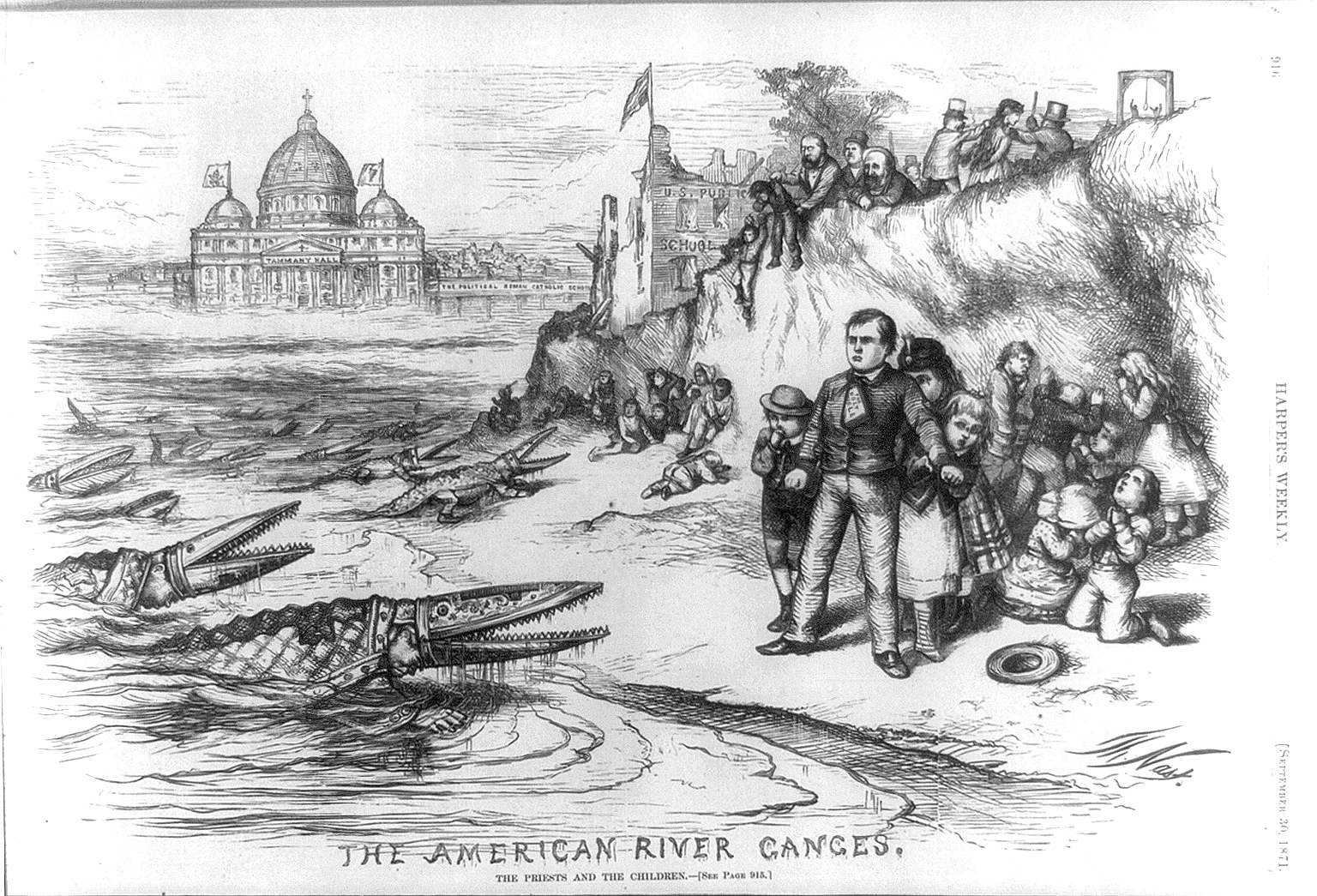
Just look at the Naturalization Act of 1790, one of the first important pieces of immigration legislation.  It limited citizenship to those who were "free white persons."  One year before the passage of the Bill of Rights, those vaunted rights were effectively being limited to white men.  When waves of Irish immigrants came over in the mid-1800s, they were feared and hated, commonly depicted as ape-like by native born whites.  This new surge in migrants gave birth to a nativist party, the Know-Nothings, who coincidentally were one of the elements that formed the nascent Republican party in the 1850s.  These nativists didn't just spread hate, they burned Catholic churches, and instigated anti-immigrant riots. 

Even though more immigrants followed from more places, paranoia and hatred still abounded.  The cartoon below by Thomas Nast depicts Catholicism in the form of bishops invading the nation and destroying its values. Replace the bishops with imams and you could run this cartoon today.


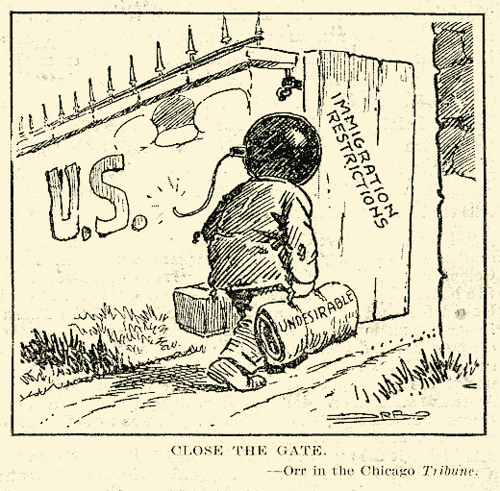
In the 1880s the government began draconian restrictions on Chinese immigrants, who also faced horrific violence.  In Rock Springs, Wyoming, in 1885 white workers torched Chinese dwellings and murdered 28 Chinese immigrants.  Depictions of the time, like the one below, show the level of racism directed at Chinese Americans.

In the 1920s restrictions on European immigration followed.  The Immigration Act of 1924 set strict quotas aimed at immigrants from Eastern and Southern Europe, those deemed less "white." That coincided with the high point of the KKK's power.  The Klan's slogan of "100% Americanism" reflected their emphasis on nativism and hatred towards immigrants, particularly Catholics and Jews. These restrictions came after a wave of paranoia associating immigrants with violence and terrorism.  Acts of terrorism in the post-World War I period, such as the passel of bombs sent out to politicians and capitalists on May Day in 1919, were blamed on radical immigrants, without proof. Foreign-born radicals like Emma Goldman were literally shipped off to Russia without trial. The supposed threat of foreign radicalism was the excuse used to bar new immigrants from coming in, including refugees from war and revolution in Europe.  Sound familiar? (The cartoon below is typical of all this.)


When European Jews fled Nazi oppression in the late 1930s, those quotas of the 1920s were not relaxed, and those refugees were cruelly turned away.  The reasons then are pretty much the same now: many Americans hated and feared Jews, just as a great many today hate and fear Muslims and Arabs.

In the last 70 years I can certainly point to other instances of nativist hate and violence, some rather close to our own time.  Vietnamese "boat people" faced opposition to their presence in America. Remember when mobs attacked buses full of child migrants from Central America?  That was only a year ago.

So yes, we must fight the bigots who are acting so cruelly to people so desperately in need of aid. But let us not pretend that the sickness we fight is "un-American."  It is a tendency in our history that we must tear out root and branch, but before we do that, we have to realize that it's there.

Monday, August 3, 2015

Reagan, Neshoba, The Voting Rights Act, And The Eternal Return


Today marks the thirty-fifth anniversary of an event little known in the general public but widely known among historians of recent American history: Ronald Reagan's speech in favor of "states rights" in Neshoba County, Mississippi, spitting distance from the site where civil rights workers James Cheney, Michael Schwerner, and Andrew Goodman were murdered by white supremacists only sixteen years before.

It's good to see Reagan's statement about "states rights" in context, so here is the relevant section of the speech:

Today, and I know from our own experience in California when we reformed welfare, I know that one of the great tragedies of welfare in America today, and I don't believe stereotype after what we did, of people in need who are there simply because they prefer to be there. We found the overwhelming majority would like nothing better than to be out, with jobs for the future, and out here in the society with the rest of us. The trouble is, again, that bureaucracy has them so economically trapped that there is no way they can get away. And they're trapped because that bureaucracy needs them as a clientele to preserve the jobs of the bureaucrats themselves.

I believe that there are programs like that, programs like education and others, that should be turned back to the states and the local communities with the tax sources to fund them, and let the people [applause drowns out end of statement].

I believe in state's rights; I believe in people doing as much as they can for themselves at the community level and at the private level. And I believe that we've distorted the balance of our government today by giving powers that were never intended in the constitution to that federal establishment. And if I do get the job I'm looking for, I'm going to devote myself to trying to reorder those priorities and to restore to the states and local communities those functions which properly belong there.


Of course Reagan never mentions African Americans or segregation by name, but he sure implies a lot.  "States rights" itself had historically been used mostly (and vociferously) by the South to defend slavery, and then Jim Crow.  Reagan also talks about "welfare" and "education," which likely conjured up images of poor African Americans in the first place and integrated schools in the latter in the mind of his audience.  Note as well the sustained applause mentioned in the transcript, so loud that Reagan had to stop for a moment.  I doubt a crowd of white folks in rural Mississippi in 1980 was cheering that hard at the mention of "states rights" because they truly believed in the efficiency of state-level agencies.  No, I can bet that they had something else in mind.

And that's why the Neshoba speech matters, because it shows how modern conservatism has deftly incorporated color-blind racism into its arsenal.  According to a depressing article in the New York Times Magazine, that same color blind racism was used by conservative operatives and jurists to dismantle the enforcement mechanisms of the Voting Rights Act.  Since the Supreme Court invalidated preclearance and allowed voter ID laws several states have passed a wave of legislation to restrict the vote, restrictions that fall especially hard on African Americans.  Such a wave of voter restrictions hasn't been seen since the 1880s and 1890s.  Gee, I wonder what was going on back then?  (Lee Atwater's infamous 1981 interview pretty much lays out the basis of this whole strategy.)

In the Times Magazine article former Kansas Senator and majority leader Bob Dole says something very interesting about what has been happening in his party:

But as [John] Roberts pressed his case [against a strong Voting Rights Act], a powerful opponent, Senator Bob Dole of Kansas, was working against him. Dole, who voted for the Voting Rights Act in 1965, thought the Reagan team’s ideological fervor put the party’s efforts to build a broad, winning coalition of voters at risk. His argument prevailed, and Reagan ultimately signed the strengthened version of the Voting Rights Act in 1982, with the new standard for bringing discrimination cases intact. “I tried to make the point to the White House that, as a party, we needed to demonstrate that we cared and were concerned about votes from African-Americans and Hispanics,” Dole, now 92, told me earlier this summer. “I don’t know where we lost track after Abraham Lincoln.”

It's obvious from this statement that Dole does not think that the Republican party is making any effort whatsoever to concern itself with representing the interests of either African Americans or Latinos.  As others have said before me, the Southern strategy has ended up, fifty years later, turning the Republican party into a white identity party.  Considering the changing demographics of American society, the only way to ensure the success of such a plan is to disenfranchise those who would be likely to vote against Republicans.  For that reason new voting restrictions target people of color, the poor of all races, women, and college students.

That desire is sadly nothing new in American politics.  From day one there have been voting restrictions, whether they be by property or race.  During the Gilded Age nativists argued against immigration in order to suppress the power of immigrant voters, and some in New York even toyed with bringing back property requirements.  The Voting Rights Act wasn't passed until 1965, only fifty short years ago.  In a society where universal suffrage is the legal principle behind voting, those who defend the interests of the privileged will always attempt to drown democracy, since they can't win any other way.  In the wake of Neshoba, Reagan's followers fought to end the Voting Rights Act, and they effectively did, to this nation's great shame.  Much like the period of postwar prosperity that lasted until the 1970s, the 48 year stretch of actual equal voting will likely be remembered in the future as a bright blip in a much more dismal story.  Of course, things could change, but I'm not holding my breath.

Monday, June 22, 2015

Has The GOP's Deal With The Devil Come Due?

Back when the Tea Party winds stared blowing back in the early parts of this decade, I wondered whether the Republican Party had signed a devil's bargain.  It was encouraging the support of fringe elements that had long been outside of the mainstream of American politics, all in order to benefit politically from the rising feelings of resentment among white people.

One such example is the Republican eagerness to put the grievances of the "open carry" movement into law, as just recently happened in Texas.  This is a movement that worships guns and views the Second Amendment as a protection against tyranny, as if the only thing standing between the status quo and a dictatorship is a bunch of dudes carrying AR-15's into the local Chipotle.  Voters who vote on gun issues tend to be highly motivated, so the Republicans are willing to break bread with armed vigilantes if it means electoral success.

The same goes for white nationalism, although the connections have been blurred more.  The continued Republican support for the official use of the Confederate flag (which was only shaken after the terror attack in Charleston), is a case in point.  The same goes for the lip service paid by Rick Perry and others to Texas nationalism, which in my experience is an idea limited almost completely to white Texans.  The anti-immigrant rhetoric and "show me your papers" laws in states like Arizona are based in a conception of the United States as a white man's country.  Sometimes the links between the "secure our borders" rhetoric and the ugly truth beneath those words gets exposed.  For example, it came out today that that Earl Holt III, the leader of Council of Conservative Citizens, has given campaign donations to multiple Republican presidential candidates.  In case you don't know, this organization was cited directly by terrorist Dylann Roof in his manifesto as instrumental in affecting his worldview.

Now this is not necessarily a case of Republicans actively seeking out the support of extremists.  Rather, they have been more subtle, in that they will take their money and promote policy positions that make those extremists happy.  Anti-immigrant legislation, voter suppression of people of color, and slashing programs that help Latinos and African Americans in poverty might be called "securing our borders, combating voter fraud, and welfare reform" officially, but everyone with eyes who can see understands that they are all policies that further white supremacy.  (Hence their popularity in large sectors of white America.)  The horrors of the Charleston killing, as well as the almost comical responses by many conservatives that downplayed any discussion of race, have highlighted just how beholden the Republican Party is to extremist elements.  In the wake of a racist terror shooting it must figure out how to spin its long-standing policies of no gun control and defending the flying of the Confederate flag.  It was easy to court extremist elements when no one was watching, now it will be much harder to hide.  Time will tell if this will actually result in any electoral change.

Thursday, August 7, 2014

Piketty, Perlstein, and Coates, Oh My!

This year has been fortunate enough to see three epic pieces of criticism from the Left enter into popular political discourse.  All three of these works deeply challenge conservative assumptions so ingrained in our politics that they have practically become part of the price of admission: that racism's effects are negligible in the present, that capitalism's prosperity is a rising tide that lifts all boats, and that Ronald Reagan was a great president who saved America from ruin.  Anyone with any sort of critical mind already knew these things were bullshit, but now those critiques have gone viral, and the purveyors of such cant are finally on the discursive defense.

I am speaking here of Ta-Nehisi Coates' tour de force piece on reparations in the Atlantic, economist Thomas Piketty's impressive tome Capital in the 21st Century, and historians Rick Perlstein's newest work, The Invisible Bridge.  All three have engendered fierce, almost apoplectic opposition from the political Right in ways I have never witnessed before, since all three are so well-written and researched, and threaten assumptions conservatives have managed to make conventional wisdom.  My personal favorite response has been the one of a conservative biographer of Reagan, he is suing for $25 million and wants all the copies of Invisible Bridge to be pulped.

That very response should hearten the forces of the Left, who have always had theorists and thinkers on their side, but haven't necessarily translated those ideas into coherent, digestible narratives.  For example, I have heard some people complain that Piketty's arguments about how capitalism inevitably leads to inequality are hardly new, but what is new is that he is leveling this accusation from within the economics profession, and has amassed a great amount of data and evidence to support his case.  He also writes extremely well, and deftly uses literature to illustrate his salient points about how wealth works in a rentier society, one his data and analysis shows we are about to return to.  With the concerns about wealth inequality growing among the masses in the wake of the Occupy movement, Piketty has given crucial ammunition to those

Similarly, Coates has a tremendous knowledge of history and has brought that into the journalistic world.  In doing so, he has taken the many great works of historians about the history of race (and especially housing) and molded them into a potent argument.  He later wrote a narrative bibliography giving credit to those works that had informed his article, bringing those scholars a much broader audience than they have ever had before.  I think academic historians everywhere should take notice of what Coates has done, and strive to make their ideas more accessible to the masses.  In their translator, Coates has utterly transformed the discourse on reparations and foregrounded (for those who couldn't see it) the ridiculousness of the claims that America is "post-racial society."

Rick Perstein is one historian in the academy who understands how to reach a broad audience with challenging interpretations while still basing his work in meticulous research.  (So much popular history is dross from a research perspective.)  I am still waiting to dig into Invisible Bridge, but having read his other books (especially Nixonland) and the reviews, I know that it is riling up conservatives because of its killer combination of depth and accessibility.  The cult of Reagan is perhaps the most hallowed of all modern conservative articles of faith, and any book with a popular audience that could call it into question represents a major threat.

I know I am sounding a lot more gushy and effusive than usual, but it's because I am feeling genuine happiness that works of scholarship are capable of altering our political discourse in the right direction. At least many of those people espousing the "post-racial society," Saint Reagan, and capitalism's benevolence won't just be given the benefit of the doubt anymore.

Monday, July 7, 2014

The Civil Rights Act And The Birth Of The Modern GOP


I just finished reading Rick Perlstein's Before the Storm, a riveting account of Barry Goldwater, the rise of the conservative movement, and the election of 1964.  It was oddly coincidental that I read this book fifty years to the week after the passage of the Civil Rights Act, an event that played a key role in the political realignment that Perlstein discusses.  One thing that amazed me about the book was that for a group calling itself "the party of ideas," the Republicans haven't come up with any new ones in a half century.  It's all there in '64: reduced regulation, privatization of Social Security, tax cuts for the wealthy, aggressive foreign policy, high defense spending, "law and order," blaming the "liberal media," comparing all government initiatives to Nazism, and last, but not least, white racial resentment.

I'd always thought of 1968, and Nixon's Southern Strategy, as the crucial moment in the Republican Party's turn toward its current racial politics, and assumed that Goldwater picked up the deep South in 1964 based on his opposition to the Civil Rights Act on gnomish libertarian grounds (he had supported civil rights legislation on the state level in Arizona), rather than his active courting of the white South.  Reading Perlstein's book shows just how wrong I was.  Goldwater's campaign destroyed the old Republican party structure in the South, where African Americans had often played a prominent role, and Goldwater's supports trotted out the noxious rebel flag at their events.  Just like Nixon four years later, Goldwater used the "law and order" issue to exploit white racial fears while giving himself plausible deniability.

Of course, the Democrats weren't blameless.  They had been more than happy to caucus with the segregationist likes of James Eastland, and did not kick George Wallace out of their party.  Johnson did not seat the Mississippi Freedom Democratic Party at the convention  in 1964.  However, the Republicans made a craven attempt to win over white votes in the South and elsewhere by mining racial animus, and gladly welcomed the Strom Thurmonds of the world into their ranks.  As late as 1960 Nixon had tried to court the votes of African Americans, after 1964 those attempts at courtship would be mere cover intended to distract from the party's real racial politics and to avoid the stigma of racism.  (It was especially gut-wrenching to read about Rockefeller Republican and national hero Jackie Robinson being insulted at the 1964 GOP convention.)  Nixon's personal beliefs didn't factor into any of this; he changed course because the growing backlash would get him more power than the votes of blacks.

The GOP's capture of the South, which of course did not just happen overnight, has been the biggest reason for its success in the last forty years.  After forty years of being a minority in the House, the GOP has had a pretty solid lock on it since 1994.  Between 1932 and 1968, a Democrat was in the White House for 32 of those 36 years.  Since then, from 1969 to 2014, 28 of those years have seen a Republican president.

To be clear, the racial backlash was not just a Southern phenomenon, and it has also continued to this day.  Look no further than the attacks on the president, which have a much more vile and abjectly disrespectful tone than in years past.  (For example, a 4th of July parade in my home state of Nebraska featured a float showing the Obama Presidential Library to be an outhouse.) Think of Reagan's words about "welfare queens" and "young bucks," and his hardly accidental appeal to "states rights" in Neshoba County, Mississippi, site of the murder of Goodman, Schwerner, and Cheney in 1964.  Think of the birther conspiracies, Sarah Palin's talk of "real Americans," and the mobs showing up in Murietta, California, to assail immigrant children.  Think of the "war on drugs" and the prison industrial complex.  Fifty years after the Civil Rights Act we are seeing the latest, craven assault on voting rights.

Americans are alarming in their historical amnesia, and the legacy of the 1960s is no exception.  Many last week fondly remembered the passage of the Civil Rights Act, but acted as if the backlash it engendered, and that still fuels our politics, never happened.  Then again, one major political party still has a vested interest in keeping that history secret.

Wednesday, May 7, 2014

David Brooks, Ross Douthat, And Cultural Conservatism's Contradictions

Conservatives are always bemoaning the cultural fallout caused by the very political economy they so rabidly support, but never seem to make the connection.  Case in point are recent columns by Ross Douthat and David Brooks on the culture of college students.

Douthat's piece discusses "party culture" on campus, wherein he highlights a study showing that affluent students at state universities benefit from a culture where they can be comfortably decadent and at the top of the social heap while working-class students find themselves isolated.  Having worked on such campuses, I've seen this dynamic at work.  However, Douthat does not see classism at work here, but the perniciousness of "cultural permissiveness."  As we say back home in Nebraska, Douthat has it bass ackwards.  The "permissiveness" by itself isn't what causes class disparities, it's the fact that party culture fits within a pre-existing class structure, a structure that Douthat would never question.  He says we'd be better off with an upper class that maintained "bourgeois values" of "thrift, diligence, sobriety, and chastity."

Douthat and other cultural conservatives never seem to wonder whether the dearth of these values has anything to do with the increasing dominance of consumer capitalism over our society.  Capitalism and the market care nothing for traditional values, in fact, they are the biggest forces against tradition in the world today.  The fundamental contradiction between cultural conservatism's professed values and conservative support for unfettered capital also bedevils David Brooks' most recent column.  He discusses how surveys of college freshmen show that they are much less interested in developing a philosophy of life than they used to be in the 1960s, and much more likely to see college education merely as a stepping stone to making money.  That's certainly what I've seen in my time on campus, but Brooks is oddly silent on the causes of this cultural shift.  He might be silent because the growing materialism among the youth reflects the ever-increasing hegemony of neoliberal economic thinking.

Brooks and Douthat love wagging their finger at what they consider the loss of traditional values, even though they support the biggest force for the destruction of tradition that the world has ever known: capitalism.  In a lot of ways, I think this reflects a fundamental contradiction at the heart of modern conservatism, one that should not be allowed to continue unnoticed.  Those who wish to destroy every human value except the cash nexus should not be allowed to stand in moral judgement over the rest of us.

Tuesday, March 25, 2014

The Republicans' Two Track Strategy

After losing to Barack Obama handily in 2012 despite his lackluster approval ratings, many in the GOP decided it was time to broaden their appeal.  There was much talk of drawing Hispanic and black voters, doing less to alienate young women, of softening the Republican image, of downplaying the Tea Party fringe and avoiding the stigma of the "stupid party."

Despite all of that talk and some sidelining of Tea Party fanatics, Republicans have been doing a lot to alienate the voters they claim to be reaching out to, all in the interests of ginning up their base to get to the polls.  In the states there has been a massive wave of anti-abortion legislation, and Republicans are attacking Obamacare provisions for birth control.  One of the party's "intellectual leaders" (scare quotes necessary here), Paul Ryan, recently fanned the flames of racial resentment with his coded language of "inner city" poor people too lazy to work.  Despite the "small government" rhetoric, there have also been attacks on Obamacare on the basis that it will reduce Medicare payments.  (Remember, it's not an "entitlement" if old white people are the overwhelming beneficiaries.)

What are we to make of this?

Obviously, Republicans know that they have a winning strategy for midterm elections.  Turnout is already low, and voter ID laws and such in many states will drive that turnout lower, especially among Democrats.  When fewer people show up, the side that can motivate its base will win.  In politics hate and fear are very powerful emotions, and the GOP has ridden the wave of hate and fear regarding the president among their base to victory.  It worked in 2010, it will work again in 2014.  (They also benefit from the woefully short attention span of the electorate, who seem to forget that Republicans shut down the government last year in a destructive temper tantrum.)  With Citizen's United in effect and the Koch brothers spending freely, the Democrats will have a hard time winning.

Republican leaders also know that this strategy is a big time loser in higher turnout presidential elections, where moderate voters hold the key.  After this coming election, expect to see a major pivot among Republicans.  Support for immigration reform will magically re-appear, as will outreach campaigns that are more intended to get wary whites to think the GOP isn't racist rather than win over any actual support among people of color.  The party establishment knows that they can't nominate an ideologue, (hence Romney winning last time despite lack of base-level enthusiasm) but that they need a candidate with the common touch, unlike the Mittbott 3000.  Conservatives have prospered by playing class politics and portraying liberals as cultured elitists; having a venture capital raider who talks like everyone's boss as your nominee doesn't help with that messaging.  This is why Christie is still beloved of the Koch brothers, despite his troubles and the wariness of many in the GOP base towards him.  He has the common touch, he can be very likable when he needs to be, and has proven an ability to win over moderates in a blue state.

Of course, this can all be derailed if the Tea Party refuses to stay leashed.  Its members won't support immigration reform, won't tone down the culture wars rhetoric, and won't even necessarily give their backing to a moderate Republican nominee.  The irony for the Republican party is that the very force that wins them midterm elections is the same one that hurts them in the race for the White House.  Considering that they have basically decided to use all the levers of obstruction to prevent an opposing president from carrying out his agenda, they might just be willing to accept that situation.

Friday, January 17, 2014

Have The Republicans Lost Nixon's "New American Majority"?

In a two party democracy, the major parties are inevitably coalitions of disparate groups, not ideologically pure or monochromatic.  From the 1930s to the 1970s Democrats dominated national politics due to the power of the so-called New Deal coalition, an unlikely combination of Southern whites, educated liberals, African-Americans, and blue collar workers.

Richard Nixon's landslide victory in 1972 pointed to the fragility of that coalition, which was definitively broken apart after Reagan's victory in 1980.  Nixon is known for his rhetoric about the "Silent Majority," which he also termed the "New American Majority."  He skillfully courted the unions, Southern whites, the suburbs, and urban white ethnics so crucial to his crushing victory in 1972.  To do so, Nixon exploited the fears of those who were confused or angry about the changes of the 1960s, and who resented the counterculture, war protestors, and growing racial equality.  Others have noted that the Republican party has increasingly become a white people's party, that trend stretched back to Nixon's "Southern Strategy" and the ways Republicans threw their doors open to the likes of Strom Thurmond and Jesse Helms.

Back then, the racial demographics were firmly on the Republicans' side.  If they were going to win a majority of white people, they would likely win the presidential election.  Reagan knew this too, hence his defense of "states rights" in 1980 in Mississippi and constant talk of "welfare queens" driving Cadillacs during that same election.  By that time evangelicals too had entered the fray as a newly powerful force for conservatives.  Calls for low taxes, flag waving, "law and order," and "family values" combined to give conservatives at least one issue that appealed to a great number of the white voters who were once loyal Democrats who might not have bought into the supply side snake oil.

It appears nowadays that just as the Democrats lost their coalition, the Republicans are losing theirs, too.  One reason, of course, is that the country is much less white than it used to be.  This change has been used to powerful effect to whip up Tea Party resentment against president Obama, but will be a diminishing return because the audience for this rhetoric is getting older and older.  Some Republicans are smart enough to realize this, and are desperately pushing forward not ready for prime-time (but brown-skinned) pols like Jindal and Rubio, and are backing immigration reform to court the Latino vote.  Their Tea Party base, intent on xenophobia, is not letting the savvier heads get their way.  Romney won a majority of white voters (including white women), but still lost the election very definitively.

Other factors are under-cutting the old majority as well.  By obsessing over ideological purity, Republicans are making it difficult to build a broad coalition in the first place.  The GOP's need to placate its religious wing is increasingly alienating younger voters who are much more secular than their forebears.  That trend will only continue.  Many of the social issues they used to peel off Democrats in the past, such as abortion, gay rights, drugs, and narrowing the church-state separation are   no longer as potent, and actually work against conservatives.  In essence, the culture wars are backfiring on their biggest warriors.  Last, the growth of cities and decline of suburbs, as well as the changing demographics of suburbs are working against conservatives, not to mention that rural America has entered permanent decline.

The question is whether Republicans can fight a rearguard action to avoid becoming a marginal, white/rural/Christian identity-politics party buoyed by corporate dough.  One thing that now is clear is that the coalition that had been so successful for conservatives going back to Nixon is breaking apart and dwindling in number.  Maybe, just maybe, a major political sea change is in the offing.