Showing posts with label Nixon. Show all posts

Sunday, April 4, 2021

Are We Still in Nixonland?

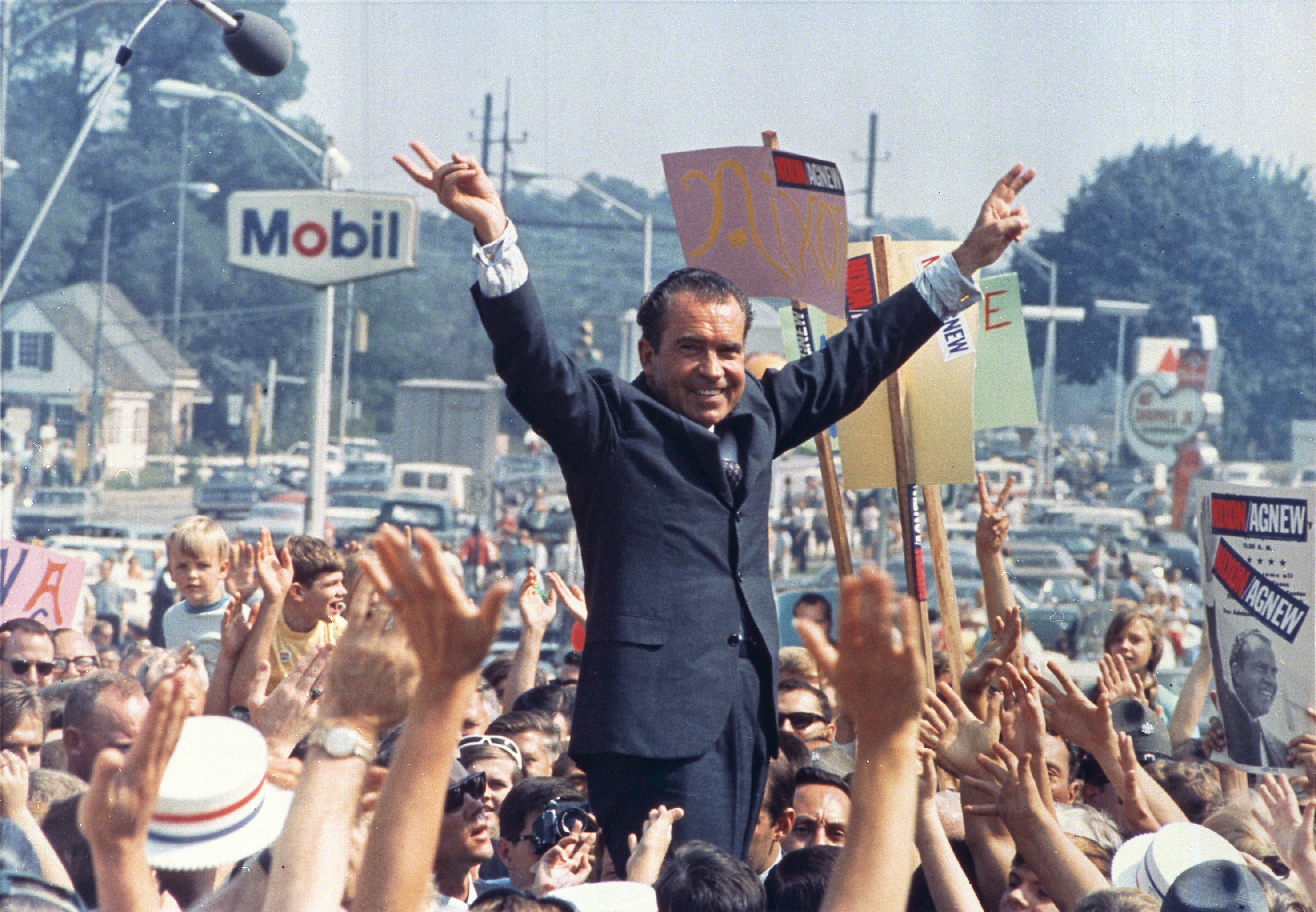
A prime example of Nixon's wedge-driving

Rick Perlstein's Nixonland might be my favorite entry in his mammoth four volume history of the conservative movement's rise from the days of Goldwater to the Reagan Dawn. His key insight is that Nixon intentionally made pre-existing divisions in America even starker, then won elections by making sure that the bigger chunk of the divided nation was on his side. Until Watergate, this strategy worked remarkably well, propelling him to a massive landslide in 1972.

The point of the book was that our politics have been stuck in Nixonland ever since. It came out in 2008, at the end of the Bush years. Karl Rove had used the Nixon strategy very well, incorporating homophobia to make gay marriage a wedge issue in 2004 and portraying anyone opposed to the invasion of Iraq as a hater of America. Those same tactics served Republicans well when they unleashed the Tea Party in 2010, effectively hobbling the Obama administration for its last six years. 

Nowadays, however, it seems that Republicans can only win by gaming the system and suppressing the vote. Bush's win in 2004 was the only time a Republican presidential candidate has won the popular vote since his pappy won back in 1988. That certainly explains efforts to manipulate elections in Georgia. 

However, it also emerged this week that the Republicans are planning a political strategy based on the culture war, as opposed to policy. Some have mocked this, but I see it merely as the continuation of the one reliable strategy Republicans have had for the past fifty years. Some are puzzled that they are calling themselves a "working class party" while failing to do anything to materially improve people's lives. They forget that the Nixon strategy depends on resentment, on saying Republicans are protecting good people against the elites. They don't mean the economic elite, whom they wish to shower with tax breaks, but the "cultural elite." Anti-university, anti-trans, anti-environmentalism, and anti-anti-racism all fit into this. 

I do not scoff at this gambit because it has worked in the past and also because it represents to much potential harm to vulnerable people in this country. The question I keep asking is whether it can still work after all these years. Will this be the time that Republicans intentionally drive the wedge, only to find themselves stuck with the lesser part? 

Demographic and political shifts seem to indicate that ground has shifted enough that Republicans just might play themselves. This is not the late 20th century anymore. Church attendance is dropping, making appeals to "traditional values" less effective. Younger people are far more progressive now than when I was young. The attacks on 1/6 have made it impossible for conservative reactionaries to pretend that opposition to democracy itself is not at their core. 

And that's what scares me, since the wedge-driving isn't happening in a vacuum. Republicans might be grabbing the smaller half of the population, but gerrymandering, voter suppression, and the electoral college mean that they don't actually need to win over the majority. In that sense we are no longer living in Nixonland, but in a place somehow far worse. 

Friday, August 9, 2019

Nixon's Resignation, 45 Years On

Take a good look at this because something like it will never happen again

I have been obsessed with Richard Nixon and his times since I was young. I blame the box of my uncle's old Mad magazines from the early 70s that sat in my grandparents' basement. Through them I saw Nixon and Agnew skewered, but also glimpses of a not long ago world that seemed so much more volatile and interesting than the height of the Reagan years I was living through.

I was fascinated at how a man could be President of the United States and yet be so despised. In the 80s Mad was critical of Reagan, too, but the intensity of contempt towards Nixon was something deeper. Then, in doldrums of the summer of 1992 one TV network (I forget which) ran a special on the anniversary of the Watergate break-in. Seeing the story laid out there before me only interested me more, and my interest continued even as I went on to grad school studying nineteenth century Germany instead of America in the 70s (which is now my field of choice.) Books like Nixon at the Movies became my refuge from my dissertation research.

Back in 1992 Watergate was not the distant past, it was a thing that happened the day before yesterday, so to speak. Now, as my middle aged self hates to admit, the 1990s are now the day before yesterday and the 1970s are fading into the distant past. Because of the scandals around Donald Trump, that history has been resurrected. Watch MSNBC on any given night and you might see John Dean or one of the Watergate lawyers on to talk about the current president. All the President's Men has been on TV quite a lot in the last year.

I fear that these comparisons are creating a false sense of security. People who believe in the justice of the current political system MUST trust that the system will work, that good will triumph and evil will be rebuked. That helps explain the ridiculous cult in some circles around Robert Mueller, who was supposed to be the avatar of our institutions' worthiness. History is something that does work in the present, and the work of Watergate comparisons today has only fed complacency. If a corrupt president got taken down before, it will happen again.

It's not going to work out like that this time. I guarantee you that Trump will never resign. There is an outside chance that he could removed through impeachment, but only if the makeup of the Senate dramatically changes, which is highly unlikely. The comparisons fail to take into account the ways America has changed over the last four decades. Richard Nixon's party was in the minority in both houses. More than that, members of his party were more likely to put principle and the law above their devotion to their president. The current Republican Party is a gang of right-wing Bolsheviks who take a strict "end justifies the means" praxis to the extent where they suppress votes and gerrymander districts down to the city block.

Beyond having a majority in the Senate that will follow him to the gates of hell, Trump benefits from a vastly altered media landscape. Fox News (started by Nixon operative Roger Ailes) and other forms of conservative media have created an alternate reality where the president's crimes simply do not exist. His administration and Fox work hand in glove, forming the biggest and most effective state propaganda apparatus this country has seen since World War II. That media has also fed into the "all or nothing" mentality that now dominates the electorate. In our low grade civil war the other side can never be allowed to win, no matter the reason. In 1974 Republicans could admit that the president was a crook. To do so nowadays would be to impugn their very identity and so cannot be done. (Just think about how guns have become an extension of identity for conservatives, and you'll get my drift.)

Ironically, Watergate's "lesson" for those in power has mainly been that they will never be brought to account. Ford infamously pardoned Nixon for "any crimes he may have committed," robbing the country of justice and even a full accounting of what he had done. Future leaders understood the usefulness of "plausible deniability" so that they would not get caught. This is what saved Reagan during the Iran-Contra scandal and Chris Christie during the Bridgegate scandal and Dick Cheney in the Valerie Plane affair (remember that?). Dubya started an illegal war on false pretenses that has killed thousands and he gets to paint in his mansion.

It's high time that we stop using Watergate's history as a way to praise our institutions. Instead we need to reckon with our failure to hold our leaders accountable since that fateful day in 1974.

Friday, December 7, 2018

An Overlooked Legacy Of Watergate

Sadly the only prison Nixon went to was the one in his mind

Today brought the clearest evidence yet that not only has Donald Trump committed felonies (we all knew that already, of course), but that federal prosecutors are willing to say that he did, and that in addition to this his team was petitioning Russia for help as far back as 2015. The president signaled this was coming with an epically unhinged temper tantrum on Twitter this morning. This day he also finally put forth a name for a new AG, a man who will presumably try to curtail investigations into his behavior. His former Secretary of State also gave an interview where he basically said that Trump constantly wanted to commit illegal acts and seemed unaware of legal restrictions.

A felonious president flying off the handle and desperately filling the Justice Department with lackeys to protect himself against an ever-growing criminal investigation sounds an awful lot like Watergate. (This is not an original observation.) As Marx said, history repeats itself, first as tragedy, then as farce.

A lot of other people have been thinking so, too. Rachel Maddow's excellent Bag Man podcast did a deep dive into the wrongdoings of Spiro Agnew, which are oft forgotten in the shadow of Nixon's greater malfeasance. Listening to that podcast I thought a lot of how the ghosts of Watergate keep coming back to haunt us.

Decisions were made by politicians and prosecutors at the time that we are still living with. Agnew's criminality was truly staggering. Not only had he taken kickbacks as governor of Maryland, he was still getting cash-filled envelopes in the White House! He also directed federal contracts to the men paying him off. In order to get him out of office as quickly as possible so that he would not succeed his criminal boss Nixon, prosecutors allowed Agnew to resign without going to jail.

The precedent that members of the White House not pay the true price of their actions was solidified when Gerald Ford granted Nixon a full pardon before he had been convicted or even tried of something. While Ford thought that he was removing a distraction from a paralyzed nation beset by economic decline and the end of Vietnam, he essentially established that presidents and their operatives would never actually be held accountable for their illegal actions in a court of law.

Just consider the Iran-Contra affair of the 1980s. This was another clear-cut case of presidential law-breaking. While it was done on behalf of policy goals instead of maintaining political power, selling arms to Iran to give money to the Contras was illegal on its face. Reagan and Bush never really had to face the music, and Bush would issue pardons for those involved. The nation mostly moved on.

In the 2000s the George W Bush administration lied the country into war in Iraq and engaged in torture. There was never even really an attempt to do much to punish those responsible. By that time the immunity of the White House to prosecution was pretty much accepted. Trump's crimes present an opportunity to break this cycle.

We talk a lot about the legacy of Watergate being that Americans do not trust the government, but the more consequential legacy is that America is a country where the president's quasi-monarchical status goes beyond expensive state funerals and ceremonial frippery to being above criminal prosecution. This thought must be in the back of Trump's mind today as he prepares a defense against the coming legal onslaught.

America desperately needs to get over this taboo of locking presidents and their minions up. Other democracies do not have this hang-up, and they are all the better for it. Just witness the recent imprisonment of Park Geun-hye in South Korea. The prospect of Trump's imprisonment is no mere legal fantasy, it actually might be crucial to ensuring the future health of our democracy.


Thursday, February 16, 2017

Stop Pretending Impeachment Is Easy Or A Foregone Conclusion

Nixon drunk-dialing his former chief of staff Bob Haldeman on the day of the latter's resignation is one of my favorite things. It took over another year for Watergate to run its course.

In the wake of the Flynn scandal, a lot of liberals and progressives have been joyously discussing the possibility of impeachment, or even the fatuous notion that we will have an election "do over." Sorry folks, I'm here throw a bucket of cold water on you. As a historian, that's kinda my job.

As to the "do over," there's absolutely no constitutional precedent for that, so just stop talking about it like it's a thing. As to impeachment, it should never be discussed as if it were something easy to do. No president has been removed from office via impeachment. Andrew Johnson and Bill Clinton were impeached but survived the process, and Nixon resigned before impeachment proceedings could be voted on. I am pretty sure Nixon would have been impeached and removed from office, so I guess I'll let you have one example of a successful impeachment.

My point is that it is almost impossible to pull off. It is beyond impossible if the president's party is in control of Congress, which means you should just stop thinking Trump will be impeached before the next midterm election. It won't happen. It's much more likely that a 25th Amendment scenario happens, but I doubt that'll happen, either. Paul Ryan is creaming his shorts about the prospect of eliminating the social safety net, and if Trump is a vessel for that, so be it. I've said it before, I'll say it again: there's no such thing as "Trump voters" anymore, only Republicans, and Trump is putting forth an aggressively Republican agenda.

So let's say the Democrats manage to win back Congress in 2018. (I'm not holding my breath.) The process behind impeachment is extremely time-consuming. The early Watergate allegations against Nixon started getting serious in January of 1973. He would not resign until a year and half later, in August of 1974. That was even with a Democratic congress. Nixon did everything he could to slow down the process. Later presidents learned from this scandal to make it even more difficult to unseat them. For example, in the Iran-Contra Scandal of the 1980s, Oliver North merely shredded the relevant documents, destroying the evidence. I imagine Trump has minions willing to take the fall, too.

I don't like this impeachment talk because it is yet another wish for the salvation to come miraculously come from on high and end Trump's rule. That simply is not going to happen. Instead of waiting for a miracle, we need to be out there opposing Trump tooth and nail. We need to fight like hell in 2018. We need to keep up the pressure. We need to put our bodies on the line, if need be. The legal processes of this country installed Trump in power, start trusting yourself instead of trusting them for a change.

Wednesday, July 13, 2016

1968 And Using Historical Metaphors

Like it or not, we're still in his world

There's been a lot of talk comparing the current election year to 1968, which has me thinking about the right and wrong ways to use historical metaphors. They can be put to deadly effect, after all. During the run-up to the invasion of Iraq in 2003, the ghosts of the Munich Conference of 1938 were constantly being invoked. The "lesson" to learn was that the dictator Hussein had to be stopped. Of course, the comparison was ridiculous, since Hussein did not have designs on expansion, as Hitler did in 1938. Nevertheless, it worked.

Comparisons of 2016 to 1968 are more valid, but also overstate things. We are seeing a great amount of social upheaval this year, but not like 1968's assassinations, burning of cities, and the raging of the Vietnam War. This does not mean that we can't learn anything from looking at 1968, but just to be aware that we are living in different times. The mass shootings of today were little known in 1968, apart from Charles Whitman's infamous actions in 1966. While Trump's campaign resembles that of George Wallace's that year, he has been running mostly on immigration, which was not a big political issue in 1968. While Trump has been borrowing Nixon's "law and order" rhetoric (which Wallace first pioneered), he does not have Nixon's ability to appeal to a new constituency, since Trump's main appeals are to constituencies that Nixon won over to the Republicans in '68 (white Southerners and white working class more broadly.) The Democrats, despite recent events, are much much more unified now compared to 1968, as yesterday's endorsement of Clinton by Sanders shows.

We are in very different times, but there are themes we can see both in 1968 and 2016: mass uprisings against racism, populist white nationalist backlash, major political party realignments, and a feeling that violence has become uncontrollable. What we are seeing in some respects is less a repeat of 1968 and more the consequences of its unresolved aftermath. As a recent book by Elizabeth Hinton shows, the urban uprisings and increased crime rates led to a massively increased police presence in black neighborhoods, and a feeling among white politicians that attempts to improve the economic prospects of inner city residents, as pioneered by the Great Society, ought to be scrapped because the dysfunction of their targets was too deep to correct. The current mass incarceration, militarized police, and death tolls from killer cops are the legacy of the failed and inhuman response to the urban uprisings of 1968.

Our politics also bear the scars of the late 1960s. As Rick Perlstein points out in his brilliant work Nixonland, Nixon gained power by exploiting the cleavages in American society brought on by the 1960s. By villainizing one side of the divide he knew he could unite the other side, and knew at that time his side was going to be bigger. That redefined our politics in a society where those cleavages over race, religion, and culture have become deeper and more intense with each year. "Liberals" came to stand in for everything wrong and evil and America, and they and their agenda had to be destroyed. This, not supply side economics, is the true heart of modern conservatism, and explains why Congress has taken the unprecedented step of refusing to vote on the president's nominee to the Supreme Court. Thwarting liberals has become the sum total of their political program. It's the same reason why so many rank and file Republicans who seem to really dislike Trump and even find him dangerous are still rallying around him.

2016 is not 1968, but we are very much living in the world that the upheavals of 1968 created. Time will tell if 2016 will be the year that takes a new direction, or keeps progressing toward the breaking point.

Wednesday, September 2, 2015

My Nixon Obsession

This fear-mongering Nixon ad is perhaps the ur-text of modern conservatism

I have had for many, many years now an inordinate obsession with Richard Nixon.  I think it started when I was a child in the 80s, and I would look through my uncle's old Mad magazines from the late 60s and early 1970s when I visited my grandparents' house.  They were merciless to him, and from those old magazines I began to develop both a more cynical eye and an understanding that Nixon had been a nefarious president.  In grad school, when I should have been spending all of my time on my dissertation on nineteenth century German history, I was also checking out books from the library like Nixon At The Movies.  (It is a must read for Nixonologists and fans of film from that era.)

That interest continues to this day.  I just recently got an early birthday present from my wife, a copy of Tim Weiner's new One Man Against The World: The Tragedy Of Richard Nixon, and have been enjoying it.  One of my absolute favorite Twitter feeds is @dick_nixon, which speaks in the voice of Nixon as if he were alive today.  The author masterfully replicates his tone and opinions, and gives me a pretty accurate picture of how the man would be responding to today's events.

None of this, of course, explains why I have been able to maintain this obsession.  Deep down, I think it had to do with the fact that he perfectly represents the American dream's dark side.  Nixon came from a poor rural family but managed to go to Duke law school.  Afterwards he could not get a job at any of the top New York law firms, despite his obvious intelligence and ability.  That gave him a lifelong hatred of the Ivy League establishment, a sentiment I share to a less unhinged extent.  (People who act as if the they are to the manner born and get high positions of power despite being complete mediocrities make my blood boil.)  Nixon, using the dogged tenacity of a Horatio Alger character, pushed his way into politics, taking down Alger Hiss and getting elected vice-president before the age of forty.  He then lived out the drama of rejection and redemption, so beloved in Hollywood films.  Nixon lost the 1960 election, was soundly beaten in his bid to be governor of California in 1962, and ended his post-defeat press conference with a bridge-burning tirade at the assembled reports.  Six years later, after working tirelessly to assemble donors and supporters, he managed to make a comeback and get elected president.    While president he managed to make major diplomatic breakthroughs with China and the USSR and managed to win reelection in 1972 with a massive landslide.

Of course, the seeds of his downfall had been sewn by a "third rate burglary" at the Watergate Hotel and by a whole host of related, illegal activities on his part.  To go from a resounding reelection to resigning in disgrace less than two years later is an amazing story.  (Relatedly, he proclaimed "peace with honor" in 1973, which was followed two years later by the fall of Saigon.)  What makes it interesting to me is that Nixon did it to himself through his paranoia and negativity.  He was so insecure about beating McGovern that he resorted to illegal tricks and financing when there was absolutely no need.  He spent several years continuing the war in Vietnam only to get a settlement that he could have achieved on his first day in office.

His negativity drove him to great heights, and it also dragged him down, quite a story.  It's also scary if you think about it, because the thought of what Nixon could have done without his self-destruction is rather frightening.  Even with his time in office cut short he illegally expanded the war in Southeast Asia, used the FBI to attack political dissenters like the Black Panthers, manipulated elections through his associates' "ratfucking," had his cronies break into the office of whistleblower Daniel Ellsburg's psychiatrist, supported the coup against Allende in Chile, and took massive and illegal campaign donations in what basically amounted to bribery.  (People who say other presidents who abused power were "just as bad" as Nixon are fools.)  The man who did this was elected president twice, and the second time his opponent only won one state and DC.  If anything, Nixon is a symbol of how a malevolent authoritarian can not only take over the reigns of the American government and wield power, but do so with the mass approval of the voters.  Who would not be obsessed with that?

Thursday, April 30, 2015

A Footnote On Baltimore and History


My last post discussed the importance of knowing history to understand the protests in Baltimore, but over the last few days I've been thinking that knowing history is also necessary to understanding the backlash against them.

One of my favorite Twitter accounts is of someone embodying (you really can't say parodying) Richard Nixon, and tweeting as if the Dark Lord were still alive, commenting on current events.  Having an unhealthy obsession with Nixon, I can vouch for the accuracy of the tweets, which have got me thinking about how Tricky Dick used white racial resentment to overpowering affect in the 1968 election.  George Wallace, running as a third party candidate, made such appeals more overtly, getting support not just in the Deep South.  Nixon could claim to be more palatable than Wallace, all the while touting "law and order."

His campaign ads in '68 trumpeted this theme time and time again.  One ad, juxtaposing Nixon's words with scenes of violence in the streets and bloodied protestors over discordant music, ends with Nixon intoning "the first civil right of every American is to be free from domestic violence, and so I pledge to you, we shall have order in the United States."  The uprisings in the ghettoes were, in this interpretation, to be seen merely as chaos to be stopped, not the result of legitimate grievances.  The whites who made up Nixon's "Silent Majority" felt the same way, and rewarded him with the White House.  Once in office, Nixon supported the FBI's infamous COINTELPRO campaign, which set out to destroy the Black Panthers and similar organizations by any means necessary.

That did not necessarily have to be.  The Kerner Commission, set up by LBJ to investigate the causes of the destructive urban uprisings of 1967 in Newark and Detroit (among other cities), concluded in its 1968 report that racism and economic privation were at the heart of the matter.  Instead of addressing these problems head on, the government kept spending money to send more young men from the ghettoes to die in Vietnam, and Nixon unleashed the FBI.  In the ensuing decades, as I mentioned a couple of days ago, the War on Drugs and the prison industrial complex made the backlash even worse.

Today I fear a repeat of the past.  So many in white America are still blind to the reasons why African Americans in Baltimore are so upset, and that blindness is on the tipping point of becoming fear.  When white America's racial fear buttons get pushed, bad bad things happen.  There's always another Nixon there, ready to exploit it.  The key this time is for right thinking people to be prepared to fight back.

Tuesday, December 2, 2014

Nixonland


I'm borrowing the title of this post from Rick Perlstein's stellar political history of America from 1965 to 1972.  He began his book about Nixon's rise to power with the 1965 unrest in Watts, and how the reaction to it helped get the likes of Ronald Reagan elected governor of California.  Perlstein deftly pointed out how Nixon used the social divisions of the 1960s, and especially white fears about newly emboldened blacks, to gain and consolidate power.  That original insight of Nixon's has been used by conservatives ever since, from Reagan's talk of "welfare queens" to the War on Drugs to George HW Bush's Willie Horton ad to Fox News' obsession with the New Black Panther Party.

Nixon's calls for "law and order" in the wake of sixties protest set the stage for a now forty-five year escalation of police force and power.  (His associating his opponents with disorder and chaos was most flagrantly expressed in his 1968 campaign's "Convention" ad.)  This escalation has led to America incarcerating its people at a higher level than any other nation in the world and police forces that have been placed above the law.  If you ask me, this is part and parcel of the neoliberal project.  Supply-side economics inevitably means misery for the poor and working class, and to prevent unrest in those quarters, its members have been thrown in jail.  Prisons are then privatized, leading to yet another boon for the wealthy.

The protests related to Ferguson are crucially important for a lot of reasons.  Ultimately, I feel that they are a true challenge to the aforementioned forty-five year counterrevolution, one whose violence has fallen hardest on African Americans.  In response to the protests, the Silent Majority has reared its ugly head yet again.  Since the Clinton era, Democrats have been trying to out-police the Republicans, hoping never again to be accused of being soft on crime.   The broad white middle class population has thus accepted the logic of the counterrevolution, regardless of political party.  Now that the four decade counterrevolution is being challenged, and policing seriously questioned on a national level, they are lashing out.  Just take a look at the anger provoked by the St. Louis Rams when they dared to quietly and peacefully acknowledge the Ferguson protests when they took the field this Sunday.

We are truly at a crossroads.  This country could finally break the spell of that old sorcerer Richard Nixon and repudiate our draconian, unjust, cruel, and racist justice system.  Or it could double down and stay on the same course.  We're still living in Nixonland, but I can only hope not for much longer, even though it looks like the Silent Majority is still alive and kicking.

Friday, January 17, 2014

Have The Republicans Lost Nixon's "New American Majority"?

In a two party democracy, the major parties are inevitably coalitions of disparate groups, not ideologically pure or monochromatic.  From the 1930s to the 1970s Democrats dominated national politics due to the power of the so-called New Deal coalition, an unlikely combination of Southern whites, educated liberals, African-Americans, and blue collar workers.

Richard Nixon's landslide victory in 1972 pointed to the fragility of that coalition, which was definitively broken apart after Reagan's victory in 1980.  Nixon is known for his rhetoric about the "Silent Majority," which he also termed the "New American Majority."  He skillfully courted the unions, Southern whites, the suburbs, and urban white ethnics so crucial to his crushing victory in 1972.  To do so, Nixon exploited the fears of those who were confused or angry about the changes of the 1960s, and who resented the counterculture, war protestors, and growing racial equality.  Others have noted that the Republican party has increasingly become a white people's party, that trend stretched back to Nixon's "Southern Strategy" and the ways Republicans threw their doors open to the likes of Strom Thurmond and Jesse Helms.

Back then, the racial demographics were firmly on the Republicans' side.  If they were going to win a majority of white people, they would likely win the presidential election.  Reagan knew this too, hence his defense of "states rights" in 1980 in Mississippi and constant talk of "welfare queens" driving Cadillacs during that same election.  By that time evangelicals too had entered the fray as a newly powerful force for conservatives.  Calls for low taxes, flag waving, "law and order," and "family values" combined to give conservatives at least one issue that appealed to a great number of the white voters who were once loyal Democrats who might not have bought into the supply side snake oil.

It appears nowadays that just as the Democrats lost their coalition, the Republicans are losing theirs, too.  One reason, of course, is that the country is much less white than it used to be.  This change has been used to powerful effect to whip up Tea Party resentment against president Obama, but will be a diminishing return because the audience for this rhetoric is getting older and older.  Some Republicans are smart enough to realize this, and are desperately pushing forward not ready for prime-time (but brown-skinned) pols like Jindal and Rubio, and are backing immigration reform to court the Latino vote.  Their Tea Party base, intent on xenophobia, is not letting the savvier heads get their way.  Romney won a majority of white voters (including white women), but still lost the election very definitively.

Other factors are under-cutting the old majority as well.  By obsessing over ideological purity, Republicans are making it difficult to build a broad coalition in the first place.  The GOP's need to placate its religious wing is increasingly alienating younger voters who are much more secular than their forebears.  That trend will only continue.  Many of the social issues they used to peel off Democrats in the past, such as abortion, gay rights, drugs, and narrowing the church-state separation are   no longer as potent, and actually work against conservatives.  In essence, the culture wars are backfiring on their biggest warriors.  Last, the growth of cities and decline of suburbs, as well as the changing demographics of suburbs are working against conservatives, not to mention that rural America has entered permanent decline.

The question is whether Republicans can fight a rearguard action to avoid becoming a marginal, white/rural/Christian identity-politics party buoyed by corporate dough.  One thing that now is clear is that the coalition that had been so successful for conservatives going back to Nixon is breaking apart and dwindling in number.  Maybe, just maybe, a major political sea change is in the offing.