Showing posts with label Civil War. Show all posts

Monday, July 15, 2019

Modern Day McClellans

The vacillating spirit of McClellan is alive today in the Democratic Party's leadership

Like a lot of American boys who get into history at a young age, I immersed myself heavily in the Civil War as a child. Once I was older and became a professional historian I distanced myself from the topic, which I thought of as being overrun by hobbyists and "buffs" who were overly invested in arcane minutiae. In the past few years, however, I have found myself obsessed again, but this time with the political and social histories of the war (as well as with Reconstruction.) 

I keep finding echoes of those histories in the present day. The biggest I see is with how both leaders and common people in the North radically reframed their understanding of the war as it went along. Lincoln's first inaugural speech, coming hot on the heels of secession, promised the South that he would not interfere with slavery where it currently existed. His second inaugural, coming as victory in the war was in sight, deemed slavery a moral evil and the Civil War as God's punishment on a guilty nation. 

I see a parallel in the ways that those Americans opposed to Trump, who is a political descendant of the Confederacy, are fighting him. Some understand that this is a fight where the enemy is simply not going to give up or play fair. They also know that the only forward is not getting back to the way it used to be, but to have, in the words of Lincoln at Gettysburg, a "new birth of freedom." Politicians like Elizabeth Warren, Bernie Sanders, Alexandra Ocasio-Cortez, and others seem to get this.

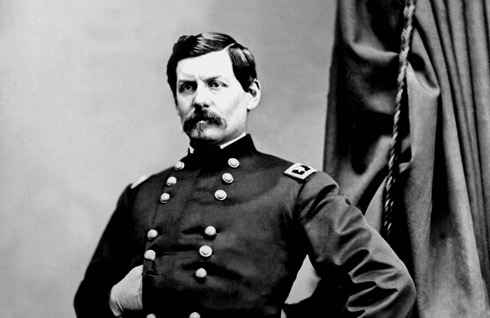
On the other hand, there are plenty of modern day McClellans. George McClellan was able to organize the Army of the Potomac into a disciplined fighting force, but was unwilling to actually USE that force. He was also contemptuous of the notion that the war was about anything other than restoring the Union, and when he ran for president in 1864 that included the willingness to allow the South back into the Union without the elimination of slavery. 

The parallels are not absolute, but I see a lot of McClellan in Nancy Pelosi, Chuck Schumer, and other Democratic Party leaders. Their current strategy is simply to wait Trump out. Like McClellan refusing to advance in the Peninsula Campaign when he had the advantage, they think by not fighting they will somehow win, and that fighting is too much of a risk. So they sit on their hands, and refuse to impeach a president who only responds with more violations of the Constitution. They attack the left wing of their own party, fearing that they will alienate a few retired white auto workers in Ohio while ignoring the masses of people of color, and youth of all races who support their policies but often feel alienated from the party. 

The Union army finally emerged victorious under the leadership of Grant, who understood that winning was going to require more sacrifice and more fighting. It meant fighting a different kind of war, one whose intensity matched what the situation demanded. When his methods came under criticism, Lincoln defended him, declaring that "he fights." Grant himself understood that the Union's fearful, defensive posture needed to stop. He famously told his generals soon after taking command that they needed to stop worrying about what Robert E Lee was going to do to them, but what THEY were going to do to Robert E Lee. 

That's something that the Democratic leadership could learn from. The Republican caucus is full of members like Gohmert and Gaetz who are FAR more outside of the political mainstream than folks like Ocasio-Cortez. Expanded health care, legal abortion, gun control, subsidized child care, and debt relief are all popular positions. Democrats need to run proudly on these positions and take the fight to the other side. If the current leadership does not understand that reality, they need to get out of the way.

Wednesday, August 16, 2017

Media Talking Points From A Scholar Of Historical Memory


My dissertation was about historical memory, and I have written plenty of scholarship and taught classes about it. For that reason, it is extremely irritating to look at the discourse around the removal of Confederate monuments and not see any scholars of memory featured prominently in the media. Since I won't be asked to go on CNN, here are some handy talking points you can use in your conversations with other folks.

Monuments are about creating a "usable past."
Folks who are in the middle seem most convinced by the argument that taking down these monuments is somehow "denying history" or "eliminating history." It is easy to understand why this argument appeals to (white) people with a low-stakes interest in this issue, but it doesn't hold water. Monuments as part of public memory are an attempt to create a "usable past." They are a way to create an interpretation of the past that is given an official stamp of approval. This is why you don't see massive public monuments celebrating emancipation in this country, but plenty of them in Caribbean nations where the population is mostly black.

Confederate monuments created a white supremacist usable past.
Other people have written about this, but it bears repeating: the vast majority of Civil War monuments in the South were built during the height of Jim Crow. They were not immediate responses to the war. They are also intended to push a certain interpretation of the war, the "Lost Cause." This narrative essentially said that the white South was the superior side fighting for a just cause, and only lost due to the material superiority of the Union. These monuments defended the old slaveocracy at a time when lynchings and other incidents of racial violence were accelerating. By being erected after Reconstruction and during Jim Crow, they are not mourning a defeat in the Civil War, but actually celebrating the victory of white supremacy in its aftermath. Context matters.

There is plenty of precedent for tearing down monuments.
This is something we know, but it bears repeating. The same people today saying that tearing down Confederate monuments is "destroying history" did not complain when statues of Lenin and Stalin were eliminated during the revolutions in the Eastern Bloc. Those monuments were symbols of hated, repressive regimes. The same goes for Confederate monuments. They are the symbols of white supremacy. Hell, American colonists in New York famously tore down a statue of King George III, and melted it into cannon balls. This event was celebrated in my history textbooks in school. No one seems to be crying any tears over the loss of that statue. We are not bound to the usable pasts created by people who lived a hundred years ago.

We should view this moment as a time for positive change.
While it is good to tear down monuments to white supremacy, we should be thinking about the usable pasts of this country that would be preferable. For example, Union monuments built in the North were also built during a time of intense white supremacy. While these monuments obviously do not celebrate the defense of slavery, they rarely, if ever, mention it. This is due to the "reunionist" feeling at the time where the memory of the Civil War eliminated its political causes, and instead the reuniting of the country was emphasized. Of course, this meant erasing African Americans from this history, and essentially accept a reunited nation for white people only. In North and South we need more public memory of slavery, and the role of slavery in the Civil War. We should use this moment to create a usable past that is more inclusive and more honest about this country's history.

Sunday, May 28, 2017

Keep The Civil War In Memorial Day

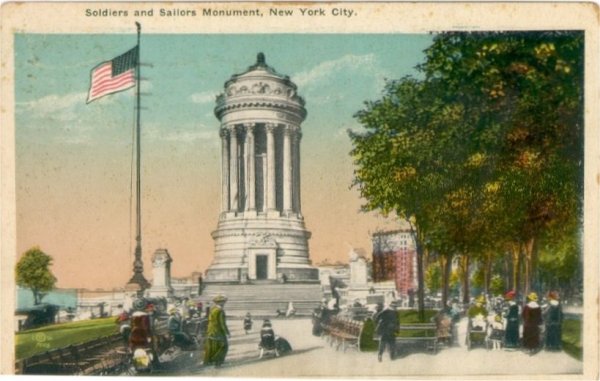
The Soldiers and Sailors Monument is rotting while Jefferson Davis' statues gleam across the South

Memorial Day is the one national holiday this country has connected to its most consequential event, the Civil War. You wouldn't know that, however, since it has been turned into a day to kick off summer, or has been co-opted as a day to express loyalty to veterans and the military. I don't want to be the pedant who has to say this, but I will: Memorial Day has NOTHING to do with veterans or people currently serving in the armed forces. It is a day to honor the dead of America's wars.

The Civil War, which took the lives of 2% of the entire country's population, required some kind of way to make sense of such immense loss. Already right after the war in May of 1865 freedmen and freedwomen in Charleston, South Carolina, honored the Union dead as a way to acknowledge the sacrifice that they had made for their freedom. While Memorial Day would not exist in an official capacity until 1868, the early, unofficial celebrations like the one in Charlestown demonstrated the desire to commemorate the dead.

It is time that we do more to acknowledge the memory of the Civil War from the viewpoint of the Union. While I whole-heartedly support the removal of Confederate monuments, that necessary work does not build up a positive counter-narrative. The Civil War monuments in the North have languished. Just go check out the graffitied and decrepit Soldiers and Sailors Monument in the Upper West Side of New York. That needs to change.

We need to remember the immense sacrifice necessary to end slavery and reunite the country. We need to remember the heroic deeds of slaves, who were the primary actors in the story of their emancipation. We need to stop seeing the Civil War through the frame of "brother against brother" and (even worse) "tragedy." And I think we should also use this day also to remember Reconstruction, and those who perished trying to improve the lives of African Americans. We need to remember that much struggle still needs to happen.

I think Lincoln's words in Gettysburg are still unequaled, and should be the basis of our commemorations on Memorial Day.
It is for us the living, rather, to be dedicated here to the unfinished work which they who fought here have thus far so nobly advanced. It is rather for us to be here dedicated to the great task remaining before us -- that from these honored dead we take increased devotion to that cause for which they gave the last full measure of devotion -- that we here highly resolve that these dead shall not have died in vain -- that this nation, under God, shall have a new birth of freedom -- and that government of the people, by the people, for the people, shall not perish from the earth.

Wednesday, June 24, 2015

The Need For A Civil War Memory Offensive

New York's Soldiers and Sailors Monument back when the living memory of the Civil War could visit it

If you travel to the Upper West Side of Manhattan and stroll along the paths in Riverside Park, you might come across two massive monuments to the Civil War: the Soldiers and Sailors Monument, and Grant's Tomb.  The former is a towering structure honoring the Union troops who served in the war, a Beaux Arts beauty in its time that now looks awful today with cracks, weeds, and poorly covered-up graffiti.  Grant's Tomb has been cleaned up, but this gorgeous monument (built with the help of fund raising by the grateful African American community in New York City) is barely kept open by the National Park Service.  If you travel to the South, you'll notice that similar monuments to the Confederacy are kept in gleaming shape, and even battlefields managed by the National Park Service will have museums that include varieties of reunionist and even Lost Cause ideology.  (Surprisingly enough, the museum in Vicksburg is not like this at all.)

There has been a lot of needed discussion in the aftermath of the Charleston terror attack about the Confederate battle flag.  I think that discussion needs to be converted into a Civil War memory offensive.  Ignorant people have been free to believe that the flag is a benign symbol of "southern pride" because those who sympathize with the Confederacy have had an inordinate influence on public memory of the Civil War.  Just witness Shelby Foote's heavy presence in the Ken Burns Civil War documentary, where he gave great praise to slave trader, war criminal, and Klan founder Nathan Bedford Forrest.  It has been so from the beginning, where 1915's infamous A Birth of a Nation presented a racist interpretation of the war and Reconstruction, and 1939's Gone with the Wind valorized slave-owners.

Those who rightfully sympathize with the Union cause (or more appropriately, the American cause) need to amplify their voices.  Many historians of the Civil War (rather than reenactor hobbyists) have been engaging with the public, more need to follow their example.  Teachers need to teach not just the battles, but the larger political and social aspects of the Civil War, and ground its causes without any doubt in slavery.  (Historians should assist in making materials that do this that teachers can use.)  Modern day Unionists need to do more to honor their own monuments, memorials, and heroes.  (I'm a fan of Ta-Nehisi Coates for many reasons, not least of which that he uses a photo of Grant as his Twitter avatar.)  Monuments like the Soldiers and Sailors Monument need to be repaired and used ceremonially.  (New York should also more formally memorialize the Draft Riots, but that's a whole other issue.)  In general, Reconstruction needs to be made much more legible to the public.  This crucial time in American history has been largely forgotten, and the few public narratives that exist still parrot a paler version of Birth of a Nation.

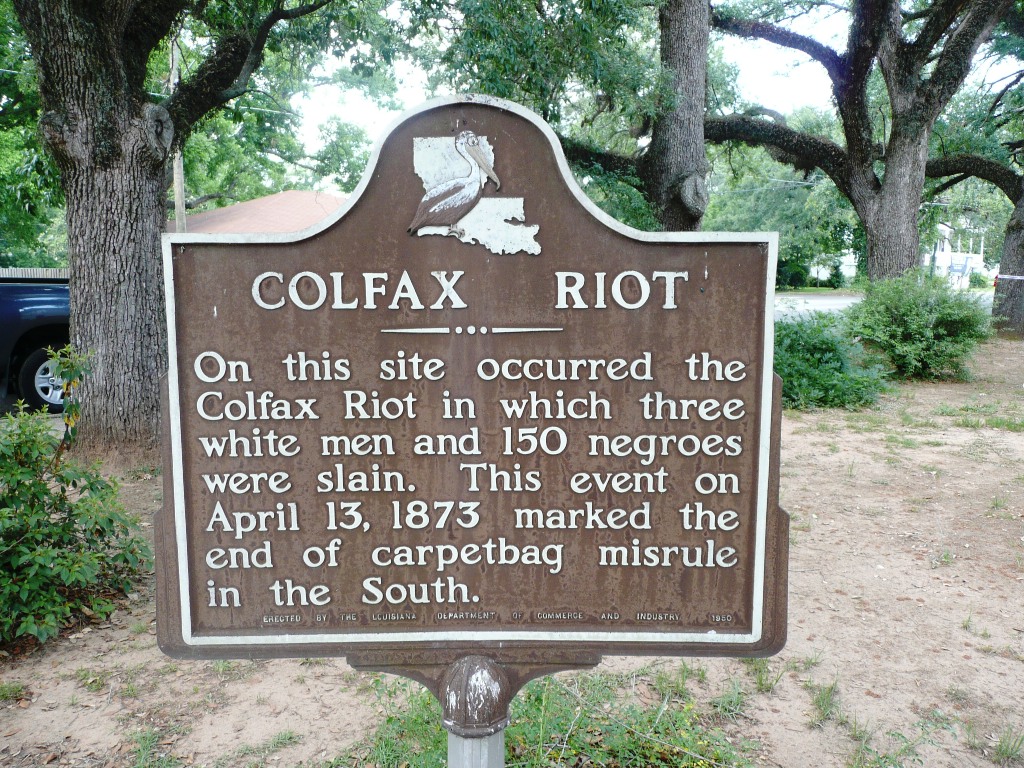
More importantly, many existing memorial sites related to Reconstruction and the Civil War need to be changed, and contemporary Unionists ought to fight for those changes.  For example, a friend of mine recently visited the site of the Colfax Massacre, a horrific act of violence perpetrated in 1873 by white supremacists against former slaves to destroy their political power.  This is what the state of Louisiana's official plaque looks like:


That's right, one of the worst incidents of lawless violence in this country's history is presented as a victory against tyranny.  It is absolutely disgusting that an event like Colfax is honored in this way.  This marker is only one of many valorizing white supremacy and its accompanying violence.  Yes, take down that traitorous, blood-soaked flag and burn it.  But also rip the historical narratives rooting that flag right out of the damn ground.

Monday, July 1, 2013

Looking At Gettysburg 150 Years On


When I was a child and first got into history, the Battle of Gettysburg, which took place 150 years ago today, really put its hooks in me.  There was a book on the topic that I checked out from the library several times that recreated the battle through the use miniatures, which I studied like the Torah.  The following summer after reading that book, my family took a road trip from our Nebraska home to Washington DC, and we stopped and spent a day at Gettysburg along the way.  There was possibly nothing that could have made 11 year old me any happier, apart from completing the series of Topps 1987 baseball cades I was furiously collecting at the time.

At the time, my understanding of battle contained nary a trace of politics or the realities of war.  I thought it was really cool and dramatic, and in the end the good guys won after being pushed to the limit.  A clue that the Civil War was more than a series of interesting events came later on the trip when my family was riding the Metro into DC from our suburban hotel.  My sister and I had bought souvenir Union soldier caps in Gettysburg, and she was wearing hers.  Some man on the train looked at her and said, "honey don't you know this is a Confederate state."  My father, needless to say, was livid, and I was confused.  Who on earth could possibly still be against the Union?  Weren't they fighting to defeat slavery and reunite the country?

That moment has stuck with me for twenty-six years now, and may well have been the first seed planted in my interest in historical memory.  I thought of that moment a lot when I read David Blight's superlative Race and Reunion, which explained how the narratives in my children's Civil War books came to be.  These books rarely, if ever, discussed slavery or African American soldiers.  My most-read Civil War book did not end with Reconstruction, but with Confederate general Joseph E. Johnston attending the funeral of his old rival, William Tecumseh Sherman.  In this telling, the war was an unfortunate conflict among brothers who quickly reconciled.

That narrative came out of strong impulses after Reconstruction to bury the reality of the Civil War's political nature.  Whites in the North and South were able to unite over their mutual hatred of blacks and support for white supremacy.  Each side was "honorable," and the role of African Americans erased.  The capstone, according to Blight, came in 1913, when president Woodrow Wilson traveled to Gettysburg for a 50th anniversary celebration that was racially exclusive and which emphasized the common American identity of the North and South.

Years further study taught me that the offhand comment made to my sister in the DC Metro got to the heart of the matter much more than any of my children's history books.  The Civil War was not just a series of battles and generals.  It was a contested revolution, and certainly not a "tragedy" or a conflict of "brother against brother" for the slaves who used it as an opportunity to seize their freedom.  It was not the romance I saw with my eleven-year old eyes, either.  About 2% of the entire American population perished in that war, most of them dying from disease rather than by falling valorously on the battlefield.  Prisoners of war starved, black soldiers in the Battle of the Crater and at Fort Pillow were the victims of the kind of war crimes prosecuted at Nuremberg, and the first blood of the war was not shed at Fort Sumter, but in the streets of Baltimore between Union troops and a pro-Confederate mob.  With that knowledge, I wonder, 150 years after the event, how we should view the Battle of Gettysburg today.

Gettysburg is the most important turning point in the Civil War.  As hard as so many books and films try to do, the battle cannot be understood outside of its broader context.  The battle was not some kind of opera, or a duel between honorable generals who were friends in peace, as the 1993 film Gettysburg would have it.  It was a horrific bloody slog that was the culmination of a failed invasion that threatened to bring about a Southern victory.  When Lee invaded North in 1863, he was taking the initiative after a string of victories ending with the Confederate triumph at Chancellorsville. With the Emancipation Proclamation going into effect, Lincoln signaled that his cause was not just to reunify the Union, but to dramatically alter it by destroying the institution of slavery.  Many Northern whites were appalled at this turn of events, including a number of Union soldiers who refused to continue fighting.  The mobs that would riot over the draft in New York City and "Copperhead" politicians like Clement Vallandigham were outraged that whites should fight and die for the freedom of blacks.  George McClellan, the former leader of the Army of the Potomac, had staunchly opposed emancipation, and even openly discussed leading a military coup before Lincoln dismissed him for the last time.

In the midst of the setbacks and strife, Lee invaded the North.  A successful invasion could very well have brought an end to the war on Southern terms.  The meaning of such a victory was pretty apparent in the behavior of Confederate troops in Pennsylvania: they kidnapped local African Americans and forced them into slavery.  By contrast, Union camps in the South drew in thousands of slaves seeking freedom, and many freedmen would go on to wear the Union uniform themselves and wreak vengeance upon the South.  Make no mistake, this was a war of clashing political ideologies, one intending to perpetuate slavery, the other to destroy it.  Gettysburg would determine whether the cause of emancipation could survive or not.

The battle itself, like most Civil War engagements, was a lot less romantic and dramatic than it has been portrayed.  Joshua Lawrence Chamberlain's creative counterattack with the 20th Maine on Little Round Top was probably much less important than it has been made out to be.  Pickett's Charge was not some kind of valiant gesture, but a stupid, prideful mistake by Lee that led to a large portion of his army being slaughtered like livestock.  As in all wars, common soldiers died for the mistakes of their superiors.  Everyone still talks about Chamberlain, but nobody really remembers General Dan Sickles' decision to move his men into an exposed position in the Peach Orchard where they were decimated all for the stupidity of their commanding officer.  War and battles are the last thing that ought to be romanticized.

As we all know, the Union scored a big victory at Gettysburg on July 3rd, 1863, and another one then next day when Vicksburg fell.  In lofty hindsight it was the turning point in the war, although Union troops from this very battlefield had to be sent to New York City to quell violent rioting a few days later.  On July 4th, 1863, the end of the conflict was still in doubt.  I still think that the ultimate summation of the meaning of what happened came in November of that year, when Lincoln gave his famous address.  It is a great misfortune that his words have been calcified and turned into fodder for memorization by school children.  We have lost the meaning of his words, which are quite profound.

Just imagine the scene.  Lincoln is giving his address at a cemetery, surrounded by the dead of a war he pushed to prosecute, a decision that must have weighed heavy on his soul.  That war was still raging, with no end in sight.  He had to make meaning of the sacrifice of the dead buried around him, both for himself and for his audience so that "these dead shall not have died in vain."  Lincoln tells his audience that the war is a war for a "new birth of freedom" and a crusade for democracy.  It is not a conflict to reunify the nation, but to forge a newer, better, and freer nation.  If the Confederate forces had been victorious at Gettysburg, a very different vision would have reigned.  That, dear friends, is how we ought to view the meaning of the Battle of Gettysburg today.
Friday, June 21, 2013

More Thoughts and Observations Gleaned From My Civil War Reading

As I've mentioned a couple of times here, I have developed a renewed interest in the history of the Civil War.  Now that I am no longer paid to be an expert in 19th-century German history, a subject I don't really care that much about anymore, I am free to indulge my actual interests without feeling guilty or hurting my career.  This has meant reading way too much on the topic, to the point where my knowledge of the current historiography on the Civil War rivals that of my former specialization.  That said, I am almost exclusively interested in the social and political side of the Civil War, rather than its battlefield aspects.  It's pretty obvious to me now that the Civil War is America's true revolutionary and defining moment, not the War of Independence.  Without further ado, here are some general thoughts on the topic for my history geek friends.

Parallels With the French Revolution
As I just mentioned, the Civil War is more a revolution than anything else.  It and Reconstruction together also constitute a contested and unfinished revolution, one still being fought 150 years later.  Racial inequality is as deep ever, the scope of government power is constantly being battled over, and we still have a fundamental conflict between those who would like a society that provides general prosperity with one that values cheap labor and the aggrandizement of a small elite.  I see some interesting parallels with the French Revolution, because it to has essentially cast the mold for political divisions in France ever since.  Those who idealize the Confederacy today claim it to be a matter of "heritage," but in reality, it is the endorsement of a hierarchical, racist and sexist social order for the present.  That's the key to why many modern Northerners like Ted Nugent sport the rebel flag that their ancestors died fighting against.  And the reason why the state troopers at Selma were waving the same flag before committing brutal violence on peaceful protestors at the Edmund Pettus Bridge.

Secession Was a Really, Really Stupid Decision That Is Best Explained By Cultural History
I am aware that hindsight is 20/20, but even in the context of 1860-1861 secession was an incredibly stupid move by the Confederate states.  I am currently reading Bruce Levine's solid Fall of the House of Dixie which posits that Southern elites had stayed in the Union when they thought it could be used to protect slavery, and bolted to the Confederacy for the same reason.  No argument here.  (He also has some interesting things to say about how Border State slave holders perceived the Union to be a better economic bet early in the war due to geography and the belief that Lincoln would not tamper with the "peculiar institution" where it already existed.)

Of course, the agrarian South was picking a fight with the industrialized North, which had stunning advantages in population, resources, and production.  Not only that, its enslaved population was actively hostile to the war effort, as were Unionist whites in several large pockets of the South.  Texas governor Sam Houston was well aware of this, and told his Southern brethren that they were on a suicide mission.  The Confederacy's leaders figured the Yankee wouldn't fight, or that the South's cotton was so important to industrial powers like Britain and France that those nations would intervene on the Southern side.  They ended up being wrong, in large part because the South's leaders refused to acknowledge the reality that chattel slavery was dying in the Americas, and that for most Europeans had come to be seen as morally reprehensible. Especially after the Emancipation Proclamation, there was no way that the British government would be willing to wage a war to protect slavery.

The Confederate elite were trying to hold back the tides of history by preserving slavery.  The newly independent, former Spanish colonies like Mexico had banned it, as did the British and French empires.    It was a dying institution, but the South insisted on starting a destructive war against all odds to keep it going.  If the South had stayed in the Union, the eventual emancipation would have come gradually with compensation, and would have been done in a way that would have preserved the elite's monopoly on political power.  Instead, emancipation came with the sword, and slaves used the war as an opportunity to overthrow and undermine the system wherever they could.  These elites only got their local power back after the violent backlash against Reconstruction, and lost the national influence they had in the Antebellum period.

This is a case where cultural history can explain what economic history can't.  Based on the rational actor model favored by economists, the white South did something incredibly irrational.  However, when viewed from a cultural historical vantage point, it is obvious that the identity that Southern white men had as masters over slaves (even for those whites who did not own slaves) was so deeply rooted in Southern society that there was no way that the institution of slavery could be allowed to perish, even if it meant brining on a war against long odds.  That's my two cents, anyway.

There Needs to Be a Civil War Epic Movie From the Slave Perspective
There aren't a lot of great films about the Civil War.  The most recent, Lincoln, takes a top-down view and removes much of the agency slaves had in their own liberation.  The two most famous Civil War movies, The Birth of a Nation, and Gone With the Wind are massive spectacles in homage to the "Old South" and white supremacy.  This got me thinking: what if there was an epic film with the scope of those films, but told from the slaves' point of view?  A three-hour epic concentrating on the lives and fates of slaves of a particular plantation could show enslaved men and women undermining slavery by spying on their masters for the Union, fleeing to "contraband camps." and joining up to fight in the Union army.  There are all kinds of opportunities for drama and action in this scenario, if that's what Hollywood needs to get it made.  Having read so much about what slaves did to bring slavery down, I know there is all kinds of amazing material for a film version.

Sunday, January 6, 2013

A Cavalcade of Reviews of Recent Civil War Books, Written by a Europeanist

Now that I am no longer an academic historian, I feel free to indulge myself in scholarly interests outside of my field of expertise (modern Germany).  I also primarily teach American history at my high school, and so feel an obligation to advance my knowledge of the field.  These impulses have dovetailed this year into a major binge of Civil War book reading.  With the current sesquecentennial, there have been a lot of new books on the topic published, so I figured this was a perfect time to explore the subject.

Like a lot of young male history buffs, I was really into the Civil War in my early teen years.  However, I only really understood the wonky battle side of things, and little regarding social or political history.  Recently the focus of my interests has reversed itself, and I am deeply obsessed with the political and social aspects of the war.  In retrospect, it appears to be the truest revolution in America's history.  Reading the current literature has only reinforced that perception.  Enough with all that, here are the reviews.

Doris Kearns Goodwin, Team of Rivals
I felt a little guilty reading this book, considering Goodwin's disreputable past and allegations of plagiarism.  I also tend to think presidential history is one of the least innovative fields, yet somehow it is these historians who are always the talking heads on television.  My obsession with the political nature of the Civil War got so intense, however, that I just had to read this book.  Goodwin's thesis that Lincoln succeeded by putting together a disparate cabinet of men opposed to him, and then getting them to work together, is not totally proven.  At times the cabinet is incredibly fractious, and some members, like Salmon P. Chase, actively conspired against Lincoln.  By the time his presidency ended, Lincoln's cabinet only retained the loyalists, and the true rivals had resigned.  All that said, Goodwin writes well, and provides a fascinating window into the day-to-day political machinations that surrounded Lincoln.  While this book is a tad hagiographic, it does a fine job of showing how the rail splitter was not some aw-shucks country hick, but a master politician.  Lincoln was very skilled at reading the political winds and getting what he wanted out of his subordinates.

Adam Goodheart, 1861
This book looks at the beginning of the Civil War through a series of mostly fascinating episodes.  This work is what quality popular history ought to be: informed by primary research and engaging, but not oversimplified.  It's a kind of episodic look at the beginning of the war, mostly in terms of events in the North.  Goodheart uncovers some interesting stories, including German-American militias taking over St. Louis for the Union and the story behind the Zouaves  He writes exceptionally well and certainly shined a light on several fascinating aspects of the time that I did not know about before.  This is the perfect book for a long journey.

Richard Slotkin, The Long Road to Antietam
I've long liked Slotkin's work on the mythology of violence in American history, and was a little surprised to see that he's been writing a lot about the Civil War recently.  I wanted to read it partly because of his reputation, but also because it promised to be a history of the political revolution wrought by the war.  I already knew that Lincoln used the Union victory at Antietam as his moment to announce the preliminary Emancipation Proclamation.  What really floored me, however, was Slotkin's look into the relationship between Lincoln and McClellan.  The latter was a Democrat who was opposed to emancipation, and was in correspondance with Lincoln's political enemies while still the leader of the Army of the Potomac.  Slotkin very persuasively argues that McClellan had designs on making himself the unquestioned Commander in Chief, and that many close to him wished that he would live up to his nickname of Little Napoleon by using his loyal army to make himself dictator.  Slotkin thus interprets McClellan's unwillingness to push hard at Antietam coming from a desire to preserve "his army" for his own purposes.  The main fault of this book is that when it comes to the battle, it switches from a fascinating story of power politics to an often tedious battlefield account overstuffed with troop movements.  While the sections on the preparation for battle take way too long to unfold, his evocation of the fighting itself is quite moving.

Amanda Foreman, A World on Fire
Man oh man was this book a disappointment.  It received every accolade you could throw at it when it came out, and even made the Times' 10 Best list last year.  The good reviews, as well as its angle on the Civil War, intrigued me.  Foreman takes as her subject the British involvement with the Civil War.  I was excited by the international perspective on the conflict, since it came at a particularly tumultuous time in world history when several other nations were unifying, engaging in civil war, or undergoing major social changes akin to emancipation in America.  In case you aren't convinced: the 1860s was the time of the Taiping Rebellion in China, the unification of Italy and Germany, the revolution against French rule in Mexico, the Meiji Restoration in Japan, the Paraguayan War, and the end of serfdom in Russia.

While Foreman writes exceptionally well, her volumnious history often drifts away from her ostensible topic and gets bogged down in detailed explanations of specific battles.  There is too much going on here, and too many distractions from what was supposed to make this work unique.  Even worse, the politics of the book are awful.  Her view of the war could have come straight out of Gone With the Wind, with slavery sidelined and much ink spilled over murderous Yankees wreaking havoc on poor Southern families.  Foreman admits she has mostly put slavery aside, but claims that this is okay, since plenty of other people have written about it.  She also buries any notion that Great Britain was an empire whose actions a few years earlier in 1857 suppressing revolts in India make Sherman's March look like a walk in the park.  (Sherman was not having rebels blown to bits point blank with cannons, for example.)  I am still amazed that so many reviewers had so many good words to say about this book.  Yes, it does a persuasive job of showing an alarmingly high level of Confederate sympathy in Britain, and its does offer rich and engaging portraits of figures like Lord Palmerston and William Seward.  However, this book is all frippery and glittering surface used in the service of a sweeping and romantic story that simply ignores the main reason for the whole conflict in the first place.  I tried to enjoy the stories and the characters, but the politics of this book made it a frustrating read.

Stephanie McCurry, Confederate Reckoning
I really learned a lot from this book, which takes the Confederacy seriously as an experiment in statecraft and as the attempt to make particular social model a reality.  McCurry argues that the Confederacy sought a system dominated by slavery, white supremacy, patriarchy, and the rule of a small class of planter elites.  What makes this book great is that McCurry takes the next step, and analyzes how many people in the South, especially slaves and white women, resisted a system that was so obviously detrimental to them.  While the scale of resistance is asserted more at times that proved, I came away persuaded of her basic thesis.  Beyond that, instead of the old bs about the Civil War being a conflict of "brother against brother," it was really a war between two contrasting political economies.  The South lost in large part because so many of its people did not buy into the Confederacy's social vision.  However, the Confederacy's alchemy of white supremacy, patriarchy, and elite economic rule still seems to excite many on the far Right in this country.

Eric Foner, This Fiery Trial
I'd been wanting to read this book since I heard Foner give a keynote address at a conference a couple of years ago when he presented some of his research from this book about Lincoln's views on slavery.  I'd long known that Lincoln's words and policies on slavery had changed and vacillated to a great extent.  Foner does a fantastic job of explaining the reasons for this, as well as grounding Lincoln's views on slavery in his political context.  In Foner's rendering, Lincoln comes across as a truly political animal in ways that the usual hagiographic explanations totally miss.  While he personally disliked slavery, he did not move against it until the political winds blew in that direction and the slaves themselves had greatly undermined the institution.  Lincoln was not out front on the slavery question, but neither did he resist emancipation when the opportunity presented itself.  Foner essentially shows Lincoln to be a moderate Republican of his time in regards to slavery.  This is a great book, not least because Foner avoids both the hero-worshipping of other books on Lincoln, as well as tiresome revisionist scolding.  Reading this book I came away seeing Lincoln as fundamentally a politician at heart, and in a strange way, that demystification has given me a greater appreciation of what he managed to accomplish, even if he often did not act up to the heroic standards that we assume he embodied.  Most jarring in this regard was the revelation of Lincoln's support of the colonization of former slaves, which persisted even after he came around on emancipation.

Thursday, December 13, 2012

Notes on a Visit to the Fredericksburg Battlefield


[Note: Last March I took a road trip down to visit the proprietess of the WCFC and her hubby in North Carolina.  On the way there and back I decided to make pit stops at Civil War battlefield sites, and I meant to write my reflections down in these pages.  I never got around to it, though, mostly because my thoughts about the experience were too thick to untangle.  I realized that this week is the 150th anniversary of the Battle of Fredericksburg, whose site I visited on my way back to New Jersey.  Seeing an article about the event in the Times' "Disunion" blog has motivated me to finally write about it.]

Over the last year or so I have revisited the Civil War with a vengeance.  It was an obsession of mine from about the age of eleven to the age of fifteen, when the Ken Burns series hit the airwaves.  I carefully taped it onto VHS at slow speed, and watched it over and over again.  By that time I had been able to visit the Bull Run and Gettysburg battlefields on a family road trip to Washington DC, which took on the air of a religious pilgrimage for me.  While in junior high I read Bruce Catton's classic three volume series on the Army of the Potomac, probably the most dense work of non-fiction I ever read at that point.

For some reason, I'm not sure why, I dropped my interest in the topic.  Nowadays my rekindled obsession with the Civil War tends towards the political and social side of the conflict, rather than Pickett's Charge or the skirmish on Little Round Top.  That said, I still get goosebumps when I visit the battlefields, which can have an otherwordly effect on me when the mood is right.  A couple of years ago I went to Chickamauga and stood at Horseshoe Ridge, where a determined line of Union troops under General Thomas -the "Rock of Chickamauga"- held fast against a Confederate onslaught.  Standing at that spot, where so many had died so brutally, I swear I could feel the presence of ghosts.  The air seemed to hang there, pregnant with memory and death.

That feeling could not prepare me for what I experienced at Fredericksburg.  I had a bit of dread going to that battlefield, largely because it was the Civil War battle that saddened me the most as a youth.  Appropriately fought in December's cold, the colossally incompetent Ambrose Burnside sent waves of attacks against entrenched positions on the heights above the town.  Union men were cut down mercilessly, many of them forced to spend the night of the battle hidden behind parapets of corpses, hoping to live to see the sun.

I visited on a crisp, overcast March afternoon, one of those early spring days when the winter chill still lurks in the breeze.  I was immediately struck by the fact that the town of Fredericksburg now stretched right up to the base of the heights, meaning that many people today live on the site of a mass slaughter.  Being there brought home to me, more than any other historical site I've visited, the reality of history.  The hill held by the Confederates, Marye's Heights, was tall, steep, and contained a ready trench in the form of a sunken road.  I'd always imagined the road to be sunk only so low that the Confederates had to lie down in it to cover themselves.  I discovered the road to be so deep that the men firing could stand up, with only their heads exposed.  Sending troops to charge that position was beyond futile, I could clearly see now that it was murder.

And that's when the reality of the accounts I'd read in the history books hit me, and I broke down and cried.  The thought of so many young lives being ended out of pure administrative stupidity was unbearable to me.  After getting myself together I trekked up Marye's Heights, on top of which sits a military cemetery, with its rows of uniform markers laid out like so many troops in formation.  The soldiers thus rested for eternity in the place they had expended their lives trying to reach.  In a strange way, this thought reassured me, even if I knew the whole battle was a useless waste of human life.

I ambled my way down the hill, jumped in my car, and drove through one of those identical, endless suburban commercial strips before merging onto the interstate, amazed that amidst this deadening debris of modern American life stood a monument to senseless death and destruction.