Monday, August 26, 2024
Visiting a Diner in Trump Country (Road Trip 2024)
Saturday, August 5, 2023
Notes on a Trip to Small-Town America
I haven't been posting due to being on the road. I went on a cross-country journey to my Nebraska homeland, where we wrapped in a trip with my parents to the Black Hills. I wrote about it in a Substack post that I am pretty proud of, and would like you all to take a look. I used my own hometown to discuss the realities of these places, not the mythical versions we encounter in pop culture.
I muse a lot about politics, and I will offer an insight here that I did not include in the original article due to its growing length. While I was there, I noticed that Wal-Mart was one of the few crowded public places. I also noticed how so many people had a worldview shaped by Fox News, and I see a connection. Small-town America used to be much more varied and diverse. Small towns in different regions could be wildly different from each other. While each town is different, national institutions like Wal-Mart and Fox have created a kind of national small-town culture. This new culture has replaced the small-c conservatism of my town with the usual MAGA stuff. That terrible Jason Aldean song speaks to the self-narrative of this newly nation-wide small-town culture.
As I write about in my piece, however, there's a lot more than this going on in my hometown. Give it a read!
Wednesday, December 25, 2019
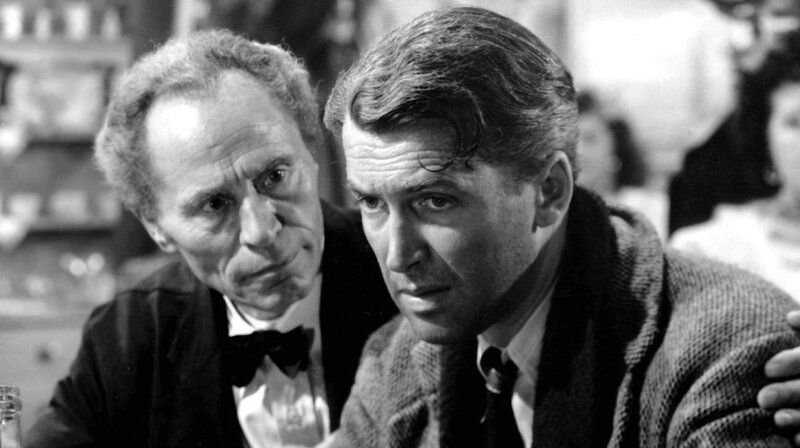
What If...Bedford Falls Was A Real Town?
[Editor's Note: It's A Wonderful Life is a holiday classic that also contains a critique of capitalism. But what if Bedford Falls was a real place? What would it look like today?]
BEDFORD FALLS TODAY (NOT SUCH A WONDERFUL LIFE)
BEDFORD FALLS, NEW YORK) Seventy-three years ago Bedford Falls became famous as the hometown of George Bailey, hero of It's A Wonderful Life. A lot has changed in this small town in upstate New York since that time.Most notably, the Building and Loan run by the Bailey family no longer exists. Like other such institutions it went under during the savings and loans crisis of the 1980s. During the 1970s George Bailey passed the business down to his children, who took advantage of Reagan-era deregulation to engage in real estate speculation. The town's economy was not strong enough to support such risky investments, a familiar story across the country.
The Building and Loan's fate was mirrored by that of the local mill, which shut its doors in the 1990s after years of downsizing and layoffs. With the decline of local manufacturing the job opportunities available to residents of the town drastically decreased. Nowadays young people who get an education do not even have the option of choosing to stay home like George Bailey did. There simply is no work requiring their degrees. Those people end up in bigger cities in the region, often with fond memories of a place they are estranged from out of necessity, rather than choice. Those who lack education have few options in Bedford Falls as well, and what jobs do exist are mostly minimum wage work in the service sector.
Todd Bishop, whose grandfather was famed local cabbie Ernie Bishop, said "I drive Uber but there's not much business in a town this poor. Mostly getting drunk people home from bars. Apart from that I work part-time at the local gas station."
The once glittering main street has gone dark, with many storefronts having been empty for decades. Gower's Drugstore became a pawnshop before closing for good ten years ago. An empty home like the one the Bailey family took over has gone from being a rare oddity to a typical sight. The one advantage to living in Bedford Falls is the low cost of home ownership due to depopulation.
The land downtown has been passed down from Henry Potter -George Bailey's economic rival- to his descendants. All but one live outside Bedford Falls, most having moved to the New York City area. These absentee landlords see their holdings more as an heirloom or tax write-off than a viable business commodity. The one exception is Jacob Potter, a twenty-something descendent of Henry who has started a microbrewery and axe throwing club in one of the downtown buildings.
The commercial center began shifting to the highway on the edge of town in the 1980s, but the closing of the mill has meant even the absence of big box stores like Wal-Mart. Dollar stores are the only retail left in Bedford Falls. For anything else residents have to drive several miles to either Rochester or Syracuse. The one industry doing well in the region is the medical industry, which makes money from an aging population and a spike in opioid addiction.
George Bailey Jr still lives in his family's old Victorian home in Bedford Falls, even after the Savings and Loan debacle. "I know my father did a lot for this town, but keeping a town afloat isn't a one person job. An individual can't hold back a tidal wave. I have no doubt he made a difference, but I am almost glad he died thirty years ago so he didn't have to see what's happened."
Monday, June 17, 2019
Uncle Tupelo, "Outdone" (Track of the Week)
I've been thinking a lot about my rural Nebraska hometown recently. Partly this was out of hearing that a bunch of businesses that were important to me there are closing, and partly this was due to finding out two priests I worked with as an altar boy were listed by the diocese as having committed sexual abuse. One of them was excommunicated 25 years ago, but this was all hushed up because I never heard about it and am finding it impossible to find information out about it.
I'll probably write more about that soon, but today I've been retreating into the music of the band that best gets at my ambivalent feelings for my homeland: Uncle Tupelo.
I first discovered them in the spring of 1994, right as I was leaving my hometown behind. Their music blew me away, a combination of punk and country roots suffused with a critical political stance and poetic words about small town Midwestern life. I felt such a kinship with Uncle Tupelo, since they seemed to be so much like me and nothing else in the pop culture universe at the time really was.
Listening to the band's compilation on Spotify while I rode the commuter train to Manhattan I was struck by "Outdone," a song that had never been a favorite before. The chorus really hit me "Now there's too many people trying to hard/ Not to be outdone/ They follow close being their proud smoking gun." Amid the thrash of the twangy punk I hear a disdain for the daily rat race, an emotion that gives my Gen X soul all the feels.
I guess the song struck me because as much as I like living in the New York City area, some parts of it will never be comfortable for me. People here are much, much more status-oriented and hierarchical than back home in the Midwest. The local bourgeoisie here just constantly walks around high on their own bullshit. When I meet someone of that class background I've learned to not trust them until they reveal to me that they're not one of these striving yuppie bores. These are the kind of people in their status obsession who are so afraid of being outdone.
I don't miss the smalltown bigoted squareheads who bitch about Muslims and immigrants and think mayo is a spice. However, I do miss the small town sages who embraced the slower pace of life but look around them with a jaundiced eye. Sadly they've been written out of the "red state" narrative.
Friday, May 2, 2014
Real Rural America On Film
The Last Picture Show
The book's great too, of course. This film is Peter Bogdanovich's masterpiece, and one of the few coming of age stories that's completely bereft of sentimentality. The end is perhaps the most accurate rendering I've seen of what it's like to feel trapped in a small town and unable to get out.
Nebraska
I was truly moved by this film, and not just because it made me homesick. Alexander Payne skillfully captured the desolate beauty of the Plains, and also dug deep into that world's social mores. I have been to family gatherings where men sat in the living room, silently drinking beer while watching football. I have hung out in small town bars that double as the local agora, and have seen people sit their lawn chairs in the yard to watch the cars go by. My rural Nebraska homeland is literally dying off, and Nebraska presents that painful truth well.
What's Eating Gilbert Grape?
I saw this one while still living in my hometown. There are baroque elements, like the morbidly obese mother and mentally challenged younger brother, but Gilbert's feeling of being trapped and chained down by his small town ties is a kind of quiet desperation found quite often in places like that.
Smokey and the Bandit
I know it might not seem like this one fits, since it's not social realism, but the tall tale of a hot rod driver and shipment of illegal beer. I have it on this list not only because it is a guilty pleasure of mine, but also because most of the chases are in backwoods places, and the film is full of backwoods characters who are heroic, but not in a simpering, moralistic way. The stereotypical authoritarian Southern sheriff is the foil, but he's played for laughs. It all adds up to a great time.
The Last American Hero
This forgotten gem of 1970s realism was adapted from a story by Tom Wolfe. It's about Junior Johnson, a moonshiner's son who takes his skills at outrunning the revenuers while transporting illegal hooch into the world of stock car racing. Jeff Bridges turns in a helluva performance with a character who faces a common rural dilemma: how to get to a better life without leaving behind who you are.
Breaking Away
Yet again, another film from the 1970s with a realistic view of rural life. The main character is obsessed with cycling and has become alien to his father in his quest to "break away" from his background. There is perhaps no better American film about social class dynamics in rural America, or the difficulty of striving for something beyond the rural confines without walling off one's family.
Friday, April 18, 2014
The Heartland Doesn't Want To Be Saved
I've always winced at the term "heartland" because I grew up there. Locals deployed it constantly, affecting a kind of moral superiority over the more supposedly wicked and less righteous parts of the country. It seemed to me an evasion of a grim reality, like the scion of an impoverished noble family trotting out his coat of arms and wearing a flea-bitten ermine coat. In reality the "Heartland" is a backwater not at the heart of much of anything in this country whose population loss has occasioned plenty of talk about what can be done to revive it. Those who have a stake in Great Plains (a term I prefer) like myself know that it is a region in dire circumstances.
Timothy Egan, who knows the area well, wrote the latest entry in this venerable genre in the New York Times last week. I agreed with much of what he had to say. He noted that irrigation-heavy agriculture is sucking the Ogallala Aquifer dry, and that the recent wave of immigrants from Latin American and Asia to the Plains needs to be encouraged, in order to bring new blood and arrest the alarming population decline in the area. He could also have added that the proposed Trans-Canada pipeline would cut right through the Aquifer, and a blow-out would effectively destroy the whole area's water supply.
However, I feel Egan missed something crucial, which I know to be true: the Heartland doesn't want to be saved. If you dare bring up the aquifer's depletion and the need for conservation you'll be treated like a communist. For more evidence of a lack of desire to change, look no further than how many of the locals are treating recent immigrants. Instead of welcoming them with open arms, ecstatic that an area that's literally dying off is getting a fresh infusion of young people, immigrants are being met with ugly nativist and racist pushback. States like Kansas and towns like Fremont, Nebraska, are passing laws intended to drive immigrants from the area and make it harder for them to vote.
What about the youth who grow up on the Plains, you ask? Those who get an education tend to get the hell out at their first convenience. They might stick close to home, in places like Omaha, Denver, or Kansas City, but those cities are increasingly foreign to their rural hinterlands. There are few job opportunities for young educated ruralites, and the culture of the area is so oppressively conservative that those who aren't Republicans, aren't straight, aren't religious, and aren't interested in maintaining a 1950s version of gender roles do not feel welcome. Of course, the locals actually tend to see that as an asset rather than a curse, since it keeps things just the way they like it. To say otherwise would challenge the aforementioned sense of moral superiority.
Despite all of this I can't help but love my Nebraska homeland, its wide vistas, laid-back attitude, and lack of pretension. Whenever I go home I mark in my head just how much emptier and more lifeless it seems with each passing visit. It makes me sad, especially when I recall my faint memories of how vibrant my hometown was before the farm crisis of the 1980s. Like an alcoholic friend who refuses to admit they had a problem, the "Heartland" will only heal when it realizes it needs healing. Don't count on that happening any time soon.