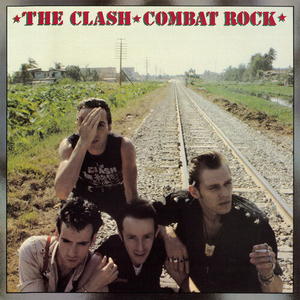
My relationship with The Clash started right at the moment that I began to develop an interest in more challenging music. I remember a cold winter day in 1991, the light of the sun faint over the snow-strewn flatlands of my Nebraska hometown as I drove to the local mall and browsed the Musicland, the one record store in town. I picked up the Story of the Clash compilation, which is maybe the worst place to start, since the track listing is pretty much nonsensical and the track choices dubious. I'd heard they were an important band, and the local FM station, perhaps because it was located out in the sticks, still allowed their DJs to play personal favorites. One DJ evidently liked "Should I Stay Or Should I Go" and "Rock The Casbah," since I heard them on a regular basis, even though they came out almost a decade before.
Perhaps because of the Nebraska winter surroundings, I gravitated more to the spookier sounding tracks initially, including "Straight To Hell." It's a sign of how much the Clash evolved musically, since it sounds nothing like the distorted guitar attacks of their early days. There's barely any guitar here, the rhythm is intricate and slow, and synthesizers dominate. At times everything drops out except for the spare percussion. It perfectly expresses a certain feelings of alienation and rootlessness, something I didn't understand until I started listening closer to the lyrics.
"Straight to Hell" is a song I always seem to return to this time of year, although political events have me thinking about it this time around. It's a song commenting on the hostility to Vietnamese refugees in America, particularly those who had American fathers. People tend to forget this, but there was very violent opposition to refugees from Vietnam in the 70s and 80s, despite the fact that America's foreign policy was the primary reason so many were having to flee their homes. The song's name comes from the expressions of xenophobia that greeted the refugees, many of whom had to survive unspeakable horrors to make it to these shores.
We don't hear much about the violent opposition to Vietnamese refugees these days, mostly because it would be embarrassing to talk about, considering that those refugees and their descendants have become such valuable members of American society. I only hope that Syrians fleeing such horrific warfare are given the same opportunity to prove the bigots wrong.
Now that I have passed the threshold of age 40, the distance between my present and my past is becoming ever-more apparent. For instance, I still love music, but no contemporary music can MATTER to me any more like it used to. Sure, I've been playing the new Kurt Vile record to death, but it hasn't become part of my greater consciousness, like say Radiohead's Kid A when I picked it up back all the way in 2000. Perhaps because I spent my 20s in grad school in a college town with multiple rock clubs, contemporary music mattered to me more then than it did when I was a teenager. And no band, not even Radiohead, mattered as much to me as Wilco.
From about 2002-2007, Wilco meant more to me than any other manifestation of popular culture. Wilco had been part of my life before, but in this time the band mattered in a way it didn't before and hasn't since. I had learned of Uncle Tupelo right before its demise, and loved the Anodyne album. For that reason I eagerly bought the first records by both Son Volt (Jay Farrar's band) and Wilco (Jeff Tweedy's), both coming out in 1995. That first Son Volt record is by far the better one, but Farrar could never best it, while the double that came next year from Wilco, Being There, was an exhilarating great step forward. The roots-rock elements remained, but songs like "Misunderstood" had something more experimental behind them. That experimentation really flowered on 1999's Summerteeth, an album I had a harder time relating to. The fact that the band's next album had been rejected by the record company intrigued me.
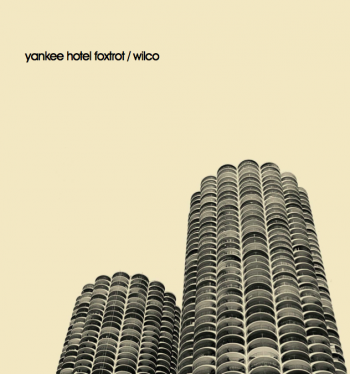
Yankee Hotel Foxtrot, October 2001 and April 2002
I first heard ripped versions of Yankee Hotel Foxtrot in 2001 before buying an official copy in 2002. That album was a complete revelation. I listened to it over and over and over and over again. In that strange post-9/11 time amidst the increasing drumbeats for war, its songs seemed to make sense of the fear and emptiness at the heart of the national condition. The fact that the record company had dropped Wilco over this album made it all the more glorious to listen to, a validation that "they" were wrong-headed and stupid, and "we" were ultimately right. This album was like medicine for the soul. During my year studying abroad in Germany, when I was mostly alone day after day, Yankee Hotel Foxtrot was a comfort, especially amidst the quiet dread of a German Sunday morning. It is difficult for me to even listen to this album again because the associations are so intense. That mostly has to do with "Heavy Metal Drummer," a song that would get played at grad school barbecues after my more musical friends had brought out their guitars. It's a song about not being able to recapture the heedless abandon of youth, and little did I know as I sang along with my friends, I was living in my own golden days.
"War on War," Late Show With David Letterman, April 2002
There was once a time when I made sure to tune into the late night talk shows if bands I liked were performing. Wilco obviously made the cut, and I remember seeing them perform "War on War," one of my favorite songs on the new record. My friend and roommate at the time took the piss out of it for me because he thought the song was too tepid and Tweedy too meek to be a rock frontman. I felt deflated, but held on to my obsession that much tighter.
October 27, 2002 (Foellinger Auditorium)
In the fall of 2002 I was ecstatic that Wilco would be playing a gig on campus in the same giant lecture hall where I was a TA during the week. I bought the tickets the day they came out, and ended up in the lower level maybe ten rows back. At this point Jay Bennett had been jettisoned from the band, Leroy Bach was still in it, and Pat Sansone and Nels Cline had yet to join. The anticipation before the show was palpable in the audience; everyone there had been absorbing the new album for months. I was not disappointed. This was perhaps the best rock show I've ever been to. I was hearing amazing material that was still fresh by a band at the height of their powers and giving it their all. Tweedy was still willing to play some of the older stuff, so I got to hear the rip-roaring "Casino Queen" live, a great thrill. I left that auditorium that night on a high, my expectations more than surpassed. I've been chasing that feeling at every other show I've been to since.
May 3, 2003 (Southern Illinois University)
My circle of friends in grad school was similarly Wilco-crazed, and when one of my friends announced that they would be playing an outdoor show over a hundred miles south in Carbondale, we road-tripped down for it. It was a beautiful spring day, sunny but not hot, with a gentle breeze. The show was a little loose, and a lot of the students there weren't hardcore fans. Tweedy was a little jokey, giving the proceedings a fun, tossed off vibe. They even played "New Madrid," a song from Tweedy's Uncle Tupelo days about predictions of earthquakes on the New Madrid fault, perhaps a nod to concert's location. This was the same line up as before, Kotche-Tweedy-Bach-Stirratt, but with Mikail Jourgensen and his laptop lurking in the background. I like remembering this trip, and the spontaneity of my 20s, so long ago.
A Ghost Is Born, July 2004
My aforementioned year abroad in Germany, where I was doing my doctoral research, ended in July of 2004. A Ghost Is Born was released right before I left, I remember reading a review of it in a Berlin culture magazine maybe two days before my flight home. I picked it up immediately after getting stateside. I listened to this one a lot alone, as I had been hired by my advisor as a house sitter that summer. The heavy Neil Young guitar on "Guess That's What You Said" kinda shocked me, but I grew to love a lot of the songs very quickly, including "Company in My Back," "Late Greats," "Handshake Drugs," "Spiders," and "Muzzle of Bees." If I strip away the layers of memory that these albums carry with them and try to evaluate them objectively, I think A Ghost Is Born just might edge out Yankee Hotel Foxtrot. I still have one very vivid memory of this album: as I was driving back to Illinois from a job interview in Michigan in May of 2006, "Company in My Back" came on somewhere south of Kankakee. As the impossibly flat prairies beneath the unending sky stretched out before me, it seemed like the most perfect song in the world at exactly that moment.
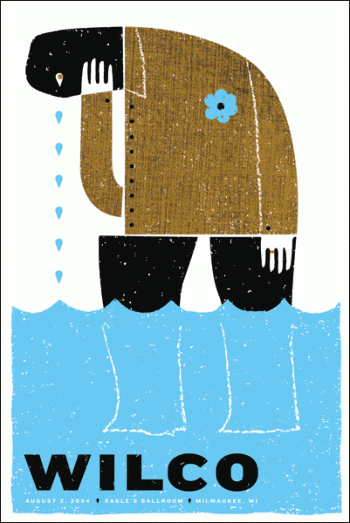
August 2, 2004 (Eagles Ballroom)
Only a month after being back in the States, I trekked up to Milwaukee with a friend (and his parents) to see Wilco live at an old ballroom downtown. It was an interesting night, as I walked down one of Milwaukee's hills on our way to a place to get dinner, I passed right by Dave Grohl of the Foo Fighters, who was chatting with someone on the sidewalk outside of a hotel. (I guess he must have been playing a show there, too.) This was also my first time seeing the current Wilco lineup, without Bach and with Cline and Sansone. The guitar pyrotechnics were certainly impressive in this show, and I do remember Tweedy doing a couple of power jumps with his guitar on "Spiders (Kidsmoke)." However, the old bash and sass I had witnessed before was gone, a relic of the 90s now put away.
February 8, 2005 (Foellinger Auditorium)
This concert was a tad disillusioning. I was back at Foellinger on a cold and dark night, but in the balcony instead of close to the stage. The show wasn't bad by any means, but not inspiring, either. That changed in the encores, which were amazing. Tellingly, the band revived "Kingpin" off of Being There, and really nailed it. They also played a bitchin' cover of "Don't Fear The Reaper."
Dinner With Jay Bennett (sometime in 2005-2006)
One of my friends was a close friend of the now departed Jay Bennett. I can't quite place the exact date, but I did in fact get to have dinner with Jay Bennett. He was in the area doing some production work at a new studio in a nearby town, and my friend and his spouse decided to have Jay and a few other folks over for dinner. Needless to say, I was a little more than starstruck. Turns out that he was a very friendly and gregarious guy, full of some funny stories a couple of which I still remember. I felt lucky just to have met the guy, but this made me especially sad at his passing, and at the impression you get of him from the I Am Trying To Break Your Heart Documentary.
Sky Blue Sky, May 2007
This album is the point at which my Wilco obsession began to simmer down into mere love and affection. This was fitting, since I had graduated with my PhD in 2006, and had trekked off to Michigan to work as a visiting assistant professor. Around that time my life had become much more difficult, having moved to a new place and working a job that was both demanding and unrewarding. This album did not make a huge impression on me when I first heard it. I didn't think it was bad, in fact it was good, but it was definitely not great. I probably like it more now than then, mostly because "Impossible Germany" has grown on me a great deal.
I've liked the other albums since then too, especially the self-titled one, but Wilco hasn't and can never mean what it did in that time roughly between 2002 and 2006. It's probably not coincidental that I reached age thirty at that point. Nevertheless, when I listen to a song like "Heavy Metal Drummer" I am transformed, sent back to a time in my life when I was young but poor, living the life of the mind with some amazing friends. While I am pretty damn happy nowadays, sometimes I wish I could go back to my Wilco days for just one of them.
There seems to be a lot more discussion in the last few years by progressives online who write about "how to win arguments with you conservative relatives" and generally more agony that usual over the inevitable holiday fights over politics. I think that this agony speaks to something deeper, namely the widening political divide in this country and the higher stakes involved.
I understand it, since I come from a very conservative family, as does my wife. Luckily for us, our parents are reasonable and loving people, and so we all are pretty much party to an unspoken truce not to drag politics into our family time. With my parents the breaking point came fifteen years ago, when the 2000 election between Bush and Gore was still up in the air. After a couple of angry disputes we pretty much decided we'd had enough of that. For all of you out there in the same position, I would recommend a similar course of action. I would just warn you I've had to deflect political discussions initiated by them from time to time.
Of course, relatives in our extended families are not parties to the truce, and so when they come in all bets are off. Since my wife's extended family is so far-flung, this isn't a problem, but when my whole family gets together there will be people trying to bait me. Since I am greatly outnumbered it's also extremely exhausted. We will probably never have a family-wide truce, but I see my extended family so seldom that I am usually just happy to be with them and can let the political stuff slide.
This brings me back to the tweet I quoted above, though. I've realized why in the Thanksgiving Table Wars it's progressives, specifically white progressives, who tend to get the most emotionally wound up about it. Any conservative white family is going to have its share of vocal racists. Sometimes it's just on the level of petty resentment, sometimes on the level of "jokes," and sometimes on the level of boldly-stated bigotry. About twenty years ago one of my cousins basically let it be known that the n-word was not be used in her presence or the presence of her children, and that toned things down, but only a little. It's one thing to have an argument with someone over tax policy, another to talk to someone spewing hate against African Americans, immigrants, gays, and Muslims (this has been a recent favorite). One uncle of mine once made a veiled (but racist in intent) comment about my then Asian girlfriend (who wasn't present.) If we hadn't been in a public place I would have broken his jaw.
As our politics have become more heated, they have become even more racialized than before. With a Right wing that wants to "take our country back" for the "real Americans" there's no question that the color line is a crucial element, if not the most crucial element, to the current political divide. White progressives wringing their hands about having to deal with their white conservative relatives aren't just being effete or solipsistic, they are responding to the very real issue of the mainstreaming of racist resentment in American politics. Like our broader politics, the Thanksgiving Table Wars have escalated. For those of you who haven't managed to broker a truce, I wish you the best of luck.
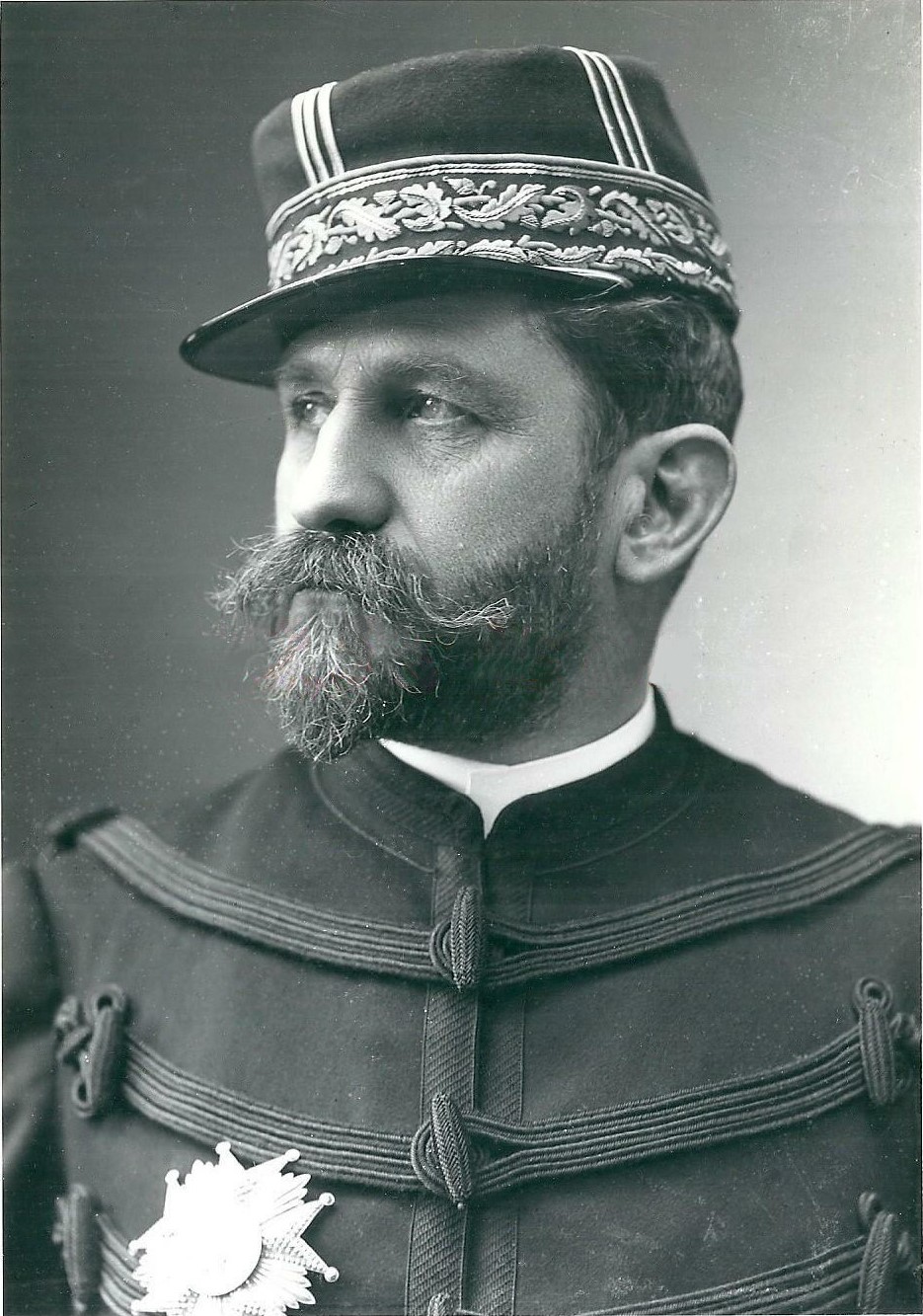
I see a lot of Trump in Georges Boulanger, a French populist general of the late 1880s who was the face of broader discontent, but ultimately unable and unwilling to seize power
I have been taking a wait and see approach to Donald Trump in regards of the viability of his presidential campaign. Yes, he has been leading the polls for months now, but this kind of polling is often inaccurate, and in the last debate he looked disinterested and tired. I have also wondered about what kinds of ground campaigns he has in the early states, since primaries can be won and lost by doing a slightly better job than others of getting people to the polls, since the number of voters is so small. Now that we are hitting Thanksgiving and Trump has rebounded after his lackluster debate performance, I am inclined to think, for the first time, that he stands a decent chance of being the Republican nominee.
What I can’t figure out is what Trump’s game actually is. Early on I didn’t think he was acting like a serious candidate. I wondered if he had in fact been aiming only for a sideline hobby, then blundered into being the front-runner of the Republican Party by accident. I’ve wondered whether he is trying to start a fascist movement, or if his hateful words are merely a cynical attempt to get support, rather than expressions of his deeply held beliefs.
In any case, Trump has benefitted by breaking a rule that Republicans have followed since the 1960s, a rule I would like to call the Atwater Directive. As Lee Atwater famously discussed once in an interview, to whip up white resentment in the aftermath of the civil rights era politicians have to avoid racial slurs and direct racist appeals. Instead they have to use dog whistles and make it clear that they want to cut the government in ways that disproportionately hurts people of color. Trump understands that a large portion of the conservative base has grown tired of this, and longs for racism to be expressed straight, no chaser.
Trump has given them that by breaking a taboo that appears to not apply anymore. I’ve long thought that at least 15% of Americans are essentially fascist in their political outlook. If the military overthrew president Obama, made Christianity the official religion, deported millions of undocumented immigrants, and banned Muslims, about that percentage of the population would rejoice. Another 15% would have misgivings, but generally prefer it over the status quo. Trump knows this, and he is exploiting it. I am still not sure to what end. I get the feeling that he is a man who enjoys power, and that his goal is less to be president of the United States, but to amass power and get adulation. He does not seem interested in starting a fascist movement, but a lot of the people who listen to him seem to be.
This does make me wonder what will happen. Here’s a list of predictions, with my current odds. I plan on revisiting them in the future.
1. Trump flames out fast
If Trump isn’t super serious about all of this, he just might flame out, unwilling to do the hard work necessary to run for president. If this was all some kind of whim turned into reality, this is the most likely option.
Current Odds: Possible, but not likely
2. Trump wins the Republican nomination
Trump is leading the polls right now, but Herman Cain and Newt Gingrich were in the lead at one time in the last election cycle as well. I really wonder what percentage of the voters who will actually turn out for a primary vote will cast their vote for Trump. His appeal is very broad, but is it deep? Trump has benefited thus far from a highly fragmented Republican field. If the GOP establishment goes all in for Rubio and gives Christie, Kasich, Fiorina, et al an offer they can’t refuse, all while allowing Cruz to appeal to the bark at the moon crowd and thus steal the Donald's votes, Trump’s goose is cooked. I could even see a brokered convention at this point, crazy as that sounds.
Current Odds: Very possible but not likely
3. Trump loses in the primaries and runs as an independent
If Trump loses the nomination, does he make a third party run? This would allow him to be the ultimate troll and take a dump in everybody’s punch bowl. The Perot run in 1992 just might an inspiration for him. This is the Republican Party’s worst nightmare, and Trump being the spiteful shit that he is just might go throw with it to give the GOP the middle finger. On the other hand, he likes winning and hates losing, and a third party run would almost guarantee not winning.
Current odds: highly unlikely
4. Trump wins the presidency.
Of course, he would have to get the nomination first, or put together a third party run. While Trump has a broad base of support, he also has an even bigger base of opponents. Unless some crazy scandal would befall Hillary that would actually be true, there’s no way Trump could win a general election. (Please let this not tempt the fates.)
Current odds: Not impossible but extremely unlikely
Basically I think Trump might win some early victories, but once the Republican establishment gets their act together, he will lose. This prediction is, of course, subject to change. And even if he loses, he has forced others to copy his nationalism and xenophobia, which will be very prominent in next year's election.
As loyal readers know, my musical tastes range far and wide. There are some genres that I've known for longer than others, and because of my parents listening to the oldies stations, I've been listening to 50s R&B for a long, long time. While sixties soul and fifties rockabilly have more tempo and drive, listening to the Platters is like taking medicine for the soul. I get the same feeling hearing Tony Williams' voice on "The Great Pretender" as I do hearing Miles Davis' trumpet on "All Blues" or the violin in Vivaldi's "Spring": joy in simple yet deep beauty. The backing harmonies have a minor tone them that's almost lush, and the saxophone and piano glue it all together. I could listen to this song thirty times in a row and not get tired of it.
Another reason I like this song is for its tale of vulnerability. The singer effects a confident pose in public, but beneath it lies anguish and heartbreak. That anguish pokes through in the hiccup that Williams uses as he enters the song with "O-o-oh yes, I'm the great pretender." Sure, it's a silly pop song, but one with just the right amount of emotional pain wrapped inside of it.
[Editor's Note: My impolitic friend Cranky Bear has emerged from this week to send me a new missive about the opposition to Syrian refugees. I have held off on publishing it, but now think that his brand of profane anger is what's needed right now.]
Hello cats and kittens, Cranky Bear coming at you here with a pot of black coffee and righteous anger seeping through my pores. I have seen a lot of awful shit in my time on this earth when it comes to this nation's politics. I remember the Reagan years' happy face on top of human misery. I remember the hysteria after 9/11 and the calls to war by our feckless idiot of president and how people actually listened to this lobotomized manchild. I have seen the rise of the Tea Party and have witnessed the racist backlash against the Black Lives Matter movement. Nothing could prepare me, however, for what has happened this week.
We are seeing fascism, pure fascism red in tooth and claw openly shouted from the rooftops by elected officials and contestants for the presidency. On Monday Republican governors fell over themselves proclaiming that their states would categorically refuse Syrian refugees, with Christie taking the cake by expressing banning orphaned toddlers and babies. They did this because they know it is a winning issue to stir up hatred against Arabs and Muslims because it appeals to their base of resentful white dipshits who don't know their own assholes from a hole in the ground. Say what you want about the godawful Dubya years, he at least had the human decency to decry attacks on Muslims and Arabs in America.
In the last couple of days this sorry-ass situation has become positively fascistic. Donald Trump, the leading candidate for the Republican presidential nomination, has said he "wouldn't rule out" closing mosques and creating special identification badges for Muslims. Other Republican elected officials have mentioned rounding up refugees and putting them into camps as a viable option. What is especially striking is that America wasn't even attacked! This hatred and paranoia has been building up for years, and now a convenient excuse has been found to unleash it.
Make no mistake, a large number of Americans actively hate Muslims and would like to see them eliminated from American society. I have often thought that if Dubya had ordered all foreign-born Muslims to be sent to relocation camps in the aftermath of 9/11, the public would have gone along with it. Hell, the mayor of Roanoke, Virginia, has used the internment of Japanese Americans during World War II as a positive example!
These fucking people make me sick, but they aren't the worst. No, these politicians are simply opportunistic hacks trying to appease the garden variety dumbshit fuckwits who post their godawful Facebook memes and actually fucking listen to what the pig fuckers on Fox and talk radio are telling them. These people, ordinary fucking people, are what's wrong with this country. They spend their lives in complete fear, defending the cops who shoot black people while hiding behind the gates of their lily white suburbs. They collect their Social Security checks while bitching about "welfare queens" and "takers." They think that the very presence of Muslims in this country is some kind of affront to their Christianity, and they get super paranoid and angry about it. A lot of these people are people I grew up with, and honestly, fuck them. They should know better.
Fascists don't fall from the sky or grow out of the ground. They are regular people who have given themselves over to a diabolical ideology. I've long thought that 15-20% of Americans are fascists in sympathy, and that if they were told that a military coup would overthrow president Obama and install Christianity as the official state religion would jump for joy. In times of strife and terror Republican politicians have learned that they can maintain their position by appealing to hate and fear. They did this in the last presidential election they won, in 2004, by going after gays and whipping up fears about terror. With political homophobia now unpalatable to the larger electorate, they have doubled-down on Islamophobia. This is how they manage to add to their fascist support, by appealing to the lizard brain fears of the run of the mill fucknut crackers who think the terrorists are going to blow up the Arby's in their shit-ass cookie cutter tract housing suburb. (They are scared to death of the Muslim boogeyman but apparently not of the Type 2 diabetes from the Big Gulp they're chugging while scarfing down fried garbage.) Once upon a time conservative pols tried to send out dog whistles, but now are just full-on, shamelessly appealing to the worst kind of hate these shitbags possess.
For years we have looked back at the refusal to accept Jewish refugees in the 1930s and the internment of Japanese Americans in the 1940s and thought "how on earth could people do such terrible things? I am glad we are so enlightened nowadays!" You know what, we're not. We are a nation dominated by hateful, fearful, stupid ass bigoted morons. In the 1930s most Americans feared and hated Jews, in the 2000s, I am afraid that most Americans fear and hate Muslims. That is the "middle America" and the "Heartland" that so many praise, which are really a massive crock of dog diarrhea. Fuck "middle America." Fuck the "Heartland." Fuck "real Americans." Fuck them all. They aren't worthy to lick a refugee's shoes. Cranky Bear out.
Yesterday will go down as a dark day in American history. As the world faces one of the worst humanitarian crises yet known, several American politicians went out of their way to attack some of the world's most vulnerable people, continually competing to be the most cruel. Chris Christie laid down the trump card (pun intended) by declaring that even orphans under the age of five would be banned from my state of New Jersey. The spectacle of elected politicians currying favor with the bigoted masses by pissing on war orphans, the group of people in the world most in need of protection, completely sickened me. My students often ask how American turned back Jewish refugees -even children- in the 1930s. Now I guess they'll know.
Unfortunately, liberals have responded to this onslaught of noxious nationalism with a decent amount of naivete. They assert that the governors don't have the power to ban certain classes of immigrants, and that's true, but that's really beside the point. Also, I have heard it said many times that this state-sanctioned hatred is "un-American."
Oh, how I wish that were true. However, if you look at American history, you'll find that this kind of hatred is as American as apple pie. We have a lot of myths we tell ourselves about our country, and one of the biggest is that "America is a nation of immigrants." Never mind that most people of African descent in this country did not have ancestors who came here willingly, or that plenty of folks here are Native Americans. And just because most people who live here are descended from immigrants doesn't mean that immigration was always welcomed, valued, or free and equal.
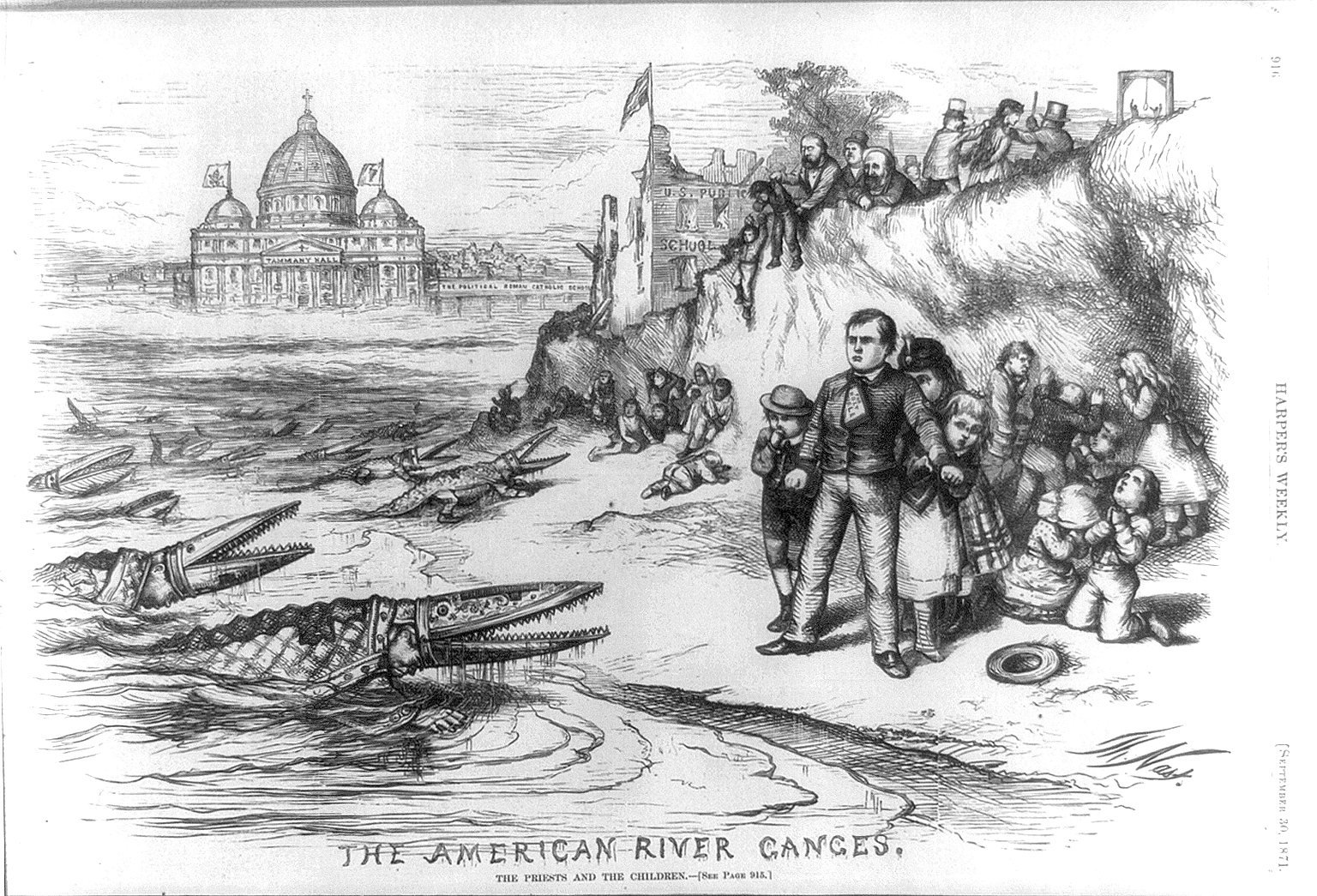
Just look at the Naturalization Act of 1790, one of the first important pieces of immigration legislation. It limited citizenship to those who were "free white persons." One year before the passage of the Bill of Rights, those vaunted rights were effectively being limited to white men. When waves of Irish immigrants came over in the mid-1800s, they were feared and hated, commonly depicted as ape-like by native born whites. This new surge in migrants gave birth to a nativist party, the Know-Nothings, who coincidentally were one of the elements that formed the nascent Republican party in the 1850s. These nativists didn't just spread hate, they burned Catholic churches, and instigated anti-immigrant riots.
Even though more immigrants followed from more places, paranoia and hatred still abounded. The cartoon below by Thomas Nast depicts Catholicism in the form of bishops invading the nation and destroying its values. Replace the bishops with imams and you could run this cartoon today.
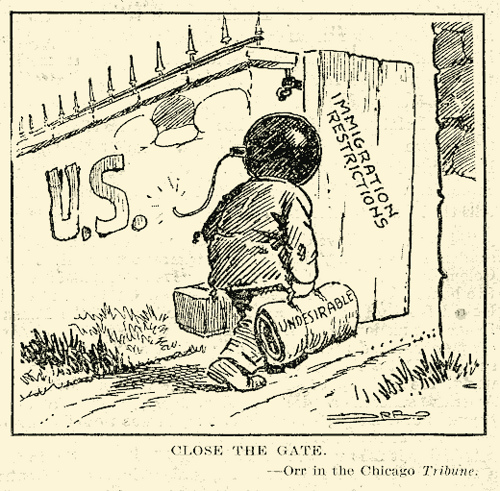
In the 1920s restrictions on European immigration followed. The Immigration Act of 1924 set strict quotas aimed at immigrants from Eastern and Southern Europe, those deemed less "white." That coincided with the high point of the KKK's power. The Klan's slogan of "100% Americanism" reflected their emphasis on nativism and hatred towards immigrants, particularly Catholics and Jews. These restrictions came after a wave of paranoia associating immigrants with violence and terrorism. Acts of terrorism in the post-World War I period, such as the passel of bombs sent out to politicians and capitalists on May Day in 1919, were blamed on radical immigrants, without proof. Foreign-born radicals like Emma Goldman were literally shipped off to Russia without trial. The supposed threat of foreign radicalism was the excuse used to bar new immigrants from coming in, including refugees from war and revolution in Europe. Sound familiar? (The cartoon below is typical of all this.)
When European Jews fled Nazi oppression in the late 1930s, those quotas of the 1920s were not relaxed, and those refugees were cruelly turned away. The reasons then are pretty much the same now: many Americans hated and feared Jews, just as a great many today hate and fear Muslims and Arabs.
In the last 70 years I can certainly point to other instances of nativist hate and violence, some rather close to our own time. Vietnamese "boat people" faced opposition to their presence in America. Remember when mobs attacked buses full of child migrants from Central America? That was only a year ago.
So yes, we must fight the bigots who are acting so cruelly to people so desperately in need of aid. But let us not pretend that the sickness we fight is "un-American." It is a tendency in our history that we must tear out root and branch, but before we do that, we have to realize that it's there.