Showing posts with label classic R&B. Show all posts
Sunday, December 4, 2016
Clarence Carter, "Back Door Santa"
In my continuing quest to find good Christmas music, I recently discovered Clarence Carter's "Back Door Santa," which I never knew was the song sampled on Run DMC's classic "Christmas in Hollis." I've always loved Carter and the school of funky, rough and tumble of Southern soul he subscribed to. (Let's just say I'm the kind of guy who bought the nine disc Stax singles collection despite being poor as dirt in grad school at the time.) As always Carter has just the right amount of grunt, and you can practically hear the sweat. Considering the fact that this man had his biggest hit with a song about stroking, the title "Back Door Santa" is not surprisingly a single entendre.
In recent years I have rekindled the excitement I used to have about Christmas. Having children of my own has allowed me to experience the holidays vicariously through them, and get enjoyment from their enjoyment. This year, with the world seemingly gone insane, I am also milking the comfortable repetitions and rituals of the holidays. I've been doing that with a lot of things, not just the holidays. Old favorites are coming back. I'm rereading books and digging up good music that I've let slip from my life. Southern soul music, like a big holiday glass of mulled wine, has never failed to warm me up. With the things being the way they are, I'll need it.
Labels:
Christmas,
classic R&B,
music,
track of the week
Saturday, April 30, 2016
Track of the Week: Stevie Wonder "You Haven't Done Nothin'"
With all of the deaths of musical pioneers this year, I have been making an effort to appreciate those of advanced age that we still have with us. Stevie Wonder is right at the top of that last, and a couple of weeks ago I found a pristine copy of Fullfillingess' First Finale on LP. It's one of the lesser-discussed records of his 1970s run of greatness, but just as good as the likes of Talking Book and Innvervisions, as far as I'm concerned.
The highlight is "You Haven't Done Nothin'," a red hot tune that appears to be about those who talk a big game about changing the world but doing little to actually make it happen. In this election year, full of empty promises, it's especially relevant. Like the best songs on Talking Book, the riff is merciless hard funk with horns blasting gloriously over it. The song is a burning accusation against those who claim to act in the interests of others but really only care about themselves.
I've heard it said that the song was directed at Richard Nixon, but I hear it more as a denunciation of ostensibly "progressive" politicians who sell out to maintain power. Bill Clinton recently learned that his own actions in that regard will not be allowed to pass on by. I feel that people like him ought to be followed around perpetually by someone with a huge boom box blasting "You Haven't Done Nothin'."
Labels:
classic R&B,
music,
politics,
track of the week
Sunday, April 3, 2016
Track of the Week: Pointer Sisters "Fire"
We live in a cultural moment where an obsession with "authenticity" co-exists with increasing cultural segmentation. Even though I am getting long in the tooth, I can still follow pop music because the amount of it that crosses over the various segments is really tiny compared to the past. The various genres of music seem to multiply with each year, and seem to be saying less and less to each other.
It wasn't always like that. Back in 1930 the king of country music, Jimmie Rodgers, cut the song "Blue Yodel #9" with Louis Armstrong, jazz legend. In the 1960s, Nina Simone's music seem to pull from innumerable genres, from jazz to classical to to show tunes to soul. The Clash's magnum opus London Calling has everything from reggae to ska to rockabilly to hard-charging punk on it.
In 1979, the same year as that Clash record, the Pointer Sisters released "Fire," which sounds as if country and soul got together to make a beautiful baby. Like the sensation described in the lyrics, this song just smolders until the drums, piano and organ come in big, then draws back again, only to burst forth once more on the solo. There are few other songs that replicate the sensation of trying to suppress burning lust so well, and it's all done with a sultriness that's neither playful or silly. I've been listening to this song non-stop for the last month, and as much as I enjoy it, it makes me wistful for a time when pop music could hold multitudes.
Labels:
classic R&B,
country music,
music,
track of the week
Sunday, February 14, 2016
Track of the Week: Earth, Wind and Fire "Got To Get You Into My Life"
Death struck the music world again this month with the passing of Maurice White, founder of Earth, Wind, and Fire. He pioneered a truly unique sound, one borrowing from jazz, soul, funk, and Latin music while not sounding derivative of any of those genres. There's a lot of songs to choose from, but I'm picking "Got To Get You Into My Life," since this cover of an already great Beatles tune showcases Earth, Wind, and Fire's pure musical brilliance.
The original had a bold horns part, making it pretty ideal as an Earth, Wind, and Fire cover, but the similarities end there. The beat and the arrangement are totally different, even if the tempo is still the same. It's funky, complex, and intricate in ways that the original, which was more of a hard-driving rock song, wasn't. Many have attempted to cover the Beatles, and this is one of the rare cases where the cover matches or improves on the original.
The context for this cover is also interesting. It was included in the soundtrack to the wretched Sgt Pepper's Lonely Hearts Club Band film, a late '70s pastiche of disco-era awfulness. Several contemporary artists, especially the Bee Gees and Peter Frampton, who starred in the film, covered classic Beatles tracks on the soundtrack. The vast majority of these covers are really shite. When Earth, Wind, and Fire come on near the end, it is an invigorating shot of energy that makes the crap surrounding it look even worse by comparison. Maurice White's vision was so unique that no one else really repeated it, not the same way as say, David Bowie. It would be a shame if that keeps a brilliant artist from getting his due.
Labels:
classic R&B,
music,
track of the week
Saturday, January 23, 2016
Track of the Week: Jimmy Ruffin "What Becomes Of The Broken Hearted"
I'm currently snowed in, in the midst horrible blizzard. I've shoveled three times today, just to keep things from getting totally crazy. Our boiler system is acting weird, so I have to check it every half hour and manually restart it because it keeps cutting out, and the repairman can't get here until tomorrow afternoon.
In the midst of this wretchedness it's good to revisit a favorite song of dejection. Motown churned a lot of hits off of their amazing assembly line back in the mid-1960s, but perhaps none pulls on the heartstrings like Jimmy Ruffin's "What Becomes Of The Broken Hearted." It is the kind of lament full of Weltschmerz that only classic soul and country songs can truly speak to. How many pop songs start with a line like "As I walk this land of broken dreams"?
Jimmy's younger brother David was the more famous Ruffin as a member of the Temptations, but this song was his chance to shine. He gives the morose lyrics a wonderful kind of confidence, as if the brokenhearted listening to this song can think that somehow, even though "happiness is just an illusion," tomorrow can be a better day.
This is an adult song trafficking in adult emotions. I don't mean to be all Old Man Bear here, but modern pop music so rarely touches on these themes, regardless of genre. It's all bragging, partying, or indie rock irony. Now that I'm middle aged, I crave songs about disappointment, dejection, and quiet desperation. In my mind I am always hearing "What's Become Of The Broken Hearted" in an empty dive bar in Michigan, snow coming down on a dark night.
Labels:
classic R&B,
music,
track of the week
Saturday, November 21, 2015
The Platters "The Great Pretender"
As loyal readers know, my musical tastes range far and wide. There are some genres that I've known for longer than others, and because of my parents listening to the oldies stations, I've been listening to 50s R&B for a long, long time. While sixties soul and fifties rockabilly have more tempo and drive, listening to the Platters is like taking medicine for the soul. I get the same feeling hearing Tony Williams' voice on "The Great Pretender" as I do hearing Miles Davis' trumpet on "All Blues" or the violin in Vivaldi's "Spring": joy in simple yet deep beauty. The backing harmonies have a minor tone them that's almost lush, and the saxophone and piano glue it all together. I could listen to this song thirty times in a row and not get tired of it.
Another reason I like this song is for its tale of vulnerability. The singer effects a confident pose in public, but beneath it lies anguish and heartbreak. That anguish pokes through in the hiccup that Williams uses as he enters the song with "O-o-oh yes, I'm the great pretender." Sure, it's a silly pop song, but one with just the right amount of emotional pain wrapped inside of it.
Saturday, August 22, 2015
Track of the Week: The Isley Brothers "Fight The Power"
[Editor's Note: In two weeks I am turning 40. In honor of that momentous and depressing occasion, my next few tracks of the week will be taken from the charts around the time I was born in 1975.]
I got into history and historical thinking at way too early an age, when I was still in elementary school. I think even as a ten year old I was interested to know what important historical events had happened on my birthday, and what was going on in the world on the day that I was born. That interest has dovetailed with my obsession with music, and a desire to know what songs were hits when I first entered the world. A lot of time has passed in my life now, and the world I was born into is pretty foreign to the one I am living in today.
Looking back to the charts in September of 1975, I am struck by the broad range of stuff in the top 20, from Bad Company to the Carpenters. I was most surprised to see a political song by the Isley Brothers, "Fight The Power" lingering near the top of the heap in the weeks around my birth. It has a very funky feel and very complex rhythm with some almost overbearing wah-wah bass that dates the song immediately to the mid-70s. It lies on the cusp between funk and disco, which is only appropriate for an innovative band that made some of the best dance music of the sixties. (The breadth and diversity of the Isley Brothers' output never ceases to amaze me.)
"Fight the Power"'s strong political nature and criticism of authority are also very striking. (Public Enemy would quote this song in their own "Fight The Power.") While the music is VERY 70s, the lyrics are reminiscent of the 60s. The mid-70s, and 1975 in particular, were a kind of transitional period, when the social movements of the sixties and early seventies seemed played out, but the conservative tidal wave that would wash over the country in the late 70s had not yet coalesced. Musically "Fight the Power" is pointing the way to the future and the sounds of disco and hip-hop, where rhythm would eclipse melody. Lyrically, this song points to the past, and the great period of change and protest receding into the distance. That makes it perhaps the most representative song on the charts in September of 1975, and one still worth listening to.
Labels:
classic R&B,
music,
track of the week
Saturday, May 30, 2015
Track of the Week: Gladys Knight and the Pips "I Heard It Through The Grapevine"
From about 1999-2002 I went down a major classic soul rabbit hole. It was music I'd always liked hearing on the radio, but I began to buy a bunch of CDs and read a bunch of books to educate myself. One thing that intrigued me about Motown was the role of its in-house producers and musicians. I soon realized that I didn't like the Four Tops and the Supremes as much as I liked the Holland-Dozier-Holland writing and production team. I didn't adore the 1969-1971 vintage Temptations as much as I appreciated the talents of Norman Whitfield. When I finally saw the film Standing In The Shadows of Motown, I also realized that many of the different name artists I loved had the same musicians behind them.
I learned too that Motown would have multiple acts record the same song, then release the version most likely to be a hit as a single. For instance, I'd always adored Marvin Gaye's spooky "I Heard It Through The Grapevine," but my new education introduced me to the same song by Gladys Knight and the Pips, a group I associated more with the 1970s. It also happened to predate Gaye's version, by a year in its release, and had been given single status over the original performer, Smokey Robinson. Gaye's version was initially not a single either, even though it went on to be the bigger hit.
The Gladys Knight version has been buried by the brilliance and popularity of the Gaye version, but it deserves more attention. It starts with an absolutely crackerjack opening by the Funk Brothers (the in house Motown musicians) reminiscent of The Temptations' "I Can't Get Next To You" or "Cloud Nine," songs also produced by Norman Whitfield. It chugs along funkily with the distinctive piano line ("dunh dunh DUNH dunh") less the sound of pained disappointment and more righteous anger. Whereas Gaye takes the role of jilted lover deeply wounded by infidelity, Knight is defiant and angry. The Pips, as they always do, add that little bit of sweetness behind Knight's powerful soul voice to lighten things up a little. Motown was so good in its hey-day that a song this good could slip through the cracks as a second-best version.
Sunday, May 10, 2015
Track of the Week: Ben E King "Stand By Me"
I can't believe it took me over a week to finally hear the sad news of the death of Ben E. King. I must have been very distracted, or our media (as usual) failed me again. Anyway, I enjoyed his smooth yet powerful voice from a young age, hearing it come out of the radio on the oldies station in my parents' van on our many trips to see my grandparents. My dad always seemed to turn up the volume whenever "On The Boardwalk," "On The Roof," or "Save The Last Dance For Me" came on.
While King had a bunch of hits with the Drifters, "Stand By Me" was his signature tune, and with good reason. In the first place, he wrote it, and in the second place, it's one of those love songs that's both managed to stand the test of time and not be totally cheesy. It's hard to describe, but it has a dark tone at the heart of it that intrigues me to this day. It might be the spare bass and percussion accompaniment at the start, or perhaps its references to the apocalypse. The very first line is "when the night," and one verse starts with the memorable lines "If the sky that we look upon/ should tumble and fall/ and the mountains/ crumble to the sea," deep stuff for a teen love song. The string section in the bridge has a very melancholic sound to it, and it never fails to put a chill down my spine.
This song went back on the charts in 1986 after it was included in the movie of the same name. I heard it first on the hits channel, not the oldies station. At that time a lot of sixties nostalgia was going around, from Dirty Dancing to Monkees re-runs on MTV, and I ate it up. In retrospect it's not hard to why. Would I rather listen to a three minute masterpiece like "Stand By Me," or the likes of Falco and Peter Cetera? The answer should be obvious. This song was part of a general opening up of my knowledge of music, and I'm bummed that its creator has left this earth.
Labels:
classic R&B,
music,
track of the week
Thursday, February 26, 2015
Track of the Week: Al Wilson "Show and Tell"
Working crummy jobs in my younger days inadvertently exposed me to a lot of good music I might not have otherwise heard. The best example is a job I had shelving books at a library in Chicago. While doing my daily rounds I would listen to my walkman, which was so old that it ate tapes. For that reason I tuned to the radio while I worked. This was the late 1990s, so I would have listened to the "alternative" station, except that they had a horrific morning show anchored by a right wing asshole who called himself "Mancow." (So much for "alternative.") I started going up the dial a little, and hit on an R&B and soul oldies station that played music from the 60s and 70s.
This was music I'd always liked when I heard it, but now I became obsessed. I sought out Sly and the Family Stone discs and practically burned holes in them. I learned that disco had its highpoints, and savored Donna Summer and Sylvester. Thelma Houston's "Baby Don't Leave Me This Way" secretly became one of my favorite songs of all time. I also learned one hit wonders of 70s soul I never knew before, and of these songs I think I loved "Show and Tell" by Al Wilson the most.
He had been a veteran of the music scene without having a hit to his credit when, in 1973, he took a song sloughed off by Johnny Mathis to the top of the charts. "Show and Tell" benefits in the first place from the exquisite 70s soul backing, intricate and slightly mannered a la The Spinners, but with just enough of a dose of funk thrown into it. Of course, Wilson deserves a lot of credit for his emotive performance. He starts so subtly and restrained, then sublimely takes the "oh oh ooooohhh" into the chorus and hits the higher register with an effortless beauty.
It's a true love song, in that Wilson sings of someone who has completed his life almost beyond the capacity of words to say. "Here is the soul/ of which you're taken control" is such a simple yet meaningful way of stating that feeling. This is a love song for adults, not the swooning to the moon in June stuff of teen pop music. It expresses more the adult knowledge of life's unfairness and harshness, and how lucky and important it is to have the right person in your life to help you get through it. I'm not sure songs like this even exist anymore.
Labels:
classic R&B,
music,
track of the week
Friday, June 20, 2014
Playlist: Soul Covers Rock
As readers of this blog know, I love vintage rock and classic soul. I also think that performing original material is an overrated fetish. A good song is something that ought to be cherished, shared, and played around with. Just because someone recorded it first shouldn't mean that the song gets frozen in the vinyl amber of the original record, never to be altered again. A great illustration of how songs can be reinterpreted in thrilling ways comes from covers that soul artists did of rock songs back in the 1960s. Back then a popular song would be covered by lots of different people, often with great results. Here are a few of my favorite covers in the specific souls covers of rock genre.
Wilson Pickett, "Hey Jude"
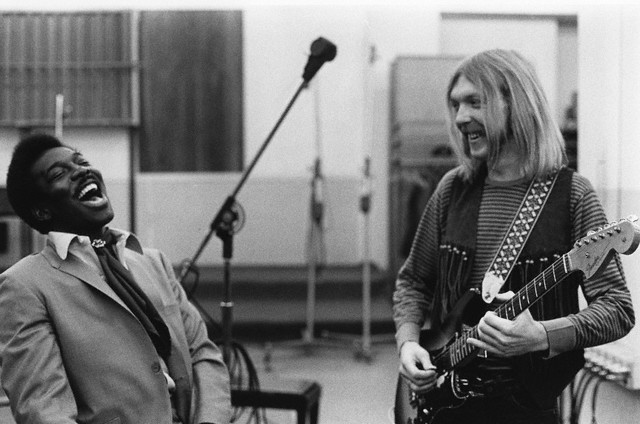
Let's start with Wilson Pickett, perhaps the most muscular soul singer that ever walked the planet earth this side of Levi Stubbs. According to the story, he was cutting a session in Muscle Shoals, and sessions musician (and later Allman Brothers Band founder) Duane Allman suggested they do a version of "Hey Jude." It was an audacious move that paid off with a supremely funky groove and some great singing from Pickett, especially when he screams as the band goes into the long "na na na na na" fadeout. Allman's guitar solo is also just absolutely killer.
Aretha Franklin, "The Weight"
Aretha Franklin went from peak to peak in the late 60s and early 70s, including on this cover of the Band. The original combined the voices of Rick Danko, Levon Helm, and Richard Manuel, but Lady Soul's pipes can carry the whole darn thing by themselves. (Since it's a collaboration rather than a cover I couldn't include the Staples Singers doing this song with The Band on the formal list. Nevertheless, Mavis Staples' singing here is some of her best.)
Otis Redding, "Satisfaction"
I've heard Keith Richards say that when he wrote "Satisfaction" he envisioned it as a soul song, with the loud, fuzzy guitar taking the place of a horn section. Otis Redding obliged Keef by dropping this killer cover, complete with horns. Instead of Jagger's punky sneer, Otis gives the song some of his patented sweat, making the frustration of the singer much more palpable.
Stevie Wonder, "We Can Work It Out"
Might as well end with where we started, with a Beatles cover. "We Can Work It Out" has the distinction of being both one of my favorite Beatles' songs and one of my favorite Stevie Wonder songs. Wonder gives the song an absolutely killer groove and some great "hey!"s to punctuate the song, not to mention a soaring harmonica solo. Like all great covers it stays true to the song while still managing to turn it into something new, and I would argue, better.
Sunday, May 11, 2014
Track of the Week: Ray Charles, "Mess Around"
Yesterday I was listening to WFMU, and that most blessed moment of grace occurred: the right song came on the radio at exactly the right moment without me anticipating it. That song is Ray Charles' "Mess Around," one of my personal favorites, and I song I associate with letting the good times roll.
At my local bar in Michigan, which was by far the best local bar I've ever had, there was a CD jukebox of impeccable quality, including a Ray Charles compilation. Practically every time I dropped in after work or on a sunny summer eve I would put some tunes on, and almost always play "Mess Around" by Ray Charles and "Cocaine Blues" as performed by Johnny Cash at Folsom Prison. The hours spent at that bar with my friends were absolutely therapeutic, and I remember them fondly.
The song is like nothing else in Charles' catalog due to its frenetic barrelhouse rush and New Orleans influence, and it never fails to bring a smile to my face. Not only is the piano an absolute joy, Charles' sax player, David "Fathead" Newman, probably laid down his sickest solo on this track. Every time the song is over I feel exhilarated, like I used to after sledding down a hill as a child. It's good to know I can still get that feeling without looking ridiculous trying to sled down a hill at my age.
Subscribe to:
Posts (Atom)
:format(jpeg):mode_rgb():quality(40)/discogs-images/A-126432-1304950426.jpeg.jpg)