Friday, January 10, 2014

Critics Of Academic Hiring Practices Are Not Merely Pining For A Lost Past

Claire Potter aka Tenured Radical recently wrote an interesting piece comparing the academic world to Downton Abbey.  There were a lot of compelling points, including the need for major structural change, the rigidity of academic hierarchy, and the need for political action to stem the tide of austerity.  However, there was an assertion within it that Potter made in her recent critique of Rebecca Schuman that she repeated here again, but needs rebuttal.  I have seen versions of it in other places, and I feel that it dismisses and misrepresents what critics of academic hiring practices actually think.  In so many words, she thinks critics are pining for an idealized past that never existed.  To wit: 

"It seems to me that part of what has been going on on this blog for the past several weeks is a vast ressentiment that the system of academic employment is broken, but only recently broken and thus can be returned to an imagined past if only there were the will to do so.  However, this romantic academic past, where merit was honored and everyone had the job they wanted, never actually existed. Those searching for jobs imagine that there was a time when there was full employment. They blame forms of gatekeeping like the traditional conference interview, or the fear of the currently tenured that they will be outshone by newcomers, for keeping employable grad students out of a well-regulated world where there is a place for everyone and everyone has a place. These things have never been true, I’m afraid: the academic world has always relied on exclusion to maintain its fictions of equal opportunity and meritocracy. There have always been people kept firmly at arm’s length in the academic job market: people of color, women, queers and Jews. But more importantly, the idea that the hiring system itself is a source of gross inequity neglects a quite recent past in which the conference interview was introduced as a democratizing reform. It replaced a system in which faculty merely called their friends and asked them to simply recommend “a good man” to replace a retiring colleague. Hate conference interviews? How about not even being allowed to apply for jobs in the first place?  In other words, if you think the current system is not transparent, you should see how they used to do business."
No, just no.  Those searching for jobs do not imagine a world of full employment ever happened, or that it used to be a meritocracy.  I, like my peers,  am well aware of how the conference interview came into being, but also know that it has outlived its usefulness.  Expecting destitute students to blow a large chunk of their meager money for a twenty minute interview in the age of Skype is needlessly cruel and silly.  To dismiss this criticism by saying "forty years ago this was a good practice" just does not cut it.  Who's the one living in the past, anyway?
This whole line of reasoning about starry eyed, supposedly naive junior scholars is another version of the "it could be worse" mantra that is used to shut people up.  Not happy with going into debt to apply for a job?  Well at least you aren't a blind beggar on the streets of Lahore.  The message I hear from Potter is this: "things are so much better than they were in the bad old days of the old boys network so stop your complaining."  However, like the informal old boys network, the current hiring system, with its onerous expenses and innumerable inhumanities, has outlived its usefulness as well.  Its expense alone means that the privileged get a leg up, just like in the bad old days.
Job candidates and contingent laborers are not looking to a past that never was.  Rather, they are looking to basic human standards of behavior, like not being paid poverty wages for a job that requires a PhD and not being forced to spend money they can't afford for a twenty minute interview on a hotel bed.  Now that I work in secondary education, the total dysfunction of academic hiring practices is quite vivid for me.  The vast, vast majority of teachers are paid salary, have a modicum of job security, and do not have to spend hundreds of dollars in their job application process.  This is not some kind of special world, it's the most basic, baseline expectation you could have of holding a professional job.  Contingent academics have been treated so bad for so long that achieving basic dignity seems too far out of reach.  We act as if things that secondary teachers -hardly a well-paid or privileged lot- can take for granted are impossible for adjuncts and contingent faculty to achieve.  
The problem is not that critics of academic hiring are naively fixated on a non-existent past, but that the expectations of the system are so low that people who want only the most basic pay and job protections are treated like naive dreamers.  It's a profession that demand a lot, and gives so little in return, and I am glad I stopped wasting my life by trying to be a part of it.

Thursday, January 9, 2014

In Praise of Frank Thomas


This year's baseball Hall of Fame class is particularly meaningful to me, because the three players inducted all started their careers after I had become a real student of the game.  In 1987 I watched Greg Maddux pitch his first games on WGN, and acquired his Topps Traded baseball card after the season was over.  I remember seeing Tom Glavine pitch as a rookie for the Braves on TBS in 1988 when he lost 17 games and I questioned whether he would ever measure up to his promise.  Most meaningfully, I saw Frank Thomas in the flesh several times while attending many games of my beloved White Sox in the years 2000-2005.

It is hard today to remember just how dominant and different Thomas was in his prime years from 1991 to 1997.  In the 80s, when I first started following baseball, the guys who put up big power numbers did not hit for average, since they were primarily  swinging for the fences.  When Andre Dawson hit 49 homers for the Cubs in 1987, he batted a merely respectable .287, and only walked 32 times.  That same year Mark McGwire hit 49 homers while hitting .289.  It simply did not seem possible to hit 40 home runs and bat .300.  Sure, there were guys like George Brett who were .300 hitters with power, but they could only get to 30 homers tops.

Thomas was not held down by these mere mortal constraints.  In his glorious 1991-1997 run he batted well over .300 every season, led the league in on base percentage four times, and hit 40 home runs three times.  He managed to get over 100 walks in every season from 1991 to 1998, despite the fact that his tall 6'5" body gave him a huge strike zone.  As big as that zone was, it was a brave pitcher who dared to give the Big Hurt something over the plate.  In fact, it was Thomas' exploits that first educated me to the power of getting on base.  I stopped judging players solely on their batting average, and paid attention to how much they walked and struck out after seeing what Frank Thomas could do.

I got to see how much he intimidated opposing pitchers first hand at my first Sox game in 2000.  When it was Thomas' turn to bat, the stadium PA played a snippet of the "Theme from Shaft," and I saw an impossibly large man step into the batter's box.  Thomas had had a couple of sub-par seasons (by his standards) in 1998 and 1999, but in the Sox's division winning season in 2000, the old Frank was back.  He had such a presence when he dug in, something I don't think I've seen in any other hitter, except maybe when I saw the roided-up Sosa and McGwire play in the late 90s.  He looked like he owned the plate, and was daring the pitcher to throw a strike at him.

Over time I also began to appreciate what Thomas did away from the diamond.  During his down years he unfairly caught a lot of flack from the Chicago press for being stand-offish and difficult, when in reality he was a strong, silent type who let his actions do the talking.  His leadership was of a quiet variety.  Had he been more brash and outgoing, Thomas would have been more of a household name.  However, that just wasn't his style, and I respect him for it.  He was by far the best hitter in the American League in the 1990s, but became such in the most low-key way possible.

Most importantly, he was one of the few players willing to blow the lid off of the PED scandal in baseball.  Thomas volunteered to testify before Congress, and urged testing.  After all, he had seemingly defied all the old limits for hitters, but now those limits were being shredded by 'roid poppers.  He had managed to accomplish what he did without resorting to such measures, and for that reason alone, we ought to praise Frank Thomas.

Tuesday, January 7, 2014

David Bowie and Iggy Pop in Berlin (a playlist)


Last Friday when we got eight inches of snow dumped on us I had to do my duty as a new homeowner and start shoveling.  Our extra-wide driveway suddenly began to look a lot less attractive.  I made a playlist to listen to while I worked consisting of the albums that David Bowie and Iggy Pop cut in Berlin in the late 1970s, and it was perfect.  I spent two hours busting my hump, but the time passed pretty fast due to re-immersing myself in music that I had let slip from my ears for far too long.

The albums in question are Low, Heroes, and Lodger by Bowie, and The Idiot and Lust for Life by Pop.  Each is a masterpiece in its own right, but together they form a distinctive corpus of work that sounds like nothing else.  Here, in my own idiosyncratic order, are five of my favorite tracks, one per album.

Iggy Pop, "Sister Midnight"
This is the first song on The Idiot, and a statement of purpose.  The old Iggy Pop rocking out in front of the proto-punk riffage and caveman beats of The Stooges is gone.  The rhythm is angular and robotic, like a funk song run through Kraftwerk's computers.  The guitars are droning textures devoid of hooks.  Pop sings in a kind of quietly deranged way about Oedipal dreams and heroin addiction.  This is a man who has been to the brink and managed to come back and talk about it, but the damage is impossible to ignore.  The sound is completely arresting no matter how unsettling it is, and I have been listening to "Sister Midnight" over and over again for the past few days.  It's an uncanny sound that will give birth to some great music. For example, without this song there would be no Joy Division, a sadly ironic fact since Ian Curtis is said to have killed himself after listening to The Idiot.

David Bowie, "Boys Keep Swinging"
Lodger is the least dark of Bowie's Berlin albums, and one that points to his future after his Berlin phase.  (It's good, but my least favorite of the trilogy.)  Robert Fripp's guitars signal the heroics he will unleash on Scary Monsters, and "Boys Keep Swinging" has seeds of the popper sound Bowie would ride to world conquest in the early 1980s on Let's Dance.  Here in '79 he still retains some of the edge on a song that is one of the weirdest things I've spent a weekend humming to myself.

David Bowie, "Joe The Lion"
Heroes is justly best known for the anthemic title track, which is one of the few songs that have ever stopped me in my tracks the first time I heard it.  There's plenty of other good stuff on that record, however, with "Joe The Lion" running a close second in my book.  The guitars are overwhelming, putting the listener into the claustrophobic mind of the protagonist until they drop out and Bowie purrs irresistibly about the morning routine before the guitars jump back in with increased ferocity.  I've never been totally sure about what this song is about, but it replicates the feeling of going crazy from the boredom of daily like nothing else I've heard.

Iggy Pop, "Tonight"
Lust for Life is also best known for its stomping title track, but just about every song is killer.  My second favorite on the album is probably "Tonight," which starts with an operatic opening about a drug overdose that segues into a sweet mid tempo ballad backed by airy synthesizers.  It has the sophistication of art rock but drained of it pretensions, replaced by a hearty dose of Iggy's punk fervor.

David Bowie, "Warszawa"
The first side of Low is made up of electro-rock tracks reflecting the singer's state of mental breakdown.  The second side is something else entirely, a bunch of soundscapes midwifed by ambient master Brian Eno.  "Warszawa" is the best of them, and a song that to me is one of the most beautiful and haunting that I know.  Bowie is famously afraid of flying, and he spent some time on a train layover in a still war-damaged Warsaw , which generated the impressions that inspired this song.  I've always felt this song described a dark city where people are less living than waiting to die, and it speaks to the fear and dread often lingering just below the surface in our daily lives.  Not many rock songs ever speak to that.

Sunday, January 5, 2014

Introducing "Police For America" (some satirical fun)

"Police For America"Seeks To Use Elite Graduates To Patrol Underserved Communities

AP)  Backed by money contributed from the Gates Foundation and other wealthy donors, the organization Police For America has recently grown from a small non-profit to a prestigious entity that elite college graduates from around the country are angling to get on their resumes.  PFA has responded to the spike in crime in poor communities by providing them with recent college graduates to work on their police force for two years.  PFAers get six weeks of training in criminal justice over the summer before walking the beat in the fall.

While some have criticized the readiness of PFA cops and questioned their lack of experience, PFA maintains that their graduates are the best and brightest of their generation.  As one spokesman said, "Our graduates come into the police force with much higher credentials than regular officers, and bring their drive and will to succeed with them.  Any issues with police work they can easily learn on the job.  Anyone who has ever had contact with the police and watched a lot of television shows understands all to the basic stuff, anyway.  Who wouldn't want the future leaders of this country patrolling their streets?"Some cash-strapped mayors in cities like Trenton, New Jersey, where hundreds of PFA cops were hired right after massive lay-offs of traditional police, agree.

While most PFAers leave the force after two years to work for the likes of Goldman Sachs, a select few have used their time in PFA to claim high-level positions in law enforcement.  This has proved especially controversial in the case of former Washington, DC, police commissioner Michael Lee, who once was caught on camera duct-taping shut the mouth of a suspect in the back of his squad car while working as a PFA cop. Although Lee lost his commissioner position after local opposition and near-mutiny by police officers in the wake of his policies, he has used the backing of wealthy foundations to advocate for "police reform" across the country, calling forcefully for privatization of the police in many communities.  "We have too many failed police departments in this country that need to shut down," Lee asserted at a recent $2,000 a plate fund-raiser in Manhattan.

Critics point out that high crime areas need experienced officers the most, and that six weeks is not enough time to prepare novice officers for the level of difficulties they must face.  They also point to statistics showing that PFA cops do not have superior arrest records or performance evaluations.  As far as the PFA cops themselves are concerned, however, they are very positive about their experiences.  Kyle Wilker, a Harvard graduate and Stockton, California, PFA officer noted that "This is a win-win for everyone.  I have the experience I can use to get a job on Wall Street, and this town has more people patrolling the streets.  And how lucky are these people to have a Harvard grad on duty?"  When asked whether he would ever come back to Stockton after leaving PFA, Wilker went silent.

The murder rate in Stockton has not gone down under the PFA-heavy force, but Wilker isn't worried, "The old way of policing wasn't about to be challenged by the veteran police officers stuck in their ways.  We are part of a wave of innovation, thinking outside of the box, and embracing the new normal.  I'll get back to you on the specifics at some other point."

Friday, January 3, 2014

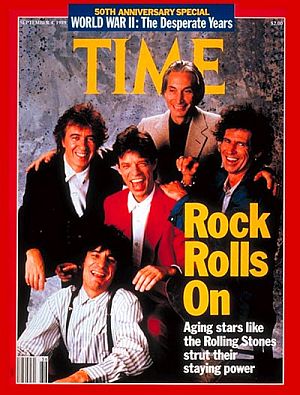
Track of the Week: The Rolling Stones, "Start Me Up"


When I first heard popular music, it was the 70s soft rock and crossover country tapes we had at home: John Denver, Kenny Rogers, The Carpenters, and Tony Orlando.  It was in the early 80s that I first became aware of what was on the radio, and began to know what the hits of the day were.  The first song I ever remember digging through the radio was "Centerfold" by the J. Geils Band.  I seemed to hear it every day on the radio on my way to school in kindergarten (which jives with the fact that it hit #1 in February of 1982.)

Of course, I had no idea of what the song was about, I just loved the catchy riff and the bright organ, an instrument for which I still have an inordinate affection.  Back then I also assumed that all the songs I heard on the radio were by new artists.  Around the same time, when I heard "Start Me Up," I thought the Rolling Stones were just as young and fresh faced as Rick Springfield or Duran Duran, and had no clue of their past.  After all, my older cousin had "Start Me Up" on 45, just as she had Bow Wow Wow and Billy Idol.  I always liked the song, which I thought of as the "make a grown man cry" song.

By the mid-1980s I saw the video for "Start Me Up," and found out that these guys were OLD.  (They were about my age now in that video.  Eek!)  It was kinda puzzling, like when I saw Bob Dylan singing in the "We Are The World Video" and thought "who is that weirdo croaking, I want more Lionel Richie."  It was perhaps my enthusiastic embrace of the Monkees and their 1986 reunion that made me aware that there was plenty of older music that I actually liked just as much as the stuff coming out of the local hits station.

Little did I know then that I had been just old enough to witness the Stones' last great single in its natural habitat, Top 40 radio (classic rock radio is more like a zoo than the wild.)  In 1981, when it hit #2, the Stones had been together for 19 years, churned out several hits, and sold out arenas under the braggadocios banner of being "the greatest rock band in the world."  Like I said, I thought they were pretty old and crusty at that point, but they've been together another 33 years, and while they still sell out stadiums, the Stones have not produced a single hit that any of their fans would elevate to the canon.  Every few years they put out another album that their fans optimistically call "the best since Tattoo You", the record that spawned "Start Me Up."  That's telling, since everyone seems to acknowledge that "Start Me Up" still hasn't been topped, and it doesn't look like it ever will be.

This begs the question, what makes "Start Me Up" so great, anyway?  I would point to the groove.  After Exile on Main Street in 1972 the Stones put out a lot of mediocre material (1978's Some Girls being the major exception), much of the mediocrity easily attributable to Keith Richards' drug use.  (Their suckitude since his cleaning up is mostly the fault of Jagger's heart not being in it, IMHO.)  That said, while the songs sucked, many of them had some seriously funky grooves.  (The idiotic yet danceable "Emotional Rescue" is a prime example.)  It's as if the band finally mastered rhythm, but lost everything else.  Someway, somehow, the old standard of songwriting actually got molded to the groove on "Start Me Up," a song that is irresistible both for dancing and singing along to.  It is their one last bright shining moment as group, and even if they've been milking their former glory for over three decades, songs like "Start Me Up" are the reason why they can get away with it.

Thursday, January 2, 2014

A Gloss On The Term "Lifeboater" tm

If I have one accomplishment as a writer and scholar, it is coining the term "faculty lifeboater," which has caught on in the wider discourse on contingency and academia.  (The relevant post is here.)  It's certainly had a much bigger impact than any of my journal articles, that's for sure.  I see "lifeboater" popping up a lot on Twitter, usually attributed to better known, better writers like Rebecca Schuman and Sarah Kendzior.  Both have been gracious and non-jerky enough to give me credit for it on numerous occasions, so I can't complain about being ripped off or anything.  In fact, I am very thankful for the exposure they have given me.

It's actually been kinda interesting to see the term's meaning change from how I originally intended it.  (That's how language works, after all.)  This is how I defined lifeboaters in my post coining the term:

 "These are junior scholars who don't bother thinking about the naked exploitation of a system where adjuncts are paid as little as $1,700 a course, and do just as good of a job (or better) as they do. In their minds, they won, they're on the lifeboat, and fuck all those other people drowning around them."

I put junior scholars in this category because they have experienced the exact same contraction of the job market as their peers, and thus cannot plead ignorance about just how bad things are, or deny the role of luck and fortune in getting them on the lifeboats.  The drowned and the saved were both on the same sinking ship.  I tend not to think of tenured faculty and senior scholars of being in this category, I envision them on a yacht in the distance, turning their heads from the carnage and drinking their sherry and eating their caviar, in the worst cases, not bothering to notice in the less worse cases, looking aghast at the toll but not sure what to do about it the better cases, or actively changing course to rescue as many as they can, in the best cases.  (And yes, there are many t-t and tenured folks who do this.)

I certainly do not excuse the willful ignorance of the tenured oblivious, but I actually think that junior scholars who refuse to do anything about this situation are actually more morally odious, even if they don't have as much institutional power as others.  Knowing what they know, it's their duty to use their positions communicate the horror of the shipwreck to those unaware of it, and by not doing so, are a key component in preserving the status quo.  There's a reason that Dante put betrayers in the lowest circle of hell.

Much of my vitriol also had to do with knowing many assistant professor lifeboaters personally, and being filled with anger about their unconscionable lack of empathy.  They have been all too willing to watch their peers from grad school go under without saying a peep, even though trends in higher ed will soon be drowning them as well.  I have even heard them make excuses about the system to the faces of their own less-fortunate (and sometimes better qualified) friends and colleagues.

"Lifeboater" is now used to include pretty much anyone tenured or on the tenure track whose main complaint about the situation for contingent faculty is the shrieks of the drowning, not the actual fact that they are being swallowed up.  That alteration is just fine with me, since people who engage in such awful behavior deserve to be called out.  If something I once wrote helped bring that about, I couldn't be happier.

It's just that I will probably never hit a rhetorical home run like that again, and I want some credit attached to my name for it, dammit.  Call it petty or silly, but life is about small victories, and this humble blog will never be reckoned among the big guns.  So let the world know that it was I, Jason Tebbe, writing under the pseudonym Werner Herzog's Bear, who coined the phrase "lifeboater."  You don't have to mention my name when you use it, obviously, but if you want to credit someone, please credit little ol' me.  Thanks.

Wednesday, January 1, 2014

Newark Is The Canary In America's Coal Mine

Yesterday my wife and I cleaned out our old apartment in the Ironbound and handed our keys over, which means I'm no longer a resident of Newark.  While I am glad to have much more space in our Maplewood home, I already miss the old neighborhood.  I also feel a little guilty, because I feel like I am abandoning a city I love during its time of need.  The small improvements and positive changes that I had been perceiving since 2007 (when I started splitting my time there) appear to have been wiped out in 2013.

Crime is way up again, evidenced by a recent New York Times article showing that Brick City is again the car jacking epicenter of America.  The number of murders jumped to an alarming one hundred and eleven, the highest total since 1990 in midst of the crack wars.  Not only is that death toll atrocious, the murders themselves have been especially heartbreaking.  Last week on Christmas night a 13-year old girl was slain by stray bullet fired by another teenager in a revenge killing that also claimed a 15-year old boy.  Corey Booker, the city's former celebrity mayor, bailed on Newark for the Senate, leaving this mess to the unlucky winner of the next mayoral election, which could very well put the old machine back in power.  That outcome would mean graft and mismanagement on top of poverty and crime and will surely make things even worse.

Of course, few people outside of Newark and Essex County seem to give a damn about any of this.  The recent killing of a man in a car jacking at the ritzy Short Hills Mall just a few miles (but worlds away) has received as much media attention as all of the 111 murders in Newark put together.  As I have said before, some lives are cheap in this country, and none more so than poor people of color.

But others outside of Newark ought to pay heed, because Brick City's woes will be coming to them, too.  There are two larger forces at work behind all of this that have made themselves felt more immediately in a poorer city like Newark struggling to keep itself above water before the twin tsunamis of economic stagnation and government austerity came crashing down.  Not to mix metaphors, but Newark is the canary in the proverbial coal mine, and its fate ought to be seen as a harbinger for what's to come across the country.

Although the economy is no longer in free fall, as it was in 2008-2009, any recovery that has happened since then has been seen by the wealthy, not by the majority.  Low wages and high unemployment are leading more and more people to desperation.  On top of that, the response by government in the midst of such want has been to slash, rather than raise social spending.  That austerity was held off for awhile by the 2009 stimulus' aid to state governments, but since Christie's coming to power in 2010, the state has slashed money to poorer cities, which has meant cutbacks in police for Newark and Trenton.  Not surprisingly, crime and murder have jumped up in those places.  Of course, most of the state's suburban population could hardly care less about the fate of black and brown people in places like Newark and Trenton, and will happily take a tax break and ignore the sight of blood on streets they'd never drive down in a million years.

New Jersey's austerity mirrors that in the nation at large.  For three years now, since the Tea Party midterm of 2010, deficit reduction has trumped stimulus and relief.  Republicans in Congress have largely gotten their way, evidenced by the fact that many food stamp recipients and the long term unemployed are about to lose their benefits.  The bill for such negligence is finally coming due, and continued austerity will only make it worse.  As a nation, we have decided to respond to a hopeless economic situation by making things even worse for the poor.  For three years people have pretended that this won't have any consequences, they won't be able to pretend that much longer.  I just wonder if when the death tolls and misery start to skyrocket in poor communities, anyone outside of them will care.