Monday, September 12, 2016

On Watching The Wizard Of Oz With My Daughters


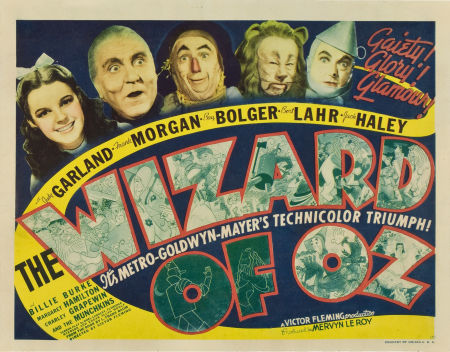
About a month ago my mother-in-law got us a copy of The Wizard of Oz on blu-ray, and my wife and I decided to show it to our four year old twin daughters, but with some trepidation. What if they didn't like it?

For my wife and I this is a magical movie. Its magic is related to its scarcity in our youth, which made viewing The Wizard of Oz a special thing. In our pre-VCR early childhoods she actually had it on 8 track, and watching it can still locate the moments where the tracks ended and the tape had to be flipped. Like so many others of my generation, I made sure each year to catch the one time annually that it was shown on television. My sisters and I would gather in front of the television to repeat a ritual that began around the time of my first firm memories. (I probably saw the movie for the first time at the same age as my daughters did.) One year they showed a little documentary afterward, and it was amazing to see Margaret Hamilton as a sweet old woman talking about her characterization of the witch. Instead of ruining my suspension of disbelief, it made me love the film that much more.

Luckily for us, my daughters love it too, and they even jump in a big basket and pretend that they are taking a hot air balloon to Oz. We've already had a repeat viewing, rare for a full length feature film for my daughters.

While it makes me so happy to share the film with my daughters, I have not been prepared for the other emotions that it stirs up. The first time we saw it together, I lost it when Dorothy started singing "Somewhere Over The Rainbow." It is a real tear jerking song, and Judy Garland invests it with such emotion, but it had never made me cry before. Sitting there on the couch with my wife and daughters I was reminded of growing up lonely on the plains of Nebraska (as opposed to Kansas), my many years in the romantic wilderness, and those years spent wandering the academic landscape for a job warding off depression the whole while. For decades I had spent my time looking to be somewhere else, whether because I was in school preparing to fly, or I was in a crummy job or a place I liked but only employed temporarily. It took a long time for me to finally land, and the precariousness of my good fortune is something  I remind myself of each day. My daughters fill me with wonder every day, the greatest reason for living I've ever had. Coming to the realization there on that couch was overwhelming.

As hard as "Somewhere Over The Rainbow" hit me, that was a light shower compared to the hurricane at the end of the movie. The scene when Dorothy has to say good-bye to her new friends used to really get me even when I was a child. Now? Positively deadly. She has to go home, but that means leaving behind the best friends she's ever had. This time around the crying started, and it was so intense that I started to get a sharp, stabbing pain in my forehead, which only happens when I am trying to keep from becoming a sobbing mess, a sensation I've had on maybe half a dozen occasions in my adult life.

In my years spent learning to fly or in my wanderings through the academic wilderness, I met a lot of truly amazing people. They're pretty much the reason I was able to survive. Between graduating college in 1998 and landing in New Jersey in 2011, I moved five times, and in each place met so many people who I still hold close to my heart. All those moves meant saying good-bye to all of them. As happy as my family makes me, I've yet to meet anyone like those people here. So I cried, weeping for the all the people I wish were near me but now live so far away. Like Dorothy, I was able to come home, but it meant abandoning my friends. It has not been easy, but I look into the eyes of my daughters, and I remind myself there's no place like home.

Saturday, September 10, 2016

REM, "Fall On Me"


I listened to REM's 1986 Life's Rich Pageant for the first time in years recently, and I was struck by how well it held up and how much I liked it. For years I'd written it off as a transitional album between their early, mystery-wrapped sound and the bigger rock sound of the late 80s that would break them into the mainstream.

That certainly wasn't the case when I first heard it. REM was my favorite band in high school, and the first group that compelled me to raid its back catalog when that still involved locating and buying actual tapes and CDs. Life's Rich Pageant was the first album of theirs I bought that didn't have a hit on it. I'd bought Out Of Time on the strength of "Losing My Religion," then gobbled up Green and Document, which had songs like "The One I Love" and "Stand" that I had head on the radio and MTV. Life's Rich Pageant grabbed me right away, especially "Fall On Me." As the years went by my tastes got more rock snobby, and I decided that like so many other bands, "their early stuff was better." Also since I had the album only on cassette, I rarely revisited it until the age of streaming.

Yes, the production is more in your face 80s than Murmur, but "Fall On Me" starts with one of Peter Buck's most beautiful Byrd-dropping folky guitar figures. The wall of jangle throughout the song is just beautiful and a perfect foundation for the vocals. The boomier, more produced drums give the song a kind of stateliness and immediacy. The chorus is super catchy, and Mike Mills, the band's great secret weapon, adds some pretty  background vocals, his clear voice as always a great compliment to Michael Stipe's nasally tone. In an ideal world it would have been a hit, but 1986 was perhaps the height of Reagan's America, before the Iran Contra scandal and the 1987 stock market collapse made it safe for pop culture to be more critical.

The song, like many on the album, has a political bent. It is about environmental degradation, asking the sky not to fall after polluting the life out of it. While my understanding is that Stipe was thinking here of acid rain, on this unusually hot September day, I think about climate change. Like the best of REM, "Fall On Me" can be political without being preachy or obvious, and is well worth a listen.

Friday, September 9, 2016

Remembering The Real 9/11

As someone who was just beginning to study historical memory, I wondered in the immediate aftermath of 9/11 of how that event would register in years to come. I never could have imagined that fifteen years later its main cultural manifestations are in "God Bless America" being sung in seventh inning at Yankees games, and whacko internet conspiracy theories. These days my biggest reminder of 9/11 comes when someone makes a "jet fuel can't melt steel beams" joke on twitter. It has been reduced to a symbol by nationalists and has lost its emotional heft due to conspiracy theories.

I have tried, every year since the event, to think long and hard about what I really felt on 9/11. Our nation soon crafted a narrative of resilience, and even Hillary Clinton recently cited the purported unity in the nation the attacks brought on that day. The deluge of official remembrance and media spin has made us lose sight of the visceral human horror of that day. Like others, I was confused and disoriented, overcome by a sickening wave of grief and fear. Nobody was sure of what had happened, or what it would mean. I remember crying quiet tears in the teaching assistants' office, thinking that the attack would unleash even bloodier wars in response. 

I never could have known that the wars would still be going on fifteen years later. Those wars have helped turn 9/11 into a symbol, and have obscured its tragedy. Real people died, real flesh and blood people, and they died by the thousands. For the most part, they weren't "heroes," just ordinary people going about their day. In fact, I just found out today that a colleague lost someone he knew in the attack. My wife has had students at her school who lost family members in the attack. The wounds are still there, even if lower Manhattan has shaken almost all of the scars. I wonder how soon before the last traces of anything real in our memory are gone, replaced completely and totally by bullshit.

So this 9/11, don't let the day be claimed by the nationalists and the cranks. Remember by remembering the people who lost their lives, and don't invest them with phony martyrdom. Don't act as if taking out Bin Laden vindicates anything or lessens the mourning of those who lost loved ones. Above all, remember what you really, really felt that day, before the mechanisms of nationalism turned it into justification for wars without end. Maybe, when the current, unending war 9/11 was exploited to foment finally ends, we can have a true, honest public memory of that day.

Wednesday, September 7, 2016

The Superman Movie I Want To See


Since delving back into comic books, I've noticed that graphic novels give me much more of a thrill than most movies based on them. Because comics are a serial medium with long story arcs, film is probably inherently ill-suited for translations, as opposed to television. (Having seen Jessica Jones and Flash, I think TV's great potential for comics adaptations is unassailable.)

Graphic novels also seem to better capture the human element of the characters than movie adaptations. The problem with seeing so many CGI cities getting shattered is that it's just pure spectacle. (Plus Godzilla movies sixty years ago did that schtick better!) We don't care much about the people involved, and in recent films, the heroes really don't seem to either.

I recently re-watched the 1978 Superman, and while it has its flaws, I was struck by how the disaster stuff was secondary to Superman's personal anguish when Lois dies. (Is his turning the earth around a little ridiculous? Yes, but pretty cool.) The scenes with him as Clark were also a master class in subtle, character-driven comedy by Christopher Reeve. It got me thinking about how a new Superman film could really grab the audience's emotions by going in a different direction.

In my ideal Superman film, the main plot point is that the Daily Planet, like other newspapers, is experiencing massive layoffs, and that Superman is trying to save Jimmy, Lois, and Clark's jobs. He's worried that Lois might move from Metropolis to take a job in Central City, or perhaps that he'll be out of work. Remember, Superman is not Batman. He does not have a family fortune to fall back on. It would be interesting to see a man (I'm not calling him an alien for these purposes) who can fly and stop bullets but who can't save his job. Worse than kryptonite is the nagging feeling of failure and insecurity. In our current world, where so many of us struggle to support ourselves and our families no matter how excellent we are, I feel that message would resonate brighter than a million CGI explosions.

We could see Jimmy Olson turned into a free lancer (as photographers are everywhere in the publishing world) scrounging for work and having to move into Clark's apartment. We could see Superman take on political corruption, as opposed to sci-fi baddies, in order to give Clark sensational stories to pitch to online magazines. We could see Lois forced to relocate to a much less desirable location in order to maintain her career, and the heartache and longing it instills in Clark Kent/Superman. Perhaps even Superman will reveal his true identity to her out of desperation. As someone forced for a time into a long distance relationship by trying to maintain an academic career, I know how helpless these situations feel. Basically, we could see the realities of economic life in America, especially in professions like journalism, reflected on film, which is so rare. It just might take the normally escapist superhero genre to do it.

Monday, September 5, 2016

The Bircher Long March


For a long time there was an established narrative, both within and without the conservative movement, that in the early 1960s William F Buckley and his allies banished the John Birch Society and other fringe elements from the conservative movement, paving the way for the more economically-focused John the Baptist Goldwater and redeemer Reagan. Conservatives have been very invested in this narrative, and defend it vigorously. Allan J Lichtman has questioned this view, and thus entitled his stellar history of the conservative movement White Protestant Nation, drawing a rebuke from David Frum in his book review. He saw movement conservatism as a repository of noble ideas, not resentments aimed at preserving a certain kind of country and social order.

This election year, however, appears to have proven Lichtman's thesis. It seems that, contrary to the old narrative, that the Birchers and assorted right wing practitioners of what Richard Hofstadter called the "paranoid style" never went away at all. The so-called "alt-right," inheritors of the racist and xenophobic traditions in conservatism dating to the 1920s, now have more pull with the Republican nominee than the free marketeers who think they represent conservatism. That candidate has built his campaign on whites resentful over losing "their" country, exactly the kind of thing that Lichtman saw as the core of conservatism.

Like most funguses, the nationalist right has flourished in darkness on a diet of eating shit. For years it lurked in the background, finding an airing in the less savory corners of the talk radio world apart from the Hannitys and Limbaughs. Those who fancied themselves the leaders of the conservative movement looked up to economists like Hayek and Friedman, and writers like Ayn Rand. They really thought that their movement was united by notions of limited government and cultural restoration.

Like Mao's army during the Long March or Castro's guerillas up in the Cuban mountains, the Birchers bided their time in the boondocks, gathering strength and ready to strike at the movement's rulers, who were losing legitimacy faster than they realized. Sarah Palin's vice presidential candidacy was like the attack on the Moncada barracks: a failure in the short term, but galvanizing. Soon came Glenn Beck and the Tea Party and the cries of "take our country back," the phrase that encapsulates the true heart of modern conservatism. The election of a black liberal president tipped the balance in favor of the Birchers. They had the power of the conservative lizard brain's revulsion on their side, which wipes the floor with the intellectual conservatism of the likes of Frum, David Brooks, and George Will.

The average conservative foot soldier has no clue who the Cato Institute or Friedrich von Hayek or Milton Friedman or Arthur Laffer are. They are much more likely to know Alex Jones, who is the most listened-to practitioner of the paranoid style in many decades. The average conservative is not a college young Republican with a copy of The Fountainhead on their nightstand. It's an exurban talk radio fan driving a pick up truck to their lower middle class job while listening to Michael Savage. Instead of being defeated in the early 1960s, the Birchers have played the long game, and are now running the show. The Frums, Brookses, and Wills of the world are modern day Alexander Kerenskys, victims of the revolution they were foolish enough to think they were in control of.

Saturday, September 3, 2016

Radiohead, "Subterranean Homesick Alien"


Tomorrow I turn 41 years old. Instead of reaching a milestone, I'm just one year closer to the grave. Whenever my birthday comes around, I do a lot of reflection. I was originally going to pick a song this week about the onset of autumn, but all that thinking made me reflect back on how much I've changed since I first heard the songs under consideration. That's especially the case with Radiohead's "Subterranean Homesick Alien," maybe my favorite track on OK Computer. It expresses a feeling I had a lot in my youth, which I am not always happy to remember.

The narrator is walking around his mundane town, and fantasizing about being abducted by aliens as a kind of deliverance from a thoroughly unfulfilling existence. I first bought OK Computer in August of 1997, a time when my need for deliverance was especially acute. It was right before I was going back to college for my senior year, and it was the summer that almost broke me. In college I had usually done factory work to make money, but that summer there weren't any full time positions at the place I usually worked. Instead of working part time and enjoying my summer more, I made the idiotic decision to take a telemarketing job. Needless to say, it was a nightmare, and that combined with getting my heart broken in an awful fashion and having to endure living with my parents in my boring hometown where my only friend in the area was at that time institutionalized in a mental hospital in another state made each day a wretched trial. I ended up taking the part time gig at the factory on top of the telemarketing job, that way I could work sixty hours a week between the two jobs, then quit telemarketing once August rolled around. It also meant working so much that I didn't have to confront my depression.

I remember hearing OK Computer as a kind of revelation, a voice calling out to me to give solace during my time in the void. It seemed to speak to my feelings of alienation and my overwhelming desire for escape from my own flesh. These were emotions that I had often felt, and now it seemed that Thom Yorke was a kindred spirit who had felt them, too. Often in my childhood and teen years I felt trapped in my own body. I was constantly bullied until about the tenth grade, (including by former "friends"), after which point I was merely ignored. Awkward, shy, and prone to developing obsessive crushes rather than talking to women, I had managed to make it to the cusp of my 22nd year without ever having kissed a girl or woman in a romantic fashion. (I still feel embarrassed to be typing those words.) Maybe I was some kind of alien orphaned on a strange planet, a Kal-El without any yellow sun powers.

Obviously a lot has changed since then. At 41, I am almost to the point where I have spent half of my life outside of the void. It's been long enough that sometimes I forget how much of my life was spent there, and how hopeless I felt back in those days. So instead of wishing for deliverance, at 41 I am happy to be where I am. Maybe I can be happy that I hopefully have more years ahead of me, enough to make my time in the void a distant memory.

Thursday, September 1, 2016

New School Year's Resolutions

[Editor's Note: personal post today. Feel free to skip if you like.]

My school year started Monday with some professional development sessions. It will be another week of meetings before I see my students, but the grind has already begun. I'm back in the trenches, back to getting up at five in the morning, back to a mad rush to get the girls up and fed before my train leaves, back to my long commute into New York City, back to coming home exhausted and barely having any time to spend with my daughters. I was filled with such dread last week thinking about the months ahead, and I decided to make some resolutions. I do love my job, but juggling that job with family life has been very difficult, to the point that by March I wonder if I am going to make it to the end of the year. I don't want to experience that feeling this coming year, so here are some things I want to do:

Get seven hours of sleep a night
When my daughters were infants my sleep got patchy for obvious reasons, and it still hasn't recovered. Last year I usually got about six hours a night, which is not enough on a consistent basis. It made me tired and irritable.

Read books on the train, rather than listen to podcasts or surf the web
Part of the reason I stay up late is that I need time for myself every day, and that includes reading. If I go a day without reading a hundred pages or so I feel like I've wasted my day. Part of my problem was that due to sleep deprivation, I was too tired to read during my train commute, and I would fall into surfing the web on my phone and listening to podcasts. Reading on the train will help me sleep more. Yes, I am that weird.

Playtime with my daughters every day
In the morning I am with my daughters in the mad rush to get ready before my train leaves. When I get home I am with them in the mad rush to walk the dog and get dinner ready. Because we get up so early, they have to go to bed early, which means I barely get time with them. I'm trying to avoid the temptation of just flopping in my easy chair while they play or watch TV. We had so much fun this summer, I don't want to lose that.

Don't work through every lunch
Being a teacher is a hectic job, and some days I am able to get a lot done by bringing my lunch from the cafeteria to my desk as I work. This kind of behavior keeps me from getting a break or socializing at school. I need to stop doing the working lunch so often, and take some time to let my mind breathe.

Do enjoyable things on the weekend
During the fall weekends can turn into a cycle of yard work, lazy soccer watching, and trying to appease irritable toddlers. Then Monday rolls around and I feel zero sense of rest or happiness as my train gets enveloped by the darkness of the tunnel beneath the Hudson. This year I want to make sure I do something legitmately enjoyable on the weekend. My wife and I certainly need to go out more without the kids, and when we do go out, venture into either the deep country or New York City. Sitting around the house for two days is a recipe for irritability, since I am not a homebody.