Saturday, June 29, 2013

Track of the Week: Fleetwood Mac, "Oh Well"


One of the many reasons I love listening to vinyl records is that some songs are so vital, so explosive, that you only feel their true power when you drop the needle on the record and feel it pulsate from the groove right into your fingertips.  I never get that feeling when I push play on the CD player, tap the screen on my iPhone, or click a link on Spotify.  I still remember hanging out with some friends before my vinyl buying days and hearing Led Zeppelin IV blasting out of their old-school hi-fi like the voice of God.  That moment sure made a believer out of me.

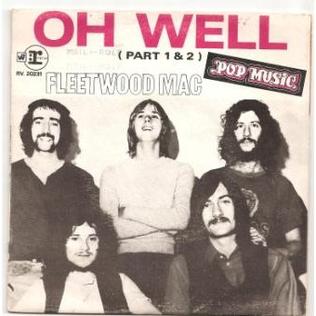
"Oh Well" by Fleetwood Mac is a great song that sounds absolutely sublime on record.  For those of you who don't know, Fleetwood Mac began as a blues band in the 1960s before they brought in Stevie Nicks and Lindsay Buckingham and perfected California cocaine rock in the 1970s.  Peter Green led their original incarnation, and for my money this cracked genius was the true guitar hero of his generation of British blues players, which included Clapton, Beck, and Page.  It's a shame that his mental illness took such a toll on his life and career.  Maybe because my best friend from childhood is also a schizophrenic, I have a soft spot for him.

It's not just general respect for Green's craft and ability that bring me back to his work, though.  I feel the aforementioned ZAP! from the needle on the record whenever I drop it on this song, which starts with driving acoustic guitar line that builds into an absolute blockbusting thrasher of a riff, underscored by a torrid, relentless beat.  If I owned a 1969 Camaro this is the song I would have blasting out of the 8 track player as I tore down the street.

However:

After a mere two minutes of absolute killer riffage of the kind that Jimmy Page made famous, the song suddenly stops, shifts into slow tempo, and goes on for seven, worldless minutes.  It's one of the most stunning about-faces I've ever heard on a record, but it works.  This tune fit for a muscle car suddenly sounds like the lost soundtrack to a forgotten spaghetti western.  This too can only truly be heard on vinyl, where the spaces between the notes take on such an open quality not possible in the compressed universe of the mp3.

In our society, so obsessed with novelty and "innovation," we rarely ask ourselves about the price of progress.  Put the needle down on "Oh Well," and you'll get a taste.

Wednesday, June 26, 2013

The Blog Post That Won My Spouse's Heart

As I mentioned a couple of days ago, this blog helped a nebbish, socially awkward dork like myself look intriguing and cool to a woman way out of my league.  Four years ago, I was lucky enough to get married to her.  In honor of that great day, here's the post I wrote on my old blog way back in June of 2006 that caught her eye.  It describes the kind of bachelor lifestyle I once enjoyed before discovering something much better.

######


Before getting into my praise of two of my favorite Lincoln, Nebraska institutions, I'd like to relate some news. The folks in Chicago hired someone else, which means I will be in Grand Rapids next year. I am a bit bummed out about losing a chance to fullfill my dream of an academic job in Chi-town, but at least I won't be too far away from the gang in the 'paign.

Yesterday, after eight grueling hours of grading (this is something I normally do with the stereo on, or while inhaling coffee at Aroma to make it bearable) I joined my friends James, Amy, and the Professor at O'Rourke's for the Professor's regular happy hour, called "Secret Seneca." Yes, he is a classics professor who has a Christian name, but in our crowd he is merely known as "The Professor," a jovial sixty-ish guy with an impish grin, snowy beard, lots of wit, and the youthful attitude of a man divorced late in life. He, like James, can pack away the beer like no one else I know, and keeping up with them last night on an empty stomach after walking several blocks in the hot sun almost put me down on O'Rourke's grimy floor.

Like good friends and good women, a good bar is hard to find. Like a good friend, a good bar is waiting for you when you come back to it, and it picks you up when you're down. O'Rourke's lies in the heart of Lincoln's still beating downtown (it is also the de facto campustown, and the city has restrictive zoning laws, which have kept it going) and is patronized by an odd mix of unalloyed alcoholics, slumming intellectuals, Lincoln's hipster elite, and assorted working folks. It has a really high ceiling that gives the place a certain open-ness that other bars lack, and a good selection of beers while still having PBR and High Life for $1.75 a pint ($1.25 during happy hour.) A chalkboard hangs on the men's bathroom wall that anyone can write on, today I saw many a lament about the 'Huskers' loss in the College World Series qualifiers. Despite my infrequent time in Lincoln, I must have made some impression, because bartenders today and yesterday both told me, "You look familiar," and my only explanation was that when I am in Lincoln, a high percentage of my time is spent at that particular institution.

Related to this, sign of a good bar or restaurant is low staff turnover, and tonight there was a young woman tending bar that I've seen over the last coupla years serving up suds for the drunks. She is a strikingly beautiful blonde with a enigmatic mouth and arresting eyes, but hers is the quiet, subtle, and ultimately superior beauty of the unassuming prairie woman. (Keep in mind, my thoughts on her beauty are only in a purely aesthetic sense, like admiring a work of art or natural wonder.) After she told me I looked familiar (not in any come on kind of way, but out of curiousity) I asked if she was from Hastings, she revealed her hometown to be Hartington, a small town north of Lincoln. At that moment I felt validated, I knew that something so sublime could not have been created in the suburbs or the city.

Enough of that. Yesterday, after getting good and soused at the bar (James kept pouring the pitcher into my glass after I was already wobbly), we headed to our fave Friday night eatery, The Tam o' Shanter, which we've always just called "The Tam." Its low red lighting, shag carpet, and leather upholstery gloriously show off The Tam's status as one of the few remaing steakhouse lounges left. The lounge has become a dying breed, just like telephone booths, the wishbone offense, and competent Democratic politicians. Instead of the steak I had the fish fry special, and wasn't disappointed despite my recent feasting on the real deal in Maine. If you ever go to Lincoln, you must eat there.

Tuesday, June 25, 2013

Today's SCOTUS Decision On The Voting Rights Act Will Live in Infamy

I have a knot in the pit of my stomach today.  I haven't felt this knot since November of 2004, when George W. Bush won re-election, and it comes from the same source: my country has upset me to the point of physical illness.  Today the Supreme Court's conservative majority, those supposed avatars of judicial restraint, effectively gutted the Voting Rights Act, in my opinion the most important piece of civil rights legislation ever passed in this country.

After the Civil War, the white South had to live with emancipation, but it would not accept social and political equality with freedmen and freedwomen.  This necessitated the 14th and 15th Amendments to the Constitution.  The latter, in 1870, banned restriction of the right to vote on the basis of race, color, or "prior servitude."  Of course, Southern governments found ways to keep blacks from voting through other means: all white primaries, the grandfather clause, literacy tests, poll taxes etc.  That, coupled with violent intimidation, suppressed the vote to the point that after 1900 there was not a single black representative left in Congress.  In the ensuing years, the courts struck down the grandfather clause and the all-white primary, but Southern states and localities were still able to restrict the vote.  The Voting Rights Act, which came only after several brave people lost their lives in order to secure it, brought in the federal government to ensure that states and counties with a history of voter suppression could not change voter requirements without federal approval.  Only when the federal government was given the power to intervene in the South did things really change.  By taking away preclearance, the SCOTUS has effectively destroyed the main tool needed to prevent a repeat of the past.  (As the last map on this link shows, the states subject to preclearance are also home to very high levels of prejudice against black people.)

The court's conservative majority claims that it is wrong to single these states out today.  There are three pretty clear responses to this.  First, there are other states, such as Pennsylvania and Ohio, where there have been attempts to suppress the votes of blacks and Latinos.  We should make preclearance nationwide in that case, since it is necessary all over the country.  Second, it isn't the role of the Supreme Court to even act in this case.  The justices writing for the majority say that the preclearance measures were necessary in 1965, but no longer.  This sounds less like the Court ruling on the constitutionality of the law, and more on whether they like it or not.  Congress should be able to decide if the Voting Rights Act is still necessary, not the courts.  I can't think of a clearer case of "legislating from the bench," the very thing these conservatives claim to abhor.  Third, this decision is based on a ridiculous logical fallacy.  Because of the Voting Rights Act, voter suppression has been greatly reduced, which the court is now using to say that the law is now no longer necessary, forgetting why the law was needed in the first place.  Let me be more direct.  When criminals commit heinous crimes, we don't take them out of prison because their being in prison has prevented them from committing more crimes.  The states and localities covered by pre-clearance were guilty of wretched crimes against democracy for a century.  It might sound unfair on the surface to hold them to a stricter standard, but murderers, whether of people or of basic human rights, should not be trusted or let off easy.

The behavior of many of the states affected by pre-clearance shows a remarkable tendency towards recidivism.  In Texas, long home to an all-white primary system in the bad old days, the legislatiure responded within hours to the decision by immediately drafting legislation that would make it more difficult to vote and redistrict in a way that diminishes the votes of blacks and Latinos.  I expect to see much of the same across the country, since the Republican Party has made voter suppression a priority. Voter ID laws are just a repeat of the old strategy where conservatives keep coming up with new devices to limit the vote (like ID) when the old ones (poll taxes and literacy tests) are banned.  The Voting Rights Act had powerful provisions to stop this, at least in selected states, and now those protections have been taken away by an out of control, partisan Supreme Court.  That is why this decision will live in infamy.

And that is why we must mobilize and fight.  Congressional Democrats need to match their Texas Republican rival and speedily draft new legislation to strengthen the Voting Rights Act.  We need nation-wide pre-clearance.  We at least need the bigoted bastards who want to benefit by suppressing the vote to be forced into the public eye and own up to their guilt.  Fot too long they have been allowed to hide behind the ridiculous fig leaf of "voter fraud," something that occurs about as often as Ted Cruz being polite.  Right here in New Jersey our celebrity governor vetoed early voting as "too expensive" when he set up an extra special election for a vacant Senate seat to keep Democratic turnout lower in the general election that is costing the state millions of dollars.  Conservatives have lost public trust, now they are just trying to manipulate elections to get around that fact.  We cannot, we must not allow this to happen.  The brave people who faced savage beatings and death to bring about real voting rights shall not have suffered in vain.

Monday, June 24, 2013

Why am I Doing This? (and other questions)

I have been blogging now for almost nine years, and it's been so long I am beginning to wonder why I do it.  Most blogs are abandoned soon after they are started, but I have been blogging for a decade.  This isn't bragging, I legitimately wonder what the hell I've been doing all of this time, since this blog was not launched to get me a book deal or be read by a mass audience.  I know what follows is rather solipsistic, but I wonder whether any other bloggers out there have some insight for me.

I started doing it right after the election of 2004, in order to put into words that shock and frustration I felt about George W. Bush getting elected.  My friends were also probably tired of getting my long-winded emails sermonizing on this same topic.  A friend of mine had started a blog (now defunct) and it seemed like the natural thing to do.

I was not writing to get anybody's attention, but to get out my thoughts and amuse my friends.  I also just enjoy writing, and it was nice to do so without any pressure of publication and vetting, which is something that took all the joy out of my academic writing.  Back then I was pretty naive, I used my actual name (meaning that potential employers would find the blog) and I gave it the unwieldy name of "Fugitive Streets/Jackal Tombs."  The title referenced lines from Proust and Melville.  Oh yes, I was still a pretentious grad student back then.

At least my naivety paid off a little.  When I met my future wife for the first time, she googled me and found my blog.  According to her, what I had written, especially a Beatnik-y piece about hanging out in bars in Lincoln, Nebraska, made me seem interesting and intriguing.  That added intrigue that helped me find a woman far out of my league and if for no other reason, has made this blog worth it.

After about three years I decided to scrub my real name and adopt the persona of Werner Herzog's Bear, in homage to one of my favorite film-makers and as kind of a juvenile joke that you'll get if you've seen Grizzly Man.  The blog was changed to I Used to Be Disgusted, Now I Try to Be Amused, in reference to one of my favorite Elvis Costello songs.  It also fit my attitude at the time, as I was working as a low-paid, overburdened "visiting" professor.  By that point I think my writing got a lot better and I started hitting my stride.  As always, I just wrote about things that interested me most, mainly music, movies, history, politics, and baseball.

As time went on, especially after I moved to Texas to take a tenure track job that turned into a nightmare, I started writing a lot more about my frustrations with the academic profession.  This stuff seemed to get the most readers, perhaps because it came out of a place of unalloyed pain and rage inside of me.  After hesitating, I started writing about my specific job situation, which generated some of my best stuff (since it was so genuine), but put me in hot water.  A colleague at my job who I made the mistake of befriending ended up joining the mobbing gang tormenting myself and others.  I had revealed my blog to him in better times, and after our falling out, he sent a message to me expressing alarm about what I had been writing.  Scared of having my cover blown, and traumatized by my experience of bullying, I did one of the hardest things I've ever done: I killed my blog.

I was giving up academia at the time, and so it did feel fitting to start anew, to reaffirm a new chapter in my life.  I conceived Notes From the Ironbound being a little different, less full of rants and bitterness and more titled towards longer essays and deep thoughts.  A lot of it ended up being me working through the shame and bitterness of having abandoned academia after having fought so hard for my toehold in it.

My blog never turned into a "post-academic" blog, though.  I still write about the things that move me, which are pretty much the same things they've always been.  It's just me under a different name, not me "branding" myself or playing to a certain niche or popular tastes.  I've come to cherish this blog as a creative outlet, and also as a space of comfort.  I can write what I like, and don't have to worry about what an editor or peer reviewer thinks of it.  Some of my friends have commented to me about how often I am posting these days, and that's because I am writing every day.  It makes me happy, and is a better way to while away the evening hours between putting my daughters to sleep and my own bedtime than watching the television.  Those hours of the night used to be spent reading or watching arty films, but I just can't hack it anymore.  I am so exhausted at the end of the day that I can't pick up a book or play something with subtitles without passing out; I do my reading on the train during my commute and have fallen out of touch with cinema.

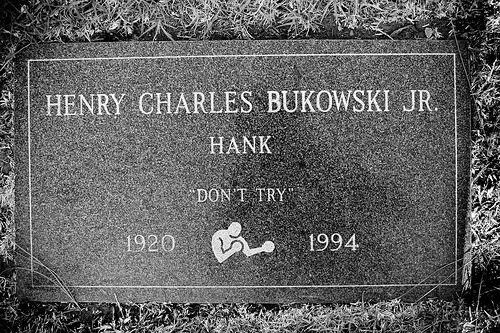
Occasionally I have tried to tout the blog a little; I've posted stuff on the DailyKos' diaries section and joined Twitter, which has led to some of my posts getting attention.  Despite these efforts, not a lot of folks read this blog.  Perhaps I do need to tout my blog more, find a more engaging focus, etc., but I am a plugger, and prefer to wait and see if anyone notices me.  Part of the reason is that when I look at the statistics for this blog, what I often consider to be the best-written material is often the least-viewed.  Trying to push up the pageviews will only result in compromising quality, I fear.  I also don't have any illusions about this blog being a pathway to something else.  The creative fields are being destroyed, and the way to get ahead is by knowing the right people, which I don't.  I didn't go to the right schools, and I am constitutionally incapable of "networking" and glad-handing.  It's probably held me back in life, but I'm just too goddamned old now to change, and I am comfortable with that.  The other path is to be like my friend Chauncey DeVega, and combine hard work, intentionality, and a kind of brilliance that I don't have.  I can't pretend to be able do that, so I will just be keeping on doing what I'm doing, with inspiration from the great Charles Bukowski:


I guess I have kept doing this blog because it fills a need that other things in my life don't, and that's good enough for me.  Other questions are on my mind, though.  I have thought about dumping my "Werner Herzog's Bear" persona and using my real name.  If anyone does like what I have to say here, I'd at least like to get credit for it!  I also wonder whether I should spin off my music stuff to a separate blog, where I can live out my teenage dream of being a music writer, and people who like my music writing don't have to be subjected to my post-academic rants and political screeds.  Anyway, thanks for listening, and I promise to stop navel gazing in the near future.
Saturday, June 22, 2013

Track of the Week: The Four Tops, "Bernadette"


Motown had an amazing ability to put out records that were as sleek and well-constructed as a Cadillac coming off a Detroit assembly line, but which still bore the warm, organic stamp of having been recorded in the humblest of studios in Barry Gordy's garage.  Years of listening to Motown records have also taught me that individual producers put as much or even a bigger stamp on the songs as the performers themselves.  For example, when Norman Whitfield started producing the Temptations, their sound became edgy, funky, and psychedelic.  "Cloud Nine" is a million miles from "The Way You Do the Things You Do."

The production team of Holland-Dozier-Holland probably did more than any other to define the "Motown sound" via Supremes songs like "Baby Love."  Their best creations were mini-pop symphonies, but not always as bright and cheery as you might think.  Unlike the Temptations, the Four Tops' love songs produced by Holland-Dozier-Holland had an air of menace and darkness behind them.  Even a positive song like "I'll Be There" has a lot of minor-key stuff going on.

I think Holland-Dozier-Holland and the Tops reached their apex with "Bernadette."  The key is lead singer Levi Stubbs' muscular yet emotionally desperate singing style.  This song is from the point of view of a man absolutely obsessed with a woman who he tells is his "reason to live" and "you mean more to me than a woman was ever meant to be."  He reveals insecurity along with obsessiveness when he warns her that other men are after her, but do not "treasure" and "adore" her as much as he does.  This does not sound like a healthy obsession, a point underscored by the musical accompaniment.  The background singers keen in a minor key like a ship tossed at sea, and the normally bright Motown symphony keeps up a staccato beat that underscores the scary desperation and obsession of the lyrics.  You worry about what would happen to Bernadette if she decided to walk out the door.

Despite these dark overtones, the song was a hit, and how could it not be?   Pocket symphonies featuring a penetrating vital soul singer embodying the creepy side of love don't come around too often, and certainly not anymore.

Friday, June 21, 2013

More Thoughts and Observations Gleaned From My Civil War Reading

As I've mentioned a couple of times here, I have developed a renewed interest in the history of the Civil War.  Now that I am no longer paid to be an expert in 19th-century German history, a subject I don't really care that much about anymore, I am free to indulge my actual interests without feeling guilty or hurting my career.  This has meant reading way too much on the topic, to the point where my knowledge of the current historiography on the Civil War rivals that of my former specialization.  That said, I am almost exclusively interested in the social and political side of the Civil War, rather than its battlefield aspects.  It's pretty obvious to me now that the Civil War is America's true revolutionary and defining moment, not the War of Independence.  Without further ado, here are some general thoughts on the topic for my history geek friends.

Parallels With the French Revolution
As I just mentioned, the Civil War is more a revolution than anything else.  It and Reconstruction together also constitute a contested and unfinished revolution, one still being fought 150 years later.  Racial inequality is as deep ever, the scope of government power is constantly being battled over, and we still have a fundamental conflict between those who would like a society that provides general prosperity with one that values cheap labor and the aggrandizement of a small elite.  I see some interesting parallels with the French Revolution, because it to has essentially cast the mold for political divisions in France ever since.  Those who idealize the Confederacy today claim it to be a matter of "heritage," but in reality, it is the endorsement of a hierarchical, racist and sexist social order for the present.  That's the key to why many modern Northerners like Ted Nugent sport the rebel flag that their ancestors died fighting against.  And the reason why the state troopers at Selma were waving the same flag before committing brutal violence on peaceful protestors at the Edmund Pettus Bridge.

Secession Was a Really, Really Stupid Decision That Is Best Explained By Cultural History
I am aware that hindsight is 20/20, but even in the context of 1860-1861 secession was an incredibly stupid move by the Confederate states.  I am currently reading Bruce Levine's solid Fall of the House of Dixie which posits that Southern elites had stayed in the Union when they thought it could be used to protect slavery, and bolted to the Confederacy for the same reason.  No argument here.  (He also has some interesting things to say about how Border State slave holders perceived the Union to be a better economic bet early in the war due to geography and the belief that Lincoln would not tamper with the "peculiar institution" where it already existed.)

Of course, the agrarian South was picking a fight with the industrialized North, which had stunning advantages in population, resources, and production.  Not only that, its enslaved population was actively hostile to the war effort, as were Unionist whites in several large pockets of the South.  Texas governor Sam Houston was well aware of this, and told his Southern brethren that they were on a suicide mission.  The Confederacy's leaders figured the Yankee wouldn't fight, or that the South's cotton was so important to industrial powers like Britain and France that those nations would intervene on the Southern side.  They ended up being wrong, in large part because the South's leaders refused to acknowledge the reality that chattel slavery was dying in the Americas, and that for most Europeans had come to be seen as morally reprehensible. Especially after the Emancipation Proclamation, there was no way that the British government would be willing to wage a war to protect slavery.

The Confederate elite were trying to hold back the tides of history by preserving slavery.  The newly independent, former Spanish colonies like Mexico had banned it, as did the British and French empires.    It was a dying institution, but the South insisted on starting a destructive war against all odds to keep it going.  If the South had stayed in the Union, the eventual emancipation would have come gradually with compensation, and would have been done in a way that would have preserved the elite's monopoly on political power.  Instead, emancipation came with the sword, and slaves used the war as an opportunity to overthrow and undermine the system wherever they could.  These elites only got their local power back after the violent backlash against Reconstruction, and lost the national influence they had in the Antebellum period.

This is a case where cultural history can explain what economic history can't.  Based on the rational actor model favored by economists, the white South did something incredibly irrational.  However, when viewed from a cultural historical vantage point, it is obvious that the identity that Southern white men had as masters over slaves (even for those whites who did not own slaves) was so deeply rooted in Southern society that there was no way that the institution of slavery could be allowed to perish, even if it meant brining on a war against long odds.  That's my two cents, anyway.

There Needs to Be a Civil War Epic Movie From the Slave Perspective
There aren't a lot of great films about the Civil War.  The most recent, Lincoln, takes a top-down view and removes much of the agency slaves had in their own liberation.  The two most famous Civil War movies, The Birth of a Nation, and Gone With the Wind are massive spectacles in homage to the "Old South" and white supremacy.  This got me thinking: what if there was an epic film with the scope of those films, but told from the slaves' point of view?  A three-hour epic concentrating on the lives and fates of slaves of a particular plantation could show enslaved men and women undermining slavery by spying on their masters for the Union, fleeing to "contraband camps." and joining up to fight in the Union army.  There are all kinds of opportunities for drama and action in this scenario, if that's what Hollywood needs to get it made.  Having read so much about what slaves did to bring slavery down, I know there is all kinds of amazing material for a film version.

Wednesday, June 19, 2013

Kris Kobach and Glenn Beck Need a History Lesson

In case you don't know, Kris Kobach is the Secretary of State for Kansas, and the architect of the extremely harsh "show us your papers" anti-immigrant laws (that are also effectively anti-Latino, immigrant or not) that have been passed in Arizona and Alabama.  He is trying to get similar legislation passed in Kansas, and in response, a group of protestors showed up at his house, leaving black shoes on his doorstep to symbolize absent family members who have been deported from their kin in the United States.  It was probably a little annoying to have protestors on his front lawn, but you'd think that a man who spouts incendiary rhetoric and pushes draconian laws would expect a little blowback.

But no, Kobach termed these protestors a "mob" whose tactics resembled the KKK.  That's right, a man who is an unabashed nativist actually said that.  As if hearing the siren call of insane, Glenn Beck echoed Kobach in their interview.  This makes Kobach and Beck either a morons or liars of the highest order (and perhaps both.)  During the 1920s, at the height of its popularity, the Klan wedded its traditional terroristic enforcement of white supremacy with an intense nativism directed at immigrants, Catholics, and Jews.  Their slogan was "100% Americanism," which is interesting because Kobach denounced the protest on his front lawn as "anti-American."  (He also discussed using his "second amendment rights" to defend his lawn from peacefully protesting brown people, which makes me wonder who here is making the threats of violence.)  In fact, Kobach is part of a long lineage of white supremacist, nativist nationalism that dates back to at least the Know-Nothings also includes the Klan.  When Beck tries to claim that supporters of a path to citizenship for undocumented immigrants are "the same" as the Klan, he actually means the exact, total opposite.

I would also add that if the Klan came to visit a person they didn't like, they typically didn't have a peaceful protest.  Oftentimes, their targets ended up dead.  The protest at Kobach's house was nothing like the Klan, but a lot like the civil rights movement of the 1960s in its use of direct, non-violent action.  There was absolutely no threat of violence against him or even intimidation.  On the other hand, Kobach's implicit threat of violence against such protestors is rather reminiscent of Bull Connor or George Wallace.

The rise of the Tea Party right has brought with it many lies about the past, which are used to justify extremist policies in the present.  Glenn Beck and Jonah Goldberg have likened liberalism to fascism, conservatives have distorted the legacy of Martin Luther King, and Kobach has now likened peaceful immigration protestors to the Klan.  This practice is just about the most Orwellian thing I've ever seen, whereby extreme nationalist white supremacists claim the mantle of the civil rights movement and call their opponents fascists.  Up is down, black is white, lies are facts.

The Tea Party obsession with metaphors from the past has long dumbfounded me, but now I think I understand.  This is not merely a matter of legitimizing one's own perspective by recalling the past.  I think the people behind these outrageous statements are aware that their ideas are echoes of the same ones that have been defeated by history, in Kobach's case, extreme nativism based on racial hierarchy.  The only way to make these ideas palatable beyond the true believers is to distract people from reality by making the opponents of nativism into the very thing, the KKK, that modern day nativists resemble, but can't risk being compared to.  The same works for messianic nationalists like Beck, who are the closest thing to fascist agitators that exist in this country's political mainstream.  His beliefs align with historical figures like George Wallace and James Eastland, but those men are stock villains in the historical narrative nowadays.  The hard Right's war on the past is necessary, because if people are aware of the realities of American history, the Right's ideas look like warmed over versions of ideologies long repudiated.

I've said it before, and I will say it again: the abuse of the past by Kobach and others requires that historians directly refute this garbage in public, lest it be taken for truth.  My brethren, we must get out of the library and take to the streets and fight these crimes against the past.