I taught in higher education for almost ten years before becoming a high school teacher: three and a half as a TA, one year as a graduate instructor, two years as a visiting assistant professor, and three years as an assistant professor. I taught at large state institutions, a flagship Big Ten school in grad school and regional state universities afterward. While I loved teaching undergraduates, I was often amazed at how students approached their increasingly pricey education with a mix of apathy, contempt, and disengagement. Many failed classes simply because they could not be bothered to show up or complete their work. The biggest moment of despair came sometime in the second half of the fall semester, when the once bright-eyed, eager freshmen of the start of the year became just as jaded and cynical as the older students.
While the small, independent school where I teach now is very different from those state institutions, I've found that teaching high school students has given me great insight into the frustrations I once had with undergraduates. I have learned that on the one hand, universities are expecting too much of many of their students (though not in the classroom, necessarily.) I have learned that the attitudes that many students have towards college have been fostered well before they showed up. I have also learned that universities foster an environment that squelches the remaining love of learning that many students have left.
As far as the first point goes, high school students receive a great deal of care. When they start doing poorly in their classes, their teacher might take them aside, their parents might come in or at least put pressure on their children. High school students get a lot of attention, and the educational methods used to teach high school students are getting increasingly rigid and structured with the advent of greater standardized testing. (Gladly this is not an issue at my school.) These 18 year olds get to college, and they do not know how to function without said structure. No one is making sure they go to class, and they are free to get blitzed on a Thursday night and blow off their Friday classes and studying. For students raised with helicopter parents (which is increasingly the case), they have been given unprecedented freedom without any of the tools necessary to use it responsibly. No wonder failure rates, especially for first year students, are so high. If colleges want to increase graduation rates, and the quality of education more generally, they are going to have to take a hands on approach with their students. They show up to school effectively still teenagers, and with current parenting and educational trends, it is ridiculous to expect them to act like responsible adults who can manage on their own.
On the second point, students come into college with a certain understanding of what college is supposed to be for. From the most elite schools on down, the majority of students view their college education as completely instrumental. Among the undergraduates I once taught, many didn't even seem to know why they were even there, other than some vague sense that going to college was just what one did after high school. They and others more highly placed see their schooling simply as a stepping stone to employment. The college application process, which has become even more arduous and ridiculous in affluent sections of society, reinforces the instrumentality of college education. In this world the selectivity of a school is an indicator of one's merit and ability. The point is not to learn something at an elite college, but merely to get accepted. Everything that comes after showing up on campus is merely icing on the cake. The idea that a college education exists to make one a better, more rounded person is taken to heart by a minority of incoming students.
Lastly, colleges and universities themselves are to blame for the cynical student attitudes that treat each class as a useless chore/obstacle to be completed with as little work as possible. Students are often presented with a dizzying array of required courses, courses that students have little interest in, and which they often take in their first year. The main goal seems less learning than making it through an obstacle course. Many universities show so little interest in undergraduate education -especially in introductory courses- that the students can obviously see it, and respond accordingly. Being jammed with 600 people in a giant auditorium while a professor gives an incoherent lecture taking the most obscure angle on a particular course is as sure a sign of the university's contempt for the students as anything else. I've taught high school students at both public and private schools, and their enthusiasm for learning never fails to hearten me. Yes, many students approach college in a mercenary way, but most universities do little to suggest an alternate viewpoint. Those students who see their education as the tool to get a future job often do have a reservoir of interest in learning that gets tapped more often in more personal high schools than in impersonal colleges. Universities need to focus more intently on their undergraduate population, and to understand that the 18 year olds coming to campus need more guidance and attention, and that if they are treated like cogs in a machine, that's exactly the expectation they will conform themselves to.
Tuesday, February 3, 2015

Sunday, February 1, 2015
Track of the Week: The Roches "Hammond Song"

Last week I was re-immersing myself in late 70s-early 80s Bowie, and got to wondering about other artists that the great guitarist Robert Fripp had collaborated with. With the wonderful power of the interwebs at my fingertips, I found out he had produced the Roches first album, and played guitar on "Hammond Song." I listened to it, and was immediately blown away. I'd seen that first Roches record in stores a few time, and a vague sense that it was good, but had never listened to it. I feel embarrassed about it now, since I have been listening to it constantly for a week.
In case you didn't know, the group are three sisters from New Jersey with folk-inflected songs full of beautiful harmonies. There's something about close harmonies sung by brothers or sisters that really gets to me. The genetic closeness of the voices allows them to do some spooky things that you just can't get out of other groups.
The song starts with beautiful simplicity, light, atmospheric organ and a sweetly strummed acoustic guitar starts things off, and then the gorgeous harmonies come in. At various times Fripp brings in his guitar, with his signature "Frippertronic" effects giving it a ghostly presence. The song glows so much I swear it warms me up like a blanket, and has been a welcome addition to my rotation this winter, when I need all the warmth I can get.
Saturday, January 31, 2015
The Democrats Are Still The Party of Richard J Daley

During the last five years Republicans have been taking radical actions on the state level, fulfilling Tea Party ambitions that have been thwarted in Washington. The new wave of conservative governors and legislators has enacted a massive wave of abortion restrictions, has gutted social services (with Kansas as a prime example), busted public worker unions, and slashed money drastically to public universities. Just this week it appears that Scott Walker is trying to essentially destroy the public university system in Wisconsin, and Sam Brownback is willing to keep massive tax decreases in place that have made it extremely difficult for the state to finance itself.
You would think that in response to this onslaught that Democrats would be using their power in Blue States to enact a progressive agenda. If you thought that, you are sadly very wrong. Democratic politicians in blue states and cities that vote overwhelmingly for their party have turned around and offered conservatism lite, as opposed to any kind of progressive agenda. In Chicago Rahm Emanuel has sought to fire unionized teachers and replace them with Teach for America recruits. In New York Andrew Cuomo keeps pushing the testing of teachers, despite the positive results so far on previous tests. His bloodlust for teacher firings must be filled, I guess. Other Democrats are more concerned about lining their pockets than anything else, as this week's revelations about Sheldon Silver revealed. Here in New Jersey local Democratic bosses like Joe DiVincenzo and George Norcross continue to support Chris Christie in a cynical power play. With Democrats like these, who needs Republicans?
Rahm Emanuel, who's re-election bid as mayor of Chicago is less than a month away, is perhaps the best example of the continuities of the worst aspects of the Democratic Party. Chicago is as true "blue" as they come; I can't imagine a Republican ever getting elected to be mayor of that city. At the same time, it has been ruled for decades by Democrats who have impeded progressive political action at every turn and have favored corporations over their own people. Rahm has attacked teachers and privatized key public functions of the city while refusing to listen to calls to reign in police violence. He is governing much the same as his predecessor, Richard M Daley, who never met a corporation that he didn't like.
Of course, little Richie never lived up to his father Richard J Daley's reputation. The elder Daley ruled Chicago with an iron fist from 1955 to 1976, and in the process became one the most important Democrats in country, despite holding only a local office. As the book American Pharaoh points out, he used his immense power and ability to tap federal largesse to keep the city segregated. Interstate highways formed walls between black and white neighborhoods, and massive housing projects warehoused the black poor. Today it might be easy to look at his racial politics and see a man from a bygone time, but modern Democratic mayors have done little or nothing to fight the growing waves of gentrification that bring segregation in their wake. They are more likely to welcome it for boosting the tax base. Just like Daley, politicians like Cuomo and Emanuel are primarily interested in one thing: the preservation and expansion of their personal power.
They are allowed to do sobecause the old party apparatus has a stranglehold on Democratic institutions on the local level, and because too many rank and file Democrats are unwilling to push for better. Back when I lived in Chicago, at a time when Richie Daley's administration was allowing mass transit to rot while throwing out tax giveaways to Boeing, most locals seemed to respond with the old chestnut "Chicago is the city that works!" As long as the Loop looks spiffy and they have jobs, these types won't complain. Organized labor is so cowed that even though the likes of Emanuel and Cuomo have been actively hostile to unions, they still fall in behind them. By undercutting labor these modern day bosses have effectively neutralized the one institution that has any chance of challenging them. It's hardly a surprise that Democratic bosses like Norcross and DiVincenzo have been Christie's buddies, they're cut from the same venal cloth.
Bill de Blasio gives me hope that genuine progressives can gain power in Democratic strongholds, but he has faced an unprecedented rebellion by police for daring to publicly utter the obvious truth that blacks and whites have a different relationship with the police. He is effectively being punished for not governing in the style of Emanuel in Chicago, where the cops still have free reign. If he governed like Richard J. Daley, "shoot to kill" order and all, the police would be just fine with him.
Progressives rightfully fear the things that Walker and his radical ilk are doing on the state level, and rightfully excoriate the inability of the president and Democrats in the capital to consistently push a progressive agenda. Something they ought to be paying more attention to is that in supposedly "blue" territory like Chicago and New York, that the Democrats are still the party of Richard J Daley.
Wednesday, January 28, 2015
More Baseball Ephemera For The Winter Blues
Pitchers and catchers report to spring training in 23 days, position players in 28. We are one orbit of the moon away from baseball's partial return, and I am joyous. The NFL has maintained its diva-esque insistence on two weeks between the conference championships and the Super Bowl, which this year has meant interminable discussions of ball inflation and Marshawn Lynch's recalcitrance in press conferences. And people call baseball boring.
Anymore baseball is less a sport than a symbol of spring, summer, and early fall to me. Baseball's return is the return life, of the sun, of days when I can wake up with something to look forward to. The older I get, the more the winter wears on my body and saps my soul. When spring returns I practically celebrate like a Russian peasant overjoyed when the ice cracks and the rasputitsa comes. To tide me over, and for your consideration, are some pieces of baseball ephemera.
Jim Kaat's 1983 Fleer Baseball Card

I love the ramshackle nature of 1983 Fleer cards. The background color is like the walls of a secretarial pool, and the Helvetica lettering makes it seem doubly institutional. I imagine if they had baseball cards in Soviet Russia, this is what they would look like. I love cards like this, when the photographer is snapping a photo of Jim Kaat while he's doing an interview, not even bothering to have him pose.
Reggie Jackson's Scrapbook

I was a weird kid, which meant that I learned an awful lot about sports events of the past by checking out recently outdated sports books from the library. One of my favorite was Reggie Jackson's Scrapbook, published after his 1977 season, when he ended the World Series by hitting three homers on three straight pitches for the Yankees. By the time I picked it up, he was a slightly over the hill slugger with the Angels. It was full of great photos, including a breakdown of the famous game 6.
Gary Matthews' 1979 Topps Card

Ron Luciano's Books

Luciano was a colorful umpire in the American League in the 1970s who went on to be a broadcaster and author in the 1980s. I devoured his books, fascinated by how the game looked from the ump's perspective. For a little while in middle school, I seriously thought that becoming a major league umpire would be my life's calling. I would get to see all the games I wanted, get paid for it, and have a lot of time off. When I got the news that he had committed suicide, I was profoundly upset.
Tim Flannery's 1988 Fleer Baseball Card
 Surf's up.
Seasons in Hell by Mike Shropshire

I just read this book, inspired by its inclusion on a top baseball books list by Dan Epstein, who's no slouch as a baseball writer himself. In it a beat reporter for the Texas Rangers of the mid-1970s describes a particularly crummy team and what it was like when the anything goes culture of the 1960s finally hit the more staid world of baseball. Shropshire has a great voice reminiscent of Hunter S Thompson, and would recommend the book to any fans of baseball or the good doctor. It also happens to contain the definitive account of the Ten Cent Beer Night fiasco in Cleveland in 1974.
Wally Moon's 1959 Topps Baseball Cards
 Great name, all-time great unibrow.
Ten Cent Beer Night

The "aw, fuck it" brand of rebellion in the 1970s was on display in Cleveland one fateful night, the same year that Nixon retired. Part of me believes they're somehow connected.
Anymore baseball is less a sport than a symbol of spring, summer, and early fall to me. Baseball's return is the return life, of the sun, of days when I can wake up with something to look forward to. The older I get, the more the winter wears on my body and saps my soul. When spring returns I practically celebrate like a Russian peasant overjoyed when the ice cracks and the rasputitsa comes. To tide me over, and for your consideration, are some pieces of baseball ephemera.
Jim Kaat's 1983 Fleer Baseball Card
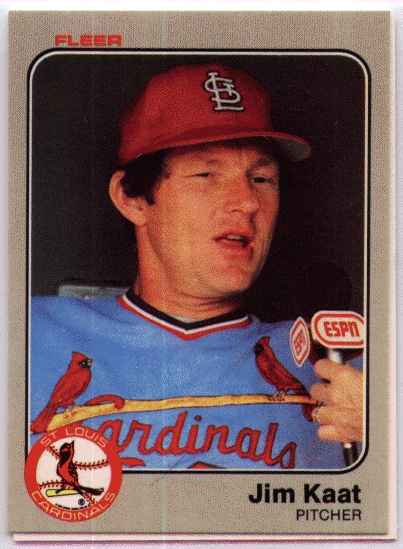
I love the ramshackle nature of 1983 Fleer cards. The background color is like the walls of a secretarial pool, and the Helvetica lettering makes it seem doubly institutional. I imagine if they had baseball cards in Soviet Russia, this is what they would look like. I love cards like this, when the photographer is snapping a photo of Jim Kaat while he's doing an interview, not even bothering to have him pose.
Reggie Jackson's Scrapbook
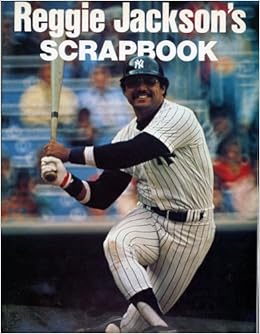
I was a weird kid, which meant that I learned an awful lot about sports events of the past by checking out recently outdated sports books from the library. One of my favorite was Reggie Jackson's Scrapbook, published after his 1977 season, when he ended the World Series by hitting three homers on three straight pitches for the Yankees. By the time I picked it up, he was a slightly over the hill slugger with the Angels. It was full of great photos, including a breakdown of the famous game 6.
Gary Matthews' 1979 Topps Card
You can see why they called him "Sarge."
Ron Luciano's Books

Luciano was a colorful umpire in the American League in the 1970s who went on to be a broadcaster and author in the 1980s. I devoured his books, fascinated by how the game looked from the ump's perspective. For a little while in middle school, I seriously thought that becoming a major league umpire would be my life's calling. I would get to see all the games I wanted, get paid for it, and have a lot of time off. When I got the news that he had committed suicide, I was profoundly upset.
Tim Flannery's 1988 Fleer Baseball Card
Seasons in Hell by Mike Shropshire

I just read this book, inspired by its inclusion on a top baseball books list by Dan Epstein, who's no slouch as a baseball writer himself. In it a beat reporter for the Texas Rangers of the mid-1970s describes a particularly crummy team and what it was like when the anything goes culture of the 1960s finally hit the more staid world of baseball. Shropshire has a great voice reminiscent of Hunter S Thompson, and would recommend the book to any fans of baseball or the good doctor. It also happens to contain the definitive account of the Ten Cent Beer Night fiasco in Cleveland in 1974.
Wally Moon's 1959 Topps Baseball Cards

Ten Cent Beer Night

The "aw, fuck it" brand of rebellion in the 1970s was on display in Cleveland one fateful night, the same year that Nixon retired. Part of me believes they're somehow connected.
Tuesday, January 27, 2015
The Link Between Snowstorm Preparation and the "War on Terror"
Living here in New Jersey, I was prepared for the worst yesterday. During my commute the snow was coming down really hard, and the train was so full that all the seats were filled and I stood in the aisle packed cheek to jowl with my fellow commuters. The only other time I experienced this was in the aftermath of Sandy, when trains ran infrequently. My wife didn't want to venture out with the kids in the snow, so I ended up walking about two miles home from the train station. The snow wasn't fearsome, but I thought that if it was just the beginning, the night would be horrible.
It turns out that I had already experienced the worst of it. It all ended up being a heavy snow, pretty nasty and inconvenient, but hardly the "historic blizzard" we'd been led to expect. Despite that fact, all mass transit had been shut down and states of emergency declared. You could say that this overreaction resulted from the storm changing its path, or a bad weather prediction, but I don't. The stringent, top-down measures are also rooted in our country's mentality after 9/11.
When I was younger I can't remember snow storms getting this much pre-game hype, or extensive and drastic measures being taken BEFORE it was apparent what the storm was bringing. Having grown up in Nebraska, I know from blizzards, but they usually didn't close the interstate down in the windswept western areas of the state until it was apparent that the roads were impassable. Yesterday four states declared states of emergency before the storm even hit. While I was on the train ride home yesterday I was told that trains would not running until Thursday, (they're already back now.)
Those actions reflect a tendency today by political leaders in this country to quickly take state action whenever there's a whiff of any kind of threat or crisis. They do it because it enhances their power, and also because the public has been inured to accepting emergency measures. Both come from the "War on Terror." In the case of politicians, they can't fail to have noticed how 9/11 saved George W. Bush's presidency, which started off with questionable legitimacy and responded to an economic downturn with tax cuts for the rich. (Of course, his poor handling of the Katrina disaster showed how not responding to a crisis well can kill a political career.) Chris Christie was paying attention, and he parlayed Sandy into a positive public profile at a time when his popularity in New Jersey was slipping. He used that event to create an image of a tough-talking leader in charge, and one able to reach across the partisan divide to cooperate with a Democratic president. Disasters are great for executive leaders in that they get to look responsible, criticism of them becomes de facto bad, and they can wield much more power than in regular times. When we hear news of drone strikes and NSA spying that should hardly surprise us.
As far as the people are concerned, they have been conditioned to accept greater authoritarian measures. We take our shoes off at the airport, accept NSA spying despite Edward Snowden's revelations, and punish anyone at the polls who dares to challenge the PATRIOT Act for being "soft on terror."As I have written before, we are a society ruled by fear. This fear now apparently extends to the weather, where a snowstorm or blizzard becomes "Snowmageddon" or somesuch thing. Of course the media play a big role in this, mostly because they've realized that the public craves fear, from the bogus "knock out game" to hyping up weather events.
Others may see a bad weather forecast to blame for the overreaction to snow in the New York City area, I see the fear spiral at work once again. At least this time it was fairly harmless, but I'm sure it will be used to gin up more wars, domestic and foreign, in the future.
Saturday, January 24, 2015
Track of the Week: David Bowie "Always Crashing In The Same Car"
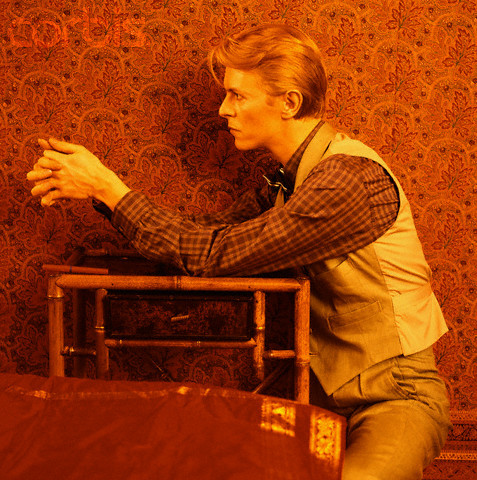
I was watching a documentary about David Bowie last night called Five Years, and I appreciated that it focused primarily on his music (rather than personae), and included a lot of conversation with his musical collaborators. It helped me to realize that after he left his Ziggy identity and the Spiders from Mars band behind, Bowie succeeded because he had such great musicians and producers working with him. Those collaborators came from different places, and the resulting friction really enabled a lot of interesting results. My favorite moment was guitarist Carlos Alomar discussing his frustration with producer Brian Eno's methods, and Eno's admission that at that point in his life he simply hadn't worked with musicians as accomplished as Alomar, and thus was using methods better suited for rudimentary punk rockers than a session man like Alomar.
The results, on albums like Low and Heroes, were amazing. Those two records, though they came out in 1977, still sound fresh and unique. "Always Crashing In The Same Car" is one of my favorites of this era, and it seems especially suited to the bleakness of winter time. It is a lament about making the same mistakes again and again in life, and not being able to break the pattern despite knowing that it exists. Despite the poignant nature of the lyrics, I tend to focus on the shimmery, textured sound of the music. You'd probably never guess that the thudding drums come from a soul/jazz session player like Dennis Davis, but the more I listen to it the more I can hear the subtle feel. The guitars are layered and trade feeling for heroics, acting much the same as the synthesizers beneath them.
It's less a song than a peak in Bowie's damaged psyche at the time, making it all the more powerful. Another thing I noticed in the documentary was that Bowie's practice of emodying a character took a hiatus in his Berlin period. The reason that I like his work at that time above all others may very well be that he was not trying to play a different person, but to actually dig a little deeper within himself. I don't think Bowie was ever more vulnerable and real than on this track.
Thursday, January 22, 2015
Andrew Jackson Still Lives
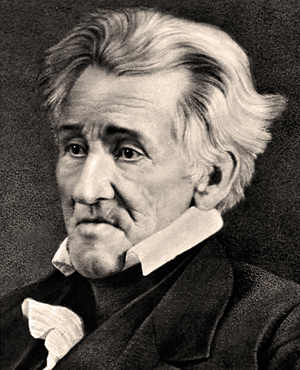
America’s true Founding Father was not Washington,
Jefferson, Madison, Franklin or Hamilton, but Andrew Jackson. The 18th century Founders were the
product of a pre-modern America where politics was conducted by the “better
sort,” not the masses. Jackson was the
first president to be a true mass politician, as have all the presidents who
have followed him since. Unlike the
likes of Jefferson and Franklin, he was not a man of the Enlightenment, but a
man of action who felt no need to find moral or intellectual justifications for
slaughtering Native Americans, removing them from their lands, expanding the
borders of slavery, and filling the government’s offices full of party
flunkies. This was not politics as
virtue in action, but politics as bloodsport.
I see much of Andrew Jackson in conservative politics
today. Modern day Jacksonians laugh at
the notions of global warming and sustainability, and champion a volatile,
extractionary economy where entrepeneurs can “drill baby drill” and have access
to as much cheap labor as they want. In
their minds, public expenditures on infrastructure are a waste. I see much in the same in Jackson’s day,
where he pushed to open up more land in the Southwest (as it was then) for the
booming cotton economy, its fields worked by slave labor. As Edward Baptist points out in his new book,
the cotton frontier exploded during Jackson’s tenure, helped by his destruction
of the Second Bank of the United States, and the reallocation of federal money
in “pet banks” happy to speculate wildly on the sale of cotton and the sale of
slaves. That same hands off,
freewheeling impulse is apparent today in the conservative push to lift
regulations on Wall Street banking. Jackson also famously rejected Henry Clay's so-called "American System" of roads and canals. I see that spirit every day when I drive on pothole scarred roads in a nation that refuses to raise its gasoline tax, even when the price is rapidly dropping.
Of course, just as Jackson and modern day conservatives champion "small government" out of one side of their mouth, they just love using the military to expand territory and reward the vested interests backing them. Jackson moved to remove Native Americans against the will of the Supreme Court, just as the "War on Terror" has relied on illegal and extralegal means. Jackson's closest imitator, James K Polk, sparked war with Mexico with terms just as illegitimate as those formulated by George W Bush for his invasion of Iraq. Jacksonians of all era scorn the notion that government can improve people's lives, but have little restraint when using it to further the goals of nationalist expansion.
While the effects of the supposed populism of present and past day Jacksonians on the lower classes tends not to be economically beneficial for them, they have wielded a powerful ideology of anti-elitism. It was hardly a coincidence that Jackson, the first mass president, was by far the least educated of those to hold the office before him, and perhaps the least literate to ever hold the office. He and his supporters denigrated the educated, much as conservatives today scorn climate scientists, academics, and teachers. All three have committed the cardinal sin of having expertise and thinking that means they know more than the average yahoo. One of Jackson's most toxic legacies has been the extremely anti-intellectual tenor of American public life, something routinely exploited by conservatives.
Last, but not least, don't forget white supremacy. Andrew Jackson's America was more "democratic" in that the franchise was no longer limited to the affluent, but was now open to all white men. Women and men of color were aggressively cast out, even in places where they had once been enfranchised. While the poorest, most low-down white man could pass a ballot, African Americans were expected to toil in slavery, and Native Americans faced a fearsome onslaught of war and ethnic cleansing. Modern day Jacksonians are a lot more careful with their rhetoric, but they still love unleashing the full force of the American military on brown people around the world. These are also the same people wearing "I am Darren Wilson" shirts and are highly supportive of the police state that incarcerates people of color at a truly fearsome rate while reenforcing residential segregation. When a black man took the office of the president, they responded by treating him with unprecedented disrespect and contempt. (Just witness the behavior at the last State of the Union address.) The Tea Party, that most Jacksonian of political movements, has been vowing from the beginning of Obama's term to "take our country back." Gee, I wonder what that could mean.
The America of the Founders is a strange and faraway place. The America of Andrew Jackson, the true Founder of our current dominant political mode, doesn't seem all that foreign, despite being almost 200 years ago, because its values so thoroughly permeate our political system today. My only hope is that if there was ever an American president who was the anti-Jackson, it was Lincoln. There are alternative traditions to draw from, and we need them badly.
Subscribe to:
Posts (Atom)