Showing posts with label Chicago. Show all posts

Wednesday, October 26, 2016

Late October's Spell

"Tubular Bells" pretty much fits the eerie mood of late October

Driving my daughters back from their gymnastics class around 6:30 yesterday, it hit me. The ancients were very wise, and much more in tune with the messages being sent by our natural surroundings than we are today. In late October (at least in this latitude), you really do get the eerie feeling come evening time that the world of the dead feels very close to the world of the living. The wind blows the dead leaves skittering across the street as the sun goes down before dinner time. That dinner time dark just feels so much darker than sundown did back in September.

I do get a thrill over this eerie feeling, but after awhile, the open portal to the world of the dead beckons in ways that are not as enjoyable. It was during this time of year three years ago that my grandmother died. I remember the last conversation I had with her, wrapped in the gloom of a dark Newark night as her voice traveled out from under the impossibly starry Nebraska night sky and found its way into my ear. I keep wishing I'd been able to have one more conversation with her, but alas.

Today while riding the bus from the train station to my house the looming dusk gave me another powerful flashback, perhaps a message from beyond the grave from a departed friend. I suddenly, and quite vividly, started recalling the dark October night when my friend Dave and I rode the Chicago el from his Rogers Park apartment down to Old Town to an art house theater to see Velvet Goldmine. We were two Nebraska rubes just arrived in the big city of broad shoulders, reveling in the freedom and excitement of urban life as only people who have come from outside of it can do. We loved the movie, I gravitating to the Bowie character, Dave to Iggy Pop. Me ever the mod, he ever the rocker. Two odd ducks too weird for regular society and too dorky to ever be accepted as bohemians. It was a great night, a night when my decision to leave the plains for the urban jungle seemed to be the best idea I ever had.

There is nothing like a Chicago night in late October. The wind blows chilly off the lake, carrying ominous rumors of winter. Despite the lights of the city, it seems oddly dark and quiet, the subdued prairie under its streets trying to reach its tendrils out through the concrete and reclaim its dominion. I spent those nights in movie theaters and record stores, dive bars and house parties, and smoking Camels while walking the streets not knowing what I was looking for.

I was too young and too unaware of mortality to know that the dead were there in the night air floating about me. Now in the less mysterious world of suburban New Jersey, settled down and wandering nowhere, I can feel them on this dark chilly night. The least I can do is think about them, and the good times we once shared.

Monday, October 5, 2015

An Ode To Mark Buehrle


Yesterday was the last game for Mark Buehrle, and it was not ideal.  He came in for two innings so that he could have his 15th season in a row with 200 innings.  Instead, he got shelled and wasn't able to complete those two innings.  It broke my heart because Mark Buehrle has been one of my favorite players, and I just wanted the best for him.  It is actually very telling that the milestone that Buehrle was shooting for was not strikeouts or wins, but innings pitched.  He was a model of consistency and professionalism, clocking in and doing his job well.  Buehrle won 214 games in his career and pitched a perfect game, but he's not quite Hall of Fame worthy.  He's one of those great players who doesn't get celebrated enough because he won't end up either in the headlines or in Cooperstown.

I was actually there for his first game on the White Sox, all the way back in 2000.  I remember sitting in the stands, Buehrle coming in, and wondering who this kid was.  (Awfully pretentious of me, considering I was only 24 years old at the time.)  He came in as a relief pitcher for James Baldwin, a player mostly forgotten by White Sox fans.  I remember baking in the first row of the upper deck on a hot summer Sunday afternoon with a couple of friends, looking down on the bullpen and seeing this unknown hurler warm up.  It was the late innings of a game the Sox had well in hand, garbage time essentially.  He gave up a couple of hits and run in an inning of work.

How could I know that this man would lead the White Sox to glory?  The next season he already pitched over 200 innings and got 16 wins, proving himself to be the workhorse that he would continue to be for the White Sox.  I noticed at that point the distinctive way Buehrle pitched: all business.  Instead of dawdling on the mound, he just kept the pitches coming like some kind of machine.  I always tuned into the so-called "Buehrle game" in the team's rotation, since it meant that 1. the Sox stood a good chance of winning and 2. it would be quick.  His quick pitching was a throwback, as well as his stuff.  In a time when pitchers have to have a fastball well into the 90s to get a cup of coffee in the majors, Buehrle got guys out with a mix of crafty pitches.  

He never got a lot of strikeouts nor did he ever lead the league in ERA.  However, he was consistently good, year in and year out.  When he pitched a perfect game it was such a great moment from my perspective because Buehrle finally got some recognition for individual brilliance on his part.  (That game also saw a miraculous catch by Dewayne Wise to steal a home run and save the perfecto, one of my all time favorite White Sox moments.)  It was a sad day for me when Buehrle left my White Sox after the 2011 season.  The bloom had already fallen of the rose of the team's 2005 World Series title, but I could still take heart in the fact that one of my favorite players from the championship was still on the team.  Alas, it was no more.  

Fifteen years after I first saw Buehrle take the mound on the hot Chicago day he is a aging veteran about to retire.  Rather than a young swashbuckler enjoying the fruits of being young, single, and gainfully employed in Chicago I am now a middle-aged family man in the New Jersey suburbs with a mortgage to pay.  During most of that time of change in my life one thing I could count on was that Mark Buehrle was going to take the mound for my team and pitch a good game.  Despite how his last game went, I hope he can look back with some great pride at what he's managed to accomplish.

Sunday, March 8, 2015

An Underdog When You're Ahead: On Being A White Sox Fan


I grew up in central Nebraska during the 1980s, which meant that when I developed an interest in baseball, the Kansas City Royals were my team.  Sometime in the early 1990s, when I was in high school, that interest waned and I stopped caring all that much about the team.  This apathy coincided with their quarter century in the baseball wilderness, which was mostly likely connected.  When in college, however, I met friends who were big baseball heads, and they helped get me back into the game.  I went to see the Omaha Royals (before their name changes) at the sadly defunct Rosenblatt Stadium, and even road tripped to KC in 1997 to see the first interleague series between the Cardinals and Royals, and to gaze upon Mark McGwire.

Just as my baseball renaissance was beginning, I moved to Chicago to get a master's degree, and was thus living in a big league city for the first time in my life.  This prompted a tough decision: Sox or Cubs.  Most baseball fans in the Chicago area don't have a choice, since geography and family ties usually make that decision for them in their infancy.  I toyed with Cubs fandom at first.  After all, they played in the wonderfully anachronistic friendly confines of Wrigley, they made the playoffs right after I moved in (1998), and Sammy Sosa was setting the nation on fire with his home run prowess.  Despite these facts, I ended up opting for the Sox.  This was partly because I was living on the South Side, and partly because I felt more at home among their fans.  While this faction is a minority of Cub fandom writ large (which is quite broad and diverse), there is a very frat contingent that dominates the culture of Wrigley and the surrounding neighborhood on game days.  Sox fans, on the other hand, tend to be more blue collar, and when they show up to the ballpark are more interested in the game than in taking part in the world's largest open air singles bar.

I also tend to think that my decision reflected my instinctual need to not be on the side of popularity.  I am a bit of a contrarian, to be sure.  The Cubs were and are by far the higher profile Chicago team, and their attendance figures versus the Sox bear this out.  This is partly because there are many fewer Sox fans, that new transplants to Chicago almost always choose the Cubs, that Sox fans are less affluent, and that following from this, are not keen to spend money on a less than stellar team.  As the numbers I quoted show, the Cubs outdrew the Sox even in 2005 and 2006, the year the White Sox won the title, and the year after, when champions tend to get a big attendance boost.  Even when they won the first World Series by a Chicago team since 1917, they were still the second team in the Second City.

The team and its fans are also quite often the target of criticism and the butt of jokes, even among their own.  Fans and outsiders have long ripped on US Cellular Field for being a bland stadium built right before Camden Yards opened up the deluge of retro parks.  In actuality it is a fine place to watch a game (especially since the renovations) and has by far the best food of ballpark I've ever been to, along with great ballyhoo traditions like the Fan Shower and exploding scoreboard.  The horrible attack by two violent Sox "fans" on Royals first base coach Tom Gamboa also gave the team a bad name.  Cubs fans have their own history of hooliganism, but the image of the team as "lovable losers" has never been tarnished. On top of all of this, Ken "Hawk" Harrelson has got to be the most hated announcer in baseball, even though his much criticized homerism is just unveiled honesty, unlike the pretense of objectivity that so many other hometown announcers studiously maintain.

I have begun to relish second class status, however.  By being a Sox fan, I feel like I am not a member of a great mass, or "nation" as Cubs fans brand themselves, but of a tight-knit club.  Sox fans are actually much less obnoxious than those of other teams, in that we don't expect other people to get wrapped up in our drama.  The best example of this came in the team's championship run in 2005, when there was relatively little media attention paid to the fact that the White Sox had gone since 1917 without winning a title.  When the Red Sox won the year before the country was deluged with stories about the "Curse of the Bambino" and fans from Pawtucket to Bar Harbor visiting the graves of their parents and grandparents to tell them the news.  Conversely, when Ken Burns put together his sequel to his series on baseball, he gave the White Sox about two minutes of screen time while lavishing all kinds of Sturm und Drang on Boston's drama and requited agony.  Of course that was an important story, but the fact that White Sox fans had been through similar trials was barely acknowledged.

While that really bugged me at the time, I've come to realize that the lack of recognition for the White Sox' vindication actually says a lot of positive things about us fans of the South Siders.  We were smart enough to know that our team's problems were not down to some vague curse like the Red Sox or Cubs (the famous billy goat, the black cat on the field in 1969, etc.) but to bad management and mediocre play.  If Sox fans were ever angry at anyone, it was at owner Jerry Reinsdorf, who had 1. pushed for confrontation with the players' union, leading to the strike in 1994 while the Sox were in first place and 2. okayed the "white flag" trade of 1997, when he traded top players for prospects down the stretch even though the team was still in contention.  (Apart from Keith Foulke, those prospects didn't amount to much, either.)

This angry feeling towards the team's ownership is less the entitled carping one hears from Yankee fans and more reminiscent of the feelings that most working people have towards management.  It is a healthy distrust born out of the knowledge that the bosses do not have your interests at heart, and must always be resisted.  Other fans seem to interpret this attitude as disloyalty, and continue to show up to the park even when their team sucks.  White Sox fans have a sort of clear-eyed, no bullshit attitude that is ingrained in the South Side and the working class culture of the Midwest writ large.  Living here in the Northeast I pine for the midlands of my childhood and young adulthood, watching White Sox games and hearing the raw cheers of the team's faithful from my living room in New Jersey at least gives me something of that world to hold on to.

Saturday, January 31, 2015

The Democrats Are Still The Party of Richard J Daley


During the last five years Republicans have been taking radical actions on the state level, fulfilling Tea Party ambitions that have been thwarted in Washington.  The new wave of conservative governors and legislators has enacted a massive wave of abortion restrictions, has gutted social services (with Kansas as a prime example), busted public worker unions, and slashed money drastically to public universities.  Just this week it appears that Scott Walker is trying to essentially destroy the public university system in Wisconsin, and Sam Brownback is willing to keep massive tax decreases in place that have made it extremely difficult for the state to finance itself.

You would think that in response to this onslaught that Democrats would be using their power in Blue States to enact a progressive agenda.  If you thought that, you are sadly very wrong.  Democratic politicians in blue states and cities that vote overwhelmingly for their party have turned around and offered conservatism lite, as opposed to any kind of progressive agenda.  In Chicago Rahm Emanuel has sought to fire unionized teachers and replace them with Teach for America recruits.  In New York Andrew Cuomo keeps pushing the testing of teachers, despite the positive results so far on previous tests.  His bloodlust for teacher firings must be filled, I guess.  Other Democrats are more concerned about lining their pockets than anything else, as this week's revelations about Sheldon Silver revealed.  Here in New Jersey local Democratic bosses like Joe DiVincenzo and George Norcross continue to support Chris Christie in a cynical power play.  With Democrats like these, who needs Republicans?

Rahm Emanuel, who's re-election bid as mayor of Chicago is less than a month away, is perhaps the best example of the continuities of the worst aspects of the Democratic Party.  Chicago is as true "blue" as they come; I can't imagine a Republican ever getting elected to be mayor of that city.  At the same time, it has been ruled for decades by Democrats who have impeded progressive political action at every turn and have favored corporations over their own people.  Rahm has attacked teachers and privatized key public functions of the city while refusing to listen to calls to reign in police violence.  He is governing much the same as his predecessor, Richard M Daley, who never met a corporation that he didn't like.

Of course, little Richie never lived up to his father Richard J Daley's reputation.  The elder Daley ruled Chicago with an iron fist from 1955 to 1976, and in the process became one the most important Democrats in country, despite holding only a local office.  As the book American Pharaoh points out, he used his immense power and ability to tap federal largesse to keep the city segregated.  Interstate highways formed walls between black and white neighborhoods, and massive housing projects warehoused the black poor.  Today it might be easy to look at his racial politics and see a man from a bygone time, but modern Democratic mayors have done little or nothing to fight the growing waves of gentrification that bring segregation in their wake.  They are more likely to welcome it for boosting the tax base.  Just like Daley, politicians like Cuomo and Emanuel are primarily interested in one thing: the preservation and expansion of their personal power.

They are allowed to do sobecause the old party apparatus has a stranglehold on Democratic institutions on the local level, and because too many rank and file Democrats are unwilling to push for better.  Back when I lived in Chicago, at a time when Richie Daley's administration was allowing mass transit to rot while throwing out tax giveaways to Boeing, most locals seemed to respond with the old chestnut "Chicago is the city that works!"  As long as the Loop looks spiffy and they have jobs, these types won't complain.  Organized labor is so cowed that even though the likes of Emanuel and Cuomo have been actively hostile to unions, they still fall in behind them.  By undercutting labor these modern day bosses have effectively neutralized the one institution that has any chance of challenging them.  It's hardly a surprise that Democratic bosses like Norcross and DiVincenzo have been Christie's buddies, they're cut from the same venal cloth.

Bill de Blasio gives me hope that genuine progressives can gain power in Democratic strongholds, but he has faced an unprecedented rebellion by police for daring to publicly utter the obvious truth that blacks and whites have a different relationship with the police.  He is effectively being punished for not governing in the style of Emanuel in Chicago, where the cops still have free reign.  If he governed like Richard J. Daley, "shoot to kill" order and all, the police would be just fine with him.

Progressives rightfully fear the things that Walker and his radical ilk are doing on the state level, and rightfully excoriate the inability of the president and Democrats in the capital to consistently push a progressive agenda.  Something they ought to be paying more attention to is that in supposedly "blue" territory like Chicago and New York, that the Democrats are still the party of Richard J Daley.

Monday, May 5, 2014

When Cross-Town Baseball in Chicago Mattered, And Why It Doesn't Now


Right now I am watching the first game of the inter league series between the Cubs and White Sox being played at Wrigley Field.  I can distinctly see some empty seats, which never would have been the case fifteen years ago, even on a cold night such as this.  The Cubs-Sox games used to have a kind of elevated, carnival atmosphere to them and an intensity one normally associates with the World Series.  The house was packed, the fans went bananas, and some serious bragging rights were on the line.

Of all the interleague games, these were the craziest and the most meaningful.  The Yankees-Mets rivalry, for instance, is not nearly so fraught.  You will find fans of both teams in all parts of the Tri-State area, but the Yankees are so dominant that the Mets are the one team in the country that does not have a majority of fans in any zip code.  Chicago, however, is different.  Cubs vs. Sox is really about North Side versus South Side, with all of the class, cultural, and racial divisions that the geographic division implies.  (Of course, there are plenty of working class Cubs fans and effete White Sox fans.)

Back when the crosstown series mattered, it was White Sox fans who approached it with particular fervor.  The Cubs are Chicago's dominant team in terms of number of fans and media coverage, and their fans also tend to be more affluent.  For many White Sox fans, beating the Cubs wasn't just a baseball victory, it was a rare victory in life against the larger forces that bear down on them on a daily basis.  In fact, I would say that White Sox fans are much too concerned with the Cubs and getting revenge on them and what they stand for.  I remember going to White Sox games in the aftermath of Sammy Sosa's corked bat controversy, and seeing mocking T-shirts for the "Sosa Cork Company" sold by vendors outside of the game.  The Sox were playing well that year and in playoff contention, which made the focus on a National League team rather strange.

Since that time, however, the rivalry has dimmed.  Some of this can probably be attributed to the fact that interleague play has lost its novelty.  (Are you listening, Mr. Selig?)  However, a lot of it has to do with the fortunes of the Cubs and Sox since their first crosstown series in 1997.  Back then both teams were pretty lame.  Sammy Sosa could sock the ball, but the Cubs only won 68 games that year, while the Sox finished just under .500 and their management had traded away veteran pitching in the infamous "White Flag Trade."  It was the end of July, and the Sox were only 3.5 games out when management decided not to contend.  Needless to say, that didn't exactly excite the fan base.  With both teams not threatening to win the pennant, it's only natural that fans could channel their energy into a crosstown series.

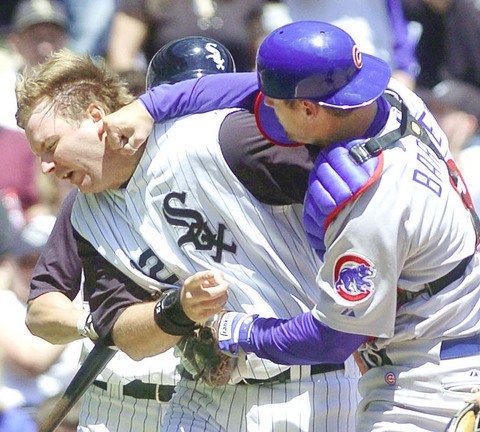
That situation didn't last forever.  In 1998 the Cubs won the wild card, and in 2000 the Sox won the division.  The Cubs' postseason ordeal in 2003, exemplified by the Bartman Game, gave Cubs fans something much worse to rue about that losing a single regular-season interleague series.  Then, two years later in 2005, the Sox won the World Series, something that mattered a whole helluva a lot more than who won in May or June between the two teams.  The White Sox had finally won a championship for the first time since 1917, while the Cubs' last victory, in 1908, has now gone well past its centennial.    Winning the Series has made most sane Sox fans drop their obsessive Cubs hatred (or at least mitigated it), and the Cubs' current problems are so deep that winning games against the South Siders is cold comfort.  There was one last gasp of the old rivalry in 2006, when an aggressive play at the plate by AJ Pierzynski led to a benches-clearing brawl.  Since then it's seemed like just another series, and that might not be such a bad thing.