Showing posts with label Reagan Dusk. Show all posts

Tuesday, October 5, 2021

Primal Scream, "Loaded" (Track of the Week)

Let me tell you children about a time when I hit adolescence, a time I call the Reagan Dusk. From about 1988 to 1991 the promises of the dayglo decade were beginning the get stale but conservatism held on. The old emperor himself was revealed to be a senile old man tied to a horoscope. Communism collapsed to be sure, but anyone who was honest about the situation understood that American bluster had little to do with it.  Instead of a peace dividend there was AIDS and crack.

If you were a left of center young person politically and culturally back then it was hard to find a home. MTV still cranked atrocious hair metal. Guns N Roses were the one bright shining hard rock band of note, but their misogyny and homophobia were hard to overcome. Over in Europe you saw the Berlin Wall coming down and the world "waking up to history" as that Jesus Jones song said, but America seemed deader than a doornail, at least in terms of mainstream culture.

While MTV blasted hair metal shite they had a couple of key exceptions: Yo! MTV Raps and 120 Minutes, both a Godsend to someone like me living in a pre-Internet rural area. Here's where I heard new music that actually excited me. It was a golden age for rap music, but in terms of rock the great "Smells Like Teen Spirit" the great breakthrough hadn't happened yet.

If you were into what they called "alternative" before it was mainstream, it meant UK stuff. It meant wistfully staring out the window to The Sundays' "Here's Where The Story Ends," writing Smiths lyrics on your school notebooks, and sniffing around the dance-y rock style known as "Madchester."

Now Primal Scream weren't from Madchester, they hailed from Scotland. But despite their origins in the dark moors north of Hadrian's Wall they nailed the sound down. They sounded as if Brian Jones had risen from the grave and listened to a stack of Happy Mondays records. "Movin' On Up" was their closest thing to a hit in the US, mixing 60s spirit and melodies with 90s beats.

That may've been the big song, but in a week like this, when I'm beat down and exhausted, I listen to "Loaded." It starts with a sample from the biker exploitation flick The Wild Angels where Peter Fonda says he wants to be free, but also wants to get loaded, and to have a party. The thing is, he says it with a kind of subtle aggression in his voice, as if so much needs to be purged from his body in Dionysian ecstasy. 

The song itself ambles along baggily like someone strolling down the street swinging their arms with a head full of chemical sunshine, not a care in the damn world. That's a lovely feeling to evoke when the day at the rat race has you down. During the Reagan Dusk reviving hippie tropes wasn't just nostalgia, it was a form of protest against the dominant culture of consumption and workaholism. We never quite managed to root that garbage out of our most deeply cherished social practices. In the meantime I will just turn this song up and have "a real good time." 

Wednesday, March 28, 2018

REM's Life's Rich Pageant And The First Shadows Of The Reagan Dusk


We often tend to mistakenly think of the 1980s in ways that paint it as uniformly conforming to certain trends consistently throughout the decade. If you look into the cultural and political history of the 1980s, however, you will see something in the late 1980s I call "Reagan Dusk." During this period criticism of unequal social conditions became more prominent in popular culture, and there was a growing negative reaction to what neoliberalism had wrought. This coincided both with the thawing of the Cold War and the Iran-Contra Scandal, which undermined the Reaganite view of global conflict as well as trust in the Gipper, respectively. The president himself was sundowning, growing senile and more prone to health problems. Public memory of the 1980s has mish-mashed it into a big neon spandex blur, the so-called "Greed Decade" for many progressives, or a golden age overseen by Ronald the Great by conservatives.

Both interpretations are wrong. Dissent coincided with greed. Reagan's popularity waxed and waned, and his so-called "revolution" started running into its own limits.

1986 was the crucial transitional year for all of this. That was the year the Iran Contra scandal broke, hampering Reagan's popularity and bringing on talk of a second Watergate. 1986 was also saw a summit in Iceland between Gorbachev and Reagan that heralded a great lessening of tensions between the superpowers. Earlier that year the Chernobyl disaster forced the hand of glasnost in the Soviet Union. In America Reagan signed a massive tax bill that included tax increases on the wealthy from the extremely low levels he had set in 1981 and a tacit admission that supply side economics were not magic beans that could lower the deficit by cutting taxes. (Of course, that idea would soon be back.) All the while, AIDS raged, the horrible toll unacknowledged by the president. In a nation where thousands were dying of disease, there was no "Morning in America."

Popular culture, however, took longer to catch up. The ultimate expression of Reagan-era ideology on film, Top Gun, was the highest-grossing film of the year. The same year also saw Cobra, Sylvester Stallone's bluntest 80s statement on violence as will to power. (His catchphrase, "you're the disease, I'm the cure" sounds chilling post Trump.) Popular music was as big as the shoulder pads and hair so common at the time and as loud as the patterns on the shorts and dresses of Americans that summer.

At the fringes, however, the Reagan Dusk was just barely visible. It could be heard on Life's Rich Pageant, the fourth album from REM, the rock band poised to bring the sound of the underground to the mainstream. REM's first three albums are masterpieces of jangly guitar and mysteriously mumbled lyrics with an overlay of Southern Gothic on top. Your average indie rock fan today still pays homage to them. They are less likely to do so for Life's Rich Pageant, where the band took a turn that in retrospect ought to be lauded rather than disdained.

The change is obvious immediately, as "Begin the Begin" starts with a hard-edged rock riff and loud feedback beneath Stipe's voice, which is suddenly much clearer, the lyrics more legible and now, for the first time, topical. The loud snare drum reflects the times and the production of Don Gehman, who had worked on heartland rocker John Cougar Mellencamp's albums. This song is a call to arms amidst the wreckage of the Reagan Era, but the lyrics are cryptic enough not to make it a traditional "protest song." There is dark talk of "The powers/ the only vote that matters" but a cautiously optimistic cry "let's begin again" as well.

Before the listener can catch their breath, the song transitions immediately without pause into "These Days," with a fast, loud, blistering riff by Buck over muscular Berry drums. (This is the album where Bill Berry's beginnings as a metal-head are most evident.) It might be the only REM song that encourages head banging. The words are fiery too, "We are old despite the times" and "I'll rearrange your scales." The one-two punch of "Begin the Begin" and "These Days" is an announcement that REM has abandoned its Southern Gothic Folk Mystery thing and is grabbing for the crown of Band That Matters.

These days, when Bono has become kind of a joke and social media has made political activism more accessible, the significance of this move has been diluted. In the middle of the Reagan Era, when nuclear war threatened, cities rotted, and AIDS ravaged the country while the media and political figures barely seemed to care, music stepped into the breach. For someone like me, who grew up in a very rural, conservative area, it was not just a lifeline, it paved a way for my embrace of a more progressive politics. Hip hop (and especially Public Enemy) provided me with the most radical musical critiques, but REM was important too. After all, they hailed from Athens, Georgia, and were a sign that resistance to the dominant politics of the time could exist in places like the one where I lived.

The political themes continue on the first side of the album, but songs ease back into folkier territory, such as in the ringing, beautiful "Fall On Me." "Buy the sky/ And sell the sky/ And lift your arms up to the sky/ And ask the sky and ask the sky/ Don't fall on me." I remember Stipe saying it was about acid rain, but for obvious reasons it calls to mind other environmental dangers we face today. The beautiful Mike Mills background harmonies truly make this song, though. While REM might be headed in traditionally more "rawk" directions here, they are doing it their way with their own unique sound.

"Cuyahoga" continues discussion of the environment, referencing the Cleveland river that was once so polluted that it caught fire. It also discusses Native American history, and how this nation's wealth was built on the theft of others' land. Such critical re-evaluations of American history would be more commonplace during the Reagan Dusk, leading to the inevitable anti-PC backlash of the early 1990s. The sound is folkier than the album's start, but the lyrical message is unmistakable.

After those first four songs, the political elements are more subdued once the band has laid down the gauntlet. With different, less big production, "Hyena" could belong on Reckoning. Of course, lines like "The greater the weapon, the bigger the fear" seem to reference geopolitics just a little. The jaunty Latin dance-y song "Underneath The Bunker" with Stipe's unintelligibly filtered voice might be a nuclear war reference, but that's easy to ignore. It closes out side one, cheekily called the "Dinner Side."

Side two, the "Supper Side," goes into more explicitly political territory with "The Flowers of Guatemala." (On CD the transition from "Underneath the Bunker" to this more serious song is quite jarring.) The song references, of course, America's support for brutal military regimes in Guatemala, but does so in a mournful rather than rage-filled way. Stipe sings mournfully of the flowers on the graves of those murdered by the state. It is one of the most moving and powerful songs in REM's canon, and highlights issue that most people in this country, even those who are political progressives, choose to ignore. Amid the justified anger over Russian meddling in American elections, folks in America might want to take a minute and ponder what their own country has done elsewhere.

It's hard to top a side-opener like that, and REM really doesn't. A trio of solid but less evocative songs follows: "I Believe," "What If We Give It Away," and "Just A Touch." The latter is my favorite for its up-tempo punkiness and the story behind it. Evidently as a teenager Stipe witnessed an Elvis impersonator being mobbed on the day of the King's death by a group of distraught female Elvis fans, one of them saying "C'mon love, just a touch." The whole thing is just a fun rave-up and an unlikely segue into "Swan Swan H."

This acoustic song puts us back into REM's Southern Gothic mode big time. The lyrics reference the Civil War, Reconstruction, and Emancipation ("Hurrah we're all free now.") For such a politically important time in America's history, there does not seem to be much politics here, more setting a mood. That said, it's catchy as hell and in my youth I would listen to it over and over again. The album ends on an unlikely note, with a cover of an obscure 1960s song, "Superman" by The Clique. It puts on full display the band's love of psychedelic garage rock (which is all over the rest of the album), but also mirrors another aspect of the coming Reagan Dusk: 60s nostalgia. One could argue it was kicked off in 1986 when MTV ran a bunch of Monkees episodes one weekend. Nostalgia for that decade, of course, was a kind of a political statement in itself in the midst of the conservative backlash.

Life's Rich Pageant is a classic "tweener" album. REM abandoned the formula that the Pitchfork crowd still idolizes, but its new, rock oriented sound did not yet yield any hits. That would soon come with 1987's Document, once the Reagan Dusk had truly started to fall. Life's Rich Pageant is a document of the other 1980s, the 80s of dissent and protest and resistance, of ACT-UP and anti-Apartheid. In our own fraught times when we need to begin again, it is well worth another listen.

Saturday, October 7, 2017

Nostalgia Rock And The Reagan Dusk


I've talked a lot on here about what I call the "Reagan Dawn," that cultural period from 1979-1982 where the transvaluation of values in favor of neoliberalism took place. I have also begun to theorize what I call the Reagan Dusk, which I date roughly from 1987 to 1991. This was a time when the promises of the Reagan Era appeared to have been false, and when the end of the Cold War forced a reckoning with the consequences of valuing missiles over people. There were contradictory forces to this self-reflection, such as the Gulf War and the peaceful collapse of communism. While these events seemed to say that America had triumphed, the social problems of the time appeared to expose them as Pyrrhic victories. (Neil Young's searing "Keep On Rocking In The Free World" and Public Enemy's "Fight The Power" both hit in 1989 and were calls to action after years of neoliberal regression.)

Culturally, this was a time when the day-glo of the 80s had muted into earth tones, primary colors, and baggy sweaters. (Watch the original Twin Peaks and look at the clothes and you'll know what I am talking about.) Rap music was confronting the realities of American life under Reagan, but the only acts to get played on the radio were the likes of MC Hammer, Young MC, and (yikes) Vanilla Ice. There was too a growing underground rock scene, but it was far left of the dial. Culturally the nineties started in late 1991, once "Smells Like Teen Spirit" dropped and NWA's second album went to number one.

During the Reagan Dusk, things in the rock music world were more confused. Hair metal was the most popular genre, but was despised by anyone over the age of fourteen with five working brain cells to rub together. The rest of us, searching for "authenticity" fed on a diet of what I would call "Nostalgia Rock." This was music rooted in the 60s, often by musicians from that era, which consciously or not opposed the values of that era to the ones of the late Reagan years. Some of this music was purely nostalgic (like George Harrison's "When We Was Fab"). Sometimes the artist simply played original songs in the mode of older forms (like Chris Isaak.)

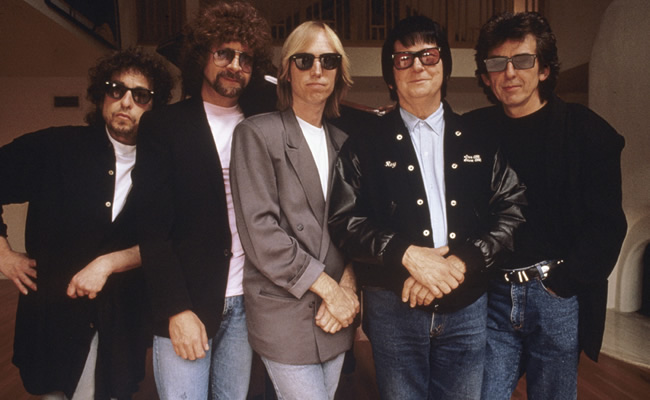
The curtain-raiser on this phenomenon was the Traveling Wilburys, a supergroup formed out of Tom Petty and the Heartbreakers touring with Bob Dylan. Jeff Lynne had produced friend George Harrison's hit Cloud Nine, and Roy Orbison somehow got roped in, too. Petty was the only artist of the now, the others were long in the tooth. This band of geezers cut some hits on their first record in 1988, including "Handle With Care," which still holds up. (I love the contrast between Dylan's late period quack and Orbison's soaring opera tenor.) It also happened to be the beginning of a Bob Dylan renaissance, as evidenced by 1989's Oh Mercy. This Wilburys supergroup album, which might have been dismissed in a time less starved for authenticity, went multiplatinum and won a Grammy.

Soon the deluge followed. In 1989 a bunch of sixties artists hit the road, including bands that had broken up, like the Who. The Rolling Stones toured behind Steel Wheels, inevitably prompting "steel wheelchairs jokes." (The joke's on us, since it's almost thirty years later and the Stones are still rolling.) There was a lot of Boomer nostalgia involved, but also a lot of curiosity by younger people (like myself) who rightly thought "Paint It, Black" far superior to "Cherry Pie." The Stones' current music was mediocre at best, but Steel Wheels was showered with accolades and sold very well.

Other legends managed to find their way back into the charts in this late 80s era, like George Harrison, Roy Orbison with "You Got It", and the aforementioned Neil Young.  Hell, even the damn Grateful Dead had a big hit with "Touch of Grey." Younger artists who borrowed from older styles also broke through. REM became the sole band of the pre-"Nevermind" underground to surface into mainstream MTV and radio play with a Byrds-y sound rooted in the sixties. Tom Petty's Full Moon Fever spawned several hits also with a very retro Byrds-y sound that departed from the more electronic, progressive music on songs like "Don't Come Around Here No More" and "You Got Lucky." Chris Isaak's pompadour, reverby guitar, and Orbison-esque vocals made him look and sound like a lost rock and roller who had fallen asleep in 1962 and woken up in 1990. The Black Crowes emerged big time in 1990 with a sound deeply rooted in early 70s southern rock and had a hit with a cover of Otis Redding's "Hard To Handle."

By 1990-1991 things got meta, and songs like "Black Velvet" and "Walking In Memphis" began to comment on the music of the past and its authenticity. Alannah Myles' "Black Velvet" was about Elvis while never saying his name. The song itself was a sultry blues, rather than Elvis' rockabilly, but recalled a music that could change the world. In 1990, that felt like a long time ago. Marc Cohn's "Walking In Memphis" made all kinds of references to American soul, gospel, blues, and rock n' roll but the song itself was built around a catchy piano hook that was very 1991. Cohn's love for this music is pretty obvious in the lyrics and his passionate reading of them.

But living in this time the years and years of nostalgia for a past music that mattered wore thin on youngsters like myself. I wanted my own music, and had been digging to find it. Public Enemy, Ice Cube, NWA, and Eric B and Rakim all energized me far more than what I was hearing on the radio. The music that mattered to me and felt important was not rock music. That changed in the autumn of 1991, when Metallica's black album and Nirvana's Nevermind dropped. Suddenly punk and metal were going from the losers and glue sniffers to the mall. Even the excesses of Guns n Roses' Use Your Illusion albums (released in late 1991) felt like a jolt to a rock scene desperately in need of one. Pretty much from that point forward the aping of the 60s lost its charm, and the new music made by the legends was immediately cordoned off into the geezer rock pastures. (Except for Neil Young and Tom Petty, who put out great stuff in this era.) For a teenager desperate for HIS generation to have its own musical heroes, it was a kind of deliverance, and marked the end of the Reagan Dusk and the dawn of the nineties.