Pope Francis is coming to the states this week, and I might even come close to crossing paths with his entourage during my commutes at the end of the week. At the very least I will be sharing my commuter train with pilgrims in New York City for his various appearances. Although he will not be holding a stadium-sized mass at Yankee Stadium, he will be doing a more humble, more Francis-like mass at Madison Square Garden, which sits above the rat trap otherwise known as Penn Station. We might both be in the building at the same time.
Although I have mostly cut my ties with the Catholic Church, an institution that was a central part of my upbringing (five years of altar boy service, etc), I do feel invigorated by Francis. He espouses the kind of Catholicism that drew me so much as a child. (It's also no mistake I prized a religious comic book about the life of St. Francis, the pope's inspiration and namesake.) For instance, my interest in social justice and my basic political orientation was first inspired by reading things like the Sermon on the Mount. People say that Francis is really just changing symbols and practices, and not doctrine, but in Catholicism symbols and practices are just as, if not more important than the doctrine. When I go to attend mass with my parents, those rituals and symbols still pull on something very deep inside of me. Francis has not changed doctrine, but he has made the church a more welcoming place, and has put his moral foot down on issues of income inequality and the effects of global capitalism, rather than sexuality and reproduction. He has been much more open to ecumenical approaches and much less judgmental towards other faiths. Of course, this hasn't trickled down to all levels of the institution.
The biggest misconception about Catholicism is that it is monolithic in nature, a perception partially stoked by the doctrine of papal infallibility, and by years of Protestant paranoia. It is in actuality a very diverse and broad church (small "c" catholic, so to speak), with all kinds of variations and orientations. This was brought home to me this summer while attending mass in my home church with my parents, right after the Supreme Court had put down its decision legalizing gay marriage. The priest, just out of the seminary, noted that he had been tasked by the bishop to speak out against the decision, which he did, with both gusto and some amount of sheepishness. It's a sermon I can't imagine being preached at the Catholic church nearest me, where the priest is of the kind of came up during Vatican II, and who has consistently threaded social justice issues into his sermons. As tolerant and welcoming as Francis wants to be, there are some bishops and priests happy to receive that message, but also many who want to stick to the old school blood and thunder.
That attitude certainly hasn't help maintain the hold of the church on its members. If "ex-Catholic" were a Christian denomination, it would be the second largest in America. According to a very recent Pew Research article, half of American Catholics have left the church at some point. This reflects some major failures on the church's part, from the unconscionable protection of abusive priests to a intense obsession with reproduction and sexuality. Catholics actually don't adhere closely to the church's teachings in these areas, so emphasizing them hardly keeps members in the fold.
It is still unknown whether Francis' reorientation towards issues of social justice will stick, and whether it will penetrate far into the "deep church," especially in America. He does have a unique opportunity, in that the church has finally been handling the abuse scandals and Francis has dramatically changed the papacy's tone. At the same time, the hard core of Catholics, those who go to mass every week, have been hewing closer to the hard doctrinal line laid out by John Paul and Benedict. The same goes for the bishops of the kind that demanded I sit through a screed denouncing gay marriage. Those weekly-mass Catholics also tend to be more politically conservative, and thus less open to hearing Francis' critiques of capitalism, which is a sacred cow in conservative America.
Francis just might alienate the most loyal American Catholics, and fail to win back the large numbers who have left. That isn't necessarily even within his control. 77% of former Catholics say they can't envision coming back. Those numbers reflect a fast-growing number of Americans who do not identify with any religion, almost 23%. That number has risen sharply in recent years. The American Catholic Church, like many of its Protestant counterparts, fought the culture wars of the last forty years with gusto, and is now paying the price with youth alienated from an institution that spent their youth assailing them with increasingly antiquated bromides. On top of that, just as American society becomes less communal and more atomized, religion is no exception. Francis just may staunch some of the bleeding, but the larger social factors in America do not favor a revival for the church as an institution.
That being said, it is heartening to see a pope who cares so much about inequality and who has tried hard to make the church more accepting. If anything, I hope that Francis' orientation will make the hardline revanchism of the church post-Vatican II look like a blip in a larger story of reform and positive reckoning with the modern world.
Showing posts with label Pope Francis. Show all posts
Showing posts with label Pope Francis. Show all posts
Monday, September 21, 2015

Saturday, September 19, 2015
The Fall "Hey! Luciani"

Pope Francis is due to arrive in the United States this week, and it's made me think of maybe the one great rock song written about a pope, The Fall's "Hey! Luciani." It's about Pope John Paul I, known as Albino Luciani before taking St. Peter's chair for only a month before dying in one of the shortest papal reigns in history. Mark E Smith of The Fall wrote this song as part of a larger play of the same name about John Paul I/Luciani in 1986, the time when The Fall popped up their sound a bit and toned down their dissonant garage punk approach. (Much of this had to do with band newcomer Brix Smith, also Mark E Smith's spouse.)
As with most Fall songs, "Hey! Luciani"'s lyrical content is hard to decipher but crucially important. It theorizes that John Paul/Luciani had not just died of a heart attack, but had been killed by members of the curia (the papal bureaucracy) for his anti-capitalist proclivities, which would have included going after the then and now scandal-ridden Vatican bank. I don't put a lot of stock into those theories (mostly due to lack of evidence, even if the motive clearly existed), but I have often wondered if any reformist pope, including Francis, has the ability to truly overcome the inertia and corruption within the institution. So far I have to say I am glad that Francis has had a lot more than the miniscule 33 days that John Paul had.
The song itself is wonderfully propulsive, starting with a catchy harpsichord hook, a sign that The Fall are up to more than their usual distorted guitars bread and butter. Then come the booming, gated snare drums, so beloved of mid-1980s studio producers. In this song, used sparingly, they actually work, and don't sound like clunky relics, as they do on REM's record of 1986, Life's Great Pageant. Smith snarls the lyrics perfectly, especially the sinister "all the cowls of black/ on the Inquisition rack," and that snarl has a great counterpoint in Brix Smith's "ba ba bad da dah dahs" in the background. The mid-to-late 80s are a musical quagmire of overproduction and overwrought songs as far as the rock scene is concerned, it amazes me sometimes that this song could have so many markers of the era but transcend them so well.
Thursday, December 12, 2013
Why Pope Francis' Words Matter
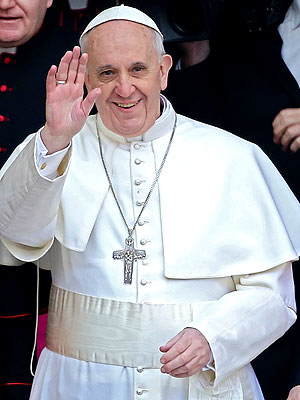
There's been much hullaballoo these last two days over the fact that Time magazine has named Pope Francis its Man of the Year. Some, like Glenn Greenwald, have lambasted the magazine for wussing out and putting Edward Snowden in the runner-up spot. Others, like Glenn Beck, have been blowing their tops about the pontiff's supposed Marxism and the lamestream media's love of said Leftist subversion. (He has also been uttering the Beckian oxymoron "progressive Fascism." When are the men in the white coats finally going to come and take him home?) I'm quite surprised that so many people still care about Time magazine.
All that said, I think now's a good time to reflect on Pope Francis' importance. While he is known now more for words than deeds, I think his words are incredibly meaningful. For the past forty years or so, the world has been in the throws of a vast neoliberal globalization that has funneled money into the hands of the wealthy at the expense of the many. It has caused unaccounted misery in its rapacious, never-ending quest for lucre, the human and environmental consequences be damned. Those who criticize this monstrous state of affairs have often found themselves to be lone voices crying out in the wilderness. With the Occupy movement and various other rumblings, from Arab Spring to Chilean student protests, it is evident that there is a growing pushback against the neoliberal tide.
Behind the various critiques lies the belief that unfettered capitalism is fundamentally immoral. The various religious and moral leaders of the world, however, have been much more interested in enforcing their very narrow standards of personal morality than addressing the moral economy. Conservatives have feasted on this omission, since it has given their greed and avarice a free pass. Pope Francis, by using his position as the most powerful religious figure in the world to criticize capitalism, has given critics of neoliberalism a tremendous amount of legitimacy. If an institution as traditional and conservative as the Catholic Church assails economic inequality and laissez-faire ideology it gives moderates the courage they need go against the lying cant of "job creators" and trickle down.
This, by the way, is why the likes of Limbaugh and Beck wail and gnash their teeth at this pope's pronouncements. They know, deep down, that unfettered capitalism is an affront to any real sense of fairness and morality, and that once the broader public is willing and able to see that fact, their political power is ruined. And that is why Pope Francis' words matter.
Subscribe to:
Posts (Atom)