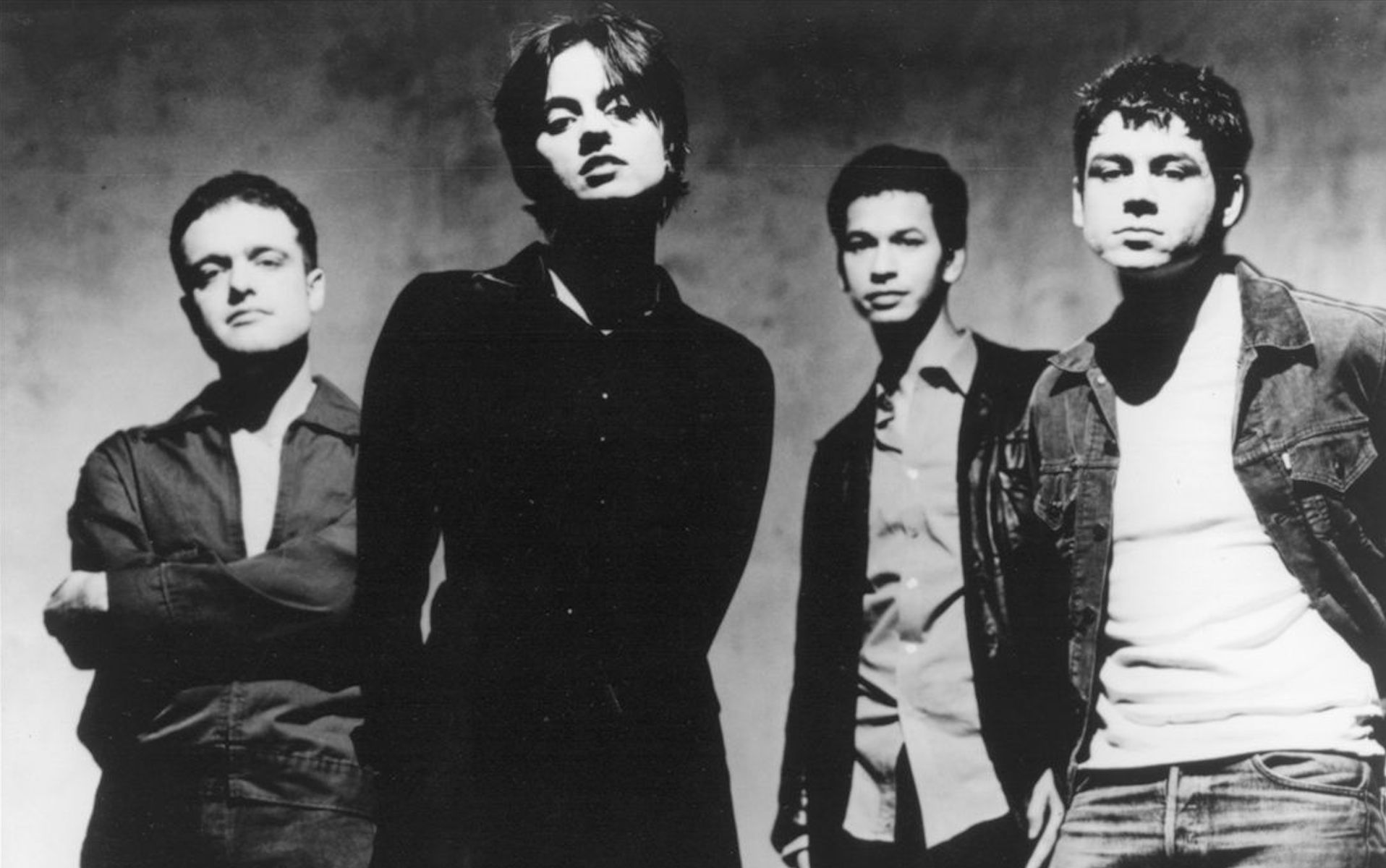
Because of an episode on one of my favorite music podcasts, I found myself revisiting 90s Britpop this week for the first time in awhile. From about 1995 to 1998 it was the genre of music I listened to the most. By the mid-90s the grunge explosion in America had devolved into corporate radio stations playing hour after hour of the likes of 311, Bush, and Silverchair. While I liked some of the more underground American bands of the time like Pavement, I found that whole scene to be exclusionary and too hip for me to fit in. For that reason even though I was going to college in Omaha at the time I totally missed out on the beginning of a great music scene. I was still a rural dork who wore sweatshirts and baggy light wash jeans.
Instead I gravitated to Britpop, something that only got more powerful after a trip to Ireland for a college debate tournament (told you I was a dork.) I heard the music in all of the pubs, and I picked up a bunch of British music mags. It was here that I learned about groups like Pulp and a pre-"Bittersweet Symphony" Verve. That same year Trainspotting came out and only cemented my obsession with the British Isles. (I'll admit, it's still one of my favorite movies.) I had also been primed for this by having been a huge Smiths fan in high school.
While Britpop's sound owed a lot to Johnny Marr's guitar playing, the songs were usually much more upbeat than what Morrissey and co. had put out. It's easy to understand how Britpop managed to cross over from the margins to the Top of the Pops. It melded catchy hooks with the indie sensibility, and so could appeal to serious rock fans as well as the kind of run of the mill people who care little about music but make the hits once their toes start tapping. However, apart from Oasis none of these groups had hits in America, despite the fact that Blur was a million times cooler than the godawful likes of Seven Mary Three and Toadies.
While some of the Britpop bands were at least known widely among American alternative rock fans, such as Radiohead, Blur, The Verve, Elastica, Pulp, etc., some are almost forgotten. One of these is Sleeper, whom I discovered with the free tape that came with the copy of Q magazine I bought in the Manchester airport on my way home from Ireland. The tape collected a bunch of live TV performances from various groups (including Oasis), but "Inbetweener" by Sleeper was among my favorites (along with a duet on "Waterloo Sunset" with Ray Davies and Damon Albarn.)
It's a tight, bouncy song with a bit of social commentary about bourgeois affectations. Songs about social class tensions are catnip to UK audiences (like Pulp's "Common People"), but that kind of thing is poison in America, where we pretend social class doesn't exist. None of Sleeper's albums are classics, but now that we live in the streaming, post-iTunes world where the single is king once again, their standout songs should be netting Sleeper some recognition. (Check out "Statuesque" and "Nice Guy Eddie" as well.) It's also kind of funny today in the midst of the Brexit fiasco to remember a time when such a phenomenon as "Cool Britannia" was a thing. Time's passage is cruel indeed.
(Is this a listicle? Well, I was writing listicles before content aggregators were, so sue me.)
Last night I started watching the new Oasis documentary and I was floored by how old everything looked. It was kinda depressing, since Britpop was my favorite music in college. I had been jamming to Suede my senior year of high school, and then picked up Definitely Maybe, Parklife, and Elastica's debut album in my first year of college (1994-1995). American "alternative" music was looking pretty bleak after the death of Kurt Cobain, and the likes of Bush and Silverchair were rushing to cash in. The Britpop bands were fun, catchy, and more sophisticated. It was a short-lived period, roughly 1994 to 1997, which also coincided with my college years. Anyway, here are ten albums that I think managed to stand the test of time.
10. Elastica, Elastica
Elastica were a one album wonder, but it's a great album. Lead singer Justine Frischmann brought a punky brashness and the band also sprinkled in elements of early New Wave. Sex was front and center in a frank and real way. Songs like "Stutter" talked about a boyfriend's impotence, "Vaseline" about well, you know. Like rock in general, Britpop was a male dominated field, but some woman fronted bands like Elastica, Echobelly, and Sleeper made their mark.
9. Oasis, Definitely Maybe
Oasis were the biggest band in Britain in this era on the strength of their catchy songs and don't-give-a-toss attitude. While the songs were catchy, the lyrics could be godawful. According to the new Oasis documentary, Noel Gallagher wrote the lyrics to "Supersonic" in the time it took for his bandmates to eat some Chinese takeout. I don't doubt it. The song has a great power to it, despite being slightly turgid with just dumbass lyrics. Liam Gallagher's punky John Lennon voice helps pull these songs off. Some of them, like "Cigarettes and Alcohol," make Oasis sound like the greatest bar band in the world. (That's a compliment.)
8. Suede, Suede
This 1993 record along with Blur's Modern Life Is Rubbish are the real kick off of Britpop. I saw the video for "Metal Mickey" on 120 Minutes and ran out to buy it immediately and it quickly became my soundtrack to that summer. Unlike the other groups, Suede were highly influenced by glam and engaged in gender bending and flirted with gay imagery (especially on "Drowners.") Lead singer Brett Anderson brought the androgyny and guitarist Bernard Butler just shredded in a creative way that seemed to have disappeared from the heavy riffing on alternative music. This record also has some range. "She's Not Dead" is the greatest Smiths song the Smiths never wrote. "See You In The Next Life" is a haunting ballad. It's a shame Butler left the band after this, they never recovered.
7. Pulp, His N Hers
Jarvis Cocker had been kicking around the Sheffield music scene for years before his band Pulp finally hit the big time in the mid-90s. They were not a typical Britpop band, in that their songs were not usually based on guitar riffs, and because the lyrics were perhaps the most important component. The music was reminiscent of 80s New Wave, but in an updated way that sounded fresh. Like Elastica, Pulp talked pretty frankly about sex and relationships in a way that was totally foreign to what American bands were doing at the time. The smart ones, like Pavement, tended to avoid love altogether and shroud everything in irony. There is perhaps no song about young love and sex more frighteningly real and awkward than "Babies," and that's only the tip of the iceberg on this album.
6. Blur, Parklife
This in many ways is the curtain-raising album to the whole Britpop thing. Instead of imitating the grunge blasting out of Seattle, Blur made a conscious decision to Anglicize their approach a la The Kinks. That was obvious from the packaging of the album, which featured racing dogs on the cover and the back, which was stylized like a racing form. I mean they had a song called "Bank Holiday," fer cryin' out loud! I was most struck by how they had rehabilitated the 80s in their music, from the synth touches on "London Loves" to the New Wave style of "Girls and Boys." The title song, with Quadrophenia star Phil Daniels providing Cockney narration, may well be the most British thing ever created.
5. Blur, Blur
1997's self-titled album, however, was a statement by Blur that they were not going to be confined by the strictures of Britpop. This album was clearly inspired by what was happening in the indie scene in America, especially the great blast of noise that was "Song 2." This was quite a surprise after the uber-Englishness of their previous outing. Along with Radiohead, by 1997 Blur had figured out that the old Britpop fields would no longer yield such a great musical crop, and began looking to reach out. Oasis, on the other hand, would fall flat on their collective arse with Be Here Now, a wet fart of a record.
4. Radiohead, The Bends
In this century Radiohead would become the bards of our fractured, uncertain world. Radiohead had first hit in 1993 with "Creep," which nailed the sweet spot of 90s grungy teen angst. The Bends was much more mature, Johnny Greenwood's guitar especially dynamic on songs like "My Iron Lung." "Fake Plastic Trees" foresaw the more adventurous musical direction was about to take as well as a focus on the daily uneasiness of modern existence.
3. Oasis, What's The Story Morning Glory
Yes, Oasis were a bunch of caveman blokes making straight-ahead meat and potatoes rock, but damn if they didn't make a perfect example of how good that music could be. Noel Gallagher may have lifted some rifts and melodies, but he had exquisite taste in which ones to choose. And despite all the bash and boom this album produced "Wonderwall," one of the best ballads of the 90s, and "Champagne Supernova," one of the great all time late night inebriated sing along tunes. The lyrics are perhaps even stupider than on the previous album, but the songs are so good you barely notice.
2. The Verve, Urban Hymns
The owl of Minerva flies at dusk. This is perhaps the last great Britpop record, coming in the autumn of 1997. The Verve had always been good, but much spacier and less poppy in their approach. On this album their cool sound finally gelled with some really strong songs from Richard Ashcroft, who looked like he was forged in a Britpop rockstar lab by a mad scientist. This album also happens to be the soundtrack to my life in the autumn of 1997, a very tumultuous time when I experienced love for the first time, a lot of drama within my circle of friends, and saw a couple of people very close to me go into some mental health troubles. ("The Drugs Don't Work" will always bring me to tears for this reason.) "Bittersweet Symphony" will last for ages.
1. Pulp, Different Class
Back in 1995 all the talk in the British music press was over Blur versus Oasis, and in the midst of it, Pulp beat 'em both. This is Jarvis Cocker's masterpiece. There are few love songs as genuinely affecting as "Something Changed." "Sorted Out For E's and Whizz" is a hilariously real description of a rave gone wrong. "Disco 2000" embodies the intersection of unrequited love, memory, and regret in ways that still makes my soul clench whenever I hear it. Most importantly, "Common People" summarized the working class attitude to affluent hipster poseurs perfectly, apparently predicting how common they would become in the next two decades. If this music doesn't move you then you have no heart.
The best British album from this period, Radiohead's OK Computer, is not on this list, since that album went well beyond the world of Britpop into something far less traditional and far stranger. A lot of folks who liked The Bends were flummoxed by it, but it soon became clear that Radiohead were operating on a totally different plane of existence. Straight-ahead melodic rock was nice, but this was an album that broke new ground and summed up the feelings of pre-millennial anxiety, a taste of the far less sunny decades to come.
I've had 90s Britpop on my brain a lot this week. Something somewhere gave me the impetus to listen to music that pretty much dominated my stereo from 1995 to 1998. Blur, Oasis, Pulp, and Radiohead all became big favorites of mine at the time. Of all the Britpop bands, however, I loved The Verve the most. Their music combined psychedelia with groovy rhythms and lyrical emotional reflection, and today still sounds pretty unique. "Bittersweet Symphony" and the Urban Hymns album raised their profile stateside, but I was first hooked by their 1995 album, A Northern Soul.
I bought it, in those pre-internet days, without having heard a single song. I'd been in Ireland in January of 1996 for a college debate tournament, and while there picked up a bunch of British music mags that placed it high in their year-end lists. I figured it must be pretty good, and in those days when I listened to Blur and Oasis incessantly, I figured anything the Brits liked must be good. (I bought Pulp's Different Class for the same exact reason.)
It's hard to pinpoint a song from A Northern Soul to highlight, since they're all so good and often go in wildly different directions. Going by how I'm feeling right now, I'll nominate "So It Goes." It comes after the first three songs, which are fairly direct. "So It Goes" is more loose, and it signals a switch in the album, which soon gets more groovy and jam-y. Nick McCabe's guitar sort of flows out of the speakers, like a lotus in bloom, over the top off a head-nodding groove. The lyrics are pretty stark: "So it goes/ you come alone into this life/ and you leave on your own." It's a rumination on mortality and heartbreak, made palatable by the beauty of the guitar work.
As usual Richard Ashcroft delivers them with just the right amount of anguish and resignation. In the The Verve he was this strange combination of sensitive poet and charismatic rock frontman, like the mutant child of Michael Stipe and Steven Tyler. He was a big part of the band's distinct musical voice, one that was too rhythmic for most rock bands, too jammy/trippy for the pop charts, and too "rock-ish" to be avant-garde. (Later hit tunes like "Lucky Man" and "Bittersweet Symphony" came after McCabe had been in and out of the group, allowing the poetic Ashcroft to call the tune.) They are evidence for one of my pet theories about regionalism and rock music. Coming from the mining town of Wigan, they were not part of the whole Madchester thing and its fallout, or the London scene. A lot of music that forges odd paths, my theory goes, tends to come from artists cut off from trend-setting scenes, allowing them to do their own weird things in isolation. That certainly helps explain the Seattle sound of the 90s, REM's emergence from Athens, Georgia, and how Minnesota could simultaneously produce The Replacements and Husker Du in the early 80s.
So give this song and the whole album a listen. I doubt you'll be disappointed.