Now that summer's here, I have way too much time to think about the esoteric elements of pop music. I find it funny that certain techniques and bells and whistles get used to the point of parody by artists and producers in certain era. For example, after SNL's famous "more cowbell" sketch, I noticed the ubiquity of cowbell all over classic hard rock, from Mountain's "Mississippi Queen" to Grand Funk Railroad's "We're an American Band." More recently, auto-tuning has become ubiquitous, and credit/blame has to be given to Cher's "Believe." The charts haven't been the same since.
Here's an odd thing I noticed awhile back while listening to classic rock radio in my car: arena rock bands of the late seventies-early eighties period seemed partial to using keyboard triplets in their songs. It kinda works, in that it gives the fairly boring arrangements a sense of urgency. This style was mastered first by the pros in Toto via their hit "Hold the Line," which got a lot of play on the Godfather's pizza jukebox in my hometown back in the day. A year later Jefferson Starship blatantly borrowed Toto's approach with the slightly more up-tempoed "Jane." (This song is used to great effect in the opening credits sequence of Wet Hot American Summer.) Last but not least, Bon Jovi began their regretably long career with the triplet driven "Runaway." Weird, huh?
Pop music of the same era also relied very heavily on saxophone riffs solos. I think it probably started with Gerry Rafferty's "Baker Street" and confirmed itself with Supertramp's "Logical Song" in the late 1970s. In these songs, which are about the pain of growing old and dying dreams, the saxophone expresses a kind of emotional anguish. Accordingly, when George Michael in his Wham! days wanted to show his more sensitive, less cavorting around in short shorts side with "Careless Whisper," he put a big honkin' sax riff on the track. This device was a tad overused, and with time became less effective. For example, the sax solo on Tina Turner's "We Don't Need Another Hero" is pretty bitchin', but moreso as a musical, rather than emotional moment. Of course, sometimes the intended effect was just to add something punchy and distinctive, like the sax solo on Huey Lewis and the News' "Heart of Rock and Roll," The Waitresses' "I Know What Boys Like" or Billy Joel's "You May Be Right."
I am not sure what replaced the sax solo after the mid-80s, but likely candidates are squeely guitar, overly big-sounding snare drums, or synthesized horn sections. As cheesy as they were, I have to say I wish they would have stuck with piano triplets ans sax solos instead.
Wednesday, July 31, 2013

Monday, July 29, 2013
Top Five Things I Miss About Smoking

I started smoking at the age of 22, and despite quitting for long stretches (sometimes for a year at a time), never gave the habit up completely until about three years ago or so. I was thinking about this today while reading an article in the Sunday Review of the New York Times of a genre I despise: the "neuroscience explains everything" article. It is authored by two scientists who claim they have discovered why certain people still smoke: they are willpower deficient weaklings who are incapable of delaying gratification. Of course, as a historian I scratch my head and recall that many, many more people smoked sixty years ago, and I doubt that the percentage of such folks was so much higher back then. The authors of the article also seem totally oblivious to the relationship that smokers have with their habit. When I smoked I knew it was bad for my health, but I also tended to smoke the most at times when my will to live was at its weakest. I didn't do it because my willpower was weak, I did it because it felt great and I wasn't thinking that living to be 90 was a worthwhile goal.
Since then, my will to live has grown. (Funny how that happened after I left academia.) I had cut down my intake to about a pack a week, which left me in the clear as far as lung cancer went, but still meant my heart could explode in an untimely fashion. That thought got me to finally kick the habit for good. Unlike other non-smokers, however, I am not some kind of born-again fanatic when it comes to nicotine. I do not evangelize smokers and urge them to quite, mostly because I know that approach doesn't work. And, truth be told, there are good things about smoking I miss. Here'a list of the top five.
1. The buzz
Of course this is #1. Smoking feels good, dammit! Picture this, you wake up groggy and tired, not wanting to start your day, but while you're waiting for the coffee to brew, you light up a cig and wha-bam! you're feeling good. Drink that coffee while you smoke that cigarette, and the buzz washes over you like a warm wave. Having a mediocre beer? Well light up your smoke and sciddly diddly bop, your beer is supercharged! Tired after a long day? Shazzam! Nicotine gives you that nudge you need. The buzz doesn't outweigh its killer consequences, but all the PSAs in the world cannot change the fact that smoking feels pretty damn fine.
2. Instant comradeship
When I smoked, I easily made new friends in every corner of the world. There were people I didn't know who would freely give cigarettes to me, and others whom I would share with without giving it a second thought. I have struck up innumerable interesting conversations with fascinating strangers simply by standing outside smoking. (In fact, that's how I met my wife!) We didn't need small talk or ice breakers, we were smokers, part of a scorned yet tight-knit fraternity. I miss being in that club sometimes.
3. Looking cool
Sucking cancerous smoke into your lungs and blowing it out shouldn't look cool, but it does. It's the reason why smoking stayed prominent in films well after it went down in the real world, despite the protestations of anti-smoking groups. The golden age of Hollywood is one big advertisement for tobacco. Could you imagine Humphrey Bogart or Marlene Dietrich without a lit cig? No way! I have always been a terminally uncool dude, but when I was about 20, and took a drag from a friend's smoke for a laugh and a cute girl I liked said that it suited me, well, some ideas got in my head. It was not often that cute girls complimented me, and smoking gave this small-town nerd some needed edge.
4. Killing boredom
These days the smart phone is the boredom killer par excellence. Stuck in line at the grocery store or waiting for the next subway train? Just start scrolling and texting. Back in olden times when this convenience did not exist, smoking was a pleasurable way to kill time. Waiting for the bus, as I often had to do when I was a grad student, was the perfect time to light one up and experience a little bit of happiness. I'd still take that over my Twitter feed if not for the health effects.
5. Feeling subversive
As I mentioned earlier, I spent my youth as a nerdy outcast in rural Nebraska. I was thus attracted to outsider culture, reading the Beats and Hunter S. Thompson, but too chickenshit and goody goody to drop acid or go hitchhiking or anything like that. When I started smoking, however, I found out I was challenging the system without even trying. This was in the late 90s, remember, right around the time of the huge tobacco settlement with the US government, which consequently unleashed a torrent of anti-smoking propaganda. I suddenly had what I'd always wanted: a totem to mark myself as a subversive outside of the confines of square society, man. I loved the fact that I could piss off prissy non-smokers, like the obnoxious person who passed me by one day in downtown Atlanta, making exaggerated, passive aggressive coughing noises. Here she was, in this horribly polluted city smelling like a Chevy tailpipe, singling me out because I was taking a drag on a Camel. I felt like I was screaming out a manifesto without saying a word: That's right, asshole, I smoke! Get used to it! Tobacco saved the Virginia colony and built America! And I didn't have to overcome my fear of social confrontation.
I am very glad I quit smoking, especially now that I am a parent. However, there are a few things about smoking I will defend. Its use spiked in the mid-20th century, a time of war, economic collapse, death, and general uncertainty. Why care about your long term health when you won't have money to grow old with, or the atom bomb will likely blow you to smithereens? In a world like that, if you don't live in the moment, you're a sucker. Smoking is the ultimate way to live in the moment, the future be damned, and with things going pretty rotten these days, I wonder if smoking isn't ripe for a comeback.
Saturday, July 27, 2013
Track of the Week: Tom Petty and the Heartbreakers, "Even the Losers"

I've always thought Tom Petty has never ascended to his rightful place in the rock pantheon, and that the Heartbreakers have been a criminally underrated band. Much of this probably has to do with timing. Tom Petty and the Heartbreakers' first album came out in 1976, at the point that 60s-originated classic rock music had shifted into terminal decline. The Stones, Beatles, Kinks and Who had been swept aside in favor of Journey, Kansas, Boston, REO Speedwagon, and Styx. Metal and punk soon pushed things into radical new directions that made the old school, blues-based rock look pretty stale.
Petty was a throwback, trading Byrds-inspired chiming guitar licks with the great Mike Campbell, and backed by a band of Southern rockers who remembered rock's R&B foundations. The Heartbreakers did have some of the intensity and edge that drove punk, but no one was mistaking them for the Ramones. Even though they were successful, they really didn't fit into any of the established categories of the time.
Listening to that music today, it's hard to think of anything from the late 1970s and early 1980s that matched Tom Petty's output. Even the non-hits still shine. "Even the Losers," from the 1979 blockbuster Damn theTorpedoes is not one of Petty's best known tracks, but is one of my favorites. There's the usual bright, jangly guitars and Benmont Tench warm organ accompaniment, but also some of Petty's better lyrics. The catchphrase on the chorus, "even the losers get lucky sometimes" has always stuck with me, especially now after I survived years of rejection in the academic world only to find unexpected contentment. In the verses there's some great imagery, like "two cars parked on the overpass/ rocks in the water like broken glass/ I shoulda known right then it was too good to last/ God it's such a drag when you live in the past." When he sings "even the losers get lucky sometimes" on the chorus, it's not triumphal (despite the soaring guitars), but a hopeful prayer that things somehow will work out the next time around.
There's no virtuosic playing, no distorted guitar, no screaming vocals, no anything reminiscent of prog, punk, or heavy metal. The music serves the song, and isn't there to posture or beat the listener into submission. It's a kind of smart minimalism that makes Petty great, but often leaves him forgotten when lists of the "greats" are composed. He's still high up in this loser's book, though.
Thursday, July 25, 2013
On Being Post Post-Academic
With the collapse of the humanities and simultaneous gutting of the academic profession, there are plenty of folks out there who have left the groves of academe for greener pastures. Many identify themselves explicitly as "post-academic," a term which I guess could maybe be applied to me as well. Post-academics are both outside academia, but also engaged in a critical critique of it. The more militant types take a John Brown approach, hoping to free those entrapped in a system that has failed them.
These days I don't really think I'm post-academic, I'm more post post-academic. Why? Because I no longer give a flying fuck about the academic profession. I. Do. Not. Care. I do not see its fate in any way to be connected to my own. Post-academics are still invested in reforming the system or at least trying to change it. I have withdrawn my investment, except for the fervent hope that my friends still immeshed in it will be protected, advance up the ladder, or find a better life.
For the longest time I wondered how I could leave something I had devoted my entire adult life to. Turns out, it was pretty damn easy. What I discovered was that for once in my life, my gut instincts were actually correct. When I started graduate school, many things I saw really bugged me about the academic profession. Many scholars wrote indecipherable prose intended to prove a didactic political point, and yet were deemed successful, even demigods. Others professed a support for the toiling masses, but were more than happy to reap the benefits of cheap grad student labor. Uninspiring scholarship on "trendy" topics got rewarded much more than much more impressive research on non-trendy topics. Some profs at my grad school, whose salaries were taxpayer supported, disdained teaching undergraduates as beneath them, and thought any professor who did care to be suspect and inadequate as a scholar. The whole enterprise stank of bourgeois snobbery, hypocrisy, and privilege, even though I had and still retain a great deal of respect and admiration for many of the professors in my graduate department. When I started going to big conferences, I had a hard time seeing myself as a member of the professors' club.
Worse, once I left grad school and became a "visiting" professor and later an assistant prof, I noticed the most damning thing of all: nobody was satisfied. I found the place where I "visited" to be a wonderfully livable city and the school to be comfortable enough, but the tenured and tenure-track professors were often miserable, thinking they ought to be in a trendier location, or employed at a more prestigious university. At conferences I often heard much the same from people I knew who actually had R-1 jobs in major cities. They still weren't satisfied with their positions, and I began to wonder if anyone in this self-hating club ever reached a stage of contentment.
Over the years I found ways to ignore my nagging doubts and socialized myself into academic culture. While a student enjoying my immersion in the study of history, I did not give much thought to what came after. I was lucky enough to be surrounded by a bunch of fantastic people, and was happier than I had ever been in my life, despite the poverty, anxiety, and labor demanded by grad school life. Once I was out and trying to claw my way out of contingent labor into a tenure-track gig, and then to fight my way out of my tenure-track job to be closer to my wife, the immense effort of six years on the job market blinded me to the fact that I was sacrificing myself for a profession I wasn't suited for, and which had rewarded my years of toil with rejection and anguish.
Leaving academia initially made me feel like a failure and a reject, but the tables have turned. I reject academia, because it has failed. It's fucked up and wrong, not me. Rather than define myself as "post-academic" and tilt my lance at the windmills of higher ed, I'd rather just forget about the whole tawdry, overrated, hypocritical, awful mess of a profession that it is, even if my posts on academia tend to get the most hits. That chapter of my life is over, and good riddance to it.
These days I don't really think I'm post-academic, I'm more post post-academic. Why? Because I no longer give a flying fuck about the academic profession. I. Do. Not. Care. I do not see its fate in any way to be connected to my own. Post-academics are still invested in reforming the system or at least trying to change it. I have withdrawn my investment, except for the fervent hope that my friends still immeshed in it will be protected, advance up the ladder, or find a better life.
For the longest time I wondered how I could leave something I had devoted my entire adult life to. Turns out, it was pretty damn easy. What I discovered was that for once in my life, my gut instincts were actually correct. When I started graduate school, many things I saw really bugged me about the academic profession. Many scholars wrote indecipherable prose intended to prove a didactic political point, and yet were deemed successful, even demigods. Others professed a support for the toiling masses, but were more than happy to reap the benefits of cheap grad student labor. Uninspiring scholarship on "trendy" topics got rewarded much more than much more impressive research on non-trendy topics. Some profs at my grad school, whose salaries were taxpayer supported, disdained teaching undergraduates as beneath them, and thought any professor who did care to be suspect and inadequate as a scholar. The whole enterprise stank of bourgeois snobbery, hypocrisy, and privilege, even though I had and still retain a great deal of respect and admiration for many of the professors in my graduate department. When I started going to big conferences, I had a hard time seeing myself as a member of the professors' club.
Worse, once I left grad school and became a "visiting" professor and later an assistant prof, I noticed the most damning thing of all: nobody was satisfied. I found the place where I "visited" to be a wonderfully livable city and the school to be comfortable enough, but the tenured and tenure-track professors were often miserable, thinking they ought to be in a trendier location, or employed at a more prestigious university. At conferences I often heard much the same from people I knew who actually had R-1 jobs in major cities. They still weren't satisfied with their positions, and I began to wonder if anyone in this self-hating club ever reached a stage of contentment.
Over the years I found ways to ignore my nagging doubts and socialized myself into academic culture. While a student enjoying my immersion in the study of history, I did not give much thought to what came after. I was lucky enough to be surrounded by a bunch of fantastic people, and was happier than I had ever been in my life, despite the poverty, anxiety, and labor demanded by grad school life. Once I was out and trying to claw my way out of contingent labor into a tenure-track gig, and then to fight my way out of my tenure-track job to be closer to my wife, the immense effort of six years on the job market blinded me to the fact that I was sacrificing myself for a profession I wasn't suited for, and which had rewarded my years of toil with rejection and anguish.
Leaving academia initially made me feel like a failure and a reject, but the tables have turned. I reject academia, because it has failed. It's fucked up and wrong, not me. Rather than define myself as "post-academic" and tilt my lance at the windmills of higher ed, I'd rather just forget about the whole tawdry, overrated, hypocritical, awful mess of a profession that it is, even if my posts on academia tend to get the most hits. That chapter of my life is over, and good riddance to it.
Monday, July 22, 2013
Good Albums, Bad Covers
For the past five years or so, record collecting has become my new, sometimes expensive hobby. At least this weekend I went trolling for vinyl at a flea market in South Jersey, where I got three classic records for a mere four bucks. One great advantage of LPs is their large size, which many have used over the years as a canvas for some truly wonderful art. Of course, there are also some famously awful album covers out there. The most famous tend not to be classic albums, but there are in fact some great albums with equally bad covers. Here are, to me, the albums with the biggest contrasts between the greatness in the grooves and the crapitude of the cover.
Rolling Stones, Let It Bleed

This is a timeless nugget from the Stones' glory years, containing such memorable tunes as "Gimme Shelter," "Midnight Rambler,"and "You Can't Always Get What You Want," along with two of my all-time fave Stones deep cuts: "You Got the Silver" and "Monkey Man." The former's got a rare Keith vocal and sublime slide guitar, the latter a searing turn by Jagger and the latter some of sickest open-tuning this side of Robert Johnson. However, the cover just sucks. There are a lot of jumbled elements to it, and none of them interesting. Who in the hell wants to picture the Greatest Rock and Roll Band in the World as birthday cake topping?
Louvin Brothers, Satan is Real

On this record the Louvin Brothers reach country gospel perfection with eerie close harmonies that can't be beat. If they see fit to give me a church funeral, I'd certainly want "I'm Ready to Go Home" to accompany my casket out the door. However, this cover features a cardboard cut-out of Satan that's more silly than scary. At least it's good for a laugh.
Beatles, Revolver

Revolver is the best Beatles record, hands down. It's full of amazing experimentation like "Tomorrow Never Knows," sitting side by side with beautiful pop songs like "Good Day Sunshine." It manages to combine all the great elements that band could muster, but without the pretentiousness of Sgt. Pepper or clunker songs like "Ob-La-Di" or "Maxwell's Silver Hammer" to prevent perfection. I have to honestly say I took awhile to pick up this album because I thought the cover was so awful. The rendering of the Beatles by Klaus Voorman look like a piece of teenage fan art drawn in a math class notebook, and doesn't really resemble the Beatles that much.
Steely Dan, Can't Buy a Thrill

The Dan's debut is a real pleasure and full of standards like "Dirty Work" and "Reeling in the Years," but the cover looks like a bad acid trip barfed all over it.
Led Zeppelin IV

Such a great record, arguably Zep's best, and certainly it's most well-known. The cover is just wretched, though. For a record full of the most mystically grandiose rock music ever recorded, including one inspired by The Lord of the Rings ("The Battle of Evermore"), they chose a peeling wall with an old painting of a man gathering sticks on it. It's too clumsy to be a knowing contrast to the music, and certainly not worthy to grace such an epic album.
Beach Boys, Pet Sounds
 Here's another fantastic record with a sterling reputation that I held off on getting because I could not believe that any record with a cover this ridiculous could possibly be all that great. Not only is the concept just silly and undignified, the photo looks hastily chosen. Carl Wilson's face is caught in a moment of contorted disgust, and Mike Love has his eyes closed. Brian Wilson must still be peeved that his magnum opus, containing such triumphs as "Wouldn't It Be Nice" and "Caroline No," among others, is associated with a trip to the petting zoo.
Rolling Stones, Let It Bleed

This is a timeless nugget from the Stones' glory years, containing such memorable tunes as "Gimme Shelter," "Midnight Rambler,"and "You Can't Always Get What You Want," along with two of my all-time fave Stones deep cuts: "You Got the Silver" and "Monkey Man." The former's got a rare Keith vocal and sublime slide guitar, the latter a searing turn by Jagger and the latter some of sickest open-tuning this side of Robert Johnson. However, the cover just sucks. There are a lot of jumbled elements to it, and none of them interesting. Who in the hell wants to picture the Greatest Rock and Roll Band in the World as birthday cake topping?
Louvin Brothers, Satan is Real
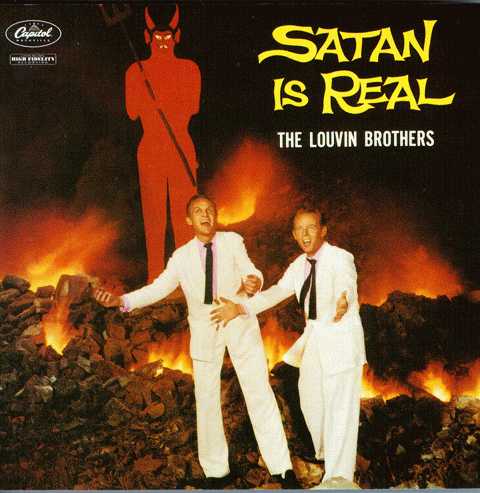
On this record the Louvin Brothers reach country gospel perfection with eerie close harmonies that can't be beat. If they see fit to give me a church funeral, I'd certainly want "I'm Ready to Go Home" to accompany my casket out the door. However, this cover features a cardboard cut-out of Satan that's more silly than scary. At least it's good for a laugh.
Beatles, Revolver

Revolver is the best Beatles record, hands down. It's full of amazing experimentation like "Tomorrow Never Knows," sitting side by side with beautiful pop songs like "Good Day Sunshine." It manages to combine all the great elements that band could muster, but without the pretentiousness of Sgt. Pepper or clunker songs like "Ob-La-Di" or "Maxwell's Silver Hammer" to prevent perfection. I have to honestly say I took awhile to pick up this album because I thought the cover was so awful. The rendering of the Beatles by Klaus Voorman look like a piece of teenage fan art drawn in a math class notebook, and doesn't really resemble the Beatles that much.
Steely Dan, Can't Buy a Thrill

The Dan's debut is a real pleasure and full of standards like "Dirty Work" and "Reeling in the Years," but the cover looks like a bad acid trip barfed all over it.
Led Zeppelin IV

Such a great record, arguably Zep's best, and certainly it's most well-known. The cover is just wretched, though. For a record full of the most mystically grandiose rock music ever recorded, including one inspired by The Lord of the Rings ("The Battle of Evermore"), they chose a peeling wall with an old painting of a man gathering sticks on it. It's too clumsy to be a knowing contrast to the music, and certainly not worthy to grace such an epic album.
Beach Boys, Pet Sounds

Saturday, July 20, 2013
Track of the Week: Waylon Jennings, "Lonesome, On'ry, and Mean"

Whenever I go back to Nebraska, I am faced with the very difficult experience of feeling like a stranger in my own hometown. Going back reminds me that I am a very different person from the one I used to be. I am fine with having changed, but it makes me feel alien and estranged from my family and all kinds of other people who were like family to me growing up. We live in different worlds, but they're still good people, even if we have a hard time relating to each other nowadays.
Of all the classic country I've listened to this week, "Lonesome, On'ry and Mean" has stuck out the most, maybe because it echoes some of my feelings. It's the first track on a killer album of the same name, the first album where Waylon Jennings was allowed complete artistic control. It's not hard to see the lyrics about getting on a bus and getting the hell out of town and "doing things my way" as a reference to his estrangement from the country music establishment in Nashville. The basic tone of the song is "get me outta this fuckin' place before I go nuts." That's pretty much how I felt back when I was 18 and went off to college. That day was like an emancipation for me, a liberation from the bullying, close-mindedness, philistinism, and exclusion that I endured from a very young age. For the longest time since that glorious day I'd felt less like I had rejected my hometown than I had fled as some sort of a refugee from a place that had already rejected me a long time ago.
These days I look back a little differently. The kids my age treated me like dogshit, but I had two very loving parents who sacrificed a lot for me. I didn't have many friends, but my parents' friends and their kids were like a second family, and we had a lot of great times together. "Lonesome, On'ry and Mean" thus embodies my binary relationship to my hometown. The song's subject matter reminds me of how happy I was to get the hell out, but it's outlaw country perfection helps me remember the good things I had that I can still take with me, like an appreciation for Waylon Jennings and badass country music.
Friday, July 19, 2013
Dear Hollywood: Bring the Joy and Fun Back to Summer Movie Season

I have been an avid movie-goer for pretty much my entire life. Two weeks ago, when my wife had to work and my in-laws had a day with the kids, I chose to go see a documentary about the cult rock band Big Star at the Independent Film Center. There's no where else I would have rather been on a hot summer afternoon with some time to kill. I grew up going to movies all the time, mostly because it was one of the few legal activities for teenagers available in my sleepy rural hometown. Most of the time I just went to theater and saw whatever struck my fancy, which is how I ended up viewing fare such as Karate Kid III, Crocodile Dundee II, Far and Away, Johnny Be Good, and any number of entries in the Police Academy saga.
Of course, I also saw some great summer movies, and I still have fond memories not just of the movies themselves, but of the time I spent in the theater with friends, having a shared experience enjoying a great movie. Films like Ghostbusters, Return of the Jedi, Back to the Future, and Goonies were well-made, funny, and yes, joyous things to behold. Nothing in my movie-going life will probably ever top seeing Indiana Jones and the Last Crusade on the evening of the last day of school in the seventh grade. I remember leaving the theater with a friend, breathing the warm early summer air and feeling nothing but hope and possibility.
That feeling has become much more elusive at the summer multiplex, and I don't think it's just because I'm older now. Up until very recently, I would take in plenty of summer flicks. My wife and I share this passion, and two summers ago during a canoeing and camping trip on the Niobrara River, we left the campsite for a night to go to the local town to see a movie. During the last two summers taking care of two infants has meant seeing many fewer summer movies, but my wife and I just don't seem to mind now. The summer movies that we are being offered just don't appeal to us; we go out of our way and beg for grandparent day care to see arty stuff like Before Midnight, not World War Z.
A lot of this is a matter of quality, since critics I trust haven't really been excited by much either. However, I think it goes beyond quality. The joy and fun that made movies like Ghostbusters and Back to the Future so enjoyable just aren't there anymore. I blame a lot of this on the current Hollywood adaptations of comic book superheroes, who, by their very nature, are difficult to relate to as human beings. They also tend to be over-serious and not fun, at least in terms of how Hollywood portrays them. I would expect this from Batman, of course, but the new Superman was (according to my sources) mirthless and even a shade vicious. A movie like Back to the Future gets you to root for the characters, or at least to be amused by the wild-eyed zaniness of Doc Brown and the oddball nerdiness of George McFly. The original Sam Raimi Spiderman had some of these qualities, but Peter Parker still acted like an annoying emo teenager.
In the last five summers or so I can only think of a small number of summer movies that gave me a glimpse of that old joy. One was WALL-E, which is less a children's flick than a brilliant social critique. Another Pixar flick, Toy Story 3, absolutely ripped my heart out. Apart from Pixar, I really loved Super 8, much more so than director JJ Abrams' more financially successful reboot of the Star Trek franchise. Super 8 betrayed a great deal of love and heart; Abrams has famously said that he had little love of Star Trek, and it shows. Super 8, however, was a throwback to the summer fare of yore, when the audience could get behind regular people thrust into extraordinary circumstances, rather than brooding crime fighters with super powers/super gadgets. Best of all, it was original. So much these days is warmed over or rehashed, and just too damn familiar. Franchises like Spider Man have had two incarnations since 2000, and Hollywood still shamelessly mines old material like Get Smart and even freaking board games, a la Battleship. Since 1989, there have been seven Batman movies. I like Batman as much as the next person, but there is such a thing as too much of a good thing. The studios think there are audiences in familiarity, but the wells are dangerously close to being sucked dry.
So Hollywood execs, pay heed and listen to me. Bring back humor to your blockbusters, real humor, not Jar Jar Binks forced humor. Take a cue instead from the hilarious interplay of Harrison Ford and Sean Connery in The Last Crusade. Cast comedic actors (like Bill Murray and Christopher Lloyd back in the day) in comedic roles, not just hunks of man meat like Channing Tatum. Start greenlighting more original ideas instead of franchises; the love of the film-makers will be on the screen, and if the film is good, the audiences will definitely respond. Go back to having real people in blockbusters. Close Encounters of the Third Kind, for example, works so well because we can empathize with Richard Dreyfus' character. You might choose not to listen to me, but do so at your own peril. Television has finally become a medium for mature, artistic expression. You still have the ability to one-up television by making great spectacles, but if those spectacles keep getting more distant from something real, true, and joyous and become rote CGI-fests, you will find fewer and fewer people willing to trek to the multiplex. You've been warned.
Subscribe to:
Posts (Atom)