Sunday, October 13, 2013

Track of the Week: The Replacements, "Bastards of Young"


This afternoon, as I usually do on a Sunday when I'm driving around the roads of the Garden State, I had WFMU on the radio.  In the midst of a typically stellar line-up of songs by famed DJ Glen Jones, he dropped "Bastards of Young" by the Replacements.  It was a reminder of the magic of radio, where a song can come out of the blue and make your day without you even being able to anticipate it.  I hadn't heard the song in awhile, but it turns out it was just what I needed.

"Bastards of Young" is one of my all-time favorite songs on one of my favorite albums by one of my favorite bands.  It's also one I associate with October, since it was way back in the autumn of my freshman year of college that I picked up a copy of Tim and proceeded to play the hell out of it.  The Minnesota based 'Mats embodied a certain kind of Midwestern drunken fatalism, one I certainly engaged in during my young bohemian years.  That attitude came out in their sound, which is unlike anything else.  They played trashy-punk rock, but threw in Kiss covers like "Black Diamond" to prove they weren't that hip after all.  They always sounded like they were about to fall apart, and on alcohol-soaked piss takes like "Treatment Bound," they did.  And yet they were capable of true greatness, somehow getting it together long enough to craft beautiful ballads like "Within Your Reach" and "Here Comes a Regular."

"Bastards of Young"would have been a big hit in an alternate, cooler universe.  It is a kind of Generation X call to arms, a commentary on young people left unclaimed by their elders.  The riff is a real blockbuster, the chorus a singalong worthy of U2's 1980s heyday.  It's an underground, snotty punk rock version of "Born in the USA," filtred through Gen X cynicism rather than Boomer anomie, and I still love it after all these years.  Hearing it come out of my car radio made me think for a moment that a cooler, alternate universe is still possible, which was maybe the most fervent hope of my own bastardized youth.

Friday, October 11, 2013

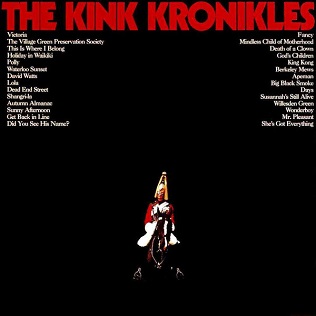
Classic Albums: The Kinks, The Kink Kronikles


Doing a profile of a compilation album seems to go against the raison d'etre of my Classic Albums series, since compilations are not usually artistic statements, but rather an agglomeration of recordings meant to make a buck or provide an easy entre for new listeners.  There are some compilations, however, that really stand up on their own, and even enhance older material by placing it in a new context.  The Kink Kronikles is just one of these albums.

The title is a bit misleading, since it does not cover the band's famous, rip-roaring early singles like "You Really Got Me," "All Day And All Of The Night," and "I Need You."  Instead, it chronicles the period between 1966 and 1970, when the Kinks made their best music while losing their stateside audience.  During this period lead singer Ray Davies' gaze turned inward, his albums becoming sociological statements on contemporary British life.  The music started borrowing heavily from English music hall traditions and referenced things like village greens and holidays in Blackpool, not exactly most accessible things for Americans.  The pictures of the royal palace guards on the front and back may thus be taken as less quaint illustrations and more a statement of purpose.

Despite focusing on such a brief, obscure (for Americans) and popularly shunned period in the band's career, The Kink Kronikles is a double album, a kind of argument to take their music of that era seriously.  It does not follow any kind of chronological order, and it does not simply collect the hits, mostly since there are so few to go around.  There are singles, both from albums and stand alones, previously unreleased tracks, and B-sides.  It misses many of the best Kinks songs of the era ("Some Mother's Son" is glaringly absent) but I can think of no better introduction to the Kinks' late sixties years.

Unlike many other compilations, great care seems to have been taken with the track sequencing.  For ecample, the rollicking "Victoria" gets things started off right, and side one of the first record ends with "Waterloo Sunset," one of the most beatifically gorgeous ballands ever written.  In between there are several previously unreleased tracks, but nothing feels forced or out of place.  Flip that record over, and the much peppier "David Watts" raises the curtain on side two, providing a new arc that ends with the bouncily whimsical "Did You See His Name," an unreleased song that closes out the first record on an appropriately abrupt note  The second record finishes with "Days," an elegiac song thankful for the days we have lived with loved ones gone, and just about the most perfect song you could ever choose to tie up a long collection of The Kinks' output.  For these reasons, the first time I heard this album, I thought it sounded nothing like a compilation at all.

I keep returning to The Kink Kronikles during this time of year because it calls forth memories of my first autumn as a PhD student living in Urbana, Illinois.  One day I went to a local, now sadly defunct bookstore, and picked the album up out of a desire to better acquaint myself with a band I'd only known from their Top 40 hits.  I was looking for a copy of Something Else, since I'd heard it was their best, but couldn't find it there, and figured that a compilation would give me more bang for my buck.  Whatever the reasons, I instantly fell in love, and listened to this album more than anything else for about a year.  It was a good year spent basking in the glow of the scholarly mission, years before I was aware of the hardships of the academic job market.  I met some wonderful friends and had some great times with them, and hearing these songs puts me back into those golden months more than anything else.  Perhaps too it's Ray Davies' nostalgic tendencies, ones I continue to increasingly indulge in myself as I get older.  Davies' waxes for the village green, I yearn for the innumerable backyard gatherings of friends, and I thank them for the days (and nights) they gave me.

Wednesday, October 9, 2013

Forget Ted Cruz, John Boehner Is The Real Villain

Rarely do extremists ever get a majority of the public to support their agenda.  To get power, they must attract more mainstream allies who can see a possible benefit in joining with extremists.  Historically, this has led to some pretty awful things.  For example, Italian elites were willing to support Mussolini, seeing his Fascist hordes as a bulwark against the Left.  For years northern Democrats were willing to bend over backwards to please their Dixiecrat wing, even if it meant not pushing for anti-lynching legislation.  Power is a drug, and those threatened with losing their connection to it will make all kinds of dirty deals with all kinds of unsavory characters to maintain their positions.

That is exactly what we're seeing in Washington this week.  The Tea Party extremists like Cruz, King, and Bachmann are getting the blame, but they would not have been able to shut down the government without the machinations of John Boehner.  As Speaker of the House, he has control over what legislation reaches the floor, and he has totally refused to allow a vote on a continuing resolution to fund the government.  I have no doubt that plenty of moderate Republicans would join Democrats in voting for it, which would bring a quick end to an entirely avoidable crisis.  The nation would win, but Boehner would most certainly lose.  The Tea Party base of the GOP, along with some of its hardline moneymen, would call for his orange head on a pike.

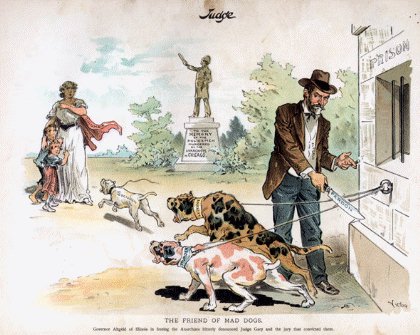
Conversely, great things are done by politicians with the courage to do the right thing, even if it means losing power.  Lyndon Johnson admitted that the Civil Rights Act would lose the South for the Democrats, but he knew it had to be done.  Back in the late 1800s, Illinois governor John Altgeld pardoned the three surviving members of the group of eight anarchists convicted of the Haymarket bombing on scant evidence.  He was rewarded with the kind of vitriol pictured below, and lost the governorship.  However, it was much more important to him that three innocent people were not put to death.  Justice trumped personal gain, as it should.

It is easy and fitting to blame ideological extremism and hyper-partisanship for our current impasse, but much of it boils down to pure venality.  That the future of this country could be hanging in the balance over such base motives might be the most depressing thing of all about this mess.

Monday, October 7, 2013

Re-post: Cranky Bear Pines For the Commonwealth


Editor's Note: My angry and impolitic friend and frequent guest poster Cranky Bear has not sent me one of his missives in quite awhile.  Perhaps he'a already in hibernation for the year, or is starting to mellow out with age.  In any case, the recent manufactured budget crisis has got me thinking about whether the United States would be better off in a parliamentary democracy.  Cranky actually wrote about this topic way back in early 2011, and it still seems all too relevant today.

*********
Cranky Bear here, hyperactive with espresso in his veins (this machine is the best Christmas gift I could have hoped for.) I've been thinking long and hard about the horrific events in Tuscon, and in the spirit of the moment, I will tone down my normally acidic vitriol. I find that when caffeine rather than booze is my drug of choice I cuss a lot fucking less (but never give it up completely.)

I've spent two years watching the Tea Party buffoons claim the legacy of the Founders, to the point where some of them want to restrict the vote again, and crow that this country is a republic, not a democracy. (Of course, these things are not mutually exclusive, but complexity of thought has never been a teabagger attribute.) As I said in my debut post, this country has a long history of violent, racist populism. Its current practitioners like to say they are "the people," but they really mean something more to the German word "Volk" with its connotations of racial community.

Anyone with half a brain is aware of the schizoid nature of the American Revolution and its legacy. Thomas Jefferson wrote the words "all men are created equal," but he was also a slaveholder who very often proclaimed the inequality of races. Although the revolutionaries claimed to fight for freedom, they did not intend freedom for all. It was the British, not the colonists, who encouraged slaves to leave their masters and protected their freedom. (Dr. Johnson put it best at the time, "Why is it that we hear the loudest yelps for liberty among the drivers of Negroes?") It was the British, not the colonists, who wanted to limit the slaughter of Native Americans, one reason the colonists were fighting for independence! Although modern conservatives like to claim Tocqueville as an apostle of exceptionalism, they forget his scathing critiques of America's hypocrisy in regards to the treatment of Native Americans and African Americans. These contradictions, which great people like Dr. King and others have tried to unravel, remain with us today.

If you compare the political culture and strength of mythologized nationalism of America to its wealthy peer nations, the differences are striking and alarming. For example, could you even imagine anything like the Tea Party in contemporary Canada? If a political movement in modern-day Germany used the talk radio rhetoric of insurrection, "second amendement remedies," etc., it would be anathema. Any politician spurring that movement with talk of "real Germans" or "don't retreat, reload" would become a pariah and would be kicked out of any of the four major parties (Left and Right) for saying such things. Because of their history, Germans are aware that violent rhetoric has consequences. Our history ought to teach us that lesson too, but because most of the public views our history as one long string of victories for freedom, we never will. After Vietnam there was a window of opportunity where the triumphalist narrative could have been laid low, but it passed.

This is why I now think what to most Americans is unthinkable: America would be better off if it did not achieve independence from Britain. It would have been ideal if right after Lexington and Concord the British leadership offered self-governance for America in exchange for continued loyalty to the crown. We like to think that our nation's war for independence was some kind of great blow for human liberty, making America a beacon of freedom to the world.

Bullshit.

The American Revolution did not extend freedom, it merely formalized freedoms that already existed, and did little to challenge the racial, class, and gender inequality of colonial society. Yes, Americans got to rule themselves, but the Canadians basically managed to do the same thing after a rebellion in 1837.

I am well aware of the horrors perpetrated by the British Empire during the 19th century, but they were no worse than those committed on the American frontier. The British also happened to abolish slavery thirty years before the United States, and did it without massive bloodshed. Two court cases provide an apt comparison: those of James Somerset and Dred Scott, both enslaved men who sued for their freedom in court.

We all know what happened in the infamous 1857 Dred Scott decision: even though Scott had lived on free territory for much of his life, he was denied his freedom. Furthermore, the court ruled that black people simply did not have any rights vis a vis whites. Somerset's case dates all the way back to the 1770s, and his circumstances were remarkably similar. He had lived as a slave in England, and when his master tried to take him back to the Caribbean, he resisted. In Somerset's case, the court ruled that there was no precedent in English common law to uphold slavery, and all slaves in England were thus emancipated. This was in 1772, a full eighty-five years BEFORE Dred Scott. Yes, the English participated the horrific slave trade, but they did finally ban it in 1806.

We like to tell ourselves that America is a uniquely free place, but our history simply does not bear that assertion out. We have not had equal voting rights for even fifty years! (The Voting Rights Act was passed in 1965, for crying out loud.) We love to pride ourselves as an egalitarian society whose top echeolons represent a kind of meritocracy. Any trip to this nation's many ghettoes, barrios, Indian reservations, dying rural towns, and trailer parks ought to confirm George Carlin's immortal quip, "It's the American Dream because you have to be asleep to believe it."

And in the midst of an economic hurricane austerity is the order of the day. The investment bankers who got us into this mess are back to giving themselves record profits, but here in Texas, where 25% of the population lacks health insurance, the sate is slashing Medicaid instead of spending a single cent of its $9.4 billion "rainy day fund." I'd say the current situation qualifies as a fucking downpour.

The reasons, of course, are blindly ideological, a belief that government is somehow inherently evil. Which brings us back to the American Revolution. The Tea Party, which is merely an echo of a long-established tradition of violent, nationalistic, Herrenvolk populism, has reinterpreted the American Revolution in its favor. The radical Right sees America as a nation where "the people" must always be ready to raise arms against "tyranny," which they interpret as any government expenditure that might somehow help out somebody else.

Like the masses who supported Andrew Jackson, who ethnically cleansed the Cherokee, they support government action when it benefits themselves or is used to slaughter brown people. These supposed libertarians support the maintenance of the biggest war machine in history and its war of choice in Iraq, they supported the warrantless wiretapping of the last administration, they voiciferously oppose closing down an illegal prison at Guantanamo Bay, but if the government tells insurance companies to abide by new regulations, that's tyranny! They claim to be against entitlements, but see no hypocrisy in drawing Social Security, Medicare, and in having gotten their boost into the American middle class via public education.

So I ultimately agree with James Madison, who promoted the Constitution's ability to tamper down faction and keep the ignorance of the masses in check. I just think that the Commonwealth would have been a much more effective restraining influence on the violent populism that dares to claim the mantle of freedom. Instead of our unwieldy system, with its Senatorial "holds," the ridiculous electoral college, and a legislative body where Wyoming gets the same number of representatives as California, we might have a proper Parliament, like most of the rest of the democratic world.
Sunday, October 6, 2013

Track of the Week: "The Baseball Boogie"


 This weekend I had the great fortune to be in Pittsburgh, hanging out with two great friends I made during my all too brief two-year time in Michigan.  One lives on the outskirts of Pittsburgh, while the other came up from Georgia.  We all met as contingent faculty, which meant that we were all scattered to the four corners of the country within three years of us meeting.  Only one of us still remains in academia.

Last night we repeated a ritual that we had developed on long winter Saturday nights in Michigan.  After knocking back a few beers, we gathered 'round the computer and started sharing YouTube clips.  This time around we threw out some new ones, but also went back to some old reliables that still retain their power.  "The Baseball Boogie," a music video featuring the 1986 Los Angeles Dodgers, probably won the night yet again, both for its ridiculousness and for provoking memories of our fun times together.

People of a certain age may remember "The Super Bowl Shuffle," a godawful rap video featuring the 1985 Chicago Bears, who went on to back up their bragging with a 15-1 run and an NFL title.  Unfortunately, other sports teams saw this and decided to come up with their own team songs.  The Dodgers, being in LA, put out "The Baseball Boogie," which is not a boogie at all, but a lifeless 1980s R&B number with more gloss than a copy of Vogue.  Highlights include Pedro Guererro's Mr. T starter-set jewelry, Orel Hersheiser's pelvic thrusting, Steve Sax's blow-dried middle-parted 80s coif, and Jerry Reuss looking like a coked out grandpa.  Oh yeah, there's also plenty of terrible rapping and cheesy mugging for the camera.

Last night I spent the whole video laughing myself hoarse.  It wasn't just the ridiculousness of the proceedings, but sharing something with old friends who "get" me in ways that nobody here in Jersey apart from my wife can understand.  Great friends, and supremely cheesetastic videos such as these aren't easy to find, and should be cherished.

Thursday, October 3, 2013

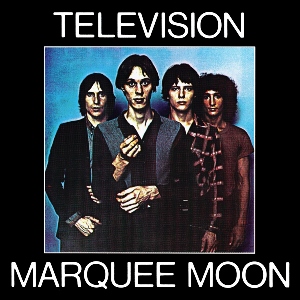
Classic Albums: Television, Marquee Moon


There is nothing like the thrill of revisiting an old favorite album after too much time apart, and realizing it was just as good, or even better than you always thought it to be.  That experience happened to me yesterday during my commute home.  I was waiting for the subway and scrolling through my old, 2007 vintage iPod, and decided to give Television's Marquee Moon a spin.  I'd been listening to a lot of Velvet Underground, so I guess I was in the mood for something New York punky.

"See No Evil" got off to its rollicking start as I hopped on the 1 train, and the combination of its exhilarating push and the subway train's rushing down the track brought the glory of this song home to me in a way I'd never felt before.  I first heard the song as part of the storied Rhino records punk compilation series (sadly out of print) as was completely floored.  I thought of punk as basic three chords heavy music, but these guys had chops, and the guitar solo that the song builds up to in a frenzied climax has got to be one of the most sublime things I've ever heard in my life.  Jimi Hendrix's epic introduction to "Voodoo Child (Slight Return)" is the only rock guitar moment that beats it, for my money.

Hearing that song in high school on a New York punk compilation intrigued me, but considering I lived in rural Nebraska before the internet age, I couldn't get my hands on any Television albums.  That changed on my German class trip the summer after I graduated, where I found myself buying up obscure punk records with every spare moment.  I bought Marquee Moon for 120 kroner on a day trip to Malmo, Sweden.  (I bought Jimi Hendrix's Life at Monterey the same day, so I guess I hit paydirt on that trip.)  I didn't get a chance to hear it until I got back home to the states.  After the blazing "See No Evil" finished, I didn't know what I was going to hear next.  The unexpectedly mid-tempo and gorgeous "Venus" followed, and I think that's where I really got hooked on Television.  The guitars have a wondrous, ringing tone to them, echoing the classic beauty of the Venus de Milo referenced in the song.

The third song, "Friction," goes back to the punky, nervy edginess of "See No Evil," but it's a smooth transition.  Just as Television broke from the punk pack with their guitar heroics, they also had a much more sophisticated grasp of rhythm than their CBGBs peers.  In a lot of ways, they took the good elements from prog rock (musicianship, complex rhythms) and filtered them through the gritty punk aesthetic.  Punks were supposed to hate prog rock and its frippery, but Television managed to have a touch of Genesis without losing their street cred.

And speaking of prog rock, Television followed "Friction" with an Emerson, Lake, and Palmer worthy epic, the eponymous title track.  Stretched out longer than ten minutes, it starts of sounding like the Cadillac of the lyrics, slinking through the dark city streets, before being transformed into a flying saucer soaring the stars.  There are few ten minute songs that are so intense that they sound like five minute songs, and this is among them.  It also weirdly showcases Tom Verlaine's voice, which can be described most charitably as "unorthodox."  His slightly quacking tone actually seems to work here, adding to the macabre sense of midnight dread.  Thus closes out what might be the best side one of any record in my collection.

Even if side two can't match such heights, it's still really, really damn good.  The guitars on "Elevation" end up burning like magnesium flares after beginning the song casting the subtler light of tapered candles.  "Guiding Light" breaks from the punk script with some piano at the center of a tender, lovely ballad, which still has room for an absolutely soul stirring solo at the end.  "Prove It" artfully brings back the New York nerves, and "Torn Curtain" begins with an epically sublime guitar figure that sounds, well, like the curtain guarding the holy of holies being ripped.

There just isn't much out there better than this.  Marquee Moon also has a sentimental spot in my heart, since I was listening to it intensely at a time -age eighteen- when I was finally coming into my own as a human being.  It was the start of a journey of self-understanding that led me to be standing on a subway platform in the heart of New York City, engaged in silent musical reverie with the same album almost twenty years later.

Tuesday, October 1, 2013

Right Wing Bolshevism


Despite their professed hatred of all things "collectivist," the recent government shutdown points out yet again the links between the Tea Party worldview and that of the Bolsheviks.  Of course, both sides would be revolted by the comparison, but I am not making it on the basis of ideology. (Ideologically they are almost polar opposites.)  I had long seen their tactics and mentalities to be similar, and just today I was validated when reading an article by Rick Perlstein, who noted that anti-tax loon Grover Norquist admires Lenin's tactical skill so much that he has a picture of him in his office.

It's not just tactics (more about that later) but also of mental habits.  The root of all evil in the world is reduced to one thing whose elimination will bring about a paradise on earth: capitalism in the case of the reds, "big government" in the case of the rightwingnuts. Whether its the revolution or the free market, both are claimed to have magical properties that will somehow solve everything from global hunger to the problems of higher education.

Like a good party apparatchik of the days of yore, your average rightwingnut sees the world through a binary prism: the good guys who are with us and the bad who are against. This I think helps explain the staggering levels of hatred being spewed forth onto public employees these days, by working for the government they are modern day kulaks. If they aren't able to get paid, all the better, they deserve it.  The same goes for those snobby college professors. (In either system intellectuals can't catch a break.) The animus against these people has nothing to do with anything they've done, and everything to do with what they represent. They are simply pure, unadulterated evil. Hence the current crop of governors can fire all kinds of state workers in the name of "job creation": those who work for the state are not considered to have "real" jobs, they are parasites.

When a narrow, fanciful ideology eventually fails catastrophically, be it Leninist or Reaganist, its adherents tend to do anything they can to blame something else. In America an unrestrained financial sector created a massive, unsustainable real-estate bubble whose bursting has destroyed our economy. That fact (and it is a fact) does not conform to the rightwingnut narrative, and so they blame government incentives for home ownership, completely passing over the fact that the banks were giving out mortages to anyone with a pulse so that they could create mortages to cut up and speculate upon under the assumption that they would always retain value. Even more glaringly, they attack taxes on the wealthy, saying that if those wonderful "job creators" get more dough, the wealth will rain down on the rest of society.  The wealthiest segment of the country now gets a bigger share of the pie than ever before, but the promised trickle down hasn't happened.  Supply side has been a thirty year failure, but their only response is more gutting of the safety net and more tax breaks for their plutocratic allies.

Likewise, in the face of the obvious and complete failure of the command economy of the Soviet bloc, one still hears Marxists who claim that it just wasn't done the right way under the right conditions. These ideologues, no matter if they carry icons of Lenin or of Reagan, are seriously deluded. (And they do mindlessly worship their heroes, don't they? So many who claim to love "The Founders" seem to have little to no idea of what they were actually like.)

Yet these ideologues get constant reaffirmation of their worldview from a propaganda machine that has an easy explanation for every complex problem, and a new set of villians to pour hatred upon each day. They are told that a snowstorm negates the scientific consensus on global warming, that union workers rather than corporations are benefiting most from our economic system, that all Muslims are supporters of terrorism, that modern-day progressives are a cancer to be expunged from the body politic, and that the current budget crisis is the responsibility of the president and him alone. They and their allies are internal enemies who threaten "real America," be it through the first lady's anti-obesity campaign or history textbooks that fail to present a triumphalist, ultra-nationalist interpretation of the American past.

Perhaps worst of all, those motivated by extremist ideology, be it on the left or on the right, tend to take an "ends justify the means" approach in order to bring about their utopia. Just witness the fillibusters, Swift Boat lies, birtherism, threats of government shutdown, "town hall" screamfests, and unilateral stripping of collective bargaining rights.  The last three years of Tea Party mobilization have made our nation almost ungovernable.  That is not an unintentional byproduct of their activities, but a wholly intentional outcome of a cynical and reckless strategy.

Obviously, I do not think that Bolsheviks and today's rightwingnuts are moral equivalents. However, I do think that our political system no longer works according to the old rules where two centrist, corporately compromised parties vie for power with some compromises along the way. Instead we have one centrist, corporately compromised party willing to work with the other side, which has been transformed into a vehicle for a messianic, nationalist, laissez-faire political movement that will stop at almost nothing to get what it wants. Historically a fight between weak centrists and strong ideologues ends badly, which is why I am glad that the president is holding the line.  Extremists cannot be allowed to win.