Surveying my generation of academics (those who got their PhDs in the last decade or so) I’ve noticed a very clear experiential divide between those who are working or who have worked “temporary” jobs (as in adjunct, “visitor” etc.) and those who landed on the tenure track straight out of grad school. These two groups tend to see the academic world very differently.
I’ve decided that we need some terminology to describe this difference, so I would volunteer the term “Shock” to describe the survivors of the untenured labor market. It is partly a bowdlerized acronym of “school of hard knocks,” a reference to the “shock workers” of the Soviet Union whose back-breaking work was supposed to set an example, and lastly, symbolic of shocks of wheat. Like the grain, the labor of Shocks is harvested and milled so that others may eat, i.e. the permanent faculty.
While I myself am a Shock, having spent two years in a thankless “visiting” job, I should start by saying that I do not hold a grudge against non-Shocks generally, and do not think the Shock experience necessarily makes us better. I am very happy for the friends of mine who have managed to make the transition from graduate school to the tenure track seamlessly, they have been spared a great deal of pain and aggravation. I also think that Shocks are more likely to become the excessively bitter person who is incapable of enjoying their job and provokes much eye rolling in response to their indignation at faculty meetings.
Shocks are almost always marked (perhaps scarred is a better word) by their experiences. When you teach more classes than tenured faculty at your university and still publish more in two years than many of them have in their entire careers, that tends to erode any notion that the profession is fair (not that these should have ever been believed in the first place.) When some of these same people refuse to acknowledge your presence when they pass by in the hallway, the rage begins. When you spend seventy hours a week in your first semester working so that you can prep new classes, write job applications, and work on the publications you need for the said job search and you see a tenure track colleague who calls in “sick” for a quarter of the semester, the indignation rises. And when you get your meager pay packet for all your troubles, and then lose most of it paying for emergency dental care not covered by your substandard insurance, it goes through the roof.
A lot (though not all) non-Shocks that I know take a rather rosy view of the profession. And why not? They’ve gone from the poverty-stricken yet exciting life of the mind offered by graduate school to a job where they get their own office, can expect respect (this is what I liked most about my time on the tenure track), teach the classes they’ve always wanted to teach, get money for conference travel and research, and have graduate assistants and office staff to do a lot of the day to day busywork for them. Some non-Shocks (not all or even most) look at this state of affairs and do not consider themselves blessed or lucky, but in fact more WORTHY than their grad school counterparts languishing in visiting and adjunct jobs. These non-Shocks see the academic class divide in a Victorian fashion: the academic working classes simply lack the merit required to rise into the bourgeoisie. Though this may be true in some cases, it is mostly a conceit, given the ratio of applicants to jobs available on the tenure track.
The one and only great advantage possessed by Shocks is that their desperate struggle for survival usually engenders a strong work ethic. In order to get a job, a Shock needs articles or even a book contract, and they need to happen fast while the Shock is teaching over one hundred students. This means a great deal of intellectual elbow grease and the forfeiture of the notion of the “weekend” and “break.” What often hurts non-Shocks by comparison is that they come into their jobs with their tenure clocks ticking while they are trying to adjust to full-time teaching (by tenure track standards.) At least when I took my t-t job I had two articles under my belt and had made a great deal of progress on my book manuscript. Now that I am no longer in academia and teaching at a private high school, I think my experience as a Shock and working in a very Shock-like tenure track job prepared me well for my new career. I got used to teaching outside of my area of expertise and busting my ass.
I think there needs to be a greater dialogue in the academic world about what it means to be a Shock or a non-Shock (until we find a better word, of course.) Is the Shock experience the enlightening school of hard knocks, or just a breeding ground for permanent embitterment? Are Shocks too haughty or judgemental of non-Shocks? Does the divide flatten out over time? I’d like to hear your thoughts.
Saturday, September 29, 2012

Wednesday, September 26, 2012
Low Budget Culinary Pleasures
With the arrival of twins to the Bear household, I am coming to grips with the fact that there's going to have to be some belt-tightening around here. Since I spent over a decade in the genteel poverty of grad school and the peon grade of the professoriate, I am well versed in the art of having a good time on just a dime. Here are my favorite low-budget pleasures in regards to food and drink, please use the comments section to enlighten me on those I've missed.
Snack Cakes

If Karl Marx were alive and amongst us today, he would say that cheap junk food, not religion, is the opiate of the masses. People are willing to passively accept warrantless spying by their government, drug tests from their employers, and surveillance cameras on any corner, but will get up in arms if you dare restrict their right to giant containers of sugary soda. Our whole agricultural policy seems designed specifically to create a mountain of cheap cheese puffs and potato chips to keep the proletariat distracted and happy. Of all of the low-priced gut bombs out there, I have a special spot in my heart for snack cakes, Little Debbie brand in particular. My parents are skin-flints of the highest order, which meant our pantry was always full of Zebra Cakes, Star Crunches and Oatmeal Pies, all of which used to come for less than a dollar a box. I used to love visiting a friend's house back in the day, since his mom always seemed to have vanilla Zingers on hand, which are a Twinky-like cake with frosting on the top, which is as decadent as it gets for a ten year old child. These days, thanks to my wife's influence, Ring Dings have become my favorite.
Pork Rinds

Sometimes you need a little savory with your sweet, and pork rinds have never done me wrong. I still remember the first time I had them; my grandparents brought a bag over to our house as an afterthought along with my grandma's usual trunk full of homemade pies and casseroles. I thought they'd taste like potato chips, and was pleasantly surprised by the flavor. The fact that I was eating the fried skin of a dead animal only made them that much cooler in my little boy mind.
Hot Dogs

The invention of the hot dog is proof, more so than the light bulb, personal computer and assembly line, that this country once harbored genius. I consider myself a bit of a connoisseur of the frankfurter, and have sampled my share of exceptional examples of the form. My favorite genre is still the Chicago-style Vienna dog, for all of its ostentation and frummery. Running a close second is the Michigan appropriation of the Coney dog (the secret is organ meat in the chili sauce.) When I lived in Michigan I would sample something from time to time called a Flint dog, which was covered in spiced ground meat of unknown provenance. In these parts when I want to bite into a truly epic dog, I go to Rutt's Hutt in Clifton and have one of their deep-fried "rippers." If anything will kill me, it's this.
Bargain Basement Beer

I love a good beer more than just about anything in the world, but even though my palette might be microbrew, my wallet is often Pabst Blue Ribbon. When I lived with my buddy Dave in Chicago, we used to buy thirty-can cubes of Miller High Life for eleven bucks, a purchase I dubbed "instant party." High Life might not be full of great taste, but it does go down nice and easy, which is more than I can say for Keystone, Busch, or Milwaukee's Best. At our neighborhood bar I would be reduced at times to ordering Stroh's, which is a brew best to be avoided. Finding a cheap beer that does not taste like iron filings is a difficult art, which is why I was lucky enough recently to make the acquaintance of Genesee Beer. I purchased a tall-boy can for the princely sum of ninety-nine cents on a whim, since it seemed to have the most plain can I'd ever seen. The good folks at Genesee appear to have put their money in the beer rather than the packaging, which is more than can be said for Budweiser.
Rot-gut Bourbon

I do love a taste of Kentucky gold, but if necessary, I'll settle for some Kentucky sludge. That's why they invented Coca-Cola, right? My favorite bourbon in this regard is Evan Williams, which should not be drunk straight unless you want to see vapor trails. However, mixed with coke, it takes on positively sublime properties.
Diners
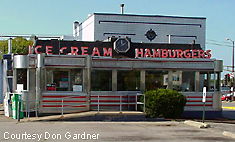
Of the many things I like about New Jersey, its diners are close to the top of the list. Diners seem to be in decline across America; my favorite greasy spoon in Illinois closed while I was there, as did a similar place in my old Michigan 'hood. Here in the Garden State, thankfully they're still going strong, with the added benefit of having items like pork roll and mazto ball soup on the menu. Whenever I'm feeling low or in need of some culinary comfort, my friends at the diner always have the pancakes or meat loaf that will kill my unhappy thoughts with a food coma. When I was a pathetic lonely bachelor in Michigan, nothing made me feel more at home than my weekly trip to my local diner for breakfast on Saturday, chatting with the waiters and the other regulars at the counter. Strangely enough, a trip to a diner played an important role in the early stages of my relationship with me wife. Now that I've got babies, they enjoy the constant background diner noise of errant conversation, waitresses taking orders, and clattering silverware, so I guess things have come full circle.
Snack Cakes
If Karl Marx were alive and amongst us today, he would say that cheap junk food, not religion, is the opiate of the masses. People are willing to passively accept warrantless spying by their government, drug tests from their employers, and surveillance cameras on any corner, but will get up in arms if you dare restrict their right to giant containers of sugary soda. Our whole agricultural policy seems designed specifically to create a mountain of cheap cheese puffs and potato chips to keep the proletariat distracted and happy. Of all of the low-priced gut bombs out there, I have a special spot in my heart for snack cakes, Little Debbie brand in particular. My parents are skin-flints of the highest order, which meant our pantry was always full of Zebra Cakes, Star Crunches and Oatmeal Pies, all of which used to come for less than a dollar a box. I used to love visiting a friend's house back in the day, since his mom always seemed to have vanilla Zingers on hand, which are a Twinky-like cake with frosting on the top, which is as decadent as it gets for a ten year old child. These days, thanks to my wife's influence, Ring Dings have become my favorite.
Pork Rinds
Sometimes you need a little savory with your sweet, and pork rinds have never done me wrong. I still remember the first time I had them; my grandparents brought a bag over to our house as an afterthought along with my grandma's usual trunk full of homemade pies and casseroles. I thought they'd taste like potato chips, and was pleasantly surprised by the flavor. The fact that I was eating the fried skin of a dead animal only made them that much cooler in my little boy mind.
Hot Dogs
The invention of the hot dog is proof, more so than the light bulb, personal computer and assembly line, that this country once harbored genius. I consider myself a bit of a connoisseur of the frankfurter, and have sampled my share of exceptional examples of the form. My favorite genre is still the Chicago-style Vienna dog, for all of its ostentation and frummery. Running a close second is the Michigan appropriation of the Coney dog (the secret is organ meat in the chili sauce.) When I lived in Michigan I would sample something from time to time called a Flint dog, which was covered in spiced ground meat of unknown provenance. In these parts when I want to bite into a truly epic dog, I go to Rutt's Hutt in Clifton and have one of their deep-fried "rippers." If anything will kill me, it's this.
Bargain Basement Beer
I love a good beer more than just about anything in the world, but even though my palette might be microbrew, my wallet is often Pabst Blue Ribbon. When I lived with my buddy Dave in Chicago, we used to buy thirty-can cubes of Miller High Life for eleven bucks, a purchase I dubbed "instant party." High Life might not be full of great taste, but it does go down nice and easy, which is more than I can say for Keystone, Busch, or Milwaukee's Best. At our neighborhood bar I would be reduced at times to ordering Stroh's, which is a brew best to be avoided. Finding a cheap beer that does not taste like iron filings is a difficult art, which is why I was lucky enough recently to make the acquaintance of Genesee Beer. I purchased a tall-boy can for the princely sum of ninety-nine cents on a whim, since it seemed to have the most plain can I'd ever seen. The good folks at Genesee appear to have put their money in the beer rather than the packaging, which is more than can be said for Budweiser.
Rot-gut Bourbon
I do love a taste of Kentucky gold, but if necessary, I'll settle for some Kentucky sludge. That's why they invented Coca-Cola, right? My favorite bourbon in this regard is Evan Williams, which should not be drunk straight unless you want to see vapor trails. However, mixed with coke, it takes on positively sublime properties.
Diners
Of the many things I like about New Jersey, its diners are close to the top of the list. Diners seem to be in decline across America; my favorite greasy spoon in Illinois closed while I was there, as did a similar place in my old Michigan 'hood. Here in the Garden State, thankfully they're still going strong, with the added benefit of having items like pork roll and mazto ball soup on the menu. Whenever I'm feeling low or in need of some culinary comfort, my friends at the diner always have the pancakes or meat loaf that will kill my unhappy thoughts with a food coma. When I was a pathetic lonely bachelor in Michigan, nothing made me feel more at home than my weekly trip to my local diner for breakfast on Saturday, chatting with the waiters and the other regulars at the counter. Strangely enough, a trip to a diner played an important role in the early stages of my relationship with me wife. Now that I've got babies, they enjoy the constant background diner noise of errant conversation, waitresses taking orders, and clattering silverware, so I guess things have come full circle.
Monday, September 24, 2012
The Theraputic Powers of Side Four of Tusk

In the period between November of 2010 and May of 2011 I lived in a state of constant fear and anxiety, due to both my dysfunctional workplace and lack of prospects on the job market. I've always used music as medicine, but it meant a lot more to me during those harrowing months than it's ever had. When I woke up in the morning, I would often throw on record and play a single side while eating my breakfast. With the radio full of news of the Tea Party ascendancy, my jangled nerves could no longer handle NPR.
Side four of Tusk was an old standby on these mornings; it never failed to soothe me. Other sides of this famous double album might indeed be better, but this one still washes over me like warm water. It starts with the disposable "Honey Hi," a typically jaunty Christine McVeigh number that sets a relaxing mood. Perhaps it's there to put the listener in a good mood before the extreme downer of Stevie Nicks' "Beautiful Child," a lament for lost love that sounds like the thoughts that go through your mind at 3AM when you can't sleep.
Tusk is full of avant-garde Lindsay Buckingham songs that provide sharp counterpoints to the more pop-oriented Nicks and McVeigh songs. "Walk a Thin Line" might be the most subdued of Buckingham's tracks on this album, fitting well with side four's quiet, spooky vibe. That spookiness gets downright surreal on the next track, "Tusk," one of the strangest songs ever to hit the upper range of the Top 40. The USC marching band, penis references, and a lack of any discernable verse-chorus-verse structure set it apart from just about anything else on the record. Listening to it over my morning coffee and oatmeal, it helped rouse me from my morning torpor and the inevitable dread about facing my workplace. Side four (and the album) end on an optimistic note with "Never Forget," just the right attitude I needed to confront the day ahead.
These days I'm a lot happier, thankfully. I get to hug my babies before leaving on a journey to Manhattan's invigorating bustle to do a job I love. As much as I still love Tusk, it won't ever mean as much to me as it once did, but that's probably a good thing.
Saturday, September 22, 2012
Why Conservatives Aren't Too Despondent About A Possible Romney Defeat
In case you haven't noticed, the Romney campaign's recent travails have led many prominent conservatives to sharply criticize him, and to generally give the impression that he is a hopeless cause. This is especially surprising, considering the conservative bloc's typical party discipline.
One conclusion I've drawn is that many conservatives have a lot to gain if Obama gets re-elected. That might sound counter-intuitive, but it makes sense if we look at the broader picture. If Romney loses, the hard right will then crow that the party needed to nominate a "true conservative," making their hold on the party that much stronger. If Romney wins, they would also lose their biggest lightning rod: president Obama. The unmitigated hatred spewed at him by the right has galvanized and united conservatives of different stripes; without a common enemy, it will be hard for the right wing coalition to not devolve into sniping and back-biting.
If Romney wins it would also put conservatives in the unenviable position of having to stop throwing rhetorical bricks and actually govern a system that has become increasingly ungovernable. It's much easier for them to wield power the way they do now, by obstructing every piece of legislation that they don't like. Why would conservatives give that up for having to actually be judged on their leadership? I have a feeling that they would much rather wail and howl and engage in their false victimization narrative. After this November, expect four more years of exactly that.
One conclusion I've drawn is that many conservatives have a lot to gain if Obama gets re-elected. That might sound counter-intuitive, but it makes sense if we look at the broader picture. If Romney loses, the hard right will then crow that the party needed to nominate a "true conservative," making their hold on the party that much stronger. If Romney wins, they would also lose their biggest lightning rod: president Obama. The unmitigated hatred spewed at him by the right has galvanized and united conservatives of different stripes; without a common enemy, it will be hard for the right wing coalition to not devolve into sniping and back-biting.
If Romney wins it would also put conservatives in the unenviable position of having to stop throwing rhetorical bricks and actually govern a system that has become increasingly ungovernable. It's much easier for them to wield power the way they do now, by obstructing every piece of legislation that they don't like. Why would conservatives give that up for having to actually be judged on their leadership? I have a feeling that they would much rather wail and howl and engage in their false victimization narrative. After this November, expect four more years of exactly that.
Thursday, September 20, 2012
Other 47% Moments and Public Meltdowns
The recently revealed and formerly secret comments by Mitt Romney about the supposed 47% of "moochers" out there so dependent on government hand-outs that they would not dare vote for him is one of those great and rare moments when a liar and professional bullshitter gets caught revealing his true self. The revelation of Romney's plutocratic leanings, unadulterated and uncut, has accelerated his campaign's meltdown. This isn't the first time a public figure has embarrassed themselves by showing their true colors or just plain imploded, so here's a compilation of my favorite real and fictional meltdowns and 47% moments.
A Face in the Crowd
This is one of my favorite films, and stars an atypically malevolent Andy Griffith as Lonesome Rhodes, an itinerant, boozing guitar picker who gets catapulted to fame via television, where he morphs into a Glenn Beck-like reactionary messiah. He uses downhome charm and aw shucks earthiness to conceal the fact that he's carrying water for wealthy reactionaries. Rhodes is undone, however, when another character, so disgusted with his transformation, turns the mic on during the closing credits of his show as he denigrates his audience for being a bunch of easily lead, naive rubes. Although Romney is about as folksy as a silver salad fork, he has tried to affect a concern for the little people that has been entirely debunked by his Mr. Burns-esque pronouncements.
Bill O'Reilly Wants to "Do It Live"
It's before his career at Fox News, but it's fun to watch this out-take of a preening prat who effects a tough-guy personae acting like a crying baby.
Lee Elia Rant
This doesn't quite count as a 47% moment, since Cubs manager Elia went on this tirade at a press conference in the early 1980s. However, it's a true artistic masterpiece in the annals of public meltdowns as well as a masterful display of profanity. The audio of this clip will live on longer than any knowledge of the Cubs' performance during Elia's tenure.
Denny Green Loses His Shit
Since I'm a Bears fan I remember well the game when Green's Cardinals improbably lost to a Chicago team that had no right winning that game. Obviously frustrated with his team and the usual barrage of stupid questions at the press conference, Green lost his shit. "If you want to crown them, then crown their ass" was a personal catchphrase for me for a couple of months afterward.
Oklahoma State Coach Mike Gundy Goes Gonzo On the Media
Three years from now I will walk around screaming "I'm a man, I'm 40!" on my birthday because of this clip. When overly testosteroned masculine authority figures like football coaches shout in front of people with twice their IQ, I always have to chuckle.
LBJ Talks About Pants
Listening to the most powerful man in the world needle a pants manufacturer about needing more inseam room while burping into the phone and saying words like "bunghole" is about as surreal as it is hilarious.
Richard Nixon Drunk Dials His Chief of Staff
Might as well close this out with one of the few modern politicians who has Romney beat when it comes to mendacity and lack of scruples in pursuing power. Nixon set himself up as the representative of the "silent majority" and a figure of moral forthrightness, but in this phone call, when he's drunk dialing Bob Haldeman, he sounds like the pathetic, slimy liar that he truly was.
A Face in the Crowd
This is one of my favorite films, and stars an atypically malevolent Andy Griffith as Lonesome Rhodes, an itinerant, boozing guitar picker who gets catapulted to fame via television, where he morphs into a Glenn Beck-like reactionary messiah. He uses downhome charm and aw shucks earthiness to conceal the fact that he's carrying water for wealthy reactionaries. Rhodes is undone, however, when another character, so disgusted with his transformation, turns the mic on during the closing credits of his show as he denigrates his audience for being a bunch of easily lead, naive rubes. Although Romney is about as folksy as a silver salad fork, he has tried to affect a concern for the little people that has been entirely debunked by his Mr. Burns-esque pronouncements.
Bill O'Reilly Wants to "Do It Live"
It's before his career at Fox News, but it's fun to watch this out-take of a preening prat who effects a tough-guy personae acting like a crying baby.
Lee Elia Rant
This doesn't quite count as a 47% moment, since Cubs manager Elia went on this tirade at a press conference in the early 1980s. However, it's a true artistic masterpiece in the annals of public meltdowns as well as a masterful display of profanity. The audio of this clip will live on longer than any knowledge of the Cubs' performance during Elia's tenure.
Denny Green Loses His Shit
Since I'm a Bears fan I remember well the game when Green's Cardinals improbably lost to a Chicago team that had no right winning that game. Obviously frustrated with his team and the usual barrage of stupid questions at the press conference, Green lost his shit. "If you want to crown them, then crown their ass" was a personal catchphrase for me for a couple of months afterward.
Oklahoma State Coach Mike Gundy Goes Gonzo On the Media
Three years from now I will walk around screaming "I'm a man, I'm 40!" on my birthday because of this clip. When overly testosteroned masculine authority figures like football coaches shout in front of people with twice their IQ, I always have to chuckle.
LBJ Talks About Pants
Listening to the most powerful man in the world needle a pants manufacturer about needing more inseam room while burping into the phone and saying words like "bunghole" is about as surreal as it is hilarious.
Richard Nixon Drunk Dials His Chief of Staff
Might as well close this out with one of the few modern politicians who has Romney beat when it comes to mendacity and lack of scruples in pursuing power. Nixon set himself up as the representative of the "silent majority" and a figure of moral forthrightness, but in this phone call, when he's drunk dialing Bob Haldeman, he sounds like the pathetic, slimy liar that he truly was.
Wednesday, September 19, 2012
Sheepish Musical Pleasures: Foreigner, "Hot Blooded"
My God,this song is horrible, isn't it? The lead singer just screams about how he wants to take a girl home and sex her with about as much romance as a jackhammer. Lou Gramm's strained singing and forcefulness make the song's character (Lord I hope it's a character) sound like the kind of guy who thinks that that yelling "brace yourself" is foreplay and that three minutes of intercourse constitutes a marathon session. This is the worst of hairy-chested 1970s masculinity in all of its sweaty, misogynistic glory.
Yet I still find myself singing along to this song, which is hooky as all get out with a monster riff designed to break down my defenses. I try to tell myself that I enjoy its grunting desperation ironically, but I give myself over to the song with all my being when it happens to come on classic rock radio when I'm behind the wheel.
Tuesday, September 18, 2012
Can My Intellectual Marriage to My Academic Specialization Last?
After my first year as a PhD student, I decided to make nineteenth century Germany my area of specialization. I knew for a long time that I wanted to be a modern Germanist, but choosing which period of time to concentrate on took me awhile. A summer spent reading histories on the period while feeling out dissertation topics helped make up my mind and draw me in. That and the fact that I felt that too much had already been written on 20th century Germany (especially in regards to the Nazis), and I felt like I wouldn't be able to come up with an original scholarly contribution.
I guess it was my contrary nature to not want to study the one topic that people who aren't historians of Germany actually care about (just look at the German history section at any book store), and it certainly didn't help me find a job or land a book contract. I loved it nonetheless, and wrote a dissertation and published three journal articles on the subject. Despite those heavy investments in the field, I feel as if I have become estranged from my old identity as a historian, and wonder whether I might be headed for a divorce.
Some of this has to do with the fact that in the five years I spent as a professor, I was never really allowed to practice my chosen specialty. The first two years, when I taught as a "visitor" at Frontier University (names have been altered, of course), I was tasked with teaching a Western Civ survey, World History survey, and a course on Europe after 1945. While I particularly enjoyed the latter course, it meant never being able to share my expertise on the nineteenth century. When I finally landed a tenure-track job, I was forced to teach more American history surveys than any other class. I did get to teach the occasional survey on nineteenth century Europe, but much of my brain energy was being spent trying to make my American history lectures credible.
I also started getting disheartened with the lack of opportunities afforded by my speciality, especially when it came to getting a book contract. (Of course, a lot of this was down to the bad job market and the fact that I was not the best candidate out there.) I started developing research interests tangential to and even totally unrelated to my old speciality, figuring they offered more enjoyment and opportunity.
The real blow to my intellectual marriage, of course, came when I jettisoned academia for my current position as a private school teacher. I do love my job, but at the end of an exhausting day, I lack the necessary energy to do my scholarly work. The amount of stamina and effort required for a day of high school teaching makes even my old 4/4 load look pitifully easy. (Since summer, when I wrote almost a whole chapter of my current book project, I have written maybe two pages.) After my hour-long commute home, I mostly want to talk with my wife, cuddle my babies, and enjoy a cocktail while watching a baseball game. In any case, I no longer have the chance to get the necessary grants to travel overseas to do research, so the point is moot, anyway. The fact that my publisher dumped me right before this job started made it easier to write off my old project and my old field. When I attended the German Studies Association conference last fall, it felt like a good-bye tour.
This meant that last year, for the first time in a decade, I did not stay up on new publications in nineteenth century German history, except for those by friends. I spent my free time this summer writing a book related to America in the 1970s, and didn't really bother with German history at all. My old specialization and I were not yet divorced, but definitely separated.
Old flames are hard to forget, though. Last week I finally picked up a recent critical biography of Bismarck that I had been meaning to read. Seeing familiar names and historiographical debates on the page took me back to the year I spent in cave-like archives in Germany and to the endless hours in coffee shops spent with stacks of books with words like Buergertum in their titles. As much as I would like to shake it and start over again, my interest in the topic won't go away. Now I am even thinking about conjuring old fascinations from the grave in the form of conference papers and journal articles. Perhaps it won't last, and perhaps this is just the intellectual equivalent of break-up sex, but it feels good to care about something that I have been falsely trying to force myself not to care about.
I guess it was my contrary nature to not want to study the one topic that people who aren't historians of Germany actually care about (just look at the German history section at any book store), and it certainly didn't help me find a job or land a book contract. I loved it nonetheless, and wrote a dissertation and published three journal articles on the subject. Despite those heavy investments in the field, I feel as if I have become estranged from my old identity as a historian, and wonder whether I might be headed for a divorce.
Some of this has to do with the fact that in the five years I spent as a professor, I was never really allowed to practice my chosen specialty. The first two years, when I taught as a "visitor" at Frontier University (names have been altered, of course), I was tasked with teaching a Western Civ survey, World History survey, and a course on Europe after 1945. While I particularly enjoyed the latter course, it meant never being able to share my expertise on the nineteenth century. When I finally landed a tenure-track job, I was forced to teach more American history surveys than any other class. I did get to teach the occasional survey on nineteenth century Europe, but much of my brain energy was being spent trying to make my American history lectures credible.
I also started getting disheartened with the lack of opportunities afforded by my speciality, especially when it came to getting a book contract. (Of course, a lot of this was down to the bad job market and the fact that I was not the best candidate out there.) I started developing research interests tangential to and even totally unrelated to my old speciality, figuring they offered more enjoyment and opportunity.
The real blow to my intellectual marriage, of course, came when I jettisoned academia for my current position as a private school teacher. I do love my job, but at the end of an exhausting day, I lack the necessary energy to do my scholarly work. The amount of stamina and effort required for a day of high school teaching makes even my old 4/4 load look pitifully easy. (Since summer, when I wrote almost a whole chapter of my current book project, I have written maybe two pages.) After my hour-long commute home, I mostly want to talk with my wife, cuddle my babies, and enjoy a cocktail while watching a baseball game. In any case, I no longer have the chance to get the necessary grants to travel overseas to do research, so the point is moot, anyway. The fact that my publisher dumped me right before this job started made it easier to write off my old project and my old field. When I attended the German Studies Association conference last fall, it felt like a good-bye tour.
This meant that last year, for the first time in a decade, I did not stay up on new publications in nineteenth century German history, except for those by friends. I spent my free time this summer writing a book related to America in the 1970s, and didn't really bother with German history at all. My old specialization and I were not yet divorced, but definitely separated.
Old flames are hard to forget, though. Last week I finally picked up a recent critical biography of Bismarck that I had been meaning to read. Seeing familiar names and historiographical debates on the page took me back to the year I spent in cave-like archives in Germany and to the endless hours in coffee shops spent with stacks of books with words like Buergertum in their titles. As much as I would like to shake it and start over again, my interest in the topic won't go away. Now I am even thinking about conjuring old fascinations from the grave in the form of conference papers and journal articles. Perhaps it won't last, and perhaps this is just the intellectual equivalent of break-up sex, but it feels good to care about something that I have been falsely trying to force myself not to care about.
Subscribe to:
Posts (Atom)