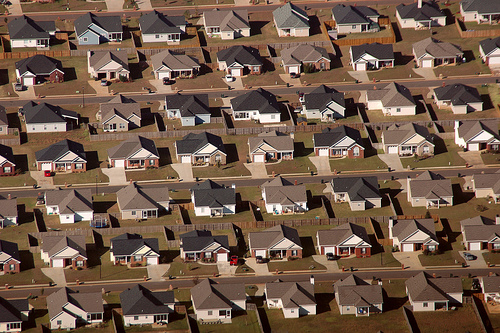
I released my newest Substack this weekend, inspired by my first viewing of John Carpenter's Halloween. Released in the late 70s after the last major waves of suburbanization and before the dawn of gentrification, it questions suburbia's founding myths. The place that supposed to be protected actually spawns true evil. Check it out!
I came of age in the 80s and 90s in a small rural town in the middle of Nebraska. Taking a drive was a small pleasure to ward off boredom, one I did a lot in the backseat as a child, and later as a teenager behind the wheel. My parents now ride bicycles instead, something I should have done for my health, but which was associated with the loserdom of not having a car in those times. While today I go for long walk and bike rides, I still derive pleasure from the drive.
Although I live in suburban New Jersey, I take the train to work, meaning driving tends to be more of an event than a daily grind. (This has especially been the case since March of 2020, as my family has tended to order a lot more things to be delivered that I used to make trips to buy.) Along with the drive, I have also not shaken my youthful love of physical media. When behind the wheel I prefer to pop a CD on or listen to the radio and usually save streaming playlists for long road trips.
Today I ran a bunch of errands and leaned heavily on the weird set of CDs in my car. I say "my" because this is the old beater of a Honda Civic that I use mostly to drive the two miles to the train station and back. (My wife gets to use the newer Subaru for her more significant commute.) Some of my CDs have found an almost permanent place in my car because they are so well suited for a suburban drive. Here are some of the songs in case you are one of those modern people making playlists.
Sonic Youth, "Schizophrenia"
I bought the Sister album on CD soon before my daughters' birth. They were born premature and my wife had to stay in the hospital another day so the day after they were born I had to drive back to our Newark apartment alone. It was one of the most surreal feelings I have ever had. The next day, when I drove out from my urban neighborhood to the suburban hospital to see my wife and newborn children, I popped this song on and played it on repeat. It seemed to express that feeling of disconnection so well. I still have the CD in my car all these years later, and sometimes play it just to remember that moment in my life when everything changed. Beyond that it fits the sometimes alienating strip mall ugliness of my surroundings when I am further west in the sprawl.
Thin Lizzy, "Rosalie"
If Sister has been in my car the longest, Fighting from Thin Lizzy is the newest addition. I still pop into record stores to find the perfect CD to have in my car. As a Gen Xer I feel an almost perverse desire to keep the CD part of my world, a connection to my teen years when I thought it was an unmatched technological step forward. I also sometimes think I have the reincarnated soul of a greasy 70s Camaro-driving dirtbag since that style of music is my favorite guilty pleasure. Then again, I don't feel much guilt about the great Thin Lizzy compared to say Foghat or Ram Jam. This song is a Bob Seger cover of all things, from the days when he was a gut-bucket rock and roll growler busting his ass to expand beyond his power base in the Motor City. Phil Lynott also knew how to rock, and this song makes me pump my fist out the window as I drive past the tidy lawns of my town.
Bob Seger, "If I Were a Carpenter"
Speaking of Bob Seger, I am obsessed with his early work, the sweaty, fervid stuff he won't allow to see the light of day. Lucky for me I have a rare CD of Smokin' OPs, a covers album from the early 70s. If I want maximum rock and roll action I will thrown it on right after the Thin Lizzy. In this case Seger takes a pretty schmaltzy standard from the 60s and gives it a gorgeous rising organ part and a soulful conviction in his voice. I usually hit the repeat button whenever this one comes on.
Steve Gunn, "New Familiar"
Believe it or not, a drive in the New Jersey suburbs can be sublime. Trees overhang my town and many of the surrounding ones, too. I can cut through the South Mountain Reservation and admire the mountains and forests not so far from my doorstep. Today I had Steve Gunn's Unseen In Between album on and just let the sound and the sweet sunshine wash over me. He's sort of like the country cousin to Philly's Kurt Vile, playing hypnotizing guitar lines that mirror that half-conscious state of mind we find ourselves in behind the wheel.
Belle and Sebastian, "I Know Where the Summer Goes"
This time of year Belle and Sebastian's Push Barman to Open Old Wounds is stuck in my CD player. Their twee, languid songs (especially twee and languid on this comp) are the perfect accompaniment of driving under the pretty cypress trees of Summit while I drive to Natale's bakery to get their world class donuts. It's perfect for a lazy suburban drive on a summer weekday, one of the great pleasures of being a teacher. I look forward to doing it several times this year.
Prince, "I Would Die 4 U"
The day Prince died I had to go run an errand so I nabbed my CD of Purple Rain and it ended up staying in the car for over a year. It's a loaded album with so many great songs, but "I Would Die For You" is just a great driving song, especially on a sunny day. There's a propulsion here but it's a restrained propulsion, made for driving suburban streets and not the open road.
Sly and the Family Stone, "Thank You For Talkin' To Me Africa"
Sly and the Family Stone's 1971 There's a Riot Goin' On is one of the ultimate documents of the onset of the 70s malaise after the dashing of the bright hopes of the 60s. This song, a robotic deconstruction of the upbeat hit "Thank You (Falletinme Be Mice Elf Agin)" makes it even funkier, but with all of the hope drained out. Be that as it may, its rhythm and laid back feel work for a slow suburban drive, and the song's weirdness makes a wonderful contrast with the bland normality outside of the window.
Bob Dylan, "Idiot Wind" (New York version)
Sometimes my best reflections come when I am driving, and the right music helps me along. I bought the single CD version of the Dylan Bootleg Series on Blood on the Tracks and immediately put it in my car, where it has stayed. This winter I listened to it almost every day on my short morning drive to the train station. The New York versions of the songs were darker and more introspective than the ones Dylan later cut in Minnesota. Waking before the dawn with the morning's news of COVID and Trump ringing in my head while I faced a train commute in those scary pre-vaccination days practically required stuff this strong.
A classic tale of fear in fortress suburbia from Patton Oswalt's youth
There is this narrative going around that "Trump voters" are all "traditional" rural folk feeling embattled by changing times, lost jobs, etc. While Trump did very well among rural whites, those people are a small part of the electorate. He got over the top (at least by the standards of the electoral college) by winning suburbia. According to the Miami Herald, his performance among suburban whites won him Florida, and by extension, practically the entire election.
With Democrats dominating in the cities and Republicans in the country, suburbia has long been the crucial swing zone, and Trump won it. This was in large part due to his campaign of fear, which tapped into the fundamental underpinnings of suburbia itself.
American suburbia is a fortress zone. It is set up to allow certain people in, and others out. It is what helps maintain the racial and economic segregation of schools and housing in this country, and which thus maintains the most pernicious aspects of institutional racism. In most of white suburbia there is a constant fear of encroachment, that the tidal wave of "inner city" migration will hit their town and destroy it. This is the reason for such beefed-up police in low crime areas.
In my experience this way of life fills its residents (especially the white ones) with a constant, nagging anxiety that they are threatened. Hence as well the proliferation of so-called "gated communities" in affluent areas. It is very, very easy for someone like Trump to mobilize fear to court voters who are already live in an environment of constant fear of infiltration. These are the people who took the "knock out game" urban legend seriously. These are the people who bought duct tape and plastic sheeting after the government told them to in the wake of 9/11. These are the people who shoot trick or treaters. These are the people who fight to keep mosques from being built in their communities. These are the people who think the very existence of transgendered people is somehow a threat to their kids. These are the people who make excuses for George Zimmerman, who murdered Trayvon Martin in a typical suburban fortress subdivision.
They needed someone to tell them they were protected and that their fears of other people were not hateful, but justified. The wall Trump talks of so fondly has real symbolic weight with them. They want walls around their communities, and want them heavily guarded. And they want the people they don't like who cross those walls to be shot. There have been far too many tragic cases to prove that point in the last few years.
So please, national news media, when discussing "Trump voters" get out of Akron and rural Mississippi for a change, and go to Suffolk County on Long Island or Morris County in New Jersey, two populous suburban counties in heavily blue states that went for Trump when the state as a whole did not. Those voters are key to understanding why Trump won.
People like to knock the suburbs, myself including. However, now that I am living in suburbia I try to make the best of it. One of the advantages to living here is being able to take a leisurely drive on a Saturday morning though leafy neighborhoods while I feel the summer breeze toss my hair about. I was doing that yesterday while running some errands while listening to Belle and Sebastian's Push Barman To To Open Old Wounds rarities compilation. It was a quietly sublime experience, especially when "I Know Where The Summer Goes" came on.
It's a low-key, quiet song with little organ swells and some yearning strings. Stuart Murdoch sings it in his high, almost strained style, giving it a frail, human touch. Despite coming from dark and rainy Scotland, I find Belle and Sebastian to be some of my favorite summertime music. Its languid quality reminds me of a gentle wind blowing through the curtains on a sunny June day. It also fits those aimless drives I love best, when I'm more interested in enjoying the scenes as they pass by than actually getting somewhere.
One of history's greatest values as a practice is that it explains how the world we live in came to be. I have been reading up recently on suburbanization and its attendant politics, and that history has a lot to tell us. Most people tend to look at the ways our metropolitan areas are structured and laid out and assume that the the suburban sprawl and urban cores just happened to form that way naturally. Of course, our built environment is in actuality the intentional result of reams of legislation and trillions of dollars.
Decisions made in the recent past are currently having a massively deleterious effect on the present, when it comes to our cities and suburbs. The automobile was elevated to an exalted throne where neighborhoods and treasure would be sacrificed to it, rail transport left for dead, economic and racial segregation ruthlessly enabled, and sprawl encouraged from sea to shining sea.
The bill is coming due. The millions of car exhaust pipes spewing carbon monoxide now threaten the very existence of life on the planet. The roads and bridges built to handle the cars are crumbling while the political will to raise the taxes necessary to fix them has disappeared. Neglected mass transit systems can't pick up the slack, and have their own infrastructure nightmares. In cities like New York gentrification is pushing residents into the Sprawl and making urban housing increasingly less affordable. (Which is one reason why I live in north New Jersey, and why practically all the new people I meet in my town moved here from Brooklyn.)
The giant swaths of sprawl surrounding our cities are becoming a dead weight that cannot be shed. To maintain the current system would be insanely expensive and destructive, of course, but hardly anyone in positions of power is willing to completely upend the current system that rewards sprawl and punishes concentration. That would mean dethroning the car and promoting mass transit at moon shot levels of commitment, something that will never happen. Instead we'll just keep on muddling through in yet another chapter in a future volume about the downfall of an empire that in a moment of supreme hubris willfully destroyed its own cities.
Every now and then my wife and I drive into Newark via Springfield Avenue, and I look around at a city that was abandoned by the state and by white New Jerseyans only fifty years after it had been so dramatically built up. What has happened to Newarkers since the 1950s is a brutal injustice, but it has been a tremendously wasteful one at that. A perfectly fine city was gutted by "urban renewal" and its people left to the wolves while the highways that ripped neighborhoods to shreds were used by white suburbanites to speed on through from the suburbs to Manhattan without having to so much as stop at an intersection in Newark. That failed, wasteful, and unjust social experiment has yet to be repudiated, and sixty years later remains an albatross around this nation's neck.
Since my teen years I've noticed that behind all of the partisan warfare at the top of the political spectrum, there is a certain kind of untapped consensus. I don't know how many people I've met who describe themselves as "socially liberal but fiscally conservative." I usually hear this from people who are rather disengaged from politics, mostly because their opinion is so embedded in the way things are done that there's no reason for them to get involved. On the one hand, gay marriage is becoming the law of the land, on the other, state governments have been slashing social spending, with Wisconsin, Louisiana, and Kansas being recent notable examples. Sure there are anti-abortion fanatics and social democrats still out there, but both groups are highly marginal these days.
I am currently reading Matthew Lassiter's The Silent Majority, a history of suburban politics in the postwar South, and I am beginning to see the historical antecedents of the modern day "socially liberal but politically conservative" cliche. He focuses in on affluent white suburbanites in cities like Atlanta and Charlotte who opposed the white supremacist "massive resistance" policy intending to halt school desegregation by closing down all of the public schools. These suburbanites instead proposed to save the public schools by allowing for only token integration while maintaining residential segregation. They found the out and out bigoted racism of Lester Maddox and his ilk to be distasteful, but were themselves not inclined to challenge the structures of institutional racism. In fact, by maintaining local school districts in highly segregated living areas, they were actively maintaining institutional racism, all while proclaiming its "colorblind" nature.
When I hear the socially liberal/fiscally conservative crowd today, I can't help but to see the similarities. They are okay with legalized marijuana, abortion rights, and gay rights, mostly because that does not cost them a thing. At the same time, they are not at all interested in income inequality, institutional racism, lack of health care access, and any other social injustice that would require wealth redistribution to rectify. The ghettoes do not concern them, nor does the fact that students who live in poorer areas have a much lower quality of education than their own children bother them. In fact, they secretly like it that way. Deep down they just want to maintain their middle class existence with as little bother and as low of taxes as possible, all while keeping others below them at bay. (I've never heard anyone who is socially liberal/politically conservative ever complain about the costs of policing or imprisonment.) They can then turn around and pat themselves on the back for not hating gays and being cool with weed.
This new silent consensus is of monumental importance, and people have been getting away with this purposefully obfuscating belief for quite some time. They need to be called on it. When someone tells you, with the usual glint of pride "I'm socially liberal but fiscally conservative," ask them what they really mean by that.
It seems like I'm not the only person out there thinking about the power of fear and its connect to suburban living spaces this week. Today Sarah Kendzior and Umar Lee published a brilliant article on the dynamics of fear in Ferguson and the greater St. Louis area. They interview many local residents, who are more than happy to cop to their racialized fears and their support of Darren Wilson. This piece is essential reading.
America's suburbanization is a disastrously failed experiment of massive proportions. The sprawl contributes to our environmental problems, social atomization, and racial segregation and inequality. And yet it won't of away, and I now find myself complicit in it as a suburb dweller, mostly because the city I work in (NYC) has become prohibitively expensive. It is time for progressive-minded suburbanites to push for change in this environment, to challenge segregation and the attitude that feeds it, namely that suburbanites refuse to believe that they share a common fate with urbanites. If that mental wall can be torn down, maybe some real progress can be made.
I've been writing a lot about fear these last weeks because the panic over Ebola has demonstrated fear's massive and destructive power in this country. Fear is what got the PATRIOT Act passed after 9/11. Fear makes the people of this country accept unprecedented intrusions into their privacy. Fear has long been one of the most potent factors in the continuation of white supremacy.
Fear's roots run deep and are evident in the most mundane structures of our daily lives. Nowhere is this more visible than in the vast, endless sprawl of American suburbia, America's fear factory. Of course, suburban America is hardly monochromatic today, and many suburbs (like the one where I reside) can be racially diverse and relatively open-minded. However, this is not the case with broad swaths of the sprawl, either here in New Jersey or elsewhere. For example, I've heard tell of multiple denizens of sprawlville saying that they were putting off trips to New York City because they were afraid of ISIS attacks. In the very safe and quiet suburb where she works there are people who live in fortress-like gated communities with the belief that the leafy suburban streets are too mean for their tastes. Back when I lived in Newark and encountered people who lived in sprawlville their faces would scrunch in barely disguised disgust when I told them I lived in Newark. When I told them I liked it there, they looked like they thought I was deranged.
Those anecdotes are hardly surprising, since suburbia was founded in fear. Fear of the "other," fear of "them," fear of urban ways of living. In some cases, like on Eight Mile Road in Detroit, suburbia meant the building of literal walls to keep out the people of color whom whites had taken flight from. On streets that border Newark in my current town of Maplewood, residents blocked them off, ostensibly to prevent speeding cars taking them as a shortcut, but I wonder. There's a suburban town where some of my wife's relatives live that's overwhelmingly white, but most of the times I see the cops pulling someone over, the drivers of the cars are African American.
American suburbanites are experts in finding new things to be afraid of. In the 1980s and 1990s, it was the idea that going to the city meant risking having your ankle tendons slashed by gang members hiding beneath your car. (This one was widespread in Nebraska when I was young, supposedly it was a common gang initiation.) Nowadays I hear residents of sprawlville speak fearfully of the much hyped "knockout game." In the 1970s and 1980s it was the bogus fear of strangers tampering with Halloween candy. In suburbia no one can be trusted, everything outside of everyone's little castle is a potential threat to fear. The fear is pervasive and never-ending, built into the very DNA of the place.
A majority of Americans live in suburbs. While not all of those people live in suburbs according to the stereotype of them as white, middle-class autotopias a la Nassau County, a very large contingent do. Is it any surprise that we are a country ruled by fear when such a large number of its citizens live in communities whose very raison d'etre is fear itself?
Although a majority of Americans live in suburban areas, apart from three months of my life spent crashing on the suburban couch of two of my college friends, I have lived either in urban neighborhoods, college towns, or rural outposts. For that reason, they've always seemed a little exotic and strange to me, but despite that fascination with suburbia I have no desire to live there. I like having either access to the culture, walkability, and excitement that urban concentrations bring or the quiet and nearness to nature of small towns. I do like to visit, mostly since my wife's folks live in the suburbs, and when we spend a Sunday afternoon there we get to enjoy easy access to convenient shopping and tree-lined curvy streets made for bicycle riding. I say this at the start just to let y'all know that I do not possess any knee-jerk snobbishness about suburbia, it's just not the type of place where I'd prefer to hang my hat each night. I think we as a society make our mole-hills of personal preference into mountains of perceived elemental differences and should just let everyone like what they like.
Now that I'm spending more time in the suburbs, songs about suburbia keep popping in my head. These tunes tend to be pretty critical of suburban life, mostly as a protest against the shallow consumerism of the postwar American Dream. With the current housing crisis and growing environmental consciousness, the suburbs have lost much of the allure that the songs I am about to discuss were protesting against. Perhaps this sub-sub-genre is about to come to an end. Anyway, here are some of the more interesting songs about suburbia as I see it.
***
The Monkees, "Pleasant Valley Sunday"
This is the first song about the suburbs I ever really got into, although it's meaning was a little unclear what it was all about. Back in 1986-87 I religiously watched reruns of the Monkees' TV show and via my cousin listened to all of their classic albums. This song confused me a little since I was used to pop songs about love and romance rather than wry bits of social commentary. As I got I got older, I started hearing lines like "rows of houses that are all the same/ and no one seems to care" in a different light. Of course, by that time I had gotten pretty tired of my monocultural home town, and even though it was rural rather than suburban, when Mickey Dolenz croons "I need a change of scenery" I could hear him loud and clear.
Rush, "Subdivisions"
I used to hate Rush in large part due to Neil Peart's rather daft lyrics, but now I love his drumming and the band's musicianship so much that I just tune out the words. This is one case where his emotive, teen-angst riven "nobody understands me" standpoint actually works. Instead of building up some kind of Ayn Randian superman battling anti-individualism as the center of his song, the criticism of conformity hits a less ephemeral and more tangible target: modern suburban life. In fact, the line about the subdivisions' "geometric order" creating an "insulated border" against the city is actually quite artful. The main irony here, of course, is that the suburbs that Peart and co. depict as a soul-sucking wasteland also produce about 90% of their fan base. (The video pretty much lets the cat out of the bag on this point.)
The Kinks, "Shangri-La"
Ray Davies of the Kinks is probably rock music's greatest poet of daily life, and someone who has written songs about the perils of moving to the city ("The Big Black Smoke") and idealizing traditional life in English villages ("Village Green.") He also penned one of the greatest songs about postwar suburban life, since it gets at the illusory nature of its promises. At the start Davies terms the suburban home a "paradise" and "kingdom to command" so much more comfortable than the "lavatories in back yard" of the old working-class neighborhood, but soon all is not well, since there's nothing else to aspire to. In the key words in the song's opener, "You've reached your top and you just can't get any higher/ you're in your place and you know where you are." It's a place with creature comforts like a TV set, car, and radio, that increasingly begins to feel like a trap where "you're too scared to admit how insecure you are" and everyone gossips about you. If this is all there is to look forward to, life is pretty damn bleak, a point that Davies makes just as effectively as literary critics of suburbia like John Updike, Richard Yates, and John Cheever.
Weezer, "In the Garage"
Of course, not all songs about suburban life are necessarily so heavy-handed and didactic. Sometimes they just give the listener a nice little slice of daily life, and "In the Garage" is a great example. The narrator of the song, who appears to be a disaffected nerdy kid with few friends, talks about the garage as his suburban refuge where he can look at his KISS posters and read his Dungeon Master's Guide without being mocked. I bought this album right when it came out in the summer of 1994, right before I left home for college, and when my first roommate loved it too (and understood what it meant) I knew we'd get along really well. Much of my adult life has been spent making friends who, like me, spent their adolescence sheltered in their geeky cocoons.
Arcade Fire, "Sprawl II"
It seems to have become a sport in the indie-rock world these days to attack Arcade Fire, the reason being something I call "Malkmusitis" in honor of Stephen Malkmus, former lead singer of indie greats Pavement. There is no greater sin in indie music than unironic earnestness and emotion. If your songs are anthemic without being satirical (like the Arcade Fire's), they are deemed cheesy or uncool. I for one love their last album, appropriately titled The Suburbs. (On it they get a little revenge on their too-cool-for school hipster detractors with "Rococo.") My absolute favorite song on the record is "Sprawl II," a sweeping number that combines New Wave and disco with an emotional evocation of suburban sprawl as an endless, suffocating Moloch-like beast eating its children alive. As a child of rural Nebraska, I do have to say that when I first went to sprawled-out cities like Denver as a kid, the sight of sprawling "shopping malls like mountains beyond mountains" made me queasy in its endlessly repetitive artificiality.
Parliament, "Chocolate City"
I know this song is about cities and not suburbs, but it's a pretty sly and powerful riposte to the white flight to the suburbs. Clinton refers to cities with a black majority (like my own city of Newark) in the beginning, before building up to the revelation that the nation's capital is "Chocolate City." He imagines a black president and cabinet in what was once the White House, and the chorus proclaims "we're gaining on you!" It's a very different American Dream than the one being propagated in the "vanilla suburbs." Although it's not one of George Clinton's better songs from a groove perspective, the musicianship is great as always, and the political message ought to let folks know that George Clinton wasn't just about laying down party jams.