Showing posts with label books. Show all posts

Tuesday, December 31, 2024

Reflections on 2024 and Thoughts on Making It Through 2025

Last year at this time on my Substack I declared 2023 to be "the year reality died." This year proved my pessimism, as Donald Trump was elected president due to millions perceiving an economic downturn that wasn't there, rising immigration as it was falling, and spikes in crime as it was decreasing. Narratives and memes are the coin of the realm now. With the rise of generative AI we are facing a future where all discourse is going to be reduced to computer-generated slop being slung about ad infinitum. Elon Musk buying the presidency is a sign that the tech overlords are running the show now, both economically and politically. Even more than when Thatcher said it, There Is No Alternative. 

In the midst of this collective insanity I have been trying to stick to the core, as Lao Tzu says. I resolved last year to keep a log of the books I read and films I watched, and actually kept it up. These logs have allowed me to retain more insights, and be a little more intentional in my habits. I read fifty-six books of varying lengths and quality. I decided not to count the films, but I engaged in little projects, like sequentially viewing all of the films of Wes Anderson and David Lynch. This gave me far greater insights into both of them. 

In terms of my book reading, here's a mini-awards show:

Best Old Novel I Read For The First Time in 2024

John Williams: Stoner

Best New Novel in 2024 that I Read in 2024

Taffy Brodesser-Akner, The Long Island Compromise

Most Engaging Re-Read of a Book I Had Read Before That I Re-read in 2024

Chinua Achebe, Things Fall Apart

Best New History Books I Read in 2024

Beverly Gage, G-Man and John Ganz, When the Clock Broke

Best Old History Book I First Read in 2024

Walter Johnson, Soul By Soul

Best Genre Fiction I Read For the First Time in 2024

Joe Hill, Heart-Shaped Box

Best Genre Fiction I Re-Read in 2024

Patrick O'Brian, Master and Commander

Book I Read For the First Time in 2024 that Made the Biggest Impact

Viktor Frankl, Man's Search for Meaning

****

As a child I first really started digging into history by reading the medieval Europe book in a world history for kids series. This book gave me an interest in the fall of the Roman Empire and the early medieval period that I carry to this day. I was fascinated by the monks who managed to keep learning going amidst the complete collapse of society. Being a nerdy, pious child misfit, these monks were the kinds of heroes I aspired to be. I've been thinking a lot about that recently, since it feels like we are enduring a massive barbarian invasion of our collective culture. In 2025 I have resolved to keep reading, to take the time to read complex and difficult texts, and to spend more of my time in the world of books than in the online world on a daily basis. 

For that reason I almost feel stupid to be writing this all down online. After all, I intentionally wrote my own film log for myself instead of putting it all on Letterboxd and kept my book log private instead of joining Goodreads. I guess I am doing so to encourage all of us to lean into our own inner lives in the coming year, rather than trapping our psyches in the constant game of comparison and clout-chasing demanded by social media. The internet has its good uses, ones that were more apparent to me in the time of the blogosphere when I first started doing all of this. Back then it felt like I was getting to share ideas and form community when I logged on, instead of being consumed by rage and resentment. If we could somehow return to that version of the internet I feel our lives would be much better.

Since the election I have been asking myself if I am giving in to the temptations of quietism, effectively giving up on engaging with the world rather than fighting for a better one. I am realizing that I can actually undergo a kind of "inner migration" that will make my capacity to resist what's coming stronger. In the coming year I have resolved to keep my mind sharp, to think rather than react, and to trust my mental instincts honed through decades of contemplation over whatever narratives are being spewed by the online hive mind. We are headed into the fire, it is time to steel ourselves if we want to survive. 

Tuesday, August 20, 2024

Tom Wolfe's The Right Stuff as "Reagan Dawn" Artifact


First off, I want to acknowledge that I have not been writing in this space. I have been focusing my efforts on my Substack (where I tend to do more political stuff) and on a couple of research projects. Come autumn I am planning on doing one of my patented "listen throughs" on Richard Thompson. In the meantime, I am re-reading a book that has me thinking again about what I call the "Reagan Dawn."

This is my name for the pop cultural moment lasting roughly from 1979 to 1981 that coincided with Ronald Reagan's election. The culture in this moment both reflected and drove the conservative political turn. I first wrote about it back in 2015 (!) and if I had the time, tools, and talent I'd write a book about it. Some of these pop cultural artifacts are pretty obvious, like Disco Demolition Night. Others are not.

That hit me while re-reading Tom Wolfe's The Right Stuff. I'd read an interesting piece on him for The New Republic by Osita Nwanevu that made me want to revisit this book, and one of my daughters had also recently gotten obsessed with NASA. I first read it in 1999, before I had really started digging into the history and culture of the 70s in a serious way, and so did not contexualize the book as a product of the Reagan Dawn back then.

From the outset, Wolfe has embarked on a project of reclamation. In heaping praise upon military test pilots and the Mercury astronauts picked from them, he is intentionally elevating the kinds of men and qualities poo-pooed by the counterculture. In a foreword he wrote in 1983 he explicitly states that his point was to elevate military officers, who he felt had been denigrated in books about war going back to key Great War works like All Quiet on the Western Front. The men he profiles -military, white, traditionally masculine, Protestant, family patriarchs, lovers of hot rods, disdainful of NASA scientists- are exactly the kind disdained by the counterculture. In the context of post-Vietnam War America this reclamation project is freighted with deeper meanings and symbols.

Wolfe makes clear that the men he profiles love their country above all else, which is the reason why they are willing to face death and make widows and orphans of their families. These men themselves stand for a "real America," one that Reagan promised to revive. Writing in the late 70s after the big cultural and political breaks of the 1960s, Wolfe offers a tantalizing nostalgia for the Mercury program, with its origins in the Eisenhower years and the first orbits before that fateful day in Dallas in 1963. Wolfe's book came out in the era of the Iran Hostage Crisis and a general yearning for national renewal, exactly the thing Reagan promised. Nor for nothing, Reagan's campaign slogan in 1980 was "Let's Make America Great Again." Then under Reagan and now under Trump the "great" era is located before 1965. 

The thing with Wolfe is that he is such an engaging prose writer (in non-fiction, at least), that I am happy to go for the ride even if I can tell where he is slipping in his own ideological commitments. The test pilots and astronauts are indeed impressive people and their accomplishments are worthy of praise. What's funny reading the book today is just how much his side won. You can't go to a baseball game without there being a moment or two of military worship, for example. I have also been struck by how much conservatism has degenerated in the past four decades. As much as I disagree with many of Wolfe's assumptions, he's a good writer and a person that I am inclined to take seriously. I was trying to find the equivalent today of a conservative kind of writing meant not to be polemical but entertaining and all I could come up with was The Babylon Bee. That pretty much says it all. 

This got me thinking even more whether Reagan's long shadow has finally passed. While supply side tax cuts are a zombie idea that won't die, Trump's economic policies are hardly the kind of thing that would have pleased The Gipper. Democrats are also now far less likely to be cowed by charges of "socialism." I used to think of Reagan Dawn as the moment that our current political economy came into being. Now I am not so sure.

Monday, January 17, 2022

Read More Novels

I was lucky to get a whole bunch of great books from my wife for Christmas this year, including the novel The Lincoln Highway by Amor Towles. Now I might be partial to it considering that a lot of the early parts take place in the corner of Nebraska where I grew up, and a lot of the rest of it takes place in the city where I work (New York), and in between there's life on the road, which is one of my favorite places to be. Even taking away those ingrained advantages, the book completely entranced me. I loved the multiple perspectives, the characters, and how it held me in suspense. Reading the book on the way to and from work on the train became a highlight of my day. Now that I am done with it, I feel an actual loss in my life, a hole in need of filling.

During the week and a half when I was reading the book I tried and failed to watch American prestige television. A really good novel truly CONSUMES me like nothing else, it dominates my thoughts in the day's idle moments. By comparison prestige TV felt far less vital, far less interesting, and far more formulaic. I tended to know which way things were going on the TV when The Lincoln Highway surprised me in every chapter. The characters felt two-dimensional, and I could never truly put myself in their heads. The beats and formulas of prestige television in the US are pretty well established. The thing is, if I want formula I would much rather read a spy novel or watch an old episode of The Rockford Files

Neither of those things pretend to be something that they aren't. They also do far less to waste my time. After an hour of The Rockford Files everything has been nicely resolved. The prestige TV format typically includes episodes that fill time and do little to drive the plot forward or even develop the characters. I have so little time in my day, and hearing someone say "you have to watch the first few episodes before it gets good" is the surest way to never get me to watch something. 

I should also add that this is a problem with American TV in particular. While I was reading the novel my wife and I watched the Swedish show Anxious People on Netflix, and I really enjoyed it. It was only six episodes and the first one left such a strong impact I definitely wanted more. It's also a show about LIFE, a topic one tends to find much more in literature than in American prestige television, which relies on some kind of high concept, even for the good shows. A mob boss who goes to therapy. A serial killer hunting serial killers. A chemistry teacher turned drug kingpin. And so on and so on and so on. Yawn.

Not that I won't pick up a new show to watch. We just started Station Eleven, for example, and I like it a lot. It has even forced me to reckon with the losses of the pandemic in ways I tend to place out of my mind. At the same time, the story is taking forever to unfold and a lot of the beats feel overly familiar. 

There's another thing too: The Discourse. The Discourse has warped viewership of prestige TV to the point that I can't watch anything without feeling like it's been talked to death already. My expectations are too fully formed by the time I put on the first episode. Novel reading is not something beloved by the people participating in The Discourse, thank God. I can read a novel without thinking that reaction to it is taking some kind of side. Even better, it's something I don't talk about online with strangers, it's something I share with my friends. And let me tell you, they are far more fruitful conversations to be had with the latter group.  

So while I am enjoying Station Eleven, what I really want is a new novel, one as good as the last few that I've read. Something to consume me. Goodness knows I need it right now. 

Sunday, May 23, 2021

Notes On Larry McMurtry's Moving On

The cover of my edition, found in a second hand store

There are few things I enjoy more than tackling a long, far-ranging novel with all kinds of characters, meandering subplots, and a scope that suggests an overview of society itself. Usually one has to go back to the 19th century for books like this. I still remember when I finished Bleak House, I suddenly felt empty and bereft, deprived now of a whole world.

Some 20th century novelists were capable of this feat, and one of them was Larry McMurtry. Because he was from Texas and wrote about Texas and set some of his books in the 19th century West he was a "regional" and "genre" writer. I will consider myself guilty of that perception, despite having read the fantastic The Last Picture Show years ago. A few years back a beloved student and prodigious reader gave me a copy of Lonesome Dove, which I kept on the shelf until the pandemic made me long for the open western skies and a book long enough to keep me occupied. 

Well pard, that book absolutely blew me away. It had the broad scope and array of characters of my beloved doorstop 19th century novels, yet also managed to deconstruct myths of the west without becoming didactic and dour. I immediately went out and bought and absorbed the sequel, The Streets of Laredo.

I was bummed when I heard about his recent death and happened to be in a local second hand store and saw a pristine copy of Moving On. This seemed to be some kind of sign from above. I had first noticed the book over ten years ago when I lived in Texas, where I saw it on the shelf of the local bookstore. It was a massive book and seemed to be about the reality of modern Sun Belt Texas as opposed to the cowboy past. It intrigued me, and I picked it up to read the back jacket on more than one occasion, but had never pulled the trigger. After all, it was a massive brick and at that time I was in a lull when it came to reading fiction. (One of the consequences of academia.)

The edition I bought came from the late 1980s, although it was first published in 1971. The author's introduction surprised me a bit. He basically admitted that he meandered in his writing of the book and that many readers were critical of how he depicted the emotional world of the protagonist, Patsy Carpenter. (She cries. A lot. More about that later.) He also talked about how going to grad school was a thing that smart but aimless young people did back in those days and, let me tell you, I knew at that point there would be at least one thing about this book that would really connect with me.

I had no clue, since the cover always emphasized the other closed world investigated by the book: the rodeo. I am sure the publisher felt this necessary, in order to draw in the fans of his other work. After all, who wants to read about grad students? 

The book revolves around Patsy Carpenter and her husband Jim. They are both in their mid-20s, both from well to do Texas families, and both unsure of their path in life. I had always thought that the "quarter life crisis" was a recent invention, and this book proved me wrong. When it begins Jim has decided to become a photographer, and takes Patsy with him as he follows the rodeo in order to construct a photo essay. Patsy is not enamored of the lifestyle, especially after being exposed to some rough characters and Jim himself gets beaten up by two angry cowboys who didn't want their picture taken. 

Jim decides instead to go to grad school in English at Rice. Jim and Patsy become increasingly estranged, have a baby, engage in affairs, and eventually split. At the end of the book Patsy has to help rescue her pregnant sister from the counterculture dream gone wrong in San Francisco. She is able to construct a life for herself, raising her son, helping her sister, and perhaps feeling optimistic about the future at last. 

It certainly seems slight for a plot to carry 800 pages. It is, since it's a book meant to convey the struggles of daily life and how they operate in sub-cultures like the rodeo and grad school. That's why I didn't mind. It's ultimately a story about life, and the hard choices it presents. The mid-20s is indeed a fraught stage in life, one that in my own case came with its fair share of romantic adventures and emotional pitfalls. 

The book also captures the changes of the late 1960s, but from outside of the center of the counterculture. Houston, obviously, is not Haight-Ashbury or Greenwich Village. McMurtry may be known for writing about cowboys, but he is secretly a chronicler of sex. (When I first read The Last Picture Show I was a bit taken aback by its frankness.) There's plenty of bed hopping among the characters and a sense that the sexual freedoms opened up at the time weren't just being enjoyed by hippies. There is also a surprising amount of writing detailing bad sex, the most difficult thing in the book to read. McMurtry takes great pains to show how Jim and Patsy's incompatibility is reflected and confirmed by their bedroom difficulties, which he returns to time and again, picking at the wound. 

Ultimately the novel throws cold water both on the traditional "establishment" way of life via the empty lives of Jim and Patsy's parents, as well as the decadence of the counterculture. This is most stark at the end, where Patsy must go to San Francisco without Jim to track down her 19 year old sister estranged sister. The one real false note in the book comes from the fact that her sister is living with a controlling, mean-spirited African American man and the plot unfortunately echoes old captivity narratives. There is a whole panoply of intriguing characters, but the Black and Chicano characters are not really fully fleshed out in this book, sadly. 

I found Patsy herself to be a very compelling character. As McMurtry notes, she does cry a lot. However, I did not read this as a statement on the emotional fragility of women, and more as a tic specific to her character's personality. (The other women don't cry like she does.) Through most of the book Patsy is deeply unhappy. She is obviously just as intelligent (or more so) than her feckless husband, but must constantly follow him and support his dreams, which he never bothers to actually follow through on. I interpret her tears as the explosion of her deep frustrations about her life and how it has trapped her. In many respects this book is a subtle argument for women's liberation.

Patsy is also a real person. She is not lovable, and she herself even acknowledges this, to the point of calling herself a "bitch." When I have looked at online reviews of the book by readers (as opposed to critics) they often note how they did not love the book because they just didn't like Patsy. I guess I didn't mind because I have known a few Patsy types in my life. Their privileged upbringings and tightly wound emotions make them prone to outbursts and judgement. At the same time, they realize this about themselves and are desperate to be better able to connect with people instead of drive them away. The novel is about ultimately Patsy growing up and finding a way to become happy despite the flaws in her personality. 

In telling this story McMurtry also weaves a social portrait of Houston at the time of its Sun Belt ascendancy, along with beautiful writing on following the open road and the disorienting but seductive nature of Los Angeles. (I skipped over some subplots in my description.) He was a master of rendering small moments, like the feeling of the wind when a norther sweeps into Houston.

I think I enjoyed this book even more for its flaws because so many of these moments were spread throughout it. It is such a sprawling narrative to properly render in cohesive fashion, and it doesn't really manage to do so. But hey, life is messy. If you like to spend time reflecting on this fact, go and pick up Moving On.

Sunday, March 22, 2020

Virus Journal 3-22-2020

Since my last entry my routine has been well established. During the week I mixed the required assignments from my daughters' teachers with activities of my own. This wasn't just so I could play teacher, my wife is doing necessary work as a tech specialist at her school and the kids need to stay out of her hair. By Friday my lessons got less regimented, and we could relax some more. That afternoon we took a long walk to drop a birthday gift off at a friend's house and had long conversations about what my daughters observed on the way. This allowed for tangents discussing the different levels of government (prompted by them noticing that electrical wires are above the ground here but not in New York City.) When we got home we put together a little robot model with a solar-powered electric motor.

Thursday I ventured out to get some groceries. The main supermarket had everything I needed, except for chicken. The only thing on the shelf was hearts and gizzards! I then went to the local Polish butcher, where I bought their last chicken thighs, which my wife made into an amazing chicken adobo yesterday. I also stopped at the liquor store to get a supplement to my current supplies. My strategy has been to go cheap on beer (which I buy in bulk) and pricey on whiskey. I got some Elijah Craig single barrel (a great value for the quality) and a four pack of a local microbrew just to give my beer supply some variety. The line was the biggest I've ever seen at the liquor store. A rumor raged that the stores would be shut down, but the order yesterday shutting down non-essential businesses did not cover liquor stores. There goes my new career in bootlegging.

I have mostly been making myself as busy as possible. In fact, I am not able to do all the things I want to do each day, which I take as a good sign. In normal times as well boredom is a luxury that I don't have. Yesterday I finished cleaning our screened-in porch, scrubbing away with a sponge and pail of water and Murphy's Oil Soap. I got special motivation from an anxiety attack, the first I've had since the virus hit, and work was my only way out.

This attack came after checking the news and realizing that the only way for the economy to start up again is for there to be massive testing, which is not forthcoming. I began to fear that the president, in all his infantile mania. thought that some "miracle drug" would save us all from the need to take public health measures. I was also freaking out over the lack of support for states suffering the worst, thinking that he didn't care if people in places that didn't vote for him lived or died. I also started freaking out about how the national media has not broken their tendency to bend over backwards to treat Trump as a "normal" president. That combined with his daily propaganda briefings I think has legitimated his authoritarian behavior. Even as Trump shits his pants in public each day and tells lies I can see that this actually makes him MORE powerful.

So I went out back and started scrubbing, then took a three mile walk.

On a happier note, I developed a Dungeons and Dragons adventure to play with my family this week. I am really looking forward to it.

Books

I am still reading Middlemarch, about 200 pages in. I realized that I needed to keep that book at a slow pace due to the richness of the writing. Eliot is one of those authors who packs a lot of meaning on the page. I really love how she is giving such a thick description of a provincial Midlands town circa 1830. When I wrote my dissertatation I was obsessed with how the 19th century novel was grounded in historical thinking, and this one is now exception. Eliot is writing about the world 40 years in the past to get a sense of what in her time represents change. If I had the time and talent I'd love to write something like this about my rural Nebraska stomping grounds and how that out of the way place has gone through its own transformations in recent history.

While I have been moving through Eliot slow, I read another, breezier book more quickly: William B. Irvine's A Guide To The Good Life: the ancient art of stoic joy. It was a Christmas gift from an old dear friend (and reader of the blog) who sensed my growing despair towards the end of last year. I figured the middle of a pandemic was the perfrect time to read a book about Stoic philosophy. I was a philosophy co-major in college, but haven't read any philosophy in quite a long time. The book reminded me of a kind of deep thinking I have missed. The main point of the book is about incorporating Stoic practice in everyday life, rather than the logic chopping of contemporary academic philosophy.

I took a lot of this book to heart. It is important for us to contemplate our eventual death, and the impermanence is everything in our lives. It is important to evaluate our attachments, and to not keep our negative emotions from overwhelming us. I have recently had to deal with some passive aggressiveness from people in my life and the book made me think about how I can deal with that while not bringing me down. Of course, the book has many of the flaws of philosophy as a discipline, namely the excision of social context from its thought process. Saying, for example, that disadvantaged people should merely banish the negative emotions caused by discrimination and oppression is some real bullshit.  But I do not want to be too negative, this book has helped center me this week and remind me that my wife and kids are what matter to me most and that I am lucky to get all this time with them.

Thursday, March 7, 2019

Requiem For A Small Town Book Store


This week I got the sad news that Prairie Books, a mainstay of my hometown of Hastings, Nebraska, would be closing. I had known this day was coming ever since one of the owners died back in 2015. His wife kept it going for four more years, but whenever I visited home I noticed that the store's hours had been cut back, never a good sign.

The store has been around in Hastings for over 40 years, there isn't a time that I can remember it not existing. It moved from downtown to the mall in the early 80s, in a sign of the economic times. It moved back downtown in the late 90s as Walmart and other box stores were killing the mall and the downtown was getting an injection of investment. The downtown now has some cafes, restaurants, and even a microbrewery, but retail is practically dead. Allen's, the local department store, closed everything but its grocery store this year, and Herberger's, the last general clothing store, also shut its doors. Walmart now competes with dollar stores, which have sprung up around town like poisonous mushrooms.

My hometown, like so many other small towns in the Great Plains, gets more and more hollowed out with each passing year. It's not just that businesses are closing, it's that these are businesses with real meaning to the community. Prairie Books has a "Nebraska Room" in the back full of books about the state, including a wealth of books on Native American history. Every time I have visited in recent years I have gone to the store to get a book, usually from that room. Places that have meaning for the local community are disappearing, replaced by outposts of corporate behemoths Hoovering up the money from Hastings and depositing it in the pockets of far-away stockholders.

Part of the reason I care about this is that I am cursed as an exile to be more invested in my homeland's uniqueness than the people who live there. But beyond that, I am legitimately sad at the loss of a place that meant so much to me. In my pre-internet childhood having a good bookstore in my small, isolated town was absolutely crucial. It was there when I was in the fourth grade and obsessed with Choose Your Own Adventure books. When I became a fantasy RPG nut it's where I bought copies of Dragon magazine, as well as way too many Dragonlance novels. (Once I developed some taste I bought my Tolkien books there, too.) Later it's where I fed my Stephen King obsession in middle school, as well as my growing interests in history and science fiction. In high school it's where I started exploring heavier literature, from Conrad to Dostoevsky. I still remember the day I came in as a 17 year old and asked the store to order me a copy of Kerouac's On The Road. The owner of the store gave me a little smile at my request. While my teenaged love of that book embarrasses me a little today, that smile was probably my first clue that I would think of that book differently in adulthood.

When I was growing up the Omaha World-Herald, Nebraska's biggest newspaper, compiled a list of best-sellers each week in the state to run alongside the Times' bestseller list. The only bookstore in the rural part of the state they used to compile the list was Prairie Books. It made me feel like my town mattered, that we were more cultured than those other cow towns out on the plains. A lot things over the past three decades have shown my town to be just another rural burg getting hollowed out by global capitalism. Of all those things none stings harder than losing Prairie Books.


Tuesday, February 13, 2018

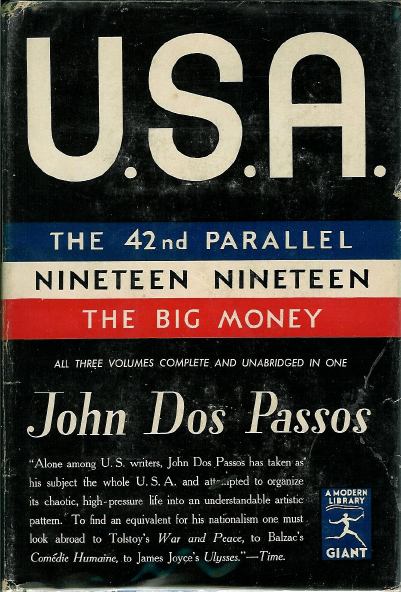
Thoughts Provoked By Reading John Dos Passos' USA Trilogy


World War I was the event that first got me interested in history. I have maintained that interest, an interest so pure an abiding that I have never wanted to sully it by formally researching and writing about it. (Yeah, I'm a weird guy) This means that I occasionally fall down a Great War rabbit hole and have to keep digging until I come out on the other side.

Recently my interest in that conflict combined with my love of modernist fiction, and I picked up John Dos Passos' USA trilogy. So far, I have not been able to put it down. The forty minutes in the morning and afternoon I spend reading it while riding my New Jersey Transit commuter train to and from New York City have become cherished to me. It tops out at well over a thousand pages, and I am already half-way through.

It is a book famous for its devices, including stream of consciousness "Camera Eye" interludes, several interlocking narratives from the points of view of a broad range of characters, "Newsreels" os scraps from actual newspapers, and best of all, impressionistic biographies of key figures of the age.

I love this aspect of the book because what I call the "contemporary historical novel" is one of my favorite genres. These are typically novels where the author is recounting a recent past that the audience has lived through, and attempts to make sense of it. Dos Passos wrote the three novels (The 42nd Parallel, 1919, and The Big Money) in the 1930s, but wrote them about America right before, during, and after World War I. We get an amazing sweeping view of a certain time and place, and it's the kind of thing we had in the 21st century about our own recent past. If I had the time, talent, and inclination, it's what I'd write. Alas, I am no one's idea of a novelist.

Reading the trilogy I have been struck by how the modernist art of the early 20th century has maintained its power to provoke. When I show my students early abstract paintings they still get shocked or put off by them. It is great and a little sad that writers and artists so long ago can be so fresh. It says a lot about how timid and safe so much of what we consume today can be. Relatedly, I am flummoxed at how these books these days are not rated much, and have become an afterthought. call me crazy, but I'd put them above what Hemingway and Fitzgerald and Sinclair Lewis were writing at the time, and I like all of those authors.

In terms of the content of the books, I have made another sad realization. It used to be when I read novels written in the early 20th century that the chasms of class differences between some of the characters seemed quite alien to me. Nowadays those differences feel all too relatable. After four decades of neoliberalism American society has practically gone back to its New Deal self, a small band of affluence sitting above the toiling masses. At least Dos Passos is deeply concerned with those disparities and revolutionary ideas. Few writers today seem to be.

One of Dos Passos' motifs is the larger story of America's rise to global political and economic power. His trilogy is partly a meditation on the start of the so-called American Century. It is interesting to read it when we are now in that century's twilight. I only hope that there is a historian or novelist or film-maker out there who can document this era in all its tragedy and messiness the way that Dos Passos rendered his.

Friday, June 23, 2017

Nancy MacLean's Democracy In Chains Is Required Reading

After hearing people whose opinions I trust talk breathlessly about it, I picked up Nancy MacLean's Democracy In Chains last week and quickly devoured it. It is the kind of book that shows how history can used to fight political battles in the present, and the importance of historical research as a way of uncovering hidden realities.

The book is about James Buchanan, an obscure name despite winning the Nobel Prize for economics in 1986. MacLean essentially argues that while most of us tend to see Milton Friedman as the godfather of modern day right wing (there is good reason not to use the word "conservative") political economy, it is Buchanan who has by far had the bigger impact. A good part of the reason is that Buchanan's ideas were completely embraced by the Koch brothers, who have used their wealth to spread their influence.

MacLean derives her title from one of Buchanan's central tenets, namely that democracy is inimical to freedom. Of course, it is the libertarian notion of "economic freedom," which essentially boils down to the supremacy of property rights. Because those pesky voters want to finance the social safety net with the money of the wealthy, democracy must be limited in the name of "liberty." This is why Buchanan was glad to go to Chile and assist the oppressive Pinochet regime in their neoliberal economic agenda.

Buchanan also vigorously fought against democracy in the United States. MacLean finds that it was the Brown court case that first gave Buchanan, who was Tennessee born and a professor at the University of Virginia in the 1950s, his impetus to apply his ideas to politics. In the aftermath of the Supreme Court ordering schools in the South to be integrated, Buchanan argued for a voucher system, and essentially against the entire notion of public education. He approved of poll taxes and literacy tests, which were onerous in Virginia at the time, as a way to prevent the "ignorant" from voting. While he never discussed race itself as a reason to suppress the vote, if it quacks like a duck etc.

Tactically, Buchanan thought it was best not to reveal to the public the true nature of his preferred agenda. Thus attempts to cut back on Social Security would couched as attempts to "save" it. The safety net was to be gradually weakened to the point of ineffectiveness, at which time it would be easy to eliminate. At that point, according to his strict ideology, freedom and liberty would reign supreme. Notice there was no supply-side argument about boosting the economy in his thinking. Allowing the wealthy to have their money was to him a moral imperative, pure and simple.

I am sure that a lot of this is sounding familiar to you. MacLean also shows how, in the past decade, Buchanan's way of thinking has more fully taken over the Republican Party via the Koch brothers and their largesse. This book has helped me understand so much. For example, on the surface it is confusing how eager the Republicans are to slam through a hugely unpopular health care act. However, it is obvious that ideology trumps everything for these people, and that they are relying on self-consciously anti-democratic means (gerrymandering, voter suppression, propaganda) to shield themselves from the effects. Buchanan's proteges openly talked of a "shock doctrine" that would be used when opportunities presented themselves to destroy "collectivism," and the current Trump administration appears to be just one of those moments.

It is obvious from this book, if it has not been obvious already, that an extremist attempt to roll back the 20th century is at the heart of the political party that now controls all levels of government. This book makes me despair, but it does a valuable service by showing us what we are all up against, and that it is democracy itself that hangs in the balance. This is a battle that we cannot afford to lose.

Footnote: I was glad to see that this book confirmed an argument of mine, that the current conservative movement is best defined as right-wing Bolshevism. Many of Buchanan's proteges explicitly called themselves Leninists in their internal documents, and deliberately copied his methods.

Wednesday, January 28, 2015

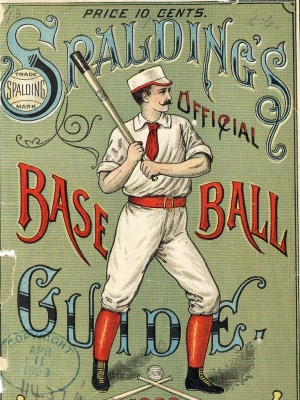
More Baseball Ephemera For The Winter Blues

Pitchers and catchers report to spring training in 23 days, position players in 28.  We are one orbit of the moon away from baseball's partial return, and I am joyous.  The NFL has maintained its diva-esque insistence on two weeks between the conference championships and the Super Bowl, which this year has meant interminable discussions of ball inflation and Marshawn Lynch's recalcitrance in press conferences.  And people call baseball boring.

Anymore baseball is less a sport than a symbol of spring, summer, and early fall to me.  Baseball's return is the return life, of the sun, of days when I can wake up with something to look forward to.  The older I get, the more the winter wears on my body and saps my soul.  When spring returns I practically celebrate like a Russian peasant overjoyed when the ice cracks and the rasputitsa comes.  To tide me over, and for your consideration, are some pieces of baseball ephemera.

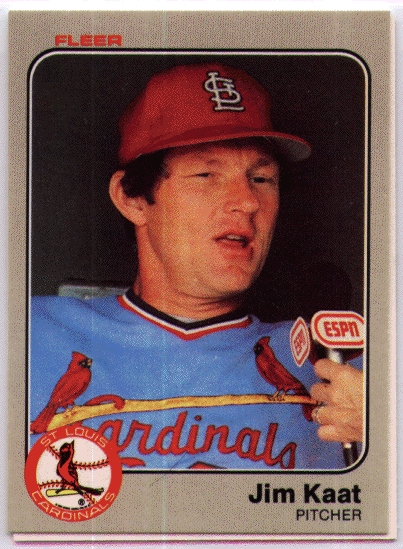
Jim Kaat's 1983 Fleer Baseball Card


I love the ramshackle nature of 1983 Fleer cards.  The background color is like the walls of a secretarial pool, and the Helvetica lettering makes it seem doubly institutional.  I imagine if they had baseball cards in Soviet Russia, this is what they would look like.  I love cards like this, when the photographer is snapping a photo of Jim Kaat while he's doing an interview, not even bothering to have him pose.

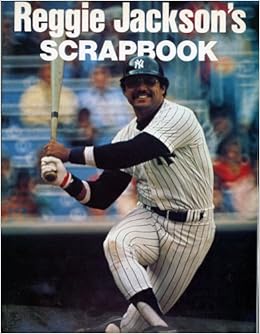
Reggie Jackson's Scrapbook

I was a weird kid, which meant that I learned an awful lot about sports events of the past by checking out recently outdated sports books from the library.  One of my favorite was Reggie Jackson's Scrapbook, published after his 1977 season, when he ended the World Series by hitting three homers on three straight pitches for the Yankees.  By the time I picked it up, he was a slightly over the hill slugger with the Angels.  It was full of great photos, including a breakdown of the famous game 6.

Gary Matthews' 1979 Topps Card
You can see why they called him "Sarge."

Ron Luciano's Books

Luciano was a colorful umpire in the American League in the 1970s who went on to be a broadcaster and author in the 1980s.  I devoured his books, fascinated by how the game looked from the ump's perspective.  For a little while in middle school, I seriously thought that becoming a major league umpire would be my life's calling.  I would get to see all the games I wanted, get paid for it, and have a lot of time off.  When I got the news that he had committed suicide, I was profoundly upset.

Tim Flannery's 1988 Fleer Baseball Card
Surf's up.

Seasons in Hell by Mike Shropshire

I just read this book, inspired by its inclusion on a top baseball books list by Dan Epstein, who's no slouch as a baseball writer himself.  In it a beat reporter for the Texas Rangers of the mid-1970s describes a particularly crummy team and what it was like when the anything goes culture of the 1960s finally hit the more staid world of baseball.  Shropshire has a great voice reminiscent of Hunter S Thompson, and would recommend the book to any fans of baseball or the good doctor.  It also happens to contain the definitive account of the Ten Cent Beer Night fiasco in Cleveland in 1974.

Wally Moon's 1959 Topps Baseball Cards
Great name, all-time great unibrow.

Ten Cent Beer Night

The "aw, fuck it" brand of rebellion in the 1970s was on display in Cleveland one fateful night, the same year that Nixon retired.  Part of me believes they're somehow connected.

Thursday, August 7, 2014

Piketty, Perlstein, and Coates, Oh My!

This year has been fortunate enough to see three epic pieces of criticism from the Left enter into popular political discourse.  All three of these works deeply challenge conservative assumptions so ingrained in our politics that they have practically become part of the price of admission: that racism's effects are negligible in the present, that capitalism's prosperity is a rising tide that lifts all boats, and that Ronald Reagan was a great president who saved America from ruin.  Anyone with any sort of critical mind already knew these things were bullshit, but now those critiques have gone viral, and the purveyors of such cant are finally on the discursive defense.

I am speaking here of Ta-Nehisi Coates' tour de force piece on reparations in the Atlantic, economist Thomas Piketty's impressive tome Capital in the 21st Century, and historians Rick Perlstein's newest work, The Invisible Bridge.  All three have engendered fierce, almost apoplectic opposition from the political Right in ways I have never witnessed before, since all three are so well-written and researched, and threaten assumptions conservatives have managed to make conventional wisdom.  My personal favorite response has been the one of a conservative biographer of Reagan, he is suing for $25 million and wants all the copies of Invisible Bridge to be pulped.

That very response should hearten the forces of the Left, who have always had theorists and thinkers on their side, but haven't necessarily translated those ideas into coherent, digestible narratives.  For example, I have heard some people complain that Piketty's arguments about how capitalism inevitably leads to inequality are hardly new, but what is new is that he is leveling this accusation from within the economics profession, and has amassed a great amount of data and evidence to support his case.  He also writes extremely well, and deftly uses literature to illustrate his salient points about how wealth works in a rentier society, one his data and analysis shows we are about to return to.  With the concerns about wealth inequality growing among the masses in the wake of the Occupy movement, Piketty has given crucial ammunition to those

Similarly, Coates has a tremendous knowledge of history and has brought that into the journalistic world.  In doing so, he has taken the many great works of historians about the history of race (and especially housing) and molded them into a potent argument.  He later wrote a narrative bibliography giving credit to those works that had informed his article, bringing those scholars a much broader audience than they have ever had before.  I think academic historians everywhere should take notice of what Coates has done, and strive to make their ideas more accessible to the masses.  In their translator, Coates has utterly transformed the discourse on reparations and foregrounded (for those who couldn't see it) the ridiculousness of the claims that America is "post-racial society."

Rick Perstein is one historian in the academy who understands how to reach a broad audience with challenging interpretations while still basing his work in meticulous research.  (So much popular history is dross from a research perspective.)  I am still waiting to dig into Invisible Bridge, but having read his other books (especially Nixonland) and the reviews, I know that it is riling up conservatives because of its killer combination of depth and accessibility.  The cult of Reagan is perhaps the most hallowed of all modern conservative articles of faith, and any book with a popular audience that could call it into question represents a major threat.

I know I am sounding a lot more gushy and effusive than usual, but it's because I am feeling genuine happiness that works of scholarship are capable of altering our political discourse in the right direction. At least many of those people espousing the "post-racial society," Saint Reagan, and capitalism's benevolence won't just be given the benefit of the doubt anymore.

Tuesday, January 21, 2014

Essential Baseball Reading For Those In Winter Withdrawal


Getting home in today's storm was a major ordeal, and I spent my time on my slow moving train staring at the swirling snow and dreaming of sitting on the third base side at Citi Field or US Cellular Field or Camden Yards (my favorite non-rooting interest ballpark) on a mild June afternoon with a beer in one hand and a kosher hot dog in the other.  That, and the Asbury Park boardwalk, is the happy place I go to when winter is at its fiercest.

If you haven't guessed yet, I love baseball.  Back when I was a child and suffering from baseball withdrawal, this time of year brought the new baseball cards.  I spent a good part of January, February, and March cracking open packs of Score, Topps, Donruss, and Fleer, poring over stats from the prior year and making my own projected standings for the coming season.  Another highlight was getting Sports Illustrated's baseball preview in the mail, which I read cover to cover at least twice before the season began.

These days I delve into baseball books during the winter months.  Most recently, I've devoured the 2014 annual of the Hardball Times, which is full of articles analyzing the last season and contemplating issues such as whether hitters do better on their birthdays, or whether the Mets' rebuilding program will succeed.  The following list is not exhaustive nor is it made up of "the best" books, just ones I'd recommend for all the folks suffering from their estrangement from the emerald diamond.

Jim Bouton, Ball Four
More than any other book, 1970s Ball Four stripped away the mythology around baseball players and showed what day to day life was like over the course of a season on a ball club.  Bouton's candor led him to be called into the office of Bowie Kuhn, who did not approve of Bouton's discussion of formerly taboo issues like Mickey Mantle's sex life and the common use of amphetamines during games.  Beyond the controversy, it is really funny, and since it is in a diary format, allows the reader to really inhabit the quotidian life of the majors.

Doug Glanville, The Game From Where I Stand
If you want something more modern, Glanville writes in a similar vein as Bouton, but about baseball in the 1990s and 2000s.  Although he is not as flip or humorous as Bouton, his writing style is much more refined and a pleasure to read.

Dirk Hayhurst, The Bullpen Gospels and Out of My League
Of course, most players don't make it to the majors.  In these two books Hayhurst details his struggles in the minors, as well as the difficulties brought on by his dysfunctional family.  These books, more than any others I've read, get at the lengths we will go to pursue our dreams, and the tremendous mental toll it takes when they don't come true.  I read Hayhurst soon after leaving academia and my own dreams behind, and it was therapeutic.

Bill Veeck, Veeck As In Wreck
Baseball owners are known to be a stodgy bunch, but Veeck enjoyed driving the stuffed shirts nuts when he owned the St. Louis Browns and Chicago White Sox.  Responsible for all kinds of gimmicks and hullaballoo, Veeck was famous for hiring a little person to pinch hit, exploding scoreboards, and letting fans be the manager for a day.  He's a classic raconteur and a true baseball character.

Howard Bryant, Juicing the Game
Baseball has experienced quite a Sturm und Drang over the steroids issue, but few have been able to put steroids in context of other changes in the game.  Bryant shows how the steroid problem was enabled by Bud Selig and the owners, and papered over by the news media's fawning over Mark McGwire and Sammy Sosa's assault on the home run record.  Of course, Selig and the baseball writers are on an anti-steroids crusade that looks mighty hypocritical.  Since this book was published in 2006, it  might seem a little dated, but nobody else has managed to write on the issue with Bryant's intelligence.

Dan Barry, Bottom of the 33rd
Baseball does not have a clock, so theoretically, a game could last forever.  One minor league game in Pawtucket in the early 80s almost did, lasting 33 innings.  Barry tells the story masterfully, and in the process gets into what makes minor league baseball so unique.

Jeff Pearlman, The Bad Guys Won
Pearlman's history of the bad boy 1986 Mets' championship run is brain candy at its best.  I remember burning through it faster than a Dwight Gooden fastball.  There's never a dull moment, unlike so many other team-profile books.

Anything by Roger Angell
From the early 1960s until very recently, Angell wrote baseball pieces for the New Yorker.  His prose is a wonder to behold and he always seemed to able to pull out fascinating observations and moments from the game.  Two of my favorites: how a spring training game displays the fundamental difference between Mets and Yankees fans, and a beautiful piece on first learning to love baseball as a child.  The Hall of Fame has finally inducted him, and it's about damn time.

John Updike, "Hub Fans Bid Kid Adieu"
Speaking of masterful prose, John Updike's essay about Ted Williams is perhaps one of the best things he ever wrote, and one of the most insightful about the fraught relationship players have with their fans.

Bette Bao Lord, In The Year Of The Boar And Jackie Robinson
Do you know a young person pining for baseball season?  Give them this book.  I read it in elementary school and absolutely loved it.  It articulates what baseball can mean from a kid's perspective better than just about anything else.

Sunday, December 2, 2012

A Review of The Last Professors by Frank Donoghue

During my last few years in academia, I spent a lot of time reading about the state of the profession, which hardly helped my desire to stick with it.  Of the many that I read, none was perhaps more on target than Frank Donoghue's brief and insightful The Last Professors. In it, Donoghue argues that the current generation of professors in the humanities will be the last, and will soon be replaced in most, non-elite institutions by a "casualized" workforce. Unlike other commentators, however, Donoghue argues that this phenomenon has largely taken place already, and that there really isn't a whole lot that can be done about it.

The one knock against the book might be that it's too episodic and doesn't hold together as it should; at times it reads more like a collection of essays than a cohesive statement. That being said, Donoghue makes five very prescient insights worth considering. In the first place, as I just mentioned, he points out that the humanities professor is already a disappearing breed. However, the public and most tenured academics seem totally unaware of this fact. Few people in America realize that most classes these days are not taught be traditional professors, but by adjuncts, "visitors," and graduate students. Because practically everyone apart from the new academic labor workforce is ignorant of the changes that have already happened, almost nothing is being done about them.

The Last Professors also manages to get at the real issue with the rise of for-profit institutions like the University of Phoenix. It isn't that these fly-by-night companies necessarily take away students from traditional universities, it's that their labor practices and ethos are now being adopted by a whole host of university administrators. They now have models of how to destroy shared governance for good and to cultivate a low paid, "flexible," docile workforce. Tenured professors in the humanities will soon be a luxury good maintained only by the Ivy League and other prestigious universities who can get their students to pay big bucks for scholarly sages.

On an entirely different note, Donoghue exposes the serious issues in the realm of academic publishing, a subject that more academics should be taking seriously. State-level cutbacks have meant cuts for university presses, which have shortened their lists and now only publish books with a potential to make money. At the same time, more and more universities are increasing their research expectations, driving up the number of prospective authors at a time when getting a monograph published is that much harder. With so many professors publishing to get tenure and so many adjuncts publishing in order to get a tenure track job, academic research has become more instrumentalized, and by virtue of its greater volume, devalued and of lower quality.

As those of you who have braved the academic job market well know, a long list of publications does not guarantee a tenure track job. Donoghue might be at his best when laying out some plain truths about the jobs situation. He asserts, quite rightfully, that there is no job crisis because there has been an endemic shortage going back to 1970. We must put aside the hopes that the job market will somehow "recover" or "get back to normal." It has about as much of a chance of improving as I do of becoming queen of Spain. Donoghue correctly connects this state of permanent crisis at a time of growing enrollments to the tremendous increase in adjunct labor in the last thirty years, not PhD "overproduction."

Last but not least, The Last Professors addresses the myths of tenure. In the first place, Donoghue claims that it is being eroded, in large part because of the relentless causualization of academic labor. On top of that, he makes the claim that tenure actually doesn't protect academic freedom because professors without tenure can be fired for all kinds of reasons unrelated to their performance. When I was an untenured assistant professor, the fear of reprisal if I dared speak up about any of the issues I see with my department and university encouraged me to keep my mouth shut.

There are many more notable observations than these in The Last Professors, and I can heartily recommend it to anyone who is concerned over the future of the humanities. However, Donoghue might be a bit bleak, even for my tastes. He doesn't seem to think that anything can be done to rescue the humanities professors, who are meeting their Waterloo. It's not much better, but I prefer to see the current situation as Dunkirk: we humanities scholars have been defeated and are running for our lives, but we still have the hope of coming back victorious. It can happen, but we need to really start fighting. Like the labor movement of yore, faculty need to unite (and I mean tenured, tenure track, and adjunct together) and get in the faces of our more complacent colleagues and ask them, as the old song goes, "which side are you on?" I'm not sure it will happen, but dammit, if we're gonna go down, we ought to go down swinging.

Thursday, February 23, 2012

A Compendium of Baseball Books

When baseball season approaches, I like to pick up a good baseball to read.  I bought this season's book all the way back at Christmastime, Lawrence Ritter's The Glory of Their Times.  It's a legendary oral history compiled in the 1960s of recollections by old ballplayers from the dead ball era of the early twentieth century.  The stories are fantastic, like Rube Marqaurd hopping trains to get from Cleveland to his minor league team in Iowa, and Nebraska native Sam Crawford going from town to town with his local team in a covered wagon.  This got me thinking about my favorite baseball books, and since I know some of the long-time readers of this blog, like me, love both books and baseball, I thought I'd share my thoughts on a few.

Favorite Book by a player: Jim Bouton, Ball Four
You have to love a book that gets its author called into the commissioner's office, which is exactly what happened after pitcher Bouton's account of his 1969 season was published in 1970.  At a time when few players or baseball journalists let the public know the reality of baseball life, Bouton gave a day to day warts and all testimony, discussing the womanizing of idols like Mickey Mantle and strong-arm tactics used by owners in contract negotiations in the days before free agency.  The dailiness of the book is its greatest asset, since it is a running diary of the season, and it more than anything else out there gives the reader a window into what it's really like to do the job of a ball player.  

Honorable mention: Doug Glanville, The Game From Where I Stand
For those wanting a more modern take on baseball life, this is the book to get.  Glanville has a wonderful writing style and great wit, as his columns attest.

Favorite Book about a single team's season: Jeff Pearlman, The Bad Guys Won
In case you didn't know, the "bad guys" of the title refer to the 1986 Mets, perhaps the most interestingly dysfunctional squad since the "Bronx Zoo" Yankees of the 1970s.  Pearlman describes that team's rocky road to victory in one of the most exciting World Series ever, vividly sketching the many characters, from Gary Carter (may he rest in peace) to Keith Hernandez to Daryl Strawberry.  Here's a hint: the title's pretty accurate.

Favorite Book by an owner: Bill Veeck, Veeck As In Wreck
Not a lot of competition for this category, but this is as funny a baseball book as they come.  The former owner of the Browns and White Sox skewers fuddy duddy owners and relates one hilarious story after another.  The best is his account of the Eddie Gaedel game, when Veeck's team put a midget in to pinch hit in order to get a player on base.

Favorite Player Biography: Howard Bryant, Hank Aaron: The Last Hero
I usually do not like biographies.  They tend to be too long, too detail-oriented, and overly exaggerate the importance of their subjects.  While Bryant's book has some issues, he does a fantastic job of exploring Aaron's life, in particular the difficult racial dynamics he faced as a black ballplayer in the early post-Jackie Robinson years.

Favorite Book of Analysis: Bill James, The Bill James Historical Baseball Abstract
As true baseball fans know, James' use of complex statistics has completely revolutionized the way that the game is seen and players are judged.  What is less known is that James is a witty, compelling writer who does a fantastic job of humanizing his formulas and explaining them to a math-phobic audience.  For my money, this is James' magnum opus and a book that any serious student of the game should read.

Favorite Book by a Manager: Joe Torre and Tom Verducci, The Yankee Years
As much as I dislike the Yankees, I really admire Torre, and he manages to do the impossible: make me feel sympathy for George Steinbrenner.  Sure, he comes off a wee bit tyrannical, but also interested in getting his team to win above all else, a quality many fans wished their teams' owners had.  Torre also offers priceless observations on A-Rod's vanity and an apt explanation of the Yankee franchise's decline after the 2001 season.

Favorite Book about Baseball Cards: Josh Wilker, Cardboard Gods
Wilker weaves his life into aphoristic discussions of individual baseball cards, making connections between the players and his own fate.  I think it's one of the most brilliant things I've read in recent years, especially in exploring the contours of sports fandom.  If you haven't yet, check out Wilker's blog.

Favorite Book That Does Not Exist Yet, but Should:  Roger Angell, Complete Baseball Writings
Angell has written on baseball for the New Yorker for decades in wonderfully crafted, evocative prose.  I have read all of the various collections of his various writings on baseball for that publication, but I think the time has come to gather them together in a single volume.  I can't think of another writer who is so consistently interesting in his observations on the game.  If you have a subscription to the New Yorker, go into the online archive and enjoy some of his vintage baseball material.