Thursday, April 7, 2016

Merle Haggard And My Crooked Path To Country Music

If "Sing Me Back Home" doesn't move you, you have a heart of stone

The passing of Merle Haggard yesterday hit me harder than I was expecting. It might be because I had just come back from visiting Nebraska and nights spent playing cards with my parents with songs like "Mama Tried" playing in the background. It also might be that the greats of country music are now almost gone. Loretta Lynn, Willie Nelson, and Dolly Parton are with us, but that's about it. Johnny Cash, Tammy Wynette, George Jones, Waylon Jennings, Buck Owens, Porter Wagoner, and others have crossed over.

Unlike almost any other genre, the weight of history and tradition weighs heavy on country music. It prizes authenticity, and lament from fans that the genre has lost its way is pretty damn old itself. Heck, Waylon Jennings' "Are You Sure Hank Done It This Way" is now over forty years old. In the midst of the "countrypolitan" movement on the sixties, with its strings and Nudie suits, Haggard brought back the old time honky tonk religion. A gut-bucket tune about trying to drink away bad memories like "The Bottle Let Me Down" is about as far from the likes of Eddy Arnold as you could get. Haggard was no rhinestone cowboy, he'd grown up in a house made out of an old box car and did time in San Quentin. Not only that, he sang about that world in songs like "Hungry Eyes."

I didn't know much about Merle Haggard, even though I came of age in a place saturated in country music. When people said "country" I thought of Garth Brooks and other generic singers with big hats and hacky songs. Country was becoming, in Tom Petty's words, "bad rock with a fiddle." It was the one genre of popular music that I had no use for.

That changed in 1994 when Johnny Cash put out his first American Recordings album. A lot of hip people were endorsing it, and it was produced by Rick Rubin, whose work I knew well. While today I consider it the weakest of his late period albums, at the time it really grabbed me. Soon I expanded beyond Johnny Cash to Uncle Tupelo, and got excited by contemporary country music made by people who sounded more like The Clash than Billy Ray Cyrus. After that I got into Hank Williams, and I was hooked for life.

Eventually I got around to listening to Hag, which I'd avoided because of his political songs, such as "Okie From Muskogee" and "Fighting Side Of Me." I learned that the former was actually meant less as an endorsement of reactionary small town politics than a tongue in cheek description of them. Now I listen to that song and get a laugh. The latter is not redeemable.  After awhile I reminded myself that while I loved old country music, my relationship with it was a bit complicated, much like my relationship with the region I come from.

I come from Nebraska and I'm proud of it, but its politics make me crazy and its parochial viewpoint tries me. But I can't deny my loyalty or my deep and sincere love for the place. At the same time, while country music has long given voice to reactionary sentiments (despite folks like Willie Nelson and Johnny Cash), it's music that affects me on an elemental level that I cannot describe. It's music that is, like my home state, a part of me, whether I like it or not. I might listen to other kinds of music more, but when I throw Merle Haggard's Same Train, A Different Time on my turntable, something deep inside of me sings along. I'm sad that one of few people left on this earth who could do that kind of magic is no more, and that his like will never be seen again.

Tuesday, April 5, 2016

Trump's Supporters Are Not The Dispossessed

Jesse Helms' infamous "Hands" ad is just proto-Trumpism in its appeal to white racial resentment

One of the most notable things about Trump is his political thievery. His slogan “Make America Great Again” was basically stolen from the Reagan-Bush campaign in 1980. He’s also fond of speaking of the “silent majority,” which was Nixon’s great rhetorical turn of phrase.

Trump may be ignorant of a lot of things, but he’s not dumb. He knows the message that has worked for conservatives in the past, and is using it. His combination of nationalism, white racial resentment, and anti-global populism brings together some well-worn strands of conservatism.

What gets me are the pieces that talk about Trump’s supporters as the dispossessed. The way that the narrative goes, Trumpers are all working class whites who are angry at an economy and political party that has left them behind.

No.

Trump may draw more working class whites than his primary opponents, but he still draws large numbers from middle and upper class whites. Not to mention the fact that a sizable number of working class whites –especially outside of the South- are Democrats. I would easily bet that a majority of working class whites to have voted in the primaries thus far have voted for someone other than him, whether it be Clinton, Sanders, or one of the other Republicans.

Trump’s supporters are the same type of people who have supported similar figures in the past. Trump's white supremacy combined with nationalist militancy and an attack on elites is the same stew that drew so many to Andrew Jackson back in the early 19th century. More recently, the same type of person who voted for George Wallace is the same time who votes for Trump.  His voters also tended to be working and lower-middle class, and they were also driven by white racial resentment and nationalism. Trump was just savvy enough to know that those voters were out there and that no one was trying to reach them directly with the red meat they wanted to eat.

The news media has made the mistake of assuming that because the white working class has suffered under the neoliberalization of the last 40 years, that that economic angst is the primary engine of white working class support for Trump. There is correlation, but not necessarily causation. Trump is playing with the same populist nationalist politics that others have before him, pure and simple.

Some of the media's misconceptions might stem from the well-meaning but untrue myth that the poor are inherently more virtuous than the rich. They are in fact people like anyone else, and thus susceptible to appeals to the darker side of their nature. Many wealthy conservatives express their sociopathic tendencies through a libertarianism hell bent on getting them more money at the expense of others. Less affluent conservatives, on the other hand, lower their sights onto those just below them on the social ladder, with promises to keep them down. It's an impulse that's been there in American history from the New York Draft Riots to the 1920s iteration of the KKK to the Southern Strategy.

Trump's supporters are thus NOT the dispossessed, but those who want to keep what they've got, and a lot of what they've got is white skin privilege. That privilege has been tenaciously guarded throughout this nation's history, we shouldn't be surprised to see a demagogue rise who speaks to the anxiety of its loss.

Sunday, April 3, 2016

Track of the Week: Pointer Sisters "Fire"


We live in a cultural moment where an obsession with "authenticity" co-exists with increasing cultural segmentation.  Even though I am getting long in the tooth, I can still follow pop music because the amount of it that crosses over the various segments is really tiny compared to the past. The various genres of music seem to multiply with each year, and seem to be saying less and less to each other.

It wasn't always like that. Back in 1930 the king of country music, Jimmie Rodgers, cut the song "Blue Yodel #9" with Louis Armstrong, jazz legend. In the 1960s, Nina Simone's music seem to pull from innumerable genres, from jazz to classical to to show tunes to soul. The Clash's magnum opus London Calling has everything from reggae to ska to rockabilly to hard-charging punk on it.

In 1979, the same year as that Clash record, the Pointer Sisters released "Fire," which sounds as if country and soul got together to make a beautiful baby. Like the sensation described in the lyrics, this song just smolders until the drums, piano and organ come in big, then draws back again, only to burst forth once more on the solo. There are few other songs that replicate the sensation of trying to suppress burning lust so well, and it's all done with a sultriness that's neither playful or silly. I've been listening to this song non-stop for the last month, and as much as I enjoy it, it makes me wistful for a time when pop music could hold multitudes.

Friday, April 1, 2016

Baseball Thoughts

Baseball season is tantalizingly close. I will be happy to have my daily friend back in my life, a welcome distraction and easy to access obsession. As I get older, I dread the winter more and more. Each day is a reminder that everything dies, and that I will be down under the ground before too long. When baseball comes it comes with spring and Easter, signs of hope and regeneration.


One of my favorite songs on this theme is Frank Sinatra's "There Used To Be A Ballpark," which came out in the 1970s, well after his heyday, and is appropriately elegiac. Sinatra sings of a non-descript city block that once had a ballpark, and was full of joy and wonder. Those days are over, but the memories faintly remain. I've been thinking a lot about this song, since the ballpark in downtown Newark is due to be torn down. I see it every day during my commute, and looking at it in the winter has long been a way for me to dream of better times. I saw some games there, it was a good place, and I'm sad to see it go. I wonder if the people who will live in the high rise to be built there will smell a faint whiff of hot dogs or hear the crack of a bat talking in the wind.


The breeze yesterday was cool but pregnant with spring's life, the kind of air that can stir memories of my youth this time of year, much of which was spent collecting baseball cards.  Before the season started I'd be buying pack after pack of Topps, Fleer, Donruss, and Score. (I thought Upper Deck was ridiculously priced. I am my father's son.) I'd pore over the stats from the year before, and rank the players at there positions and come up with predictions for the season, written down and saved until the October. I've long stopped putting them in blog format, since I tend to be ridiculously wrong. I still remember the 1990 season, and thinking that the acquisitions of Mark and Storm Davis would put the Royals over the top for a championship.  Boy was that wrong. On the bright side, I never would have thought last March that there was any chance that the Mets would go to the World Series.


It's strange to think of what it was like to follow baseball in the 80s and early 90s. Nowadays due to my mlb.com subscription and cable services I can see every single baseball game, and through the magic of DVR can even watch them after the fact with ease. My phone gives me real-time scoring updates, and baseball-reference.com allows me to look up any player's stat at any time. Back then, when baseball first put its hooks in me, things were different. I could watch all the Braves and Cubs games I wanted due to TBS and WGN, but for other games I relied on NBC's Game of the Week on Saturday and Monday Night Baseball (remember that?) on ABC. To get scores immediately I would tune into CNN Headline News at either 19 or 49 minutes past the hour, back when that station just ran a half hour newscast 24 hours a day. (I miss the esoteric days of early cable.) I could also wait for the nightly Sportscenter broadcast or for the box scores in the next day's paper. Speaking of the newspaper, the sports section of the Sunday Omaha World-Herald did a great service by printing a complete list of of all the players' stats up to that point in the season, as well as the team stats. That could occupy me for hours, much as baseball-reference.com does today. Baseball is often too laden with nostalgia, but in this case I have none. After all, who wants to go digging through newspaper box scores?


Speaking of the NBC Game of the Week, Joe Garigiola, one of that telecast's defining voices, passed away last month. More than any other sport, baseball relies on its broadcasters. The great announcers have to be narrators and conversationalists. Since there's 162 games, the folks you listen to on the radio or hear and see on TV have to be engaging and interesting enough, lest you get sick of them by August. The Mets have great TV and radio teams, which has made it easy to follow them. My favorite announcer, and probably the favorite of most hardcore baseball fans, is Vin Scully. He is set to retire after this season, after broadcasting Dodger games since 1950. To put that in perspective, he was calling games with Jackie Robinson and Stan Musial on the field. I first encountered him as a broadcaster for NBC in the 80s, both on Game of the Week and in the World Series. Thirty years ago he was already legendary, a fount of diamond wisdom. Scully also clearly understood how to enhance the events on the field without overshadowing them. (Notice how he calls Hank Aaron's record breaking homer in the clip above.) When the crowd went crazy he dialed it back, letting the moment speak for itself. He calls the games by himself, which feels like sitting down with a friend. Every now and then I watch a Dodgers game during the season just to hear him call it. I know I will be there this season to hear his last one.

Thursday, March 31, 2016

A Political Report From Nebraska

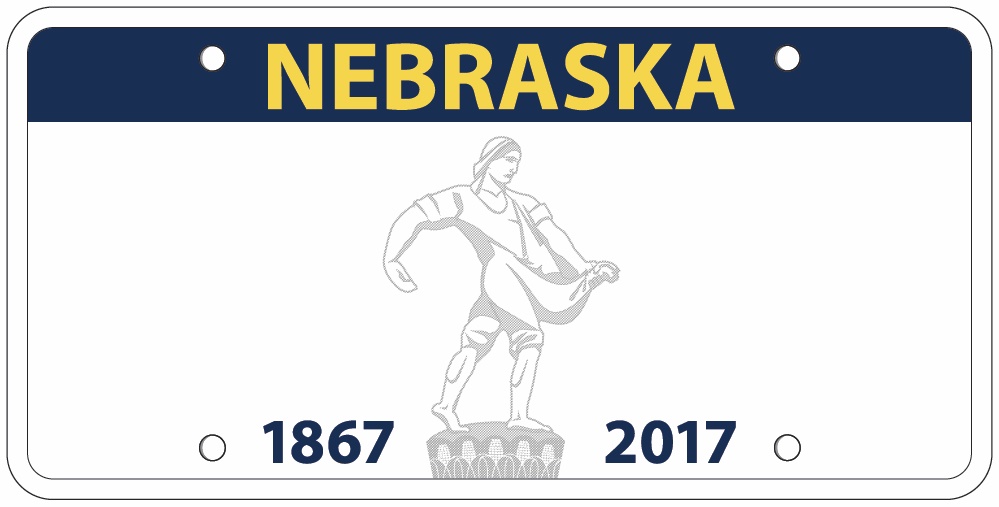
This license plate redesign was the subject of much more discussion than the presidential election in my home state this week

Whenever I go back home to Nebraska I always keep my ears open to gauge the political mood, mostly because the political worlds of the Great Plains and the Northeast are so foreign as to be different countries. Nebraska (especially central Nebraska, where I'm from) is one of the reddest states in the country, and hasn't voted for a Democrat since the LBJ landslide of 1964. New Jersey, after decades of swinging back and forth, hasn't gone for a Republican since Bush the Elder in 1988. Essex County, New Jersey, where I live now, gave Obama 77.4% of the vote in 2012, compared to 32.1% for Obama in Adams County, Nebraska.

The differences have been striking. I remember back during the Tea Party upswing in 2009-2010, and hearing folks who I never pegged for that kind of thing loudly saying stuff like "America is a republic, not a democracy!"  I head a lot about creeping socialism. I saw a sign in the window of a gun store breaking Godwin's Law.  The attempt that the Republican party was making to oppose president Obama with massive resistance, assisted with the radical voices of the likes of Glenn Beck on Fox, was really having an effect. The whole atmosphere just seemed politically supercharged with Bircher ideas out in the mainstream, which surprised me considering that my home state's conservatism rarely tended in the radical direction.

I would have expected a lot of that charge in the air when I visited this week. After all, this is a hotly-contested election year. Despite that fact, the political issue most discussed in my time in Nebraska was the new design for the state's license plates, which many people in the state find to be sub-optimal. (I concur) I heard a great deal of passion on this issue, which might seem esoteric to an outsider. The silence on the presidential election, in contrast, was very telling. I heard the real estate developer's name spoken only once, and in disgust by a dedicated, conservative Republican. So what happened?

A look at the electoral map shows that Trump is very weak in the Plains states. His style rubs people the wrong way in a place where humility and substance are valued across the political line. Trump also has a very hard time getting the votes of regular church-goers outside of the South, and that demographic is the core of the Republican party in places like Oklahoma, Iowa, and Kansas, states that Trump has lost. The Republicans I know in Nebraska tend to be church-goers, and to place a great deal of importance on "values" issues. Trump disgusts them, but they don't really seem enthusiastic for any of the alternatives, even though Cruz has been trying hard to woo this group.

The lack of discussion of politics reminded me a lot of the later Shrub years, when even his former die hard supporters began to see him as an embarrassing screw-up. The silence I heard in Nebraska this time around spoke volumes, both about the feelings of many Republicans toward their party, but also for Democratic prospects in the upcoming election. Whenever conservatives in my home state seem low-energy, it's a pretty good indicator that their party is about to lose.

Tuesday, March 29, 2016

A Letter From Nebraska


I arrived back in the Cornhusker State on Saturday, and so far have really been enjoying my time here. Spending day after day commuting to New York City and enduring its crush and push then coming home to parent two amazing yet rambunctious three year olds with my equally exhausted spouse can get really tiring. Last week I got to spend a day just exploring the city, which was helpful, since I could exult in New York's energy without feeling like a rat in a maze. Nevertheless, I needed to get some peace and quiet.

That exists in abundance in my home state. Getting off of the plane I was struck, as always, by the immense expanse of the sky, a sky so huge to seem threatening. When you are in Nebraska you get the feeling that the towns and cities are a middle finger to nature, which obviously never intended such things to exist here. That ever-present tension is responsible in large part for the humility of people who live here. You know full well that the wind and sky are permanent, and you are simply a temporary occupant of their space, and are there at their discretion. Occasionally a tornado comes around to remind you of that fact.

We landed in Omaha about 6:30, and that feeling of smallness got much more intense after the sun came down and we were driving west of Lincoln. It had been an overcast day, and the clouds blotted out the moon and the stars. Miles from any city the darkness was positively primeval, a kind of darkness that I had forgot could even exist in the world. It was so dark I couldn't see my daughters in the back seat, despite being on the one and only major interstate highway in the state. Under that huge dark sky you can feel as if the world outside of your car has simply disappeared. It felt good to be so isolated, the polar opposite of being packed cheek to jowl on the 2 train with someone's elbow in my kidney.

Easter morning I walked outside and smelled an old smell I had almost forgotten about: cow manure. My parents' house is near the edge of town, and just a few miles southwest there's a big feedlot. On the rare days the wind comes out of that direction, the smell saturates everything. As a child I hated it, but now I have to admit I exult in it a little. It is a wonderfully earthy smell, without the sickening burn of the ammonia in pig manure. And it was a welcome change from the unnatural chemical smells of New Jersey or the fuggy miasma of Penn Station. More old smells awaited, from the incense at Easter mass (used perhaps overzealously by a young priest) to my mother's ham baking in the oven.

Even better than the smells were the sounds of my daughters playing enthusiastically with their cousins. It made me feel a bit guilty that they only ever see them about once a year. I was lucky enough to have lots of great cousins, which made going to family events something to look forward to, rather than dread. I feel like out in New Jersey, where they don't have any cousins, that they are missing out on something important. My wife and my parents and I are currently plotting ways to get them out to Jersey this summer. Maybe we can introduce them to what real pizza tastes like before it is too late.

The smells of manure, incense and ham are all memory triggers, and coming home can be difficult for me sometimes because it reminds me too much of the person I once was. My home life was great growing up and I was lucky to have such caring parents and siblings and a tight extended family. However, much of what happened outside of that cocoon was shit. We walked all the cousins over to my old elementary school on Sunday to use the playground, and as I walked past the brick wall outside of the cafeteria I vividly remembered the time a kid shoved me, causing the skin on the tops of my knuckles to rip apart. I saw the kickball field where the other boys in the sixth grade banned me from playing with them during recess. I saw the spot in the schoolyard that very year where a bully literally spat on me and I finally cracked and started going after him. I wish I'd had the nerve to do that more growing up. I was a passive child, probably somewhere on the spectrum, and thought ignoring the bullies would make them go away. That passivity in my youth held me back so much in so many ways, from an inability to ask girls out to an inability to stick with student journalism because I was mortified at asking people questions. In my time growing up outside of my family I was as lonely and lacking in confidence as someone could be.

My dad showed me an old videotape of us playing a game of touch football with some of my relatives in my grandparents' farmyard when I was 16. I was a bit horrified by the gangly dork I saw before me, but watching it made my father really happy. I saw on the video that I managed to throw a pretty wicked bomb to my cousin for a touchdown, and started to feel a little bit better about myself. After all, I spent years and years pushing to not be that gangly, withdrawn dork. I'd like to think I've been largely successful. Coming home has been so relaxing as an escape from the stress of my daily life, but also an uneasy reminder that it took getting away from it for me to have any chance of coming into my own as a human being.

Sunday, March 27, 2016

Track of the Week: Bruce Springsteen "Atlantic City"


It's not making too many headlines outside of the Garden State, but Atlantic City is in trouble again. The collapse of the casino industry there, hampered by new competition, is driving the city to bankruptcy. Governor Christie is exploiting the situation, withholding aid unless the city puts itself under state control, the kind of thing that has led to poisoned water in Flint and uninhabitable schools in Detroit. Like in the casinos themselves, in modern American life the house always wins, and the regular palooka always loses. Donald Trump famously invested huge in Atlantic City and helped build the reputation he is using to run for president, all the while the people of Atlantic City are seeing their lives fall apart.

The casinos came in the 1970s in an attempt to save a once bustling resort centered around a famous boardwalk. Generations of American families had grown up battling for supremacy over its streets in countless games of Monopoly, perhaps never aware that these were real places. By the early seventies, as the stellar film The King of Marvin Gardens illustrates, Atlantic City had died off as a tourist mecca in the age of interstates and airports. When the casinos came to Atlantic City, gambling was really only legal there and in Nevada. As other, more convenient places closer to the homes of the marks have built casinos, Atlantic City has suffered.

Back in 1982, when Bruce Springsteen recorded his austere Nebraska album, he seemed to grasp the dark lie behind the supposed salvation. The whole record is a document of the harsh reality underneath the "shining city on a hill" rhetoric of the early Reagan years, stories of people on the margins who are losing out. "Atlantic City" hits the listener right away with the lines "Well they blew up the chicken man in Philly last night/ They blew up his house too." This world of casinos and the hopes of easy money is infused with organized crime and assassinations. The character singing the song is desperate, he talks of having "debts that no honest man can pay." As he sings to his lady, he promises her a romantic night out in Atlantic City, and lets her know ominously that he's "met a man and I'm gonna do a little favor for him." It's implied that this desperate character has found his way out by killing someone else for money.

It is a beautiful, dark, haunting song. The harmonica cuts like a cold wind coming in off the ocean whipping the boardwalk, and the mandolin echoes spookily. The key, cryptic lines of the song have always stuck with me "Everything dies baby/ That's a fact/ But maybe everything that dies/ Someday comes back." It could be a cheap justification by this newly minted killer for hire about what he's about to do. It could be fatalism about chucking his soul in the garbage can to do it. Or it could be a comment on the once beautiful city fallen into disrepair hoping to make a comeback. Today it looks like Atlantic City is never coming back. Like the character in the song, it made a dirty deal to save itself, but the bill for that deal has come due.

The leading candidate in one of the major party's for president made so much of his money off of a town that's broke, desperate, and having to beg for mercy from one of his political lackeys. As "Atlantic City" tells us abundantly, that town is a window into the dark heart of the American Dream, and the human cost of its illusions.