Sunday, September 18, 2011

Academic Misery Index Quiz

I promised not to talk about my new job on this blog, party because nobody wants to hear about it, but mostly because my new employer heavily frowns on it (and besides, my students are minors.) But I will say this: I love it. Love love love love love it. During my morning commute on the first day, I lamented the chain of events that had gotten me cast out of academia. I lament no more, and instead exult in my good fortune to be doing a job I enjoy in a city I adore while living with my soul mate. Alright, I'll stop my gushing, and get to the point.

When I think about my current state of happiness, I contemplate the awfulness that I endured as a low-wage "visitor" and an assistant prof at a totally dysfunctional institution located in a cultural backwater. Many of my academic friends have less bitter attitudes about the profession, and I've been thinking about how their jobs differed than mine, and those of some of my other friends, who are not as happy. So, for shits and giggles, I decided to concoct an academic misery quiz, one that should tell you whether you should find a new job.

Each "A"answer is worth zero points, each "B" answer one point, each "C" answer two points, and each "D" answer five points.

1. Which best describes the kind of academic job that you currently have?
A. You possess the great golden ring of tenure.
B. A tenure track position with the tenure clock ticking away.
C. A "visitor" or lecturer position with limited appointment and substandard pay.
D. A temporary adjunct position with no security paid by the course.

2. How would you describe the students at your university?
A. They are self-motivated, mature adults with a love of learning.
B. They are smart yet entitled children of privilege who need some prodding.
C. They are middle of the road intellectually and see their classes with a mostly vocational understanding, i.e., "why do I have to take this class?"
D. They are barely literate and seem to have no clue whatsoever as to why they are in college in the first place. The few brain cells they have left after nightly games of beer pong are devoted to texting.

3. How would you describe the town where your university is located?
A. A world-class city brimming over with fine dining, cultural events, and like-minded individuals.
B. An idyllic college town with a relaxed atmosphere and lots of cultural amenities.
C. A non-college town, mid-sized city that's a little boring, but at least has all the stuff you need, and the occasional cultural event.
D. A backwoods 'burg lacking a decent sit-down restaurant where the locals actively resent the university community for making them look like the countrified rubes that they are.

4. What are the politics of your department like?
A. What politics? We all love each other and most of us are good friends.
B. There are minor disputes, and we aren't all that close, but mostly because we're too busy to fight.
C. The silverbacks and the young'uns clash from time to time, but mostly inside departmental and committee meetings. We all know the two people who hate each other's guts, but the rest of us stay out of that mess.
D. They make Renaissance Florence look like an eight year old girl's tea party. Long-held grudges, character assassination, and intentional sabotage are the norm.

5. How would you describe your chair?
A. A far-sighted leader who tirelessly strives to protect the best interests of the department.
B. A competent technocrat who gets the job done but lacks vision.
C. A well-meaning buffoon who mostly tries to avoid doing work.
D. A malicious control-freak who plays favorites and considers any alternative viewpoint to be treason.

6. What is your institution doing with assessment?
A. What's assessment?
B. Writing standard boilerplate to keep the accreditation people happy but little that faculty have to deal with.
C. There's lots of pointless meetings and discussion and it's a big annoyance, but profs are not really told what to do in the classroom.
D. Faculty have lost control over what material is taught in their courses and spend a great deal of their time filling out asinine forms and getting reprimanded for failing to follow hopelessly labrynthine policies to the letter.

7. What happens when you report a plagiarism case?
A. I have to hold back the chair and dean from nailing the student to a cross.
B. There's lots of paperwork and I am asked to give the student the benefit of the doubt, but if I want to punish a student, I am able to do it.
C. I am reluctant to push cases because I am usually asked to lessen my penalties.
D. The chair and other higher-ups immediately take the student's side, and get irritated with me for taking up their time.

8. How would you describe your university's priorities?
A. To achieve educational excellence and foster world-class scholarship.
B. To provide a quality education for its students and give some support to research.
C. Mostly football and manipulating the categories in the US News rankings.
D. To keep distracting outsiders from the fact that the place is a complete joke and ought to be shut down.

9. What's the financial outlook of your institution like?
A. We are a wealthy private school with a huge endowment that our regents swim in like Scrooge McDuck.
B. We have had to make some cutbacks in course offerings and travel budgets, but faculty have mostly been spared.
C. Our state government is run by anti-intellectual GOP blockheads who force us to make do with less with each passing year. There's less money for research and few raises, but our jobs are relatively safe.
D. We have a psychotic governor hell-bent on destroying whole programs and firing tenured professors with budget cuts/we are a poor private school running on a showstring budget always begging alumni for money which is only keeping us afloat for just one more year.

10. When you talk to your faculty friends outside of class, what sentence are you most likely to utter or hear?
A. "Wasn't the pinot grigio at the faculty reception last night delightful?"
B. "With the cutbacks it looks like I won't be able to get the library to order all of the books on my list."
C. "I don't know how they expect me to teach more students with these increased tenure and service requirements."
D. "If I can't get a job somewhere else this year I will end up dying of alcohol poisoning."

Scoring:
After tallying up your scores, look the misery index below:

0-10 points: Shangri-La
Congratulations, you are living the academic dream! The next time you think about complaining about your job, please do the rest of us a favor and shut the fuck up.

11-20 points: The Good Life
You have the right to the occasional gripe, but things are looking good. If you can avoid the tendency in this profession never to be satisfied, you'll have a happy and fulfilling time at your institution.

21-30 points: The Danger Zone
If don't absolutely love academic work with all of your heart and soul, it might be time to explore your options.

31-50 points: Soul-sucking Misery
Get the hell out while you are still young and relatively sane. If not you will end up like the senior colleagues you respect who always have looks of bemused sadness on their faces.

Wednesday, September 14, 2011

The Party of Lincoln Becomes the Party of Jackson


I recently read Gore Vidal's Burr, something I'd been meaning to do for years, and now I've got early American history on the brain.

The Tea Party and others on the political right are big on swearing their allegiance to the Constitution and the Founders, but are typically pretty vague when it comes to the details. The main reason, of course, it that when they say "Constitution" and "Founders" they mean faith in a political Bible and its patriarchs. They possess beliefs founded in belief itself, rather than reason or any knowledge of history. That tendency to reduce politics to religion is why Enlightenment thinkers on the order of Franklin, Madison, and Jefferson would cringe in horror at the Tea Party's illiteracy and wild-eyed evangelicalism. Franklin was famously comsopolitan, and in his later life was more at home in Paris than Philadelphia, unlike today's uber-patriots who seem proud of their provincialism. Madison warned of the dangers of political factions taking over the levers of power, and evinced a strong desire to keep populism at bay. Although modern day Tea Partiers might appreciate his small government inclinations, Jefferson advocated a wall of separation between church and state. To top it all off, George Washington was a committed Federalist who tried to increase the power of the federal government, especially in his decision, at Alexander Hamilton's prompting, to assume the debts the states incurred during the Revolution. Ron Paul he was not.

Yet the GOPers still claim fealty to the Founders. Perhaps they do, but to the wrong figures. Our contemporary right-wing populism owes little to the founders, who mostly disdained popular participation in politics, and much more to the Jacksonian era. (This is of course highly ironic, since Jackson is one of the founders of the Democratic party!) Unlike the Enlightenment thinkers of the founding generation, Jackson and his ilk cared little for deep thought. In fact, they disdained it, and saw intellectual pursuits as inherently suspicious. After all, how dare those pointy-headed know it alls tell us what's right and what's wrong? Whenever I hear mainstream candidates for president deny global warming and evolution, I think of Old Hickory in all of his bigoted ignorance, especially his destruction of the Bank of the United States against all evidence of its necessity.
Jackson's decision helped bring on the Panic of 1837, just as the misbegotten economic religion of supply side has left us with an impoverished middle and working class unable to spend the money needed to restart the economy. Like their dark ancestor, modern Republicans replicate Jackson's provincialized nationalism, in which the only people who count are "real Americans."

And last but not least, they recall his bloody-mindedness. Jackson was famous in his day for his willingness to take lives, from those of his own soldiers to a man he shot to death in a duel to the Cherokee who perished in the ethnic cleansing known as The Trail of Tears. Recently modern day Republicans have made headlines by baying for blood at presidential debates, from the cheers for Rick Perry's bloody record of executions (including a man, Cameron Todd Willingham, who was most likely innocent) and urging that those without health insurance be thrown on the dung heap to die. I'd like to think that the dark spirit of America's historical id could be exorcised, but in a culture where consumer is king and criticizing popular tastes, no matter how idiotic and debased, meets with the strictest condemnation, Jackson's ghost will remain with us. Whenever there are fearful white people who want to maintain their privileged position and beat down on others to do it, he will be there. As long as the Tea Party continues to stoke the flames of racial resentment, he will be there. Truth be told, Old Hickory's bigoted, violent, provincial, illiterate nature will always resonate with more Americans than the reasoned Enlightenment worldview of the Founders.

Saturday, September 10, 2011

A Decade of Nightmares Without End


Commuting to work each day in New York City, sometimes right into the World Trade Center, I have been thinking especially hard about the ten year anniversary of 9/11. Friday, right before I left home, I heard the talk of a possible attack in the city. Once I sat down on the train, I cued up Radiohead's "Pyramid Song" on my iPod, the song that I listened to the most in 9/11's aftermath, and started trying to sort out what it all means ten years later. I am only one of a great many people writing about this question, and by far not the most qualified. Instead of contemplating the horror and trauma of that day, which dominates my memories, I'd like to get deeper into how we are still living in a world shaped by that day, whether we like it or not.

One of the most powerful memories I have of the attack is that once its full enormity was revealed to me (it was a couple of hours before I saw it on TV), I told myself "Things are going to get a lot worse for a long time." I despaired for the dead, but also for the future, and the knowledge the future was going to be horrible is still one of the most painful realizations of my entire life. I knew with George W. Bush's cronies in power, the attacks would be used to unleash the worst kind of authoritarianism wrapped in the flag and abetted by a fearful populace. I knew too that this attack would lead to the deaths of many more people in the wars to follow. When I got home that day, the feeling of sickness worsened, since my roommate was watching Fox News, which kept juxtaposing the collapse of the towers with Palestinians celebrating the attacks, over and over again. Nationalism's dark side was being whipped into a frenzy without a moment to mourn, a fact that has been lost in all of the remembrances.

That blind jingoistic rage and the softer yet just as powerful fear of the time got us into two wars that are still dragging on, despite bin Laden's death. We want to remember the immediate aftermath of the attacks as a time of national cohesion and collective action, but the reality was more complex. Amongst the lines of people donating blood and the many workers who risked their health in the clean-up, one could see an ugly, unfocused desire for bloody retribution, and not just against enemies abroad. There were well-documented hate-crime murders of Sikhs and Muslims. In just the next year our virulently partisan political culture barfed up Saxby Chambliss' ads using images of bin Laden to impugn the patriotism of then Georgia senator Max Clelland, who had lost multiple limbs in Vietnam. More tellingly, the strategy worked. Remember, very quickly after the attacks president Bush told the world "you're either with us or against us." Any criticism of said president, especially in the run-up to war in Iraq, was deemed treasonous.

It was all too fitting that the dark sneering vision of his puppet master, Lord Cheney, was back again on our television sets last week, like an old wound reinjured. He and his ilk fell out of power and crept back into the shadows over two years ago, but we still suffer from their decisions. The war in Iraq, built on his deceptions and lies, was waged while simultaneously retaining low taxes for the wealthy. That bill has come due, and in the midst of an economic catastrophe, the social safety net is being gutted, teachers are being laid off, and our infrastructure left to rot to pay it off. Young Americans are still fighting and dying in the deserts of Iraq and Afghanistan, and war without end is still ravaging the lives of people in those nations. American Muslims are being villainized now more than ever, evidenced by attacks on mosque building sites and the mainstreaming of bigoted paranoia over a supposed Sharia conspiracy.

Ten years later, America is in its worst economic crisis since the Depression, but is being paralyzed from taking action by a completely dysfunctional political system made unworkable by ideological zealots on the Right. I thought it telling that some of their more prominent fire-eaters publicly crowed that the president's speech on jobs in the midst of nine percent unemployment was "stupid" and refused to attend. I simply cannot recall a single instance in my lifetime of a sitting president being treated with such open contempt and disrespect, and this at a time when political compromise is necessary to prevent further economic damage. Not to mention the fact that this president had so recently successfully ordered the takedown of bin Laden. Of course, we all know that the virulence of the unprecedented contempt shown to president Obama has to do with the unstated premise that he is not a "real American." America has always had a problem with violent nationalism inflamed by racial and religious resentments, but its resurgence in the last ten years is especially disturbing since it threatens the basic ability of our political system to function.

We like to think sentimentally these days about the sense of cohesion and purpose in the immediate aftermath of 9/11, of how politicians of both parties dropped their daggers and showed unity. These days I look back at that time more cynically. The fire-eaters had one of their own in power, they gained by having their political opponents do the right thing and put partisan rancor aside. When the fire-eaters got voted into the opposition, they had no intention of returning the favor, but rather intentionally filibustered and obstructed to their heart's content. Had Al Gore been president, I sincerely doubt that the fire-eaters would have resisted the temptation to blame him for the attacks. In the meantime, the "with us or against" mentality and its attendant search for internal enemies goes on unabated, and has migrated away from "homeland security" to other political regions. Teachers are made the scapegoats of our educational system, the poor rather than the banks are blamed for the housing bubble, and Glenn Beck and others refer to political progressives as a cancer in need of excision from the American body politic.

I don't really know where this leaves us. Tomorrow I will mourn the dead and hope that somehow the long nightmare finally ends. That horrific day's shadow still engulfs us, it is present in the veteran with a prosthetic leg that I saw today at the store and the run-down trains that take me into New York City on a daily basis. I only hope that soon that fear no longer continues to be the lifeblood of our political life in this country.

Friday, September 9, 2011

Musical Interlude: Instrumentals

After digging around in the world of sixties British Invasion bands, I also got side-tracked into another sixties genre long dead: popular music instrumentals. Like the novelty song ("Coming to Take Me Away" or "Disco Duck," anyone?) the instrumental has fallen off the charts, the victim of our apparent modern sophistication, or something like that.


Booker T. and the MGs are the uncontested kings of instrumental music, and managed to fit their quirky masterpieces into a recording schedule that included laying down the grooves on an endless number of Stax Records tracks. I especially like their covers, where Booker T's organ provides a kind of surreal edge, most notably on "Hang 'em High."


For some reason or another, instrumentals dominated surf music, from the Ventures to "Wipeout." That stuff is just child's play next to the cinematic sweep and stately grandeur of Jack Nitzsche's "The Lonely Surfer."


Dick Dale also managed to make surf music that defied the genre's conventions, but did so via an absolutely violent guitar style. Very few songs can top "Misirlou"'s frenetic intensity, in an genre.


Speaking of Pulp Fiction, I was really irritated back in the day when the soundtrack did not include "Rumble," even though it as featured to sexy effect as Uma Thurman slinked off to the bathroom inside of Jackrabbit Slim's.


Of course, not all great instrumentals hail from the sixties. Johnny Thunders' cover of the surf-song (of course) "Pipeline" is one of the best showcases out there for his brutal punk guitar style.

Thursday, September 8, 2011

Re-post: Open Letter to the AHA

My first week at my new job is kicking my ass, so I figured that I should reach back into the vaults for a new post. This one is apropos my angst over attending a conference in two weeks, my first after leaving academia. The conference in question is the most important in my field, and I have attended several times. This year the program is bigger than ever, despite the apparent dearth of tenure-track jobs for the young scholars in all the many multifarious panels to take.

To be honest, I don't really want to go, and I wish that I had backed out. Although I will continue to write scholarship, I do not want to endure the "independent scholar" stigma at conferences, or to be subjected to their usual environment of glad-handing with the right hand while the left conceals a dagger. In sum, I am sick at heart with the academic historical profession and need a break from it. I wrote the following two years ago while I was still in the thick of it, and this letter reflects the AHA's mentality before Anthony Grafton and others started to actually care about getting junior scholars jobs.

******
A while back, I got a message from the president of the American Historical Association, and it read in part:

"We are writing to ask you to contribute to the AHA 125th Anniversary Fund. This new endowment fund has been established to support an expansion of the public programs and outreach efforts of the Association. Any amount is welcome, but $125 or more will significantly help us to increase our efforts. Strengthening the work of the organization will help us to serve you, your interests, and your profession better. By contributing to the Anniversary Fund, you will help to assure that these activities can continue and develop for the next generation of historians, thus supporting the work and mission of the AHA for another 125 years."

I greatly admire the historical work of AHA president Laurel Thatcher Ulrich and so I will generously assume that she has just attached her name to the usual fund raising letter and so will address my reaction to the leadership of the AHA as a whole.

During these hard times I do not have $125 to spare on an institution to which I already pay an exhorbitant membership fee. Furthermore, I just paid you a king's ransom to attend your conference a couple of months ago so I could walk away with bubkus. I currently have a tenure track job after three years of trying with a school that did not interview me at your annual conference. Most schools had me interview at the AHA, and in my three year quest this meant three road and plane trips and several nights in overpriced hotel rooms for the privilege of engaging in rushed half-hour interviews with fatigued committee members in the pit of Hell known as the job annex. I've spent three thousand dollars over the years to attend your conference in return for nothing, which is just what you will get in return.

There's a lot of boilerplate in your letter about the "next generation of historians." As a junior scholar myself, I've been long aware that the AHA is an exquisite purveyor of platitudes, but a poor advocate for my interests. The reports you publish in the Perspectives about the job market are as laughably optimistic and mendacious as an issue of Pravda. The already wretched market became a bloodbath this year in the wake of the economic downturn, yet in the midst of the shitstorm that is causing untold stress and suffering, you buried this truth in statistics purporting to show improvement.

What members of the "next generation" like me need are steady jobs, not community outreach. That's for the lucky chosen ones at the top, the rest of us subsist in adjunct and "visitor" positions with low pay, no security, and no respect. That you are not treating the current job crisis, which has been festering for years, as a dire emergency in need of attention is bad enough. To not use your resources to protest the degrading work conditions that so many of your paying members languish in is abomnidable. I'm all for protesting the reactionary political beliefs of hotel owners in San Diego, but before pointing out the faults of others you might address the unjust, hierarchical, and downright exploitative nature of your own profession. Until that day comes, you won't get a single thin dime from me.

Monday, September 5, 2011

A Labor Day Call to Progressives (A Guest Post By Cranky Bear)

[Editor's Note: Devotees of my old blog may remember Cranky Bear, a rather impolitic friend of mine who is not shy about speaking his mind. I thought that my blog change would keep ruffians like him out, but since I am taking this Labor Day off to relax before a hectic week, I'll late Cranky have the spotlight.]

*****
Cranky Bear here, with a rocks glass of straight sweet brown bourbon at my side, the tangy flavors of aged Kentucky gold on my tongue and ready to shake you namby-pamby liberals up for a change. Labor Day is a special holiday in the Cranky Compound when I can celebrate a past when the Left improved the lives of the American working and middle classes rather than engaging in tedious narcissism. I do enjoy me some "slow food," especially kielbasa from the traditional Polish butcher down the road, but shopping at farmers markets and driving a Prius is not doing diddly squat to avert our slide into a fearsome Gilded Age of high unemployment and the enrichment of the robber baron class. It's just one more goddamned consumer choice that reinforces our consumerist mindset, the thing that's rotting civic duty and social justice.

Take a long hard look at the following clip, wouldja? Lord knows Ted Kennedy wasn't perfect, but unlike most supposed liberals these days, the man actually FOUGHT, and fought for the right things.


Nowadays the consensus is that his primary run in 1980 was divisive and harmed the Democratic Party. I heartily disagree. He was trying to revive the real Democratic Party, which Carter had betrayed by selling out labor, pushing deregulation, and prioritizing inflation over unemployment. The horrific spike in interest rates by the Fed under his presidency slayed inflation (but too late for Carter's 1980 campaign), but did untold economic damage to people on the margins of poverty. (It also helped get Ronald Reagan elected president and solved the inflation problem for him with the economy recovering in time for the 1984 elections, one of the lesser known of the most significant economic policy decisions in this country's history.) Ever since 1980, the voices of those who shared Kennedy's passionate dream have faded, with perhaps only Bernie Sanders left in Congress to continue it.

Thirty years later we have another Democrat in the Carter mode in the White House who is similarly straying from the urgent need to provide employment and ease the economic pain of those not lucky enough to sit at the top. Like Carter and Clinton before him, president Obama likes to present himself as above politics, and to appeal to the middle by running down his own base. Any time the president raises the issue of social inequality, the Right's propaganda organs scream "class warfare" like the braying asses that they are. Usually this leads the president to retreat rather than to double down. After all, there IS a class war going on these days, but only one side is bothering to fight it.

Let me be especially frank here. The labor movement is the backbone of the Democratic Party, and has been so since at least the New Deal. On election day nobody gets the voters to the polls like the unions, and nobody is more willing to take to the streets when necessary. Remember what happened in Wisconsin last year? Walker went after unions because he knows that they are the one group on the Left with real money, and money in our current political system is power, the only power that matters. Remember the response? These are people who fucking FIGHT. Labor's demise at the hands of globalization, job migration to the South (a phenomenon made possible by federal funding of highways), and what amounts to the legalization of union busting has gone hand in hand with the erosion of the Democratic Party's grassroots support. The nouveau Democrats at the party's levers of power since the 1970s have seen it fit to be centrist by doing the bidding of what passes for capitalism's conventional wisdom. To wit: NAFTA under Clinton, deregulation under Carter, and a health plan that is a boon to private insurance companies under Obama (a plan that is Romney's write large). Guess what assholes, you helped kill off your most vital constituency. And let me not let labor's leaders off of the hook, either. You fuckers got fat, corrupt, complacent, and removed from the concerns of the rank and file.

A goddamned economic and political hurricane is currently ravaging the working and middle classes, we are truly in the fight of our lives. Right now, the same people who scream "class warfare" then turn around and cry their eyes out about the 50% of Americans who are too poor to be able to pay federal income taxes, as if they, not the billionaires who pay a lower percentage than their secretaries, are the real cheats. And these fuckers control the public discourse. Liberals, progressives, whatever the hell you want to call yourselves, what is your fucking problem? Get off your asses! Are you irritated at the president's tendency to fold under Republican pressure? Well fight their narrative, and put some of your own pressure on him, for fuck's sake! Are you scared or something to tell people that corporate America is rogering them with the red hot poker of laissez-faire capitalism? Or are you so wrapped up in your low-impact lifestyle and lip service to the right causes that you've forgotten that politics is a street fight, not a parlor game?

People are suffering, they are frustrated and looking for answers. Democrats, now's the time to ask yourself an important question: what do you believe in, anyway? As far as I can tell, the Democratic Party has completely failed to answer that question. They won't figure a solitary thing out until those of us at the grassroots level give a swift hard kick to the party's big old DLC butt.

Let me provide one answer, just so you know what I mean. I believe that it's a disgusting travesty that people in Newark and Camden are being murdered because the authoritarian fat fuck who's the governor of New Jersey would rather grandstand for the national GOP than provide funds for local governments to provide enough police officers to keep their streets safe. People are fucking dying so that millionaires in New Jersey don't have to pay a slightly higher income tax rate. Maybe it's time to be frank about the costs of "austerity" and to end the fiction that it is any way a "shared sacrifice." Since the victims are poor and black, nobody outside of these communities seems to give a fuck. If the supposed progressives out there aren't moved by these travesties to get pissed off and push for some real change, I fear that Ted Kennedy's dream may finally be dead.

Friday, September 2, 2011

The Rhythms of My Commute

I was back on the job this week, and with my new work comes a brand new commute, the longest I've ever had. Not that I'm complaining. My last job had the shortest commute I've ever had, about a five minute drive from door to door, but it was a job that nearly killed me. The shortness of the commute only gave me more time in which to contemplate my state of utter unhappiness. In fact, the commute may have been too short; I only had time to listen to one and a half songs on my car stereo, and was plunged too quickly from the quiet of my apartment to the cacophony of work. That usually meant trying to wake myself up with something loud and driving, with "Teenage Riot" by Sonic Youth and "Keep on Knocking" by Death being my two favorites. On overcast days, I would mix it up with The Fall, whose songs exude the grim grey skies of Manchester. "Hey! Luciani" also made for great steering-wheel drum playing.

Nowadays it takes me twice as long just to walk from my apartment to Newark Penn Station, where I have to catch a train over to the city, and then take the subway to the upper west side before getting out and walking another ten minutes to work. I have to say that I do really enjoy the walking, it gets my heart beating without exhausting me in the morning, and starts the blood flowing again after sitting at my desk all day long. (No teaching yet this week, though. When classes start I might be lumbering my way home, half-fallen over.)

I've had walking commutes before, back when I was a student and when I was researching my dissertation in Germany. As in those days, I am beginning to know every single crack in the sidewalk on my morning walk, and have even started seeing some of the same faces. Since I leave about 6:30 in the Ironbound, the sidewalks are full of construction workers waiting for the van ride to the job site and domestic workers boarding the bus. There's quiet conversation, joking, and an air of taking in a little freedom before a day spent in dull, enervating labor. It's a very different street scene in the upper west side, which is crowded with women walking small, yippy dogs and men wearing tailored suits and impossibly luxurious Italian shoes, toes tipped to the sky. They walk with an air of purpose, striding down Broadway as if no one is on the sidewalk in front of them. Deep down I envy the odor of power that I get a whiff of as I pass them without even a sideways glance in my direction. I often wonder how their decisions at work in Wall Street that day will alter the lives of the builders and maids back home in the much less exalted neighborhoods of Newark.

This week I also faced the fateful decision of which train to take from Newark to New York, since I would be a sucker not to buy a monthly pass. I had a choice between the PATH (the Port Authority train, to the uninitiated) or New Jersey Transit. It was a tough decision, because the PATH is about half as expensive as NJT, but NJT is about twice as fast and five times more comfortable. The PATH train is basically a subway train between Newark and New York with a stop in Harrison and several in Jersey City. (There's another line that goes to Hoboken, which is, believe it or not, gentrified hipster haven, and not hipsters as in Frank Sinatra, the town's most famous son.) During the crowded rush hour, I usually have about as much of a chance of getting a seat on the PATH as Rick Perry does of getting the Sierra Club's endorsement in the presidential race. And let me tell you, there's nothing like being wedged jeek to jowl with complete strangers, some who have their headphones turned up so loud you are inflicted with a kind of buzzingly muted ear torture, while a creaking old train on a crowded track moves with jolts and jumps that slam you into aforementioned complete strangers. On top of all of this, the air inside, especially in the older cars, is a sooty diesel ether that reminds me a cross between Victorian London and a poorly ventilated bus terminal.

For the first few days this week, I tried to tell myself that it was worth it because it was so inexpensive, but after impulsively spending the extra money to take NJT home on Thursday and sitting in relative luxury leisurely reading a novel while being whisked along on gently rocking, smooth ride, I decided that my long-term sanity depended on having this nice little time to myself to decompress at the end of my working day. So this morning I bought my monthly pass on the NJT, and was rewarded with a comfortable seat in which to read the Times while watching the rising sun bathe Manhattan's glorious spires in a breathtaking red-orange light. In any case, I grew up in a cheapskate family where I always had to endure the shoddy, cheap version of everything, from store-brand ice cream to Go Bots instead of Transformers. It's nice to spend the extra money to get the higher-quality option for a change.

The arrival points in the city on the different trains are also pretty distinct, but I'm not sure which I prefer. The PATH drops me off at the World Trade Center, and the last part of the journey snakes right into Ground Zero. The station, still under construction in the wake of the attacks, lies very far underground, and thus means a long escalator ride to get out. The commuter is then dropped smack dab next to the site of a horrible atrocity swarming with cranes and infuriating tourists trying to look between the cracks in the canvas-covered fence. I can't count the number of times I've been there, and my heart still fills with sadness and sorrow, the dust of the dead lingering in my nostrils.

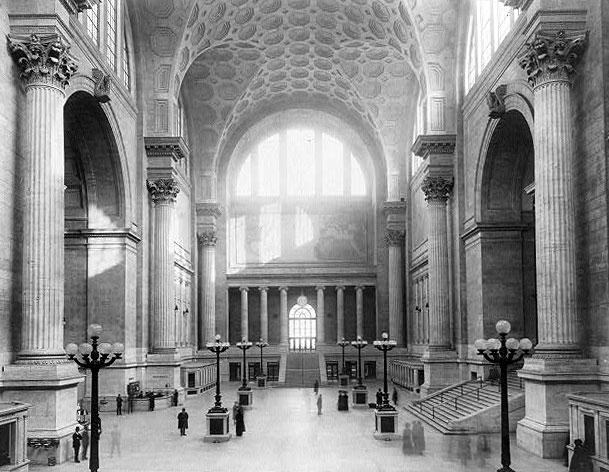
That said, lower Manhattan is my favorite part of the city, and I tend to like breathing in the vital spirit of its streets when I walk two blocks from the PATH station to the subway. The NJT train, by constrast, drops me off in Penn Station, the product of one of the heinous crimes against architecture in America's history. Penn Station had once been a marble monument to the ascendancy of the Iron Horse, the kind of building to make a beautiful ruin to be admired many centuries hence. Instead, it was the victim of the wrecking ball in the 1960s, and it effectively became the basement of Madison Square Garden, a building with all of the dead-eyed monolithic functionality of modernism and none of its daring invention. Its ceilings are quite low, making a tall person like me feel antsy and claustrophobic. It really does feel like a low-rent basement, and its full of low rent chain eateries and stores. Today I saw the K-Mart in its depths for the first time, the store that embodies my childhood spent subsisting on shitty, cheap clothes. For a functional space, it is remarkably dysfunctional. The track numbers for trains leaving the station usually aren't announced until a few minutes before they leave, which at the end of the workday means frantic, pushy crowds dashing madly once the number is called in an atmosphere of rushed nervousness.

Despite these complaints, though, there is nothing quite like train travel, the most relaxing way to get where you're going. And as much as I might moan about the pushy, rushed nature of my commute, there is nothing to compare to sitting back in a gently rocking train car, waiting to be transported on a clear morning into the beating heart and throbbing crotch of American ambition.