Wednesday, August 17, 2011

Musical Interlude: Sixties Beat Boom

I made it a practice on my old blog to throw in posts based on whatever music I was listening to at the time. Initially I thought that I was not going to do that here, and stick to long form essays. I then remembered how much I enjoyed these little breaks, and so I return with the first musical interlude for Notes From the Ironbound.

I came of age musically in the second half of the 1980s, perhaps the all-time nadir of American popular culture. It was the high point of glammed-up, spandex-encased hair metal a la Poison and Bon Jovi, and overproduced saccharine pop a la Rick Astley and Whitney Houston. (At the time Bill Hicks pretty well summed up the crapitude of what was on the radio.) I found safe refuge in two vastly different genres: hip-hop (which I called "rap" back then) and sixties guitar pop.


I was reminded of this love on the road to Pittsburgh last weekend, when my iPod cued up "Heart Full of Soul" by The Yardbirds. This has led me down a rabbit-hole of sorts, blowing the dust off of discs that I haven't listened to in a long time. Most folks know the Yardbirds only as the launching pad for Eric Clapton, Jeff Beck, and Jimmy Page. (Little known fact: Led Zeppelin were originally called "The New Yardbirds.") While I love a lot of the subsequent stuff that this trio of guitar wizards produced, I appreciate the Yardbirds for adhering to the principles of compact songs and a strong beat. (I love the mighty Zep, but I do not want to hear a twenty minute drum solo by anyone, not even John Bonham.) "Heart Full of Soul," with its fast breaks and galloping spaghetti western theme vibe manages to bring it all on home in just two and a half minutes. I like them best, though, for their British Invasion takes on American blues. Instead of merely ripping off or weakly imitating the original blues standards, they make them something unique and different. The epochal "I'm a Man" and the absolutely propulsive "I Ain't Done Wrong" are my favorites in this regard. The former's reworking of the stellar Bo Diddley grinder into a stomping anthem followed by a feedback assisted express train was pretty much xeroxed by The Count Five on another gem of the era, "Psychotic Reaction."


The mid-sixties were just chock full of bands churning out killer tunes with three chords and a lot of moxie. Some of these groups, like the Kinks, progressed beyond the caveman riffs and thumping beats to rock operas and long careers. Others, like the Troggs, burned hot and bright with a handful of classic singles before being pushed aside by the rise of classic rock in the late sixties. Many rock and roll bands have described young lust, but none nailed it with the properly leering face and bulging crotch of Reg Presley and the Troggs. Fer cryin' out loud, they had a song called "I Can't Control Myself"! The fact that they delivered these dirty ditties in matching striped uniforms -like a gang of badass carnival barkers- made it that much more perverse.


Back on these shores suburban garages and urban neighborhoods spawned legions of young bands who may not have had long careers or great albums, but were able to put together one or even a half dozen three minute masterpieces. The Seeds had a special kind of menace on classics like "Can't Seem to Make You Mine" and "Pushin' Too Hard," a freaky song that Alice Cooper wishes he could have written. They had plenty of competition in the garage band world at the time from the likes of Paul Revere and the Raiders, The Blues Magoos, The Standells, and The Electric Prunes. They are footnotes to musical history, but a lot more interesting than plenty of what's in the canon and what gets played on oldies radio stations.


Back in the late eighties when I was starting to dig sixties music, there were two groups I loved best: the Beatles and the Monkees. In fact, it was the Monkees who were my gateway into sixties rock and roll after MTV started airing reruns of the TV show, which I watched religiously. I didn't know at the time that the Monkees were a made-for-TV attempt to cash in on the Fab Four's runaway success. It didn't matter then, and it doesn't matter now, cuz The Monkees have a lot of great songs to their credit. Hell, it doesn't matter that they didn't play their instruments on their first two albums because they had great studio musicians laying down the tracks and top songwriters penning the tunes. Case in point: the best Byrds folk-rock riff of all time is actually on "Last Train to Clarksville." Once they got more creative control they produced some far-out awesomeness, like "Randy Scouse Git" and "The Porpoise Song." It's easy to put down the Monkees, but they deserve a spot with their '66-'67 peers.

If I had any musical talent, I'd start a tribute band called The Substitutes (in reference to the Who song) to play covers of this music while being clad with sharp toed boots, tight black jeans, a houndstooth jacket, skinny tie, and dark sunglasses. I still can dream, can't I?

Monday, August 15, 2011

In Praise of Urban Neighborhoods


Years of experience and living in a variety of places, states, and countries has taught me that no matter what region or place I live in, I will be happy as long as I live in a distinct neighborhood. Living in a real neighborhood, like I do now, allows me to walk to go grocery shopping, to be a regular at local establishments, and to feel like I am a human being amongst other human beings.

The beauty and meaning of urban neighborhoods was brought home to me in two very different ways this weekend. I drove to Pittsburgh to visit some old friends, and was astounded by the city's beauty and livability. It was a city on a human scale. Built on valleys and steep hillsides of three rivers, the city naturally divides itself into unique neighborhoods. Its daunting geography may very well have saved Pittsburgh from the horrors of "urban renewal." While I was gone in Pittsburgh, I got the sad and shocking news that a building in my neighborhood burned down in a massive four alarm blaze. (Luckily, nobody died, and only a few were hurt.) The fire left fifty-eight people homeless, and in a testament to the bonds of community, money is being raised locally to help the victims. Two local businesses were consumed by the blaze, and as sad as that is, it is worth noting that people feel a loss. The same would probably not be said if it were a McDonald's that met the same fate.

The American Way of Life over the last seventy years or so has been one big massive assault on neighborhoods. The new cities that have sprung up in that time are built around the automobile, and those cities that came into maturity before the auto age have been gutted and dismembered by the mad zeal to accommodate the internal combustion engine. In the process, countless neighborhoods were demolished, and the roads helped spur the seemingly endless process of suburban sprawl. Only the recent housing collapse could stop the metastisization of the subdivisions.

Suburbanization allows for tight-knit neighborhoods only in rare cases. Usually it creates a world of people segmented into their own private little boxes, and where there aren't even sidewalks to walk on. I know from my experiences and those of others that travelling by foot or bike in America's sprawl zones isn't just difficult, it often means being heckled by assholes driving by in their cars. Increasingly, Americans are tied down to their homes and do little outside of them. To cite one striking example, kids don't play outside with other kids in their neighborhood like they used to, but are more likely to stay indoors or participate in structured activities. I will admit that there are suburban neighborhoods out there with real community, but the very geography and culture of suburbia work very hard to prevent them from blossoming.

Believe it or not, the prophets of the current American Way of Life had high ideals, rather than visions of shopping malls in their heads when they pushed the freeways and "urban renewal." One of the first advocates of the "radiant city," the Swiss modernist architect and city planner Le Corbusier, even proposed demolishing central Paris and replacing it with modern high-rises surrounded by parks and highways. (This was the so-called Voison Plan, one of the greatest assaults on humanity from where I stand.) Plans such as this were intended to liberate city-dwellers from the noise, confusion, disorganization, lack of air, and overcrowding that often accompany urban life. Who wouldn't want modern convenience in the midst of beautiful park space?

As is usually the case, it was the poor who got to be the guinea pigs in the experiment practiced via postwar public housing high rises. The people who were warehoused in these structures lost access to neighborhood living, with the inevitable alienating effects. A few patches of green were not going to make up for that. The white middle class, on the other hand, sprawled out in the ever-expanding suburban hinterlands. That phenomenon too had been predicted in advance with much fanfare and optimism. At the New York World's Fair in 1939, the most popular exhibit was Futurama, sponsored by General Motors. It predicted a future of megahighways and integration of urban and rural space. It was hardly surprising, of course, that GM portrayed the automobile as key to a liberated future. In a related fashion, the central exhibit of the entire fair was a diorama called Democracity that imagined a modern "radiant city" full of parks and bereft of neighborhoods. The imagined everyday "man" of the script worked in the center among the high rises and drove through landscaped parkways to his house at the edge. In these visions the neighborhood was absent. Like traffic, noise, and crowding, it was just another annoying and messy facet of urban life to be liberated from. I am sure that I am not alone in thinking that our current American Way of Life has not brought what it promised at its birth.

I actually feel strangely liberated living in a place where I can't help walking the streets as part of my daily routine. It's much more fun walking the dog when other people are taking their children out on their post-work/pre-dinner errands and the little ones light up with delight and yell out "bow wow!" when they see my dog. (She likes kids, and sometimes allows groups of kids to pet her while she sits still for them.) If I need to grab a little something at the grocery store, there is no ordeal of driving someplace else just to get a carton of milk, I simply walk three blocks to the local supermarket.

I also get plenty of free entertainment. Due to the cosmopolitan nature of where I live, international soccer tournaments bring a lot of fun. Right after Uruguay won the Copa America, a bunch of people wearing blue and white and carrying the Uruguayan flag converged on my corner, had a little party and sang their national anthem, and quietly went home. What struck me most was that practically everyone, from the revelers to the police who showed up to the bemused bystanders, was smiling. How can you beat a totally spontaneous moment of happiness on a Sunday afternoon? I'll take that over ready access to an Appleby's every time.

Rick Perry's Texas Hustle

Some new stuff is coming soon, but until then here's a relevant piece from awhile back.

*****
Yesterday my state's illustrious governor and defender of "states' rights" came to my campus to speak and hawk his book. Unfortunately, I was in a meeting, and so I could not ask him directly how he can claim to be against a meddling government when he opposes gay rights and abortion rights while forcing all state university professors to put their student evaluations and syllabi online and calling for predator drones to patrol the border.

In any case, in recent weeks Rick Perry has been busy taking his message outside of the Lone Star State, even to the Daily Show. I am constantly amazed at how much credibility he seems to get outside of Texas, as if he is some kind of innovator worth listening to. Perry is in fact a practiced political hustler of the smoothest and lowest sort. His state does not provide a shining example to the rest of America. In fact, it is a good example of how the hard Right's neo-Gilded Age ideas benefit the few at the expense of the many. I am getting tired of the kid-glove treatment that Perry gets fromt the national media, and the false narrative that his leadership of Texas presents some kind of success story. It's hard even to know where to begin, so here's a quick bullet-point list:

In my experience living here, I've found Texas to be like Alabama with oil and better roads. The Texan penchant for bragging and self-importance seems to have obscured that basic reality from the rest of the country.

Tuesday, August 9, 2011

In Defense of Teachers

Here's a topical re-run from my old blog that I'm quite fond of. Each new day brings more attacks on the teaching profession, attacks given voice by a news media that is notoriously shallow in its analysis. I am glad that Matt Damon's recent comments have been given a wide circulation, but the discourse still needs to be shifted.

*********
The journalistic world is a highly predictable entity; some social issues have been discussed with exactly the same tropes as long as a I can remember. Case in point is education reform, which is nearly always portrayed as a battle by innovative administrators trying to change the system for the better who are arrayed against intransigent teachers and their obstructive unions. The New Yorker has published several such articles in recent months, including a profile this month on Arne "Katrina is the best thing that happened to the New Orleans school system" Duncan. According to the standard trope, our current ranks of teachers are lazy time servers who refuse to make the necessary changes to rescue the education of our children.

Today I'd like to defend teachers, and to ask the media to consider the voices of actual teachers in their reporting.

This article, like practically every other I've ever seen, does absolutely nothing to consider the thoughts of rank and file teachers. Union reps might be consulted, but they are usually speaking in their capacity as labor leaders, not classroom leaders. There's also an assumption that all teachers who support the union are goldbrickers. This is simply not true. My mother, little sister, and wife are all teachers who put in 50 hour weeks and constantly look for new ways to engage their students. They also all happen to be active in their respective unions.

According to the standard narrative, this is a gross contradiction, but it's not when the realities, rather than myths, of the classroom are considered. Rather than avoiding change, teachers are forced to change every two years or so with the pedagogical seasons and with whatever new half-baked idea that their administrators foist on them. School administration itself is a highly volatile profession whose members are constantly looking to climb up the greasy pole towards more prestigious jobs. To do so, they must burnish their resumes by applying whatever new trend happens to be in vogue at the time to their faculties. The teachers, who actually know the classroom and through years of experience have gained an idea of what works, get understandably resistant under these circumstances.

Case in point: the government and large portions of the media pushed the test-centric No Child Left Behind initiative, but at the time I did not know a single teacher who thought it was a good idea. Guess who was right?

So please, members of the journalistic profession, stop being so lazy with your reporting. Do not take the sanctimonious drivel spouted by school administrators at face value. The majority of them are careerist hacks who care much more about enlarging their power than improving education. Actually take the time to talk to career teachers, and stop assuming that they are inferior to 22 year old Ivy League graduate Teach for America types, who make up in arrogance what they lack in classroom experience. Stop treating teacher unions solely as defenders of shiftless layabouts; the NEA and AFT often deserve criticism, but hard-working teachers support these organizations because they are the only thing protecting them from capricious administrators and fickle parents. On the last point, start levelling your sights on parents, too. They block meaningful change by howling whenever their precious snowflakes are held to high standards by teachers. Perhaps worse, they are failing to get their children to read outside of school or develop any kind of respect for knowledge. When children are raised to be secure in their stupidity, there's not much a school can do for them.

Monday, August 8, 2011

Using Economic History to Understand the Present

For many years I found economic history to be boring and dull, and generally avoided it as much as I could. However, ever since the crash of 2008, I have become fascinated by economic history, mostly because it provides some very useful ways of interpreting our current crisis. You hear a lot of people compare our current situation to the 1930s, but I think it is best to go back further, to the original "Great Depression" between 1873 and 1896. (The term actually dates from that period.) It was a time of extreme volatility exacerbated by the fact that both major political parties refused to break with conventional thinking that favored austerity and limited government action in the economy.

Although there was economic growth and many advances in industry in this era, the economy worldwide was put through horrible convulsions in 1873 and 1893. In America, both financial collapses were brought on by investor panics once the money-men realized that they had overvalued their stock in railroads. Substitute "railroad stock" for "mortgage financed derivatives" and voila, you have something akin to the 2008 financial collapse. If you look at the history of modern capitalism, such sudden financial collapses are quite common: 1819, 1837, 1857, 1873, 1893, 1907, and most famously, 1929. They are not anomalies, but the norm.

As these events well demonstrate, when capitalism is not reigned in, it is a catastrophic force, a kind of economic hurricane, what its proponents like to call "creative destruction." One of the great stories of the twentieth century is how modern industrial societies managed to balance capitalism's economic advantages with social protections that helped shelter the masses against its worst excesses. Those generations who endured the Depression knew that the beast had to be kept under control, and heartily supported the New Deal. For that reason, in the United States there were no banking collapses from 1932 until the S&L crisis of the late 1980s, after the Depression-era restrictions were being lifted. Contrary to what the free marketeers prophesied, the economy grew at unprecedented levels in the post bank regulation period, despite these supposedly deleterious encumbrances. This growth, because of better tax and social policy, did much to benefit the middle and working classes, rather than the wealthiest (as the following graph illustrates.)

Since the Reagan era, that commitment to balancing capitalism with regulation and a solid social safety net has been abandoned. As Jefferson Cowie has shown in his brilliant work on the working class in the 1970s, Stayin' Alive, the seeds were already being planted in Carter era. When faced with the first sustained economic decline since the Depression, Carter and Congress both prioritized staunching inflation over unemployment. This ought to ring a few bells in light of our political class's obsession with deficits at a time of crushing joblessness. As Cowie also discusses, the late 70s saw new corporate attempts to break the power of organized labor, along with the latter's arrogant inability to muster a proper response. We now live in an era where unions are scarce and with the likes of Scott Walker in power, the right to bargain itself is being threatened. With the social state being gutted and workers losing union protections, we are going forward into our Gilded Age past. This has been going on for about thirty-five years, but critical mass has now recently been achieved. Corporate capitalism is the only game in town, hence the president's inability to get tax raises or even elimination of subsidies to oil companies in his recent compromise with the GOP.

In some ways, Gilded Age II could shape up to be a lot worse than the first time around. At least back then, the United States was becoming the foremost industrial nation in the world, something that is far from the case today. According to Judith Stein's recent economic history of the seventies, Pivotal Decade, national trade and economic policy encouraged the growth of the financial sector and neglected industry, which fell into permanent decline. Our economic wagon has been hitched to the lame horses of real estate and finance. The former is dead in the water at a time when there are empty homes all over suburbia, and the latter still sees plenty of profit, but contributes almost nothing to the wider prosperity of the nation outside of Wall Street. The service economy has grown in the last three decades, but now that's hard to sustain when such a large percentage of the population can no longer afford to spend money. The years of easy credit masked that problem brought on by our gross social inequality, but those days are over. Nowadays luxury stores are booming while the rest of the economy is getting whacked. With no new economic stimulus, either from the government or private sector, coming to increase demand by the real job creators in the middle and working classes, we can just expect more austerity in an attempt by corporate America and their paid political lackeys to bring globalization home. Why outsource cheap labor to foreign nations when you can have exploited, low-wage labor right here in America?

Right now I think that most people, even those worst affected by the current crisis, are too politically disengaged or justifiably disgusted with the political system to bother raising hell over any of this. Instead we have an astroturfed Church and King mob in the form of the Tea Party, taking its marching orders from the trumpet of corporate propaganda, Fox News. However, we should remember one last tidbit of economic history. The French Revolution began with a debt crisis, debts run up because of war bills and a state that did not really tax its richest subjects (sound familiar?). I don't see anything so dramatic coming soon, but the lords of finance might want take heed of history when they keep supporting our worsening social inequality.

Friday, August 5, 2011

It's A Ditch Trilogy Kinda Day

Today I got the startling and upsetting news that the publisher who I had a contract with for my book is dropping me. (I looked at the fine print, and yep, they can just cold do that.) That hurt less than the comments by one of their readers, which were painfully critical. My run of happiness since moving here to New Jersey seems to have hit the first real snag, it seems. Anyway, I thought this would be the perfect occasion to re-introduce some favorite material from my old blog related to another time I felt rotten. Enjoy.

******

The cold front that has struck this week couldn't have come at a worse time. I am aware that I am lucky to be living far enough south to avoid the blizzards, but I typically rely on the nice weather here in the early months of the year to counteract their inherent awfulness. January and February are by far the worst months of the year, and this year more so than usual. I'm prone to getting the blues already, and recent developments in my life have only made that tendency more pronounced.

To counteract these feelings, one can either try to feel better, or just wallow in depression in order to get through it. I find that music is a good tool for either option, and when I want to wallow, nothing beats Neil Young's so-called "ditch trilogy." This is the term for three of his mid-1970s albums: Time Fades Away, On the Beach, and Tonight's the Night. He made them all in the aftermath of his mega-successful Harvest album (which, apart from a couple of great songs, is not that all that strong), which had put him in the middle of the road. In his words, he followed it up with some time in "the ditch."

It's some harrowing stuff, reflective of the times, which today seem so much like our own. In the larger world, this was the era of Watergate, stagflation, and the death of the sixties dream. In Young's life, people close to him had died from overdosing on heroin, a drug that represented the degeneracy of hippie mind expansion into 70s numbness and self-absorbtion. It's a soundtrack of malaise, disillusionment, and bitterness, things that are all too real for me and a lot of other people in this country these days.


The first album in the trilogy, 1973's Time Fades Away, is a live album that has been out of print for decades. One of the many reasons that I love my wife is that she managed to track down and buy a vinyl copy for me for Christmas a couple of years ago. I've heard various reasons why it hasn't been re-released, from speculation that it is a document of a time Young would rather forget, that he is dissatisfied with how it sounds, or that he simply thinks it's low quality. The shows are from his post-Harvest tour. The stadium crowds probably expected a mellow-folkie experience intended to evoke a "peaceful, easy feeling." Instead, they got a ramshackle, wasted depressive performing brand new material highly unsettling in nature. The cover is almost a kind of joke: there's a long-haired bearded guy in front of the crowd flashing a peace sign, totally unaware of what he is going to have inflicted on him.

Despite the fact that his distinctive voice cracks and the band sounds stretched to the limit, the music is actually quite lovely. His solo piano rendition of "Journey Through the Past" is the kind of wistful ballad that so many other songwriters have set out and failed to write. The best might be the closer, "Last Dance," a kind of lament for the soul-crushing nature of the workaday world. In the midst of all its thrashing, there's the hope that the painfully banal quotidian rat race can actually be transcended.

No such hope is present on the next album, the harrowing Tonight's the Night. This one might be too depressing even for me to handle. Evidently ol' Neil thought so too, he recorded it in 1973, but it didn't get released until 1975. Despite the fact that it's not three chords and a cloud of dust rock'n'roll, it's one of the most punk rock records ever made before punk. Voices crack and shatter, songs limp to their finish, and all is pervaded by an air of don't-give-a-fuck ennui. ("Albuquerque" is exemplary in this regard.) The album, especially the title track, deals directly with the heroin casualities in Young's circle, roadie Bruce Berry and Crazy Horse guitarist Danny Whitten. The only song on the album that doesn't rip into the listener's soul is the live rave-up "Come on Baby Let's Go Town," which actually becomes more depressing when you realize it's Whitten on vocals and guitar. Of all the songs on this album, "Tired Eyes" resonates with me most, especially the key lines, "he tried his best but he could not."


The last album in the trilogy, On the Beach, is actually my favorite. Of course, "favorite" is a tricky word to use with something that boasts dark stuff like "Revolution Blues" and "Ambulance Blues," both fitting eulogies to the death of the sixties with the proper level of bitterness attached. After all, the key phrase of the latter song, referring to the counterculture, is "you're all just pissing in the wind." Despite the presence of such sentiments, the listener actually gets a little hope. The opening track, "Walk On," has become a bit of a personal theme recently. Listen to it and you might figure out why, since the first lines are "I hear some people talking me down, bring up my name, pass it 'round."

Tuesday, August 2, 2011

On Vacation with the Civilian Conservation Corps and Captain America


I had the good fortune to be on vacation last week during the height of the Debt Ceiling Hostage Crisis, and so spent much time camping, hiking, and kayaking in the plains, forests, and hills of Nebraska and South Dakota, rather than obsessively reading news off of the web and wanting to scream until my voice box shredded. Instead of following the minute-by-minute reports, my sojourn into nature prompted some deep reflection and some surprisingly relevant tourist destinations.

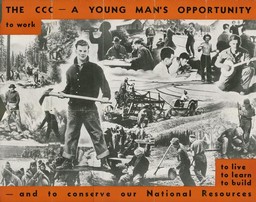
All along our travels, we found constant reminders of the New Deal and its legacy of public works. Our first stop was camping in the Nebraska National Forest, located near Halsey. (Yes, that's right, a national forest in the treeless Nebraska Sand Hills. It was a successful experiment in learning to grow trees on the arid plains.) Although the forest began in the Progressive Era, the Civilian Conservation Corps made a great number of improvements on it, turning it from a laboratory for forestry into a great place for camping. Growing up, my family often stopped there on our trips west, and enjoyed picnic lunches in the shade, and I never knew that the CCC had made it all possible.

Further down the road, we stopped at Fort Robinson, in northern Nebraska, another great site that benefited from CCC labor. Later on we visited the magnificent Wind Cave in the Black Hills, and found out that the cement walkway that allowed larger groups of tourists to visit had been built in the 1930s by, you guessed it, the CCC.

For those of you who don't know, the CCC was a New Deal program that hired unemployed young men to make improvements on public land. Although it is less well-known than the WPA, TVA, or PWA, it is near and dear to my heart because without the CCC, I might not be here. My grandfather lost his farm in the mid-1930s, and found work through the CCC, which may very well have saved his life. It makes me proud that he was part of something that created lasting places for his grandchildren and great-grandchildren to enjoy. However, it also made me sad that in the midst of our greatest economic calamity since the Great Depression, we are not putting the unemployed to work by building up public works, we are instead putting people out of work by gutting our public institutions. Today we have the power to create a new CCC, to get the jobless back to work through public works, and to create lasting parks, pools, roads, and bridges that future generations can benefit from.

Yet such a plan isn't even being discussed in the halls of power.

In many ways, the events in Washington this last week show that the spirit of the New Deal, and any sense that public institutions and the public good are things to be cherished, may finally have been squelched by the avaricious spirit of Reagan and his disciples. I wish that all the folks who live in supposed "red states" and enjoy the parks built with CCC labor every weekend thought a little deeper about how these cherished places came to be in the first place.

It was also on vacation that my wife and I saw Captain America. We had spent a very hot and tiring day canoeing down the Niobrara River, and were in no mood to sweat and get eaten by bugs at the campground. Luckily, tiny Valentine, Nebraska, has a twin cinema, and we were able to cool off by watching one of the more adroit and entertaining superhero movies I've seen in awhile. (I must add, though, that the historical anachronisms, especially the portrayal of a racially integrated military and empowered women in WWII, are highly problematic. For more on this, read what Chauncey has to say.)

It seemed strangely appropriate to me that this film would be released when the American empire was about to die from a self-inflicted gunshot wound. As hokey as this sounds, I did like the fact that Steve Rogers was so willing to sacrifice himself for his country, since that sense of shared struggle and common good seem to be dead at a time when a political faction is willing to hold the nation's economic future hostage to win a presidential election. Our myths about World War II deemphasize the real divisions and fissures on the home front (Japanese Internment, Zoot Suit Riots, 1943 Detroit Riot, etc), but at least in many other times of crisis our leaders have been willing to stop acting like selfish children and work together for the common good.

Although Captain America is a product of Hollywood's globalized entertainment capitalism, it like the CCC sites was a potent reminder that things don't have to be this way. I am not confident that much will change, but the inspiration for a nation better committed to the public good, rather than the Teabagger ideology and its corporate sponsors, is waiting there for us to discover in our forests, caves, bridges, and swimming pools.