Showing posts with label world affairs. Show all posts

Sunday, July 17, 2016

The Fear


Time to get a little personal today, because I am not made of stone. I have spent every day since July 6th in a perpetual state of anxiety over the fate of the world. I have been getting what the great Hunter S Thompson referred to as "the fear." It started on the 6th when I watched the video of Alton Sterling's killing at the hands of the Baton Rouge police. Two years ago after watching Tamir Rice get killed by the Cleveland police I resolved never to watch one of those videos again, because the images from Rice's death have been haunting my idle thoughts ever since. In Alton Sterling's case I suddenly felt some kind of duty to bear witness, and it was much more horrifying than I could have imagined. I soon learned of Philando Castile's murder, which was just as horrifying. I spent a good half hour that day sobbing in front of my computer, feeling helpless. Every day since has been full of some kind of horror.

Having the summer off, I am stewing in the misery. I am on Twitter all day, and if an hour goes by when I am not, I wonder what new horror awaits me. On Thursday I checked in on the news before leaving for an evening session at the gym. Once I got there the slaughter in Nice was plastered all over the televisions. That night I finally cracked a bit. The recent events were already building on things that had been shaking me, from the mass murder in Orlando to Brexit to the continuing prospect of a Trump presidency. I am fairly skeptical about the power of prayer; I tend to think that the unseen force that animates the universe cares little or not at all for the fate of humanity. (If it did it would have a lot to answer for.) But Thursday night I walked out of the gym slathered in sweat, walked across a baking parking lot, got into my car, and fervently prayed. In that moment I again felt completely helpless.

Of course, things only got worse. That night the president's televised roundtable on police violence was terribly framed, and only served to make everyone mad at him and to confirm them in their opinions. I knew watching it that nothing was going to change. The next day the attempted coup in Turkey led to hundreds of dead and the possibility of an authoritarian crackdown by Erdogan. Today after an hour away from Twitter I learned of the murder of three police officers in Baton Rouge.

It is not just that horror seems to pile on top of horror, it is that there is no end in sight. Every terror attack gives more and more power to the forces of bigotry. In Europe and America the reactionaries are using the violence for their own ends, just as much as the radicals are. The likes of Le Pen, Fortyn, Gingrich, Boris Johnson, and Trump exult in the blood of the innocents, calling for eradication, deportation, and "law and order." All the while restricting access to firearms is off of America's political table, making more mass shootings an inevitability. The murder of police officers is making attempts to hold police accountable even more difficult. That will mean more killings by edgy police, and then probably more killings in return. Even if Trump loses, the politics in this country are so divided that nothing will change for better. Nothing. Things will only get worse. Trump has introduced white supremacist nationalism into the American mainstream, and as whites get more resentful in a nation that's less white, their anger will only get more powerful. Calls to deport or strip basic rights from Muslims have also been normalized by Trump. And if Trump wins...well, my mind cannot bear to contemplate such a catastrophe.

American politics will only get more uglier and more violent. Europe will only get more xenophobic. Erdogan will only get more authoritarian. Russia and China will only get more nationalistic. The mass shootings will only get bigger and more common. The center will not hold. Time for a beer.

Tuesday, July 5, 2016

Breaking Point Or Crossroads?

British soldiers during WWI in Ypres, Belgium

Looking at events in the world today I can feel the tectonic plates of history shifting beneath my feet in ways I have rarely felt. What is happening does not seem to be the usual tumult of world affairs, but something different and deeper.

As I mentioned on the eve of the Brexit vote, we appear to be heading to the end of the post post-Cold War world. Plenty of folks, including yours truly, have mocked Fukuyama's "end of history" thesis over the years, but now we seem truly to be at the definitive end of a world where someone could think that global capitalist democracy was the only ideological game in town. Nationalism and Islamism (and nationalist Islamism) are driving world events, and the Left has been reawakened in countries dominated by neoliberalism in recent decades.

The old political consensus in the West simply is not holding. Brexit may very well lead to the end of the UK, and the vote has shaken the major political parties there to their core. The EU's validity as an institution is in serious doubt. In Germany nationalism has crept back into the political mainstream for the first time since 1945. A far right candidate may very well achieve the presidency in Austria, and nationalists with an undemocratic bent have taken over in Hungary and Poland. In America a nationalist television personality gained the Republican nomination, and a socialist (well, at least he calls himself that) came close to getting the Democratic nomination. Congress has refused to even consider the president's nominee to the Supreme Court, an unprecedented act that would have spurred a constitutional crisis in less tumultuous times.

I look at all of this, and wonder if we are at a historical crossroads, or a breaking point. It is definitely one of the other. In terms of a crossroads, perhaps we are seeing something similar to the early 20th century, when the strains of laissez-faire capitalism and fear of worker uprising led to reform. In America this is referred to as the Progressive Era, but similar changes occurred in Europe as well, when voting rights and worker protections were expanded. We seem to be at a similar point, where forty years of neoliberalism and globalization have drained resources from the masses and funneled them to the wealthy. If you look at the income gap in the United States, it currently resembles that of the Gilded Age more than it does the postwar period. I doubt that the political status quo can be maintained under such economic conditions. There's a chance that in fifty years the Occupy movement of 2011 will be seen as the harbinger of a new era.

Unfortunately, the forces for political change in the West on the right are currently much more powerful than those on the left, as Brexit, Trumpism, and recent elections in Eastern Europe have shown. These forces also seem to have little use for the current world order. The lack of credibility possessed by the elite maintaining the global order only gives more fuel to the fire of the likes of UKIP, Trump, and Victor Orban. I can very well see a breaking point on the horizon, a world of closed borders, diminished or shredded international institutions, and perpetual war. The film Children of Men may turn out to be quite prophetic.

That might sound alarmist, but historically people have not been aware of the changes building up around them, until they explode. Few predicted the collapse of Communism in 1989. Few if any foresaw a world-altering revolution when the Estates General were called in 1789. When the guns of August of 1914 sounded, most did not anticipate a political and cultural earthquake that would level empires and engender revolutions.

I have been avidly reading Vera Brittain's Testament of Youth, her memoir describing her experiences in World War I as a nurse. She talked about how the news of the coming war barely registered with her in the summer of 1914. By the time it was over, she lost her fiancee, brother, and two of her closest friends, and everything seemed to have been changed forever. Obviously no war on the scale of the Great War is currently raging, but I do wonder if we are indeed stepping into a new political world. Are we too sleepwalking into the abyss? Time will tell, I guess.

Wednesday, March 23, 2016

Brussels And The Power of Nightmares

David Ortiz's fearless and unifying response to the terror attacks in Boston is one we ought to emulate, not the fearful hate mongering clogging up the airwaves today

After the attack in Brussels yesterday we saw the ever more predictable response. (Note as well we didn't see this response after similar attacks in Mali, Burkina Faso, and Turkey.) Trump renewed his calls to ban Muslims from entering America and use torture. Ted Cruz, ever the eager Eddie Haskell trying to curry favor with the talk radio masses, proposed that law enforcement "secure" and "patrol" Muslim neighborhoods within our own borders. If there is a similar attack in this country I can expect that internment camps will be Republican orthodoxy within a matter of days.

Of course, this kind of stuff only helps the extremists who plan these attacks. As anyone except the American news media appears to know, terrorism is a tactic intended to provoke a disproportionate response that will hurt bystanders and thus get the people affected to support the cause of the terrorists, which they would normally find to be too extreme. "Carpet bombing," torture, and mass detentions plays right into the hands of terrorists. Of course, Trump and Cruz could care less, since fear is their biggest selling point, especially for Trump. When people are afraid, their lizard brains kick in and they become children, looking for mommy or daddy to protect them. Authoritarians like Trump know this, and feed off of it.

Keep in mind, however, that Trump and Cruz are merely less subtle practitioners of this dark art, which had been mastered by Dick Cheney and his crew of neo-cons. I've said it before and I will say it again: the most important political documentary of our times is the BBC's 2004 tour de force The Power of Nightmares. In three parts it tells parallel histories of neo-conservatism and Islamist extremism. The basic thesis is that after the failures of the political elite to improve the lives of their constituents, many of them turned to using fear of the other as a justification for staying in power.

Dubya and his handlers certainly understood this. Before 9/11 he was a semi-legitimate president whose one accomplishment was pushing through tax cuts for the wealthy that had little broad support. He exploited the attacks (which his administration had failed to prevent) to both gain popularity and re-election, and also to make the neo-con wet dream of invading Iraq to come true.

While Bush, Cheney, and their gang used the power of nightmares to advance an imperialist agenda under the auspices of "preserving freedom" and "expanding democracy," Trump and Cruz are more nihilistic. Cruz seems willing to say anything if it will appeal to the hardcore conservative base (hence his "New York values" comment). He knows that these people hate and fear Muslims, and speaks to them accordingly. Trump, I am more convinced, is not putting on an act. I really and truly think that he is a committed fascist, even if he wouldn't use that term. (More on that in a future post.) Like any good fascist, he wants to "cleanse" the nation and make it great through military conquest ("we're going to take their oil!") Increasing fear only helps him.

People who are usually level-headed can lose their minds in moments like this, driven by the imperatives of their fear reflex. If we are to break out of the fifteen year nightmare we have been living in, we must stop living in fear and stop looking for some authoritarian daddy figure to protect us. If not, the nightmare will just keep going on and on and on.

Monday, March 14, 2016

Reports Of The Nation State's Demise Have Been Greatly Exaggerated

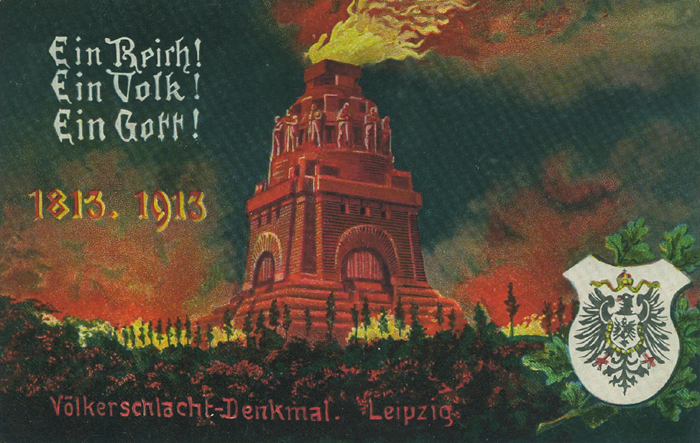
In 1913 world trade was at an all time high and Germany exported to the world. It also completed this massive nationalist monument. Globalization and nationalism coexisted then, and appear to still coexist now

I've spent a lot of time talking about Donald Trump in historical terms, but it's probably better to ground him in a present day, international context.  As I have been saying on repeat, Donald Trump's rise has to do with the power of American nationalism. I will add today that his appeal to nationalism is indicative of a rise in nationalism's impact worldwide. This I feel has caught a lot of people off guard, since globalization seemed to be bringing about the weakening of nation states. Of course, as any student of the past well knows, history does not move in a straight line. In 1913 the world looked as if it were globalizing, but after the bloody events spawned by 1914 levels of world trade would not return to 1913 levels until the late 20th century. Nothing guarantees that a similar shift is impossible today.

It already seems to be happening. Nationalism is on the march all over the world. In Europe anti-immigrant parties have gone from fringe elements to major political forces. Witness the National Front in France, UKIP in Britain, and Alternative for Germany, which won big in local elections recently. In Eastern Europe full on nationalists have won in Hungary and Poland, and Vladimir Putin has pitched his appeal in terms of national renewal. In India the Hindu nationalist BJP is in power. In China Xi Jinping has made nationalism a hallmark of his time in power. Even the famous non-state actors like Islamist terrorists have gotten in on the act, as ISIS strives (as its name suggests) to build a new nation-state.

We should not be surprised, then, that a politician like Trump has come around to exploit American nationalism, in yet another riposte to the silly notion that America is an exceptional nation. Based on what's happening in Europe, we should also not be surprised by who supports him. In both Europe and America nationalist politicians draw from working and lower-middle class voters anxious about their status. In Europe the traditional parties of the working class, like the SPD in Germany and the Socialists in France, were successful in setting up a robust welfare state, union recognition, and hybrid economy. Those ideas are now the political consensus, meaning that it is hard for those parties of the left to have much political ground to stand on. The nationalists offer a new scapegoat for their uneasy voters, and profit. In America the dynamics are a little different, as a combination of racist resentment by whites and the Democratic party's adherence to pro-corporate policies makes it hard for them to appeal to the white working class.

The nationalist wave in the West at least has everything to do with the consequences of the last four decades of neoliberal globalization. It created a new global elite, but also a system that shut out a lot of people who had been conditioned to prosperity in the immediate postwar period. The nationalists in Europe and America are not neoliberals in economics. They want to maintain a robust social state, but to do it for people "like us." The Left is in tatters and the progressive parties are often run by privileged members of the global elite, making so many voters easy pickings for nationalists. Part of the reason that Bernie Sanders has energized so many despite being a 74 year old with one real issue is that he is actually speaking to the discontents of globalization from the Left side.

The rise is nationalism is disturbing because I find it to be such a noxious, anti-humanist ideology. You could argue that it is the "ism" that killed to most people in the 20th century, responsible for the First World War and countless others, and the biggest ingredient in Fascism. It is crucial for the Left to reconstitute itself, because it is the one force capable of breaking the nationalist wave. Instead of hate and tribalism, the Left needs to once again preach the message of solidarity and humanity. Failing to do so will have disastrous consequences, I fear. Nationalists are never happy until they destroy the "enemies within" and start invading other peoples' countries.

Tuesday, July 22, 2014

The Return of Nationalism and A Multi-Polar World

The past weeks have been pretty dramatic when it comes to world affairs: ISIS threatening the Iraqi government, increased bloodshed in Afghanistan, Germany catching an American spy, Ukrainian separatists shooting down a Malaysian airliner, and the Israeli invasion of Gaza.  Beyond the surface headlines, there are bigger trends afoot.

One of those trends is the obvious loss of American hegemony.  Iraq and Afghanistan are American imperial adventures that have completely backfired, and there is little that can be done about it.  Despite Russia's erratic and violent behavior, the US is having a hard time convincing Europe to take action against Putin.

In fact, for the first time since the end of World War II, we are seeing the emergence of a multi-polar world.  Russia is reasserting its power, and rising China has been flexing its muscles with its southern Vietnamese neighbor and traditional rival Japan.  Ironically, this process was abetted by the administration of George W. Bush, which claimed to be making America stronger than ever before.  The failed operations in Iraq and Afghanistan exposed America's weaknesses, damaged its credibility, and have reduced the American public's support for aggressive foreign policy.  One of the great "what ifs" that will be discussed by future historians will be "what if Al Gore had not been cheated out of the presidency," not least because he likely would have continued the safer, multilateral foreign policy of George HW Bush and Bill Clinton.

While I am not a cheerleader for American hegemony, I do not look optimistically at the emerging multi-polar system either.  A multi-polar world lends itself to conflict, a fact scary to contemplate one hundred years to the month after the "July Crisis" of 1914 that led to worldwide war.  Nationalism provides the fuel for such fires, and gives the masses reason to cheer their troops on the road to the slaughterhouse.  After years of talk of globalization many observers have been acting as if nations are a thing of the past.  Russia and China put lie to that belief, as the Chinese government has whipped up anti-Japanese sentiment, and Putin is pursuing an ultra-nationalist foreign policy that calls for all Russians to be united, regardless of borders.

That kind of nationalism might seem paradoxical in a world of greater and greater global economic convergence, but it shouldn't.  After all, in 1913, on the edge of World War I, global trade reached new heights despite the rabid nationalism that would send the world into conflict.  Nationalism is an incredibly potent force, since it gives legitimacy to autocratic and undemocratic regimes, by riling up the masses and giving them a feeling of having a stake in the state.  While it is not the only game in town (just look at ISIS and its idea of Sunni state), it's still really, really important, and has been fatally ignored for too long.