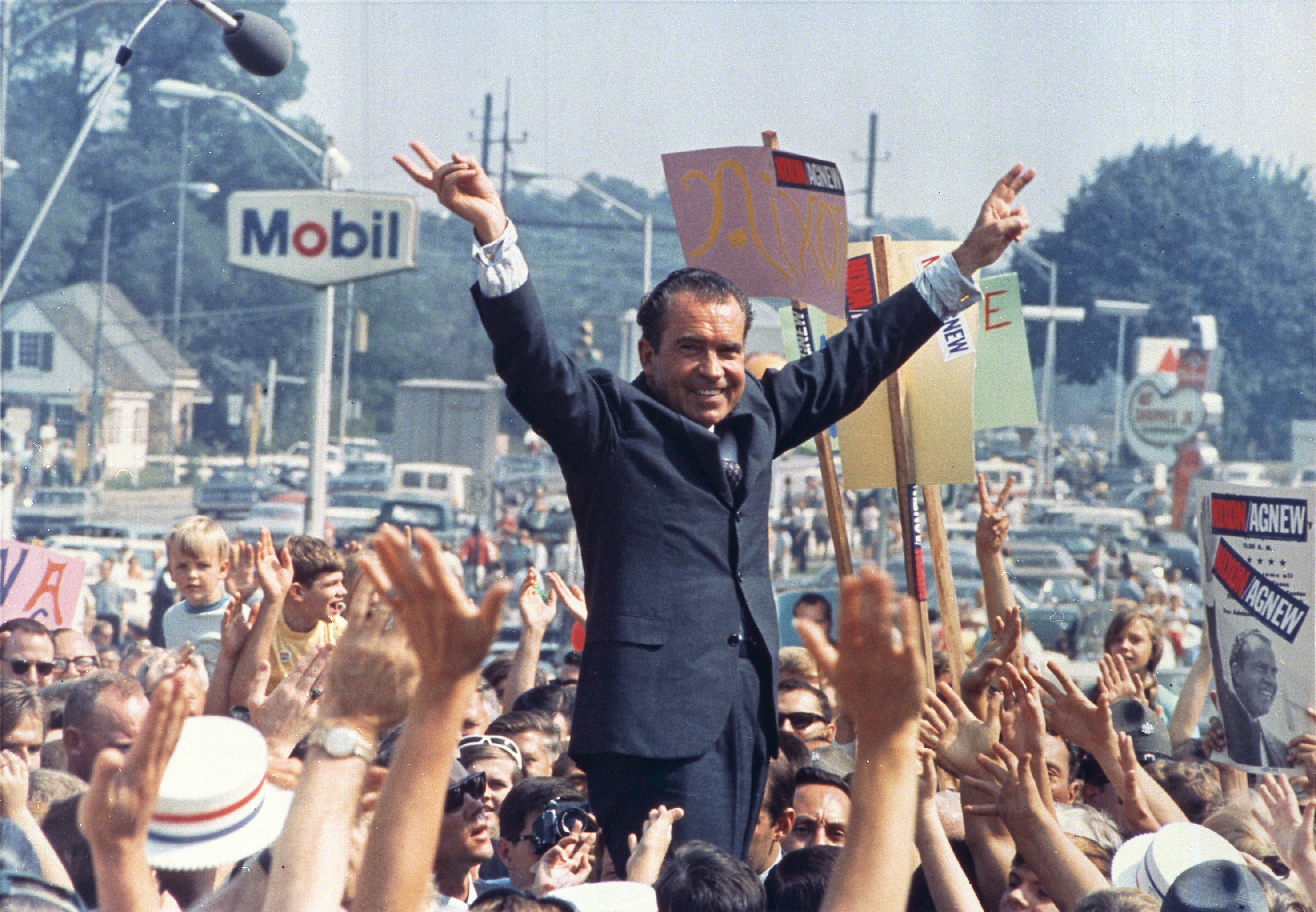
For this month's installment of the Top Ten retrospective I thought I'd look back at the eve of the election of 1968, perhaps the last election year as momentous as this one. (I should add that there was a lot more going on in that year than now, so it's not an equal comparison.)
10. Cream, "White Room"
Cream was pretty much the first hard rock group, or at least the one that set the template for so much to follow. along with The Jimi Hendrix Experience. Ginger Baker's drums stomp like a Stegosaurus and Eric Clapton's guitar bludgeons out a caveman riff. While Clapton would abandon Cream's heavy psychedelic sound for the rootsier Derek and the Dominoes, Cream would beget Led Zeppelin and by extension the whole hard rock universe. At the end of the sixties, this is a clear taste of the seventies.
9. Diana Ross and the Supremes, "Love Child"
Motown finally started getting a little more topical in the late sixties, even with the Supremes, perhaps the label's most successful and mainstream act. This is full Motown pocket symphony mode, the stabbing strings insistent behind Diana Ross's breathy, fragile voice. It is a song about shame and also about a woman claiming her independence. The song's narrator refuses to have sex with her boyfriend because she does not want to give birth to a "love child," since she herself was one who grew up in a "tenement slum." It's the Supremes' first hit without the great Holland-Dozier-Holland production team, and also a sign of a new, more socially relevant Motown.
8. Johnny Nash, "Hold Me Tight"
I honestly never knew that Johnny Nash had a hit in the US before "I Can See Clearly Now." This is a sweet little rocksteady song with a Jamaican rhythm beneath Nash's smooth, sweet voice. Like the last two songs, it's a sign of things to come, as in the next decade Jamaican music would start having a major influence on the US and UK. I hear this and also realize how narrow oldies stations are in their playlists. Some wonderful songs just get left by the wayside to be forgotten.
7. Gary Puckett and the Union Gap, "Over You"
On the other hand, oldies stations in the Midwest play the shit out of Gary Puckett and the Union Gap. I wish they wouldn't. This group was responsible for a lot of overwrought, bombastic pop balladry, including "Young Girl," perhaps the creepiest song to ever hit the top ten. This is the kind of thing that The Guess Who and Bee Gees were doing a whole lot better at the time. Unlike the preceding songs, this is the sound of a kind of pop music on its way out.
6. The Turtles, "Elenore"
The Turtles as another group very firmly rooted in this period, but much more pleasant to listen to. The song has a swingy, jazzy beat and interesting vocal harmonies. It also hits on that common theme of sixties pop songs: "I love her but her parents think I'm a loser." It's a trope one almost never hears after this point in time, apart from Bruce Springsteen songs.
5. The Grass Roots, "Midnight Confessions"
It's yet another vocal pop (as opposed to rock) group. This was still an obviously popular formula in 1968, and not much afterward. The Grass Roots had a sackful of hits, but aren't remembered all that much these days. This song has the advantages of a pleading vocal and an almost freakily insistent organ sound.
4. The Crazy World of Arthur Brown, "Fire"
Ahhhh yeah! Now this is what I'm talking about. "Fire" has got to be one of the weirdest fucking songs to ever climb this high on the charts. I mean, it starts with ol' Arthur screaming "I AM THE GOD OF HELL FIRE!" Musically it's mostly just drums, a demented organ and some scratchy horns with Brown getting progressively more psychotic in his singing. A performer who took the stage in a flaming helmet, he paved the way for KISS and Alice Cooper.
3. OC Smith, "Little Green Apples"
Now this here is a strange song. It combines Burt Bacharach, southern soul, and some country music twang. It was written by Bobby Russell for country singer Roger Miller, and the song's waking up in the morning with the blues lyrics are very country. Smith's version has got a loose, funky background but with a prominent glockenspiel. It's a reminder of a time when songs existed much more independently of the artists who sang them, and that they could cross over genres much more fluidly. It's one thing about the pop music world of this time that I truly envy.
2. Mary Hopkin, "Those Were The Days"
Nobody does maudlin and sentimental like the Brits. All of the emotions they spend their days repressing come out in sappy-ass pop music. This is a song of nostalgia, of remembering old friends past. The music (produced by Paul McCartney) recalls old timey Western barrooms, even if it has its origins in a Russian folk song. The fact that this song hit so high on the charts on the eve of Nixon's election perhaps shows a strange longing for a pre-sixties past, the kind of "make America great again" nostalgia that plagues us today.
1. The Beatles, "Hey Jude"
I've heard some songs so many times that it's difficult hard to see their greatness anymore, no matter how good the song is. "Hey Jude" is one of those songs. But if I think really, really hard I can remember the 11 year old who got a Beatles comp for Christmas and would listen to this song over and over and over again, absolutely transfixed. Yes Paul McCartney made some schlock at this point in the Beatles, but he also made some real pop music magic. The melody is irresistible, but what makes the song is the powerful ascent into the fade out chorus, an ecstatic emotional outpouring like a gospel song. I get high every time I hear it, even now.
I've had the sixties on my brain a lot this summer. I think there's finally been enough distance from that turbulent decade for us to get a little perspective, and to get beyond the nostalgia that has infected our understanding of that time. Boomer nostalgia makes us see the summer of '69 through Woodstock. What did it really look like? On with the countdown.
10. The Beatles, "The Ballad of John and Yoko"
What a perfect song to start with. It was basically recorded with just Paul and John, in one of the last times that they had an amicable recording session. In August of 1969 the Beatles were all but broken up, but other people didn't know that. This song couldn't be further from either their teenybopper beginnings or their flower power image circa Sgt Pepper. The great drums and bass show off Paul's growth as a musician, and John's lyrics are directly autobiographical. The whole thing flips the critics of John and Yoko's activism the bird, especially the lines "The ways things are going/ They're going to crucify me." Two years after getting attacked for his "we're bigger than Jesus" quip, he playfully reminds the listener of it. I love this song less for its musical qualities and more for knowing that when I hear it I am hearing two old friends who've had their conflicts getting together for a bit of fun.
9. Andy Kim, "Baby I Love You"
I never knew Andy Kim had a big hit apart from the wonderful "Rock Me Gently." The yearning and rising, swelling progress of the song here appear to be a way to jump on the trail blazed by Neil Diamond. Not a bad song, but probably the weakest in this top ten.
8. The Rolling Stones, "Honky Tonk Women"
This song was climbing the charts at this point, soon it would spend several weeks at number one. There's no mystery as to why. It is supremely funky, ass shaking music from a time when rock bands could still swing. The local hits station in my hometown was still throwing it onto the air in the 80s and early 90s, and why not? The "she blew my nose and then she blew my mind" must be one of the dirtiest lines to sneak its way into the top of the charts. Also without a doubt Charlie's finest moment on the drums.
7. Neil Diamond, "Sweet Caroline"
I have an appreciation for Neil Diamond, who could write good pop songs and sing them with gusto. Before he got completely glitzed out later in his career, his sixties persona was of the "solitary man" of the title of one of his early hits. We all know the song for the stirring chorus, which is probably why the Red Sox play it at their games. However, I love the way he starts with such quiet emotion in his voice, lowly intoning "Where it began/ I can't begin to knowin'." That lonesome start makes the ecstatic chorus that much more exciting.
6. Kenny Rogers and the First Edition, "Ruby Don't Take Your Love To Town"
Before he cut some of the best countrypolitan sides of the late 70s and early 80s and starred in The Gambler TV movies, Kenny Rogers was known as the lead singer for the folk-rock band The First Edition. This song is incredibly dark, and its high place on the charts reflects how mainstream opposition to the war in Vietnam had become. Rogers sings from the point of view of a vet who lost his legs in Vietnam whose wife is going to go cheat on him. He then threatens to kill her if she does so, and reminds her "it wasn't me who started this crazy Asian war." This is not exactly normal fodder for a hit song, but it's a good one. Rogers uses his patented low croon to convey the hurt and despair of the song's narrator so well, but without descending into cheese.
5. Jr Walker and the All Stars, "What Does It Take (To Win Your Love)"
1966's "Shotgun" by Junior Walker is maybe the hottest, most intense track Motown ever cut. This song is much more laid back, Walker's saxophone going from rocking blaring to smooth texture. This song is a million miles from the gut bucket sound he used to have, and sound like a precursor of the smooth soul put out by Philadelphia International in the decade to come. More than any of the other songs on the countdown it sounds like the 70s, instead of the 60s.
4. Stevie Wonder "My Cherie Amour"
Now this right here is just one of the sweetest pop soul ballads ever recorded. I will sing along with gusto when I hear it on the radio, since it is right within my rather limited vocal range. Wonder is the perfect person to sing this song of an unrequited crush, since he makes it yearning and not creepy. It's one of his many great songs in the traditional Motown pocket symphony mode he made before he went on his amazing run in the 70s of groundbreaking, personal albums. While that stuff is what he's known for, I always will have a place for the pop hits he churned out in this period.
3. Blood, Sweat, and Tears "Spinning Wheel"
In 1969 rock bands were still getting inspiration from soul music (as well they should have been.) Blood, Sweat, and Tears had a strange combination of jazz, soul, rock, and even a little dash of prog that was very much of its time. Horn sections were really a thing for poppy rock in this era, also including The Ides of March's "Vehicle" and the first hits by Chicago. It's a sound that I don't seek out, but I do enjoy hearing it from time to time.
2. Tommy James and the Shondells "Crystal Blue Persuasion"
Tommy James put out a lot of great pop songs with bubblegum hooks, but it was long lasting Bazooka Joe bubblegum, not that cheap crap. (If you want to chew on that, listen to "Sugar Sugar" by the Archies.) The wind-chimey hippie vibes in this song definitely reflect the time when the counterculture started cascading into the mainstream.
1. Zager & Evans "In The Year 2525"
Believe it or not, this was the song of the summer in 1969, sitting at number one for six straight weeks. It coincided with the moon landing, which might explain how a song with such a futuristic theme gained such popularity in that moment. Zager & Evans are quintessential one hit wonders, hailing from my home state of Nebraska. Their tale of humanity's possible extinction is a rather dystopian one in the midst of the moon landing's technological innovations, but perhaps it reflected some ambivalence about the changes sweeping the globe. That theme is hardly alien to today, but the modern day charts don't have any room for topical music, even topical songs as cheesy and apolitical as this one.
I am almost done reading Jon Savage's 1966: The Year The Decade Exploded, an impressionistic look at the pop culture of that year in America and England. I've really enjoyed the book, which has had me going back and listening to lots of Motown and the sounds of Swinging London. He makes the point early on that 1966 was the last point where singles mattered more than albums in music. (Well, at least up to that point, since these days albums have been eclipsed, though just as much by streaming as by singles.) For instance, I know the Stones' singles by heart from 1964-1967, but I have little knowledge of their album tracks in that era. Pet Sounds in 1966 and Sgt Pepper in 1967 would really begin to change things, and the acts that had relied on killer singles would take a hit.
The Yardbirds were one of those bands, churning out barn-burners influenced heavily by Chicago blues, but with a youthful spirit and some original touches. (Just listen to the minor-key dirge "Still I'm Sad" for proof.) While Eric Clapton's name is much more well known than Jeff Beck's, Beck's entrance into the band and Clapton's departure coincided with a great leap forward in sound. The Yardbirds would push the bounds of the pop single to its limits, and explore new ground that other rock bands would soon grab for themselves.
"I'm A Man" is the fountainhead of something entirely new, even though it's a cover. The Bo Diddley original is one of his best, a slow-burner with a classic, much copied blues riff underneath it. He was much covered by British beat bands and for the very good reason that his songs have irresistible grooves that even rudimentary musicians can copy. The Yardbirds took it in a different direction, drastically increasing the tempo, giving it a straight, headlong crazy drive, like a train speeding down a mountainside. This version is all untamed youth and amphetamine, and that's before it gets really nuts.
A minute and a half into the song comes one of the most important moments in rock history, the minute-long instrumental break that finishes the song. The guitars get louder and louder and the song gets faster and faster and faster until it comes crashing into a "whomp whomp wha-BAM!" blues ending. It is an exhilarating experience, and it's all over in less than three minutes. Later rock bands would go all the way, extending the breaks and the solos and the jams and making longer songs not meant to be played on the radio. The Yardbirds, recording this in 1965, had not broken that barrier yet, but they had shown the way.
Fittingly enough, in 1966 that band took in hotshot guitarist Jimmy Page, and after one failed album without the departed Beck morphed in "The New Yardbirds." Instead of that derivative name, they ended up going with "Led Zeppelin," and the rest was history. Zeppelin famously did not put out singles, and their magnum opus "Stairway To Heaven" was over seven minutes long (and never released as a single.) Nevertheless, it was the most requested song on 70s FM radio stations. It still gets overplayed on classic rock radio today, decades after mediocre stand-up comics mocked its ubiquity. You won't hear "I'm A Man" on any radio format, but it's the song I'd rather listen to.
There's been a lot of talk comparing the current election year to 1968, which has me thinking about the right and wrong ways to use historical metaphors. They can be put to deadly effect, after all. During the run-up to the invasion of Iraq in 2003, the ghosts of the Munich Conference of 1938 were constantly being invoked. The "lesson" to learn was that the dictator Hussein had to be stopped. Of course, the comparison was ridiculous, since Hussein did not have designs on expansion, as Hitler did in 1938. Nevertheless, it worked.
Comparisons of 2016 to 1968 are more valid, but also overstate things. We are seeing a great amount of social upheaval this year, but not like 1968's assassinations, burning of cities, and the raging of the Vietnam War. This does not mean that we can't learn anything from looking at 1968, but just to be aware that we are living in different times. The mass shootings of today were little known in 1968, apart from Charles Whitman's infamous actions in 1966. While Trump's campaign resembles that of George Wallace's that year, he has been running mostly on immigration, which was not a big political issue in 1968. While Trump has been borrowing Nixon's "law and order" rhetoric (which Wallace first pioneered), he does not have Nixon's ability to appeal to a new constituency, since Trump's main appeals are to constituencies that Nixon won over to the Republicans in '68 (white Southerners and white working class more broadly.) The Democrats, despite recent events, are much much more unified now compared to 1968, as yesterday's endorsement of Clinton by Sanders shows.
We are in very different times, but there are themes we can see both in 1968 and 2016: mass uprisings against racism, populist white nationalist backlash, major political party realignments, and a feeling that violence has become uncontrollable. What we are seeing in some respects is less a repeat of 1968 and more the consequences of its unresolved aftermath. As a recent book by Elizabeth Hinton shows, the urban uprisings and increased crime rates led to a massively increased police presence in black neighborhoods, and a feeling among white politicians that attempts to improve the economic prospects of inner city residents, as pioneered by the Great Society, ought to be scrapped because the dysfunction of their targets was too deep to correct. The current mass incarceration, militarized police, and death tolls from killer cops are the legacy of the failed and inhuman response to the urban uprisings of 1968.
Our politics also bear the scars of the late 1960s. As Rick Perlstein points out in his brilliant work Nixonland, Nixon gained power by exploiting the cleavages in American society brought on by the 1960s. By villainizing one side of the divide he knew he could unite the other side, and knew at that time his side was going to be bigger. That redefined our politics in a society where those cleavages over race, religion, and culture have become deeper and more intense with each year. "Liberals" came to stand in for everything wrong and evil and America, and they and their agenda had to be destroyed. This, not supply side economics, is the true heart of modern conservatism, and explains why Congress has taken the unprecedented step of refusing to vote on the president's nominee to the Supreme Court. Thwarting liberals has become the sum total of their political program. It's the same reason why so many rank and file Republicans who seem to really dislike Trump and even find him dangerous are still rallying around him.
2016 is not 1968, but we are very much living in the world that the upheavals of 1968 created. Time will tell if 2016 will be the year that takes a new direction, or keeps progressing toward the breaking point.
Growing up in the 1980s meant I knew a lot about the 1960s. That might sound strange to you, but the second half of the 1980s featured a strong and intense wave of sixties nostalgia. Reruns of The Monkees on MTV were so popular that the Pre-Fab Four (minus Mike Nesmith) made a successful comeback. Other groups followed suit to cash in on the reunion circuit, from Jefferson Airplane to The Who. Classic rock radio began to take form, meaning that I soon knew the music of that era just as well of the hits of my own day. Not an hour of cable television viewing could go by without seeing the commercial for the "freedom rock" compilation. Films about Vietnam, from Platoon to Missing in Action came fast and furious as the country began to grapple with the war's legacy. Growing up I seemed surrounded by that conflict, from the touring version of the wall memorial I saw in a nearby town to television commercials for the Time-Life book series about the war. Twentieth anniversaries of events like Woodstock and the "Summer of Love" got massive coverage in the media.
At the time the 1960s looked like a much more interesting time to be alive than the reactionary, frivolous eighties. I remember a stand-up comic of the time making the same comparison, saying that "sex, drugs and rock n' roll" had regressed to "AIDS, crack and Madonna." There didn't seem to be any hope that I would get to live in as interesting times as my parents did, or that the Baby Boomers would ever relinquish their hold on popular culture.
The sixties' grip on the public imagination continued into the 90s. JFK assassination theories, culminating in Oliver Stone's film, drenched popular culture. When The Beatles' Anthology appeared in 1995, it was one of the last great television events of the pre-internet age. In every presidential election from 1992 to 2008, service in Vietnam (or its avoidance) was an issue in presidential elections. Much of the animus against Bill Clinton seems to have stemmed from the notion that he represented all the aspects of the sixties that conservatives despised. The culture wars waged bright and hot in the 1990s, and those battles were really a referendum on the social and cultural changes wrought by the 1960s.
It is with this in mind that I have been surprised to see the inevitable: the fading of the 1960s from popular consciousness. President Obama was a just a child at the time, and not a participant in those heady years, even if the very fact of his presidency was enabled by the changes of that time. Potential foreign policy entanglements are never criticized as the potential to be "another Vietnam." We have now fought plenty of other wars and have our own new quagmire in Afghanistan to worry about. The culture wars are not over, but recent events, such as sweeping acceptance of gay marriage, seem to show that the reactionary side is bound to face ultimate defeat in the culture wars. Recent anniversaries, like those of the JFK assassination and the Beatles coming to America, don't seem to have resonated very deeply. There is perhaps a sense that our times, which have witnessed international revolution, war, political polarization, and economic volatility, are plenty interesting enough.

:format(jpeg):mode_rgb():quality(40)/discogs-images/R-2590023-1444585024-9192.jpeg.jpg)