[Note: I know it's no longer May, but life gets in the way.]
After completing his miracle five album run from 1997 to 2007, McCartney started to slow down a bit. Nevertheless, he still managed to put out two fine albums and one absolutely stellar record, McCartney III. He hasn't put out another record since, and maybe he's decided to go out on a strong note. As fitting as that would be, I'd love to hear some more. I really do now believe that the 21st century represents perhaps his solo best work, or at least the equal of Ram or Band on the Run, the only music that can compete with it. Unlike those milestones, however, Paul has not been following up his recent classics with clunkers. It's just good music all the way down.
Kisses on the Bottom, 2012
Initially, I wondered if the title was some kind of cheeky joke, but it's the name of an old song about kissing the bottom of a love letter. Instead of early rock and roll as on earlier cover records, this time Macca is tackling old standards. I find it interesting that Dylan recorded a lot of similar cover records around the same time. For men their age, Tin Pan Alley was the sound of their earliest childhood, and also a template for pop songwriting that followed. While Run Devil Run showed that Paul wanted to get raw again, this album is a signal that he wants to do more of his craftsmanship. It's not as exciting, but pleasant enough.
Rating: Three and a half Pauls
New, 2013
In another sign that McCartney was swinging away from rock and rolling and back towards pop territory, he worked with contemporary producers on New. The title and aesthetic imply that this is an album intending to be relevant. Things start with "Save Us," an up-tempo number speaking to a new energy. Despite the newness of this record, McCartney is thinking a lot about the past. It shows up in the music, which often has some quite Beatle-y piano touches, and also in the lyrics of songs like "Early Days." The ruminations on the passing time are certainly reminiscent of Memory Almost Full. Like that album, this is a really good record.
Rating: Four and a Half Stars
Egypt Station, 2018
Now here's one that came as a complete surprise. For some reason I did not know that this album even existed. That did not give me high hopes, but when I first listened to it I came away invigorated. Once again Paul is working with a producer, something that tends to save him from his worst instincts. As with his last record, the sound is not the rocking of his Flaming Pie era, but here it seems less self-consciously contemporary. It pops, but it's more like indie pop. "I Don't Know" melds these elements perfectly. A lot of the songs have big, snappy beats that you can groove and nod your head to, like "Dominoes." Some of the music is positively inspired, like "Back in Brazil." There's angular beats and bloopy keyboards a la McCartney II, perhaps a sign of where Macca was about to go musically. What I like about the album is this air of experiment, something that I think separates his best solo records from the rest. Because Paul was always seen as the poppy, people-pleasing Beatle folks have forgotten about his more artistic tendencies. In his late career he finally decided to give into that instinct full time.
Rating: Four and a half Pauls
McCartney III, 2020
I'll just say it right now: I love this record. I had not listened to his recent output when I came out, but I gave it a virtual spin on Spotify because I had always liked McCartney and McCartney II. I was immediately smitten, mostly because I had been ignorant of how good his other 21st century records had been. We had all been in lockdown in 2020, and I was curious what Macca did with his time in that liminal space. Some songs have a ruminating darkness befitting the year of COVD, like "Deep Deep Feeling." Unlike his famous love ballads of the 60s, this is a song about love as a curse, the kind of thing that can break you.
As with the other albums in the self-titled series, Macca is doing this all himself. When he's in this mode he's most likely to get freaky with it, a la "Temporary Secretary" on McCartney II. What I love is that the songs never go where you predict them. "Find My Way" is delightfully scattershot, for example. Despite the darkness on some songs, this whole thing is a bright blast of the joy of creation. That's something Paul has been able to deliver ever since he shook his mop top and belted "yeah yeah yeah" all those years ago. I don't know if he has another album in him, but dear Lord, I hope he does.
Many legacy artists find themselves lost in the wilderness, as Paul McCartney did in the second half of the 80s into the mid-90s. The great pop craftsman no longer got his songs on the charts, and the more he tried to fit the times the less interesting his music became. Not all legacy artists recover from losing ground so dramatically, but McCartney managed to bounce back. Not only did his music improve, I would argue that the period from Flaming Pie through Memory Almost Full represents the best period of his entire solo career. Back in the 70s and early 80s Paul put out some good records, but he could be maddeningly inconsistent. In this period Macca released five high-quality studio albums in a row, something he never did at any other point in his career after the Beatles. I am sad to say I never listened to any of these albums before this project because I was missing out on some great music.
Flaming Pie, 1997
McCartney spent the early to mid 90s engrossed in the Beatles Anthology project, a film documentary and series of albums of unearthed material, along with two new singles. It must have been a whallop upside the head for him to turn out years of dross then be confronted with his younger genius. That whallop seems to have awoken him from his stupor.
The album's title is a direct Beatles reference, and here Paul is letting the music get, for the lack of a better word, Beatle-y. It's produced by Anthology producer Jeff Lynne, a man who knows a thing or two about mining the Fab Four's sound. "The World Tonight" was not a pop hit, but I heard it all over classic rock radio at the time. It's obvious from this song and others that Paul has his spark and his confidence back again. The closer, "Great Day," sounds like a lost track from Ram, a sign that Paul was willing to strip back the pop sheen and embrace an indie feel that was huge in the 90s but which he had helped pioneer decades earlier on his first two records. So many of the tracks have a driving rhythm to them, reflecting an energy and restlessness on Paul's part.
Rating: Four and a Half Pauls
Run Devil Run, 1999
My God I love this record! It's mostly covers of old time rock and roll with three songs by Macca written in that style. He has never rocked this hard before on record, and I include his time in the Beatles. This is the sound of the Cavern and Star Club, of down and dirty rock and roll played with bash and sash. This album came after Linda's death, and Macca seems to be working out a lot of emotional pain and anger over her loss by embracing the music that first inspired him. Covers albums are a way for artists to reclarify their approach, and here Paul is emphaszing sponaneity and creativity over craftmanship. The latter quality had been overdone in his work since the early 80s, now he is ready to cut loose.
Rating: Five Pauls
Driving Rain, 2001
This album did not sell well and I see it slagged a lot online, and I just can't understand either fact. He takes a step back from rock and roll here to the more eclectic realm of his "McCartney" branded albums. The songs are emotional and sometimes dark, reflecting Linda's death with a directness worthy of less "poppy" songwriters. I was also struck by the high quality of his musicianship on this album. It's sometimes easy to forget that Paul is just as good a musician as he is a songwriter. His bass playing is especially delightful here. Unfortunately, he ends this album with a real clunker: "Freedom." It sounds like a response to 9/11, but one whose themes seem to preemptively justify the invasions of the "war on terror."
Rating: Four Pauls
Back in the US, 2002
Oh no, it's another arena rock live album. Here's the deal, though: this one isn't terrible! Paul went heavy on Beatles material on this tour, and angered Yoko Ono by listing the songwriting credits as "McCartney-Lennon" instead of the traditional "Lennon-McCartney." (He did this back in the 70s too without so much uproar.) That's pretty much all I knew about this album. This time around Paul sounds more engaged, even if he does not take his old songs in new directions. I will never listen to this again, but it didn't hurt me like other live albums have.
Rating: Three Pauls
Chaos and Creation in the Backyard, 2005
Whereas Paul dabbled with his experimental side on the last record, here he fully embraces it. He has returned the approach of his earliest records where he is making personal music with eclectic flourishes. As a solo artist I feel that this is where he is at his absolute best. Tellingly, he recorded this one back at Abbey Road with an outside producer (Mike Goodrich.) Macca seems to understand that he is at his best as a solo artist when he's keeping some familiar elements, is in control of playing the instruments and making the music, but has a producer to keep him in check and guide him. The results truly speak for themselves.
As with his other 21st century albums, his willingness to discuss darker subjects in his songs gives his work a weight it was missing for a long time. "Too Much Rain" is a case in point, a song about trying to endure the worst moments of depression. "Riding to Vanity Fair" is a sad and bitter song about a relationship gone bad that sounds like something off of Beck's Sea Change. I also love that he is able to balance this stuff with delightfully silly pop confections like "English Tea." After all, this is a crucial element that makes Paul who he is.
Rating: Five Pauls
Memory Almost Full, 2007
Paul is getting more poppy and less experimental here, but poppy in a Beatle-y way. He is also in a reflective mood. The album's title itself points to a feeling that his time is short. (Wild to think this came out 17 years ago and he's still active.) When I first heard about this album I was skeptical, especially since it was being sold at Starbucks. I overlooked it at the time, but dang, it's a good record. The theme I keep seeing is that Paul is finally embracing the kind of music he made at the outset of his solo career, which also included a lot of self-reflection. Just as "Every Night" was a frank song about depression and how love rescued him, "The End of the End" focuses squarely on death. Listening to these albums I firmly believe that Paul could have been the greatest indie artist of all time had he maintained that mode instead of trying to be a rock star in a band with Wings and a chart-topping pop star on his own. Now that he's older and not relevant to the current Top 40 I feel that his muse was finally free to wander and explore. Honestly, it is inspiring to hear someone at this stage in his life able to find new creative vistas.
Rating: Four and a half Pauls
Amoeba Gig, recorded in 2007 and released in 2019
After years of dismal Macca live albums, here's one that's actually good! It was recorded at Amoeba Music in LA, maybe the coolest record store in America (at least based on my experience.) He feeds on the smaller crowd and the energy in the room, and is obviously having a blast. At his core McCartney is a performer, and it's a shame that in his solo career he's only been performing on the arena stage, where it's hard to make a connection with the audience. This album is a good place to end. In 2007 Macca may have been a legacy artist in his 60s, but he was rocking as hard as he ever did without sounding desperate or cringey. If you like his work with the Beatles you have probably missed his 21st century material, I highly recommend that you check it out.
After shaking off Wings' ignominious end and releasing popular and daring music in the early 1980s, McCartney drifted into the wilderness. In this he was typical for legacy artists of a certain vintage. After all, this was the decade when Neil Young put out a bunch of failed genre experiments, Bob Dylan put out the worst music of his career, and Johnny Cash seemed completely lost. All would find new life in the 90s, but Paul would take some time getting there.
In this era of his career, I picture Paul in his then signature mullet, wearing a vest. He sported both past their stylishness (if it was ever there), a kind of statement that he had given up and was going to cash in by playing sold-out tour dates. Not all artists who enter the wilderness ever leave it, and back in the early to mid 90s when I was blasting punk and grunge on a daily basis I could not imagine music any lamer than what Paul McCartney was putting out. It was the origin of my early devotion to John, something that took me years to overcome.
Give My Regards to Broad Street, 1984
I had never listened to this one until doing the project. Its reputation is so bad that I once bought a used record of it as a gag gift for a friend who was suitably amused. In case you don't know, this is the soundtrack for an unsuccessful film where Paul plays himself, and it includes reworkings of many of his songs from the Beatles. The new versions are not markedly different from the originals in their arrangements, which raises the question of why in the hell this stuff even exists. One exception is an almost Muzak rendering of "The Long And Winding Road," which somehow manages to make the musical accompaniment even worse than the original's. (I think the original is a great song, which I didn't know until I heard the stripped-down versions.)
Now that I've put that out of the way, there are actually some good songs here amidst the dross. I used to dislike "No More Lonely Nights," but in the context of this album it suddenly sounded good to me. It's a well-crafted bit of 80s pop cheese, something I am becoming more accepting of as I age. There's also some up-tempo, jangly songs like "Not Such a Bad Boy." There's a bit of Cavern and Quarry Men spirit in this track, and it irks me that Macca completely stepped away from this vibe.
Rating: Two Pauls
Press to Play, 1986
From the title, you just know this is Lamesville (although the cover photo of Paul and Linda is lovely.) Earlier in the decade Macca had managed to make records with the sound of the time, but without sounding derivative. That's gone here, and this record just sounds like limp overproduced 80s corporate rock. It's not as clumsy as Dylan's similar efforts of the time, but it's just not all that good. What's worse, is there isn't the kind of quirkily bad song that can add a little "so bad it's good" enjoyment that Paul showed with "Cook of the House" and "Wonderful Christmastime." The album was not successful, and should be seen as the moment where Paul passed from being a contemporary artist to being a geezer.
Rating: Two Pauls
CHOBA B CCCP, released in the USSR in 1988 released in the US in 1991
I remember this album getting a lot of attention when it came out in the States. The title is "Back in the USSR" in Russian, a product of the years of Glasnost. It's a covers album of old time rock and roll, the exact opposite of the 80s processed cheese he had been turning out. Much like Bob Dylan, McCartney is using covers to get back to a certain spirit that he has lost. The songs themselves are lively, fun, and not always obvious selections. It may be slight, but it's better than any of his albums in the 80s after Tug of War.
Rating: Four Pauls
Flowers in the Dirt, 1989
Paul goes back to the 80s production here, but it is handled more adroitly than Press to Play. He also collaborated with Elvis Costello, and I think that gives these songs more spark and inventiveness. But my God, the heavy thudding of 80s drums just about drowns everything out. I wish so much that Rick Rubin or Jeff Lynne was at the controls to let these songs breath. It's also frustrating that he could write songs like "This One" and "That Day Is Done" with real heart and power behind them but end the album with the absolutely dreadful "Motor of Love," which may be his worst song ever. A lot of artists of his generation were having "comebacks" in the late 80s, but this ain't it, chief.
Rating: Three Pauls
Tripping the Live Fantastic, 1990
Midway through this massive document of Paul's tour on the heels of Flowers in the Dirt I rued the day I came up with this project. Full of despair, I realized I had to get through over TWO HOURS of the crap on this record. It sounds like a bar mitzvah band running through a bunch of Beatles covers. Paul is in fine voice, but the presence of synthesizer horns lets you know this was produced with maximum laziness. Dreadful.
Rating: One and a half Pauls
Unplugged - The Official Bootleg, 1991
This came out at the same time as the Soviet album release, and showed off a leaner, spunkier McCartney. Unplugged had just started on MTV, with plenty of buzz. By appearing on the show, Paul looked more hip than he had in years. The stripped-down nature of the proceedings allows the songs to breathe instead of being strangled by overproduction. Paul seems to be enjoying himself, and he even throws in some deep cuts like "Every Night" along with the hits and some rock and roll covers. It's frustrating to listen to because he's still the same talented musician and crowd-pleasing entertainer he's always been, but also unable to craft quality new songs.
Rating: Four Pauls
Off the Ground, 1993
On this record the 80s overproduction is thankfully a thing of the past. Unfortunately, it has been replaced by a bland version of the open production style used on MOR rock albums in the 90s. Unplugged and CHOBA B CCCP showed real signs of life, but on his official studio albums, Paul has decided to try to be relevant by aping popular sounds of the time. The problem is that the songs are weak, and the attempt to sound like other people robs the music of verve. A friend who knew I was doing this project specifically warned me about this one. The problem is not that it's bad; it's just mediocre to the point of tediousness. The whole time all I can think is that Paul is so much better than this. The fact that he tries to get political on some of these songs makes it worse, since the music does not come close to matching their high-flown lyrics.
Rating: Two and a half Pauls
Paul is Live, 1993
I will give this album credit for the title, at least. It is not nearly as dreadful as Tripping the Live Fantastic, but the presence of a lot of the mediocrities from his last album and repeats of old standards from other live albums drags it all down. Needless to say, this album is completely unnecessary. Some legacy artists like Bob Dylan will mess around with their old songs and reinterpret them, something Paul never does. He has always been a people-pleaser at heart, and here he's giving the people what they want. Sometimes he does so in more exciting ways. For example, his cover of "Kansas City" played in Kansas City explodes with raucous energy. In this era Paul kept showing signs that he could still rock out like he was playing the Hamburg clubs all night long. Meanwhile, he kept suppressing these impulses while cutting records that blandly and ineptly aped popular styles of the time. Thankfully he was about to give in to the inner rocker who had been waiting to fully come out.
Non-album singles
"Spies Like Us" b/w "My Carnival," 1985
This song is Paul's last top ten hit in America. In the mid-80s soundtrack songs were all the rage and a big pop star recording a song for a Chevy Chase-Dan Ackroyd comedy could not miss. As a kid I liked the song a lot, listening to it now it feels sort of half formed. It's not bad, but forgettable and a strange one to be Paul's last major hit. Not with a bang but with a whimper etc etc.
In the mid-70s Paul McCartney climbed back on top of the pop world, finishing it all up with a massive tour and triple live album. Despite that apparent success, he soon found himself adrift, and then in a crisis that threatened his career. Somehow he managed to pull out of it to once again establish his relevance and ability to change with the times. McCartney would follow up his early 80s renaissance with a long stint in the wilderness, but that shouldn't detract from how well he navigated a really difficult midlife crisis.
London Town, 1978
This is officially a Wings record, but like Band on the Run, it's only with Linda and Denny Laine. As in the past, this small lineup actually results in a better album than what he normally does with a full band. After rocking out a bit with his recent Wings material, Paul opts here for yacht rock. In this case it's literal, as much of the album was recorded on a yacht in the Caribbean. That might seem a recipe for disaster, but I have always had a soft spot for this album. If I have learned anything about this series, it's that Paul is best as a solo artist when he works with fewer collaborators and tries to narrow his focus.
Not all of the songs work, but "London Town" is one of my favorite solo Paul tracks. It does a great job of giving the feel of London on a rainy day, and sounds like the Beach Boys if they had been from Southwark instead of Southern California. At other moments he gets cheeky and adventurous, as on "Famous Groupies." As with Band on the Run, he sounds like he's actually enjoying himself.
Rating: Four Pauls
Back to the Egg, 1979
On this album Paul goes back to a bigger Wings, and the results are quite lackluster. The songs just flat-out lack distinction. There's no great pop song here, and while the proggy flourishes are interesting, they aren't wedded to quality songs. I get the feeling that this was a rush job so that he could get back on tour. The best thing about it is the cover, which is some faint praise indeed.
Just as Paul was hitting an artistic low, he slammed into a personal one, too. Wings came to Japan in January 1980 to tour, and a large amount of weed was found in Paul's luggage. He spent over a week in jail, and could in fact have spent several years there if the Japanese government wanted to throw the book at him. He didn't, but this meant the end of Wings. Perhaps it took a truly scary experience for Macca to find a new direction.
Rating: Two and a half Pauls
McCartney II, 1980
This was all recorded before the arrest in Japan, showing that even before that setback Paul was wanting to get more adventurous again. It's a stripped down, one man band record like his first solo album, but one reflecting an interest in new wave, disco, and punk. After listening to his mediocre to pretty alright material after Band on the Run, this is a true revelation. Right off the bat, the funky groove of "Coming Up" sets a fantastic tone. He goes right from this to "Temporary Secretary," a weird experiment that has become a massive cult hit. While I am not a huge fan of the song, it represents why I like this album so much: Paul is experimenting again. His best work with the Beatles was all about pushing the envelope and doing new things, whether it was the string quartet of "Eleanor Rigby" the manic insanity of "Helter Skelter" or the song suite that closed out Abbey Road.
He's also able to lean on his pop sensibilities. "Waterfalls" is a gorgeous love song with his new synth sounds woven in. A lot of the other songs are not as memorable, but this a vibes affair, a hang-out record. It's one I never tire of, and while writing this I decided to throw it on again. This album makes me wish he had spent the 70s continuing to pioneer lo-fi and bedroom pop rather than trying to make Wings a thing. That band could have worked as a side project for rocking out. A missed opportunity.
Rating: Four and a half Pauls
Tug of War, 1982
Right here Paul took the independence and rejuvenation of McCartney II applied it to his incomparable pop music skills. Miraculously, the guy who seemed completely lost at the end of the 70s was back on the top of the pop charts in the early 80s. There is a confidence you can hear write from the opening title track, something missing from his more mediocre Wings albums of the prior decade. Yes, there is some real premium grade A cheese on the likes of "Ebony and Ivory," but the hooks are so damn good that I can forgive it. On other songs, like "Take It Away," he throws in unexpected flourishes just when you think he's getting too smooth. What I appreciate the most is that he is not just going back to his old sounds or aping the styles of the early 80s in ways that would sound dated now. "What's That You're Doing" may sound inescapably 80s, but is also sounds like a million bucks. More than that, there's real guts and heart here. If only McCartney had sustained that for the rest of the 80s.
Rating: Four and a half Pauls
Pipes of Peace, 1983
These songs were mostly recorded at the same sessions as Tug of War, and so have the feeling of warmed-over leftovers. The edge and adventure of Tug of War are mostly missing here except for "Say Say Say," a killer hit Macca did with Michael Jackson. (It's far far better than "The Girl is Mine.") "Say Say Say" is the first McCartney song I remember, and I did not yet even know the Beatles were a thing. My main takeaway was "I kinda like Michael Jackson's goofy friend." The title is song is likely a statement on the recently concluded Falkland Islands War. It is quite treacly, but for the past two days I have not been able to get the song out of my head. A lot of the songs have a theme of love on the rocks and apologizing, which gives things more of a somber note. It's not as strong as his last record, a harbinger of Paul's decade-long fall into the wilderness.
Non-Album Singles
"Mull of Kintyre" b/w "Girls School"
I read in a Rolling Stone magazine one time in high school that his had not only been his biggest hit in the UK, but the biggest selling single anybody had ever put out there. It's a good song to be sure, but not as distinguished as the likes of "Maybe I'm Amazed" or "Band on the Run." In any case, it's a lovely song about the area around his farm in Scotland. As someone who has adopted a place far from where he was born as his homeland, I like the sentiment. "Girls School" is a surprisingly fun rocker on the B side.
Rating: Fab
"Wonderful Christmastime" b/w "Rudolf the Red-Nosed Reggae"
I almost felt like fucking with you all and giving this a "fab" rating. Over the years, this wet fart of a song has had me in a Stockholm Syndrome situation. By any objective measure it is truly awful, a distillation of the wretchedness of so much Christmas season music. However, I kinda respect that it has become the Holy Grail of crappy Christmas songs. Paul understood the assignment.
McCartney’s first two solo records were interesting, homespun little jewels. His first two records with Wings were sclerotic and frankly sloppy. Paul could have given up at that point, but he bounced back with aplomb, entering the most popular phase of his solo career with what he had been missing: great pop songs. While McCartney found his mojo again, he only put out one truly great album in this era, and would soon find himself adrift yet again.
Band on the Run, 1973
Two members of Wings left after the lackluster Wild Life and Red Rose Speedway. Paul made the admirable decision to shake things up. He looked at where EMI had recording studios, and decided to record his next record in Lagos, Nigeria. It was the kind of wild, impulsive thing he needed to inspire a new wave of creativity. Only Linda and Wings stalwart Denny Laine came along, giving this album a similar feel as his first two (which is a good thing).
Miracle of miracles, McCartney got his immense pop chops back. “Band on the Run” and “Jet” sound amazing even today after decades on classic rock radio. I’ve also developed a new appreciation for “Mamunia,” a beautiful song about the LA rain and accepting what comes to you in life. It’s a strong record top to bottom with catchy hooks galore. It’s almost as if the messsage is, “Lest you forget, I’m still Paul fucking McCartney.” This record hit as the other Beatles were losing steam. Paul was now the most relevant Beatle after a couple years in the wilderness. While he was not able to follow it up, I think this one has to be considered a top five Beatles solo album.
Rating: Five Pauls
Venus and Mars, 1975
This album is not as good as Band on the Run, but far better than the other preceding Wings records. Not all of the songs are memorable, but it’s a well-crafted set. “Venus and Mars” and “Rock Show” start things off with excitement and would make a perfect concert opener once Wings went on tour. “Listen to What the Man Said” is insanely catchy. "Letting Go" has a great down-and-dirty blues vibe. None of the other songs make the same impression, but they come off well. The presence of Jimmy McCulloch, who can really let it rip on guitar, helps liven things up.
Rating: Four Pauls
Wings at the Speed of Sound, 1976
This is more of a band effort, which is not a good thing. There’s still some catchy tunes, like “Let ‘em In” and “Silly Love Songs.” Both, however, show that Paul was lapsing again. The first song is about…answering the door. The man knew how to write hooks, but he too often wedded them to phenomenally stupid lyrics. John would’ve laughed this one out of the studio of Paul had presented it to the Beatles. “Silly Love Songs” basically celebrates his status as a schlockmeister. He's telling the world that yes, he writes silly loves songs, so fucking what. That all sounds a wee bit defensive and self-indulgent. The thing is, Paul’s bass playing on it is amazing. It raises the question of how a man this talented could toss off his abilities so frivolously. It's a frustration I have had time and again listening to most of these albums.
Rating: Three and a half Pauls
Wings Over America, 1976
The arena rock show was one of the key cultural innovations of the 1970s. The double live album became a necessary addition to every band’s catalog, big or small. Paul was no ordinary artist, so his live album is a triple. People flocked to the Wings shows for that old Beatles magic, and Paul obliged them. He plays songs like "Blackbird" and "Yesterday" solo acoustic, emphasizing that HE made these songs. The length of this one is a bit of an issue, but the performances are energetic and fun. The surest way for a legacy music act to make a pile of dough is to give the fans what they want, and that's exactly what McCartney does here. After this moment of triumph, McCartney would fumble around for awhile through the rest of the 70s.
Rating: Four Pauls
Non-album singles
(Again, for these the ratings are Fab, Meh, and Ob-La-Di-Ob-La-Don't)
"Helen Wheels" b/w "Country Dreamer," 1973
This one was recorded in Lagos during the Band on the Run sessions. The A side is a great little rock and roll raver, not as produced as the stuff that would make the album. It's got a Chuck Berry feel and fun to play behind the wheel of a car. It's a bit slight compared to the songs on the album, but whatever. The B side is a leftover from earlier sessions, but I dig the laid-back feel and country steel guitar. It's another side of Paul, the kind of small revelation I always love to get on a B-side.
Rating: Fab
"Junior's Farm" b/w "Sally G," 1974
Alright, I'll say it, I love this song. The lyrics might be slight but there's such propulsion and looseness. I love how Paul says "take me down Jimmy" right before new guitarist Jimmy McCulloch rips open a great solo. This, to me, is what Wings could have been had they been willing to rock full-time. The B-side is another country track, and it makes me wish Wings had cut a full country record.
Rating: Fab
(I'm not including the Dixieland jazz single Wings recorded as The Country Hams because, well because)
While Paul has had the most successful post-Beatles career, he seems to have been the bandmate most negatively affected by the breakup. The recent Get Back documentary illustrates how hard he was working to keep the group together, and how much friction he was sparking with George and John in the process. By all accounts, McCartney sank into depression, drinking, and isolation. (Tom Doyle's Man on the Run is a fine account of McCartney in the 70s, btw.) His first set of solo records are the story of a man facing the abyss, then finding deeper meaning from his family. In this recovery mode Macca is not writing the kinds of show-stoppers he was known for in the Beatles. The fans did not react well, but his first two records just might be the genesis of the whole lo-fi genre.
McCartney, 1970
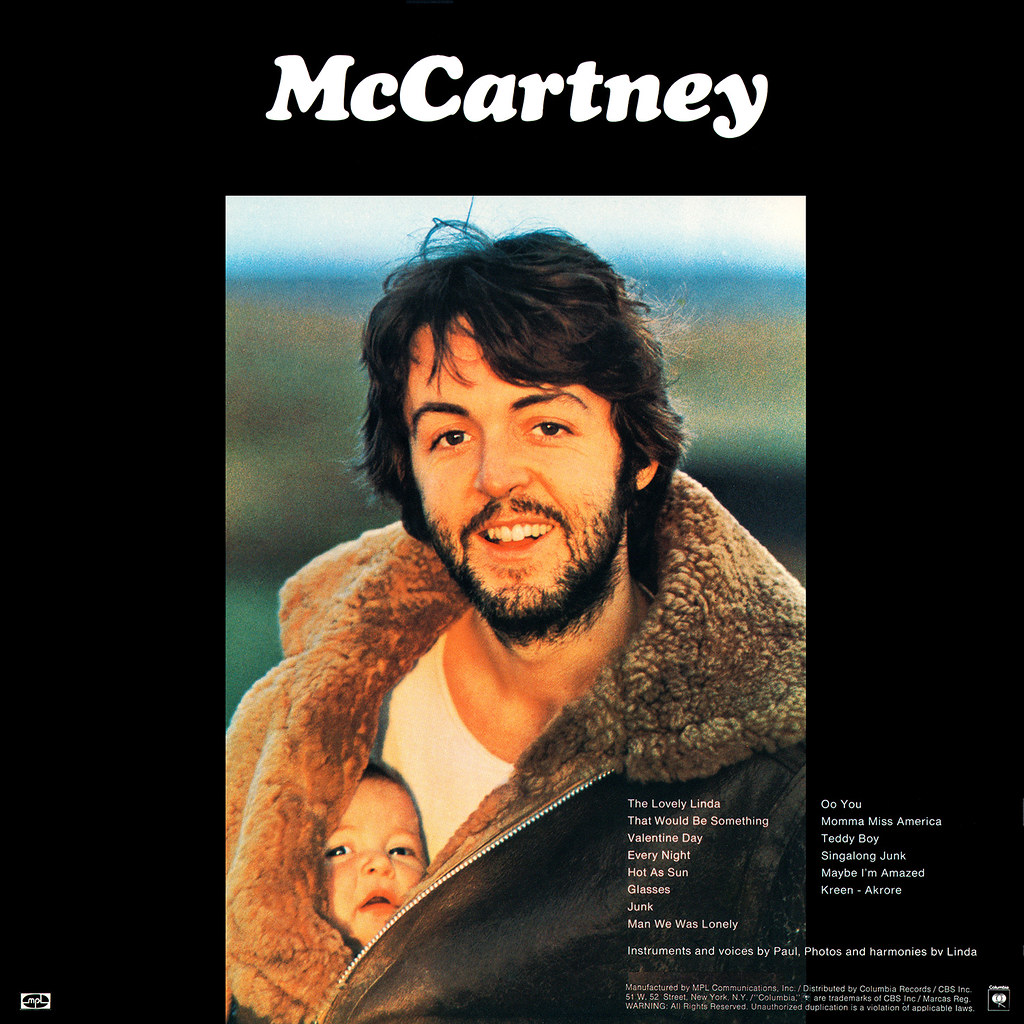
It confuses me that this fine album was panned so thoroughly upon release. It was probably because Paul included the "self-interview" in the liner notes about leaving the Beatles, and because the music was so stripped down, especially compared to recent Beatles records. The liner notes broke a lot of hearts, and the music itself confounded people's expectations. It's telling that the front cover is a striking artistic photo without McCartney's face or name, while the back has the lovely picture of him holding his baby daughter Mary in his jacket. The whole thing is a declaration that the Beatles are done and that Paul is focusing on matters closer to home. I am sure that was a shock to the 60s generation. As someone born five years after this album came out, I can listen to it on its own terms.
The fact that McCartney recorded all the instruments himself reveals his virtuosity. He's an excellent drummer and guitar player. The hard drum hits on "Momma Miss America" are thrilling and the subtle touch on the kit brings out the pathos of "Every Night." "Maybe I'm Amazed" is his one big Beatles-y ballad in the old mode, but it also includes a stirring guitar solo. Because this is an intentionally lo-fi album made at home on a four-track, not all of the songs are as finished as they could be. "Junk" is probably the most emblematic song. It's a little, gorgeously affecting thing, little bauble of a cast-off about old odds and ends, much like these songs. "Every Night" is the most meaningful, in that Paul details his depression and how Linda is the one thing allowing him to hold on. Despite our stereotypes about McCartney's "silly little love songs" this is a deadly serious one.
Rating: Four and a half Pauls (out of five)
Ram, 1971 (with Linda McCartney)
After taking some first steps with the lo-fi approach, McCartney masters it with Ram, which is certainly among his favorite album among rock snobs. Being one myself I probably concur. While there's a lot of spare songs he also brought in the more orchestral mode he had perfected with the Beatles on "Admiral Halsey/Uncle Albert" and "Back Seat of My Car." The former is a little silly but quite beautiful and fun. He does a great job of evoking a rainy Sunday afternoon early in the song, and the "hands across the water" chorus is practically transcendent when it hits. I might like "Back Seat of My Car" even more, since it shows off McCartney's bright guitar tone so well.
From the first song, it's also apparent that Paul has shaken off the deep blues so apparent on his first album. Here he is feisty on "Too Many People," taking a couple of potshots at John Lennon. It also sets the tone for his new life. He is saying that he just doesn't give a shit what other people want from him. He's going to hang out on his farm, smoke weed, and enjoy time with his family. Accordingly "Long Haired Lady" is a wonderful note to Linda and "Smile Away" and "Dear Boy" allow him to expiate his anger at his former songwriting partner. (In my opinion "Dear Boy" is far more effective than Lennon's "How Do You Sleep." "Eat At Home" is bluesy fun and a little dirty, too. This album got panned at the time but I attribute this to Boomer trauma over the Beatles breakup and Paul refusing to give them the Beatle-y stuff they wanted to hear. Good on 'im.
Rating: Five Pauls
Wild Life
Oy
McCartney's first effort with Wings was not an auspicious start. The laid-back feel that made his first two records is interesting, but the songs just are not here, to an almost shocking degree. This album was evidently rushed, and that's pretty apparent. While I like his two albums a lot, I understand how at the time they may have looked slight compared to Lennon's Plastic Ono Band and Harrison's All Things Must Pass (which for my money are the two best Beatles solo records.) For McCartney to follow them up with this when his peers had just released some truly epic efforts had to have looked especially awful in the context of the times.
It's easy to think that McCartney is missing John's input on these songs, but I think John's absence is a problem in a different kind of way. McCartney is a competitive guy with a lot of pride in his craft, and having another great songwriter in the band forced him to try harder to one-up him. Now Paul does not have that motivating factor. These songs are just flacid and forgettable.
Rating: Two and a half Pauls
Red Rose Speedway, 1973
Things are slightly improved here, with songs that have more shape. Evidently it was supposed to be a double album, but the label forced Paul to cut it down after the lackluster sales of his last record. "My Love" is the hit, and while it is a sign of Paul's increasingly cornball ways, I must admit that it's catchy. The problem is that so many of the songs are indistinct and not fully formed, but not in the charming way they were on Ram. There's a little song suite at the end trying to do what he did on Abbey Road or "Uncle Albert/Adminral Halsey," but it's just turgid. At this point in his career it was obvious that Paul needed a new direction. The fact that members of Wings quit after this album is telling; the project seemed so hopeless that they were willing to give up a sure meal ticket.
Rating: Three Pauls
Non-Album Singles
Many of McCartney's biggest hits were non-album singles, so I am going to include a special section about them in each installment. Instead of a star rating I will be classifying them as "Fab," "Mid," or "Ob-La-Di-Ob-La-Don't."
"Another Day"/"Oh Woman Oh Why" 1971
This is a song in the vein of "Lady Madonna" and "Eleanor Rigby" about the day-to-day letdowns and struggles of life. It's catchy and affecting and while not a masterpiece is pretty good. The B side has some great slide guitar. It's a perfect B-side: just a rocking little raver of small importance.
Rating: Fab
"Give Ireland Back to the Irish" 1972
This one, released at the height of the Troubles, got banned from the BBC for its political message. If only the music matched the cause. For such a serious and searing topic this song sounds almost like a tossed off joke. I gave it a slightly higher rating just because I agree with its sentiments.
Rating: Mid
"Mary Had a Little Lamb"/"Little Woman Love" 1972
A nursery rhyme Paul, really? Another sign that he was lost post-Ram.
Rating: Ob-La-Di-Ob-La-Don't
"Hi Hi Hi"/"C Moon" 1972
This one got banned on the BBC for drug references, proving once again that Paul was edgier than people normally credit him for. "Hi Hi Hi" is a fun bit of rock and roll, but nothing more than that. I understand why fans at the time were underwhelmed by Paul's efforts.
Rating: Mid
"Live and Let Die"/"I Lie Around" 1973
George Martin was back producing this Bond theme, perhaps the best one ever. There's more excitement and guts in this one song than all of Wild Life and Red Rose Speedway put together.
Rating: Fab
Soon after "Live and Let Die," Paul, Linda, and Denny Laine would go off to Lagos together to work on Band on the Run. He would find the spark of creativity he had on his lo-fi records, but finally brought back his pop music mastery into the mix. The result would be the most popular run of any Beatle post-breakup.
Immediately after doing my Neil Young series a friend asked which legacy artist I was going to cover next. I realized that I actually did want to do another series, but I wasn't sure who. Initially I thought of Richard Thompson, but his music is far too dreary for this sunny time of year. For a minute I thought of a very ambitious project listening to every Beatles solo record, but I don't think I am quite ready for that. However, I soon realized Paul McCartney would be perfect.
When I first got into the Beatles at age 11 Paul was my favorite. When I became a teenager, it was John. Sometime in my late 20s it shifted to George. In a strange twist, I returned to Paul in my 40s. I had long poo-pooed him, so I am actually not that familiar with his solo work. I only listened to a couple of albums and all the hit singles. This series will give me an opportunity to finally dig deeper.
Around this time of year I invariably dig into the early solo albums from the Beatles. I am not sure where this comes from. Is it because I played All Things Must Pass to death in that dreadful post-9/11 autumn of 2001? Or is the feeling of tough transitions evoked by these albums as summer turns to winter and the sunny past fades to an uncertain future? Probably a bit of both.
Paul McCartney has churned out his fair share of dross and laughably cringey music in his solo career, but he will surprise you out of nowhere with that old magic. His last album, for example, is pretty damn great and the man is almost 80. Like that album his early albums were one man band affairs, proto-versions of indie bedroom rock.
A recent New Yorker profile revealed that Paul still really isn't over the breakup of the Beatles. It seems he took it the hardest at the time, retreating to a farm in Scotland and turning to drink. He was slowly able to get back on his feet due to his family, especially Linda. "Every Night" is the story of that recovery. He describes being lost, wanting to go out and "get out of my head," to drink and forget. Soon he discovers it's best to stay at home with his wife, who is the only person who can make him happy.
Like the other songs on his first solo album it is sparse and sounds a little dark. This is a million miles away from the layered sounds and baroque arrangements McCartney had recorded the year before for Abbey Road. The themes are also a million miles away from being at the epicenter of the 20th century's biggest pop cultural phenomenon.
It's easy to mock Paul's songs as treacly, as John Lennon himself often did. However, this song of marital devotion is rooted in the darkness of depression. It's love as a kind of grace, there to save you when everything seems to be going wrong. I don't begrudge the cheeseball Paul that followed because that cheesiness was enabled by his personal happiness. There are things in this life more important than being cool.
Yesterday Paul McCartney came out with a quarantine album of his own, McCartney III. It's a successor to his earlier self-titled albums, which are one man band lo-fi experiments. There are many reasons why the stereotype of Paul as the poppy, conventional Beatle are wrong, but these albums are the strongest. I find the most recent one inspiring because McCartney is 78 and still trying new things and putting out good music.
As I have gotten older I have begun to appreciate Paul a lot more, not least because he's a family man with a grounded sense of priorities. And, unlike other Boomer rock stars, he hasn't become some reactionary troglodyte denouncing lockdowns. I wrote the following four years ago, and it still holds true today.
Dr Sillylovesongs: Or, How I Stopped Worrying and Learned to Love Paul McCartney
*****
Contrary to stereotype, Paul McCartney can make dark, introspective lo-fi music
Anyone who gets into the Beatles at a young age decides which Beatle is their favorite. This choice is not merely an aesthetic one, but also is meant to reflect the personality and values of the fan. In my teens, John was far and away my favorite. To me he was the rebel Beatle, the one who stood up for peace and was not afraid to speak his mind. I also valued his musical contributions more, seeing him as the true artist in the group. The Revolver album, my fave Beatles record, seemed to make the choice pretty clear. The John songs on that record are searing and full of all kinds of spiritual angst, perfect fodder for an adolescent. What teen hasn't just wanted to not get out of bed, as in "I'm Only Sleeping"? The real kicker, however, was "Tomorrow Never Knows," which still sounds amazing and different fifty years later. It was almost impossible to think that the band responsible for "Love Me Do" had created it. Paul had some fine songs on that record ("Yellow Submarine," "Good Day Sunshine," Got To Get You Into My Life," Eleanor Rigby" etc.) but they tended to be less rockish and more poppy.
As my twenties progressed, I started gravitating towards George, rather than John. Much of this had to do with my friends Debbie and Brian, who were big George fans. I had also loved his wry perspective in the Beatles Anthology interviews. The more I read about the Beatles, the more I liked George and felt less of a connection to John. While John finally seemed to be getting it sorted out at the end of his tragically short life, he could be a mean drunk who neglected his first child and treated his first wife, Cynthia, poorly. I empathized with his bouts of depression, but he began to strike me as a rather unpleasant person. On the positive side, I finally heard Harrison's All Things Must Pass, and I still believe that it's by far the best Beatles solo album.
Ringo was never a candidate for favorite Beatle for me, but I've always loved him. I think his drumming is very underrated, and it pisses me off when people put his musical ability down. (Harrison and Lennon could have had anyone drum on their first solo records, but they chose Ringo.) Paul, of course, was the one I had the most mixed feelings about. The more I learned about the breakup of the Beatles, the more I realized that those who blamed Yoko Ono were completely wrong. Of course, the four men growing up and developing their own separate personalities and interests was the root cause of the break up, which I now take to be a good thing, since it saved us from terrible reunion tours and the kind of mediocre music we've been getting from the Stones in the last thirty years. The Beatles break-up had its immediate origins in the death of manager Brian Epstein, which left a huge vacuum. Paul tried to step in and be the leader of the band, and to have his brother in law manage. I attributed this to Paul being a control freak, something I saw first hand in his unbearable antics in the studio in Let It Be. I'd also heard the story that he had forced the band to record eighty takes of the mediocre "Ob La Di Ob La Da," which is enough to make anyone quit any band, including the Beatles.
I also generally thought of Paul as "the cute one" who made, in his own words, "silly love songs." Could I really rate the guy responsible for "Honey Pie" above the man who wrote "Tomorrow Never Knows"? Plus, as a child of the 80s and 90s, I thought of Paul as a guy with a terrible mullet wearing fashion-victim vests touring the world playing his hits. This to me, in my punk rock phase, was the height of uncool.
In recent years, however, my attitude has been changing. Paul is most definitely a control freak, of course. In the Wingspan documentary his own daughter seems a bit exasperated at all of the lineup changes in Wings brought on by that tendency. At the same time, aren't a lot of great artists control freaks? Paul isn't someone I'd want to work with, but his exacting standards are probably responsible for the timeless nature of his best songs. I also came to realize that while his attempt to take a controlling interest in the Beatles after Epstein's death backfired, it might have been the right way to go. They ended up hiring the infamous Allen Klein over Paul's objections, who, as he often did with the artists he represented, ripped them off. At that point in the late 60s John, who had been the leader of the group early on, was beginning to check out and act more erratically. Somebody had to step in and do something. Paul did it maladroitly, but he intentions were in the right place.
Paul's iron will to keep things together is also what gave us Abbey Road, which next to Revolver is my fave Beatles record. Even though the band was falling apart, they managed to end on an extremely high note. Paul was chiefly responsible for the second side's pastiche of song fragments. I think that medley might be my favorite thing that the Beatles ever did. (George also has some fantastic songs on that record. John's are good, but not at the same level.)
Over the years I also came to realize that while John got the credit for being experimental and George for bringing in Indian music, Paul was not just the guy who wrote silly love songs. Imagine my surprise when I learned that "Helter Skelter" was a Paul song, since that totally went against narrative. While may have penned some schmaltzy numbers, he had a well-documented interest in experimental music, as well as decidedly non-schmaltzy sleaze like "Why Don't We Do It In The Road." On top of all of that, he was definitely the best musician in the Beatles. His melodic bass lines are really miles ahead of what most rock bassists were doing at the time. What really put me over the top musically with Paul were his first two solo albums, which I didn't hear until a few years ago, mostly due to my old prejudices. He recorded the first one completely by himself, and the second with only some background vocals from Linda. They are idiosyncratic albums with a great amount of looseness to them. Hearing them now, they sound like the earliest antecedents of lo-fi indie rock. They also happen to be really good, and daring in their own way. The fan reaction was not greatly positive, and McCartney would find great solo success after creating Wings and going for a big 70s pop-rock sound.
Beyond the music, I really started empathizing with Paul after reading the book Man on the Run, about his career in the 70s. He fell into a deep depression after the breakup of the Beatles (which he had worked hard to avoid), complete with overconsumption of alcohol. His relationship with Linda and the loose experimentation of those early records are what helped him cope and recover. (I myself could certainly understand the difficulties that come with having to make a major career change in your thirties against your will.) I always get irritated when people mock Linda and her presence in Wings. Paul brought her and their children on tour as a way of keeping the family together, rather than indulging in the rock and roll party lifestyle. Learning this now that I am a parent made me respect him even more. (Not to be petty, but compare this to John's treatment of Julian.)
I am not sure who my favorite Beatle is anymore, probably because I'm no longer young enough for that to be meaningful. I can say that time and wisdom have made me appreciate Paul McCartney much more than before. And hey, if some people want to fill the world with silly love songs, what's wrong with that? I'd like to know.