Yesterday I was one of the millions who turned out for March for Our Lives events in the United States and the world. I attended the one in Newark, partly because it was the closest one, but also because I'm a former resident of Brick City, a place I hold close to my heart. (I made sure to go back to my old neighborhood afterward and get a giant plate of Portuguese food and a big bag of stuff from one of the bakeries.)
I was not anticipating a huge turnout, mostly because people around here tend to go to marches like this in New York City to be a part of the bigger, more noteworthy event. I was happily surprised to see a very large crowd at Military Park in downtown Newark when I arrived, and by the time things got kicked off, it doubled in size. The event started with a half hour of speeches and performances, then we marched over to Washington Park and snaked around it to go back to Military Park to hear speeches by the big shots in attendance. I knew we were a big congregation because I was near the front, and once we got around Washington Park we had to stop because the people in the back third were blocking our way because they were still coming.
One thing I was very glad to see that while this event drew a lot of people from suburban New Jersey, it still put a lot of focus on Newark. Students from Newark schools performed music and dance, and they gave speeches that talked about gun violence more broadly. They spoke not just about school shootings, but also of the day to day gun violence in the streets of Newark, domestic violence, and police shootings like the recent tragedy in Sacramento. I came away from the event thinking that many of the white, suburban attendees might also see the issue of gun violence with a broader lens. That's necessary, and also an important rebuttal to naysayers who refuse to participate in this movement because they think it doesn't check all of their woke checkboxes.
While the students may have stumbled a little over their speeches or not have been completely polished, those things only served to highlight their courage. I did speech and debate in high school, but I could not have imagined giving a speech in front of thousands of people with the governor and my Congressman sitting in the wings. The politicians in attendance did a good job motivating the crowd and keeping things brief, at least. My representative in the House, Donald Payne Jr, has actually been out front on this issue and has crafted a bill for gun buybacks. He kept things fiery, and connected the march with the need to vote in the upcoming election. (A lot of the people there hail from purple districts currently represented by Republicans.) New governor Phil Murphy gave a very short, to the point speech emphasizing efforts on the state level. I even cut state senator (and charter school supporter) Teresa Ruiz some slack because her comments were pretty effective.
This event gave me hope because the main reason gun control has failed to be passed at the national level has less to do with the NRA itself and more to do with the extreme pro-gun minority. These people have always cared a LOT more about guns than the people who wanted to limit them. Guns for them are closely tied to their deepest identities, and so like Prohibition gun control is really an argument over what kind of country this is. Opponents of gun control have been acting desperate and attacking teenage survivors of mass shootings because they know they have been in the minority for years and have been getting by on complacency. Will this actually lead to meaningful change? I do not know, but I get the feeling that outside of deep red areas politicians who are highly rated by the NRA are going to be forced to answer for that.
On an unrelated sidenote, I briefly talked yesterday with Essex County Executive Joseph DiVincenzo yesterday, but only realized it after he walked away. "Joe D" is one of the big political fixers in the state, with rumors of corruption swirling about him. Despite that, Chris Christie never prosecuted him during his stint as state's attorney, when he went after several corrupt politicians. Joe D paid him back by supporting Christie's re-election, despite the fact that he was a conservative Republican and DiVincenzo is a Democrat in a a county that is deep blue.Yesterday, as we were stopped on the march route, a distinguished gentleman struck up a conversation with me, and his face looked strangely familiar. I made a little friendly small talk, and when the march ended he squeezed my arm and thanked me for showing up. At that moment I realized it was indeed Joe D, but it was too late. I was going to ask him why if he cared about gun control so much he supported a governor who vetoed new gun legislation.
My hope is that Democrats like Joe D saw what was happening yesterday and got a little scared for themselves. Machines like his rely on political complacency, a complacency which has made it possible for a blue state like New Jersey has been living under austerity for the past eight years. Even if gun control does not get passed in the short term, we are perhaps seeing a political awakening from the left that will not only get Republicans tossed out of office. Just as importantly, it could also give us better Democrats. One can only hope.
Showing posts with label Newark. Show all posts
Showing posts with label Newark. Show all posts
Sunday, March 25, 2018

Monday, April 14, 2014
Notes On A Trip To Branch Brook Park
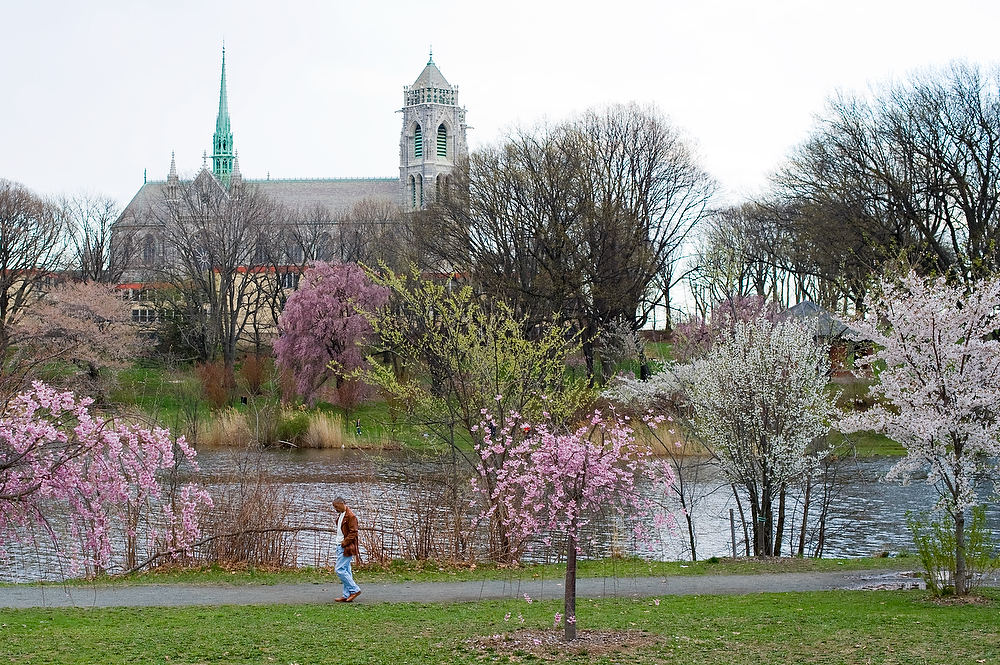
Spring has finally sprung here in New Jersey, which meant I spent a lot of this weekend with my daughters outdoors. On Saturday my wife and I decided to take them to Branch Brook Park, a massive, beautiful landscape designed by Frederick Law Olmsted in Newark that juts into neighboring Belleville. We were married in nearby St. Lucy's church and had our wedding photos taken in the park, so it was a sentimental journey of sorts. Although the park has lost some of its glory over the years (I remember the photographer having to get a stray condom in the grass out of the shot,) it's still a wonderful place, and still draws plenty of people. We walked our giddy daughters along its path, saying hi to the other strollers and enjoying an island of fresh air in north Jersey's tangle of expressways and traffic.
Instead of taking the Garden State Parkway to Branch Brook, we decided to explore the backroads through South Orange, Orange, and East Orange. (Northern New Jersey is a bewildering patchwork of towns akin to the Holy Roman Empire.) I began to notice that these towns, like Branch Brook Park itself, were the product of the period between 1890 and 1930. I began to feel sentimental because that also happened to be the heyday of my rural Nebraska homeland before its long slow decline. The architecture of these towns too reminded me of my hometown: elegant yet tidy. There were flourishes, cornices, and bits of whimsy among the brickwork that modernism later killed in favor of sterility.
The industrial growth of the time was cruel and sometimes horrific in its inequalities, but at least it left behind some nice things. Enough of a public-minded spirit existed to build something like Branch Brook Park in the first place. If such land was up for grabs these days I am sure it would be turned into a subdivision, corporate office park, or a line of strip malls. Many of the old buildings in impoverished East Orange have fallen into disrepair, but beneath it all their lovely bones live on, and the city still has its gorgeous city hall it can be proud of.

We live today in a new Gilded Age, one of ridiculous wealth next to grinding poverty. However, public-mindedness has not persisted, and public institutions are under increasing attack, especially schools. The new wealthy do not build elegantly, but in a vulgar and ostentatious fashion. Our era is alarming in it frivolousness and impermanence. When we are dead and gone there will be little built in our time left around. I'm still willing to bet that Branch Brook Park will still be there, though.
Tuesday, March 18, 2014
A Reply to David Brooks' Column About Newark
I have long stopped reading David Brooks' columns, along with most of the Times' op-ed writers, because they have become rather stale and predictable. (Even Krugman has lost his edge.) However, this morning I noticed that David Brooks, the paper's resident neo-con Pangloss, had weighed in on the current mayoral election in Newark.
Like a lot of people in the media, Brooks just can't resist writing about a place he doesn't know and doesn't understand because it helps him score points talking about charter schools, "reform," and the "culture of poverty." In case you don't know, the race is now between two candidates, Shavar Jeffries and Ras Baraka. Both hail from Newark, although Jeffries made his name elsewhere as a high-powered lawyer and later as assistant attorney general for New Jersey. (He also heads a charter school.) Baraka (son of the late poet) is a school principal in Newark and a political activist. While he occasionally invokes more radical, populist rhetoric, he has done a fine job of reassuring local business elites and building relationships with them. Jeffries is more of a technocrat, and is pushing the kinds of corporate style "reforms" (charter schools, etc) favored by elites.
I do not doubt either Jeffries' talent or his genuine desire to make Newark a better place, but I think his priorities are badly misplaced and reflect his immersion in the corporate policy world. Baraka isn't perfect, but I think he cares a lot more about making life better for Newarkers in concrete ways. Anyway, Brooks doesn't really deal with the real Shavar Jeffries or the real Ras Baraka. As he always does, his column devolves into a lazy, simplistic false dichotomy. In this case, it is the "regular vs. the reformer," with charter schools as the focal point (as if that's the issue Newarkers care about most. It isn't, but I'll get to that later.) He describes their differences on education in a typical sweeping generalization wrapped in a false dichotomy:
"Then there is the split, which we’re seeing in cities across the country, between those who represent the traditional political systems and those who want to change them. In Newark, as elsewhere, charter schools are the main flash point in this divide. Middle-class municipal workers, including members of the teachers’ unions, tend to be suspicious of charters. The poor, who favor school choice, and the affluent, who favor education reform generally, tend to support charters."
Brooks makes no mention of the fact that thousands of students in Newark have engaged in walk-outs protesting the neglect of public schools. These students are not "middle-class municipal workers." He has not mentioned the fact that the schools themselves are not run by the city, but by the state of New Jersey, which is proposing to eliminate several schools and fire large numbers of teachers and replace them with Teach For America scabs. He does not mention that Baraka and other high school principals were suspended for the crime of daring to criticize this scheme. He also fails to consider whether charter schools are actually all that effective in the first place, considering that recent research argues that they are not. In Newark they are self-selecting, because parents have to be assiduous enough to apply in the first place, and schools can easily kick out low-performing or disruptive students, an option public schools don't have. (The easiest way to improve test scores is to get weak students out of the testing pool.)
Brooks spends a lot of time burnishing Jeffries' record and biography while disparaging Baraka. For instance, this is how he describes Baraka:
"Baraka has the support of most of the major unions and political organizations. Over the years, he has combined a confrontational 1970s style of racial rhetoric with a transactional, machine-like style of politics. Baraka is well known in Newark and it shows. There are Baraka signs everywhere there."
What does Brooks mean by "confrontational 1970s style of racial rhetoric"? As far as I can tell, it means that Baraka is openly and publicly talking about how racism has harmed and continues to harm Newark, something of which there can be no doubt. A lot of white New Jerseyans like to dispense the lie that Newark was a great place to be until the riots in 67 changed everything. Of course, the truth is that riots were the result of poverty related to deindustrialization, red-lining, and racism, and that the city was horribly oppressive to its black population. After the riots, the rest of America and New Jersey wrote Newark off and just hoped it would die in a gutter somewhere. I have no doubt that if Newark fell of the face of the earth that many in suburban New Jersey would be relieved. When Baraka talks about Jeffries being supported by outside forces hostile to Newark, he's not just blowing hot air or being demagogic, he's drawing on the very real knowledge that Newarkers have of their own abandonment of and exploitation by outsiders. The city has not been able to run its own schools for two decades, and now neighborhood schools are being destroyed and the classrooms filled with TFA neophytes. The parents who are mad about this are not mad because they are union members, they are mad because their children are guinea pigs for corporate "reformers" and they have had their democratic voice over their schools, which people in most communities take for granted, stolen away from them.
By fighting for these parents and students Baraka is not fighting for the status quo, he is actually representing what the majority of people in Brick City actually want, a democratic impulse that has intentionally been repressed. That, Mr. Brooks, is why you see Baraka signs all over Newark. That, Mr. Brooks, is why when I came across Baraka workers or canvassers in Newark I could really feel the emotional weight and momentum behind his candidacy. You see, that's the messy thing about democracy, the people, not the self-appointed experts like yourself, get to have the final say.
As ridiculous as Brooks' attempts to turn Baraka into a modern-day Eldridge Cleaver might be, his talk of "machine politics" is even more ridiculous. Baraka is not a political fixer, he is an activist and an educator. In fact, the biggest political fixer in the area, Democratic boss and Essex County commissioner Joseph DiVincenzo, has thrown his weight behind Jeffries. Baraka threatens Joe D because he is an independent source, and Baraka is instead allying himself with another promising young urban New Jersey politician, mayor Steve Fulop of Jersey City. Of course, Brooks doesn't know that, because he doesn't actually seem to know anything about Newark or Essex County politics. He does however know his usual neo-con narrative, and he tries and fails to cram Newark into it.
Brooks basically lets the cat out of the bag with his last paragraph, a masterpiece of sophistry and cant:
"These contests aren’t left versus center; they are over whether urban government will change or stay the same. Over the years, public-sector jobs have provided steady income for millions of people nationwide. But city services have failed, leaving educational and human devastation in cities like Newark. Reformers like Jeffries rise against all odds from the devastation. They threaten the old stability, but offer a shot at improvement and change."
So basically Brooks thinks Newark is in the state it's in because it pays its city employees too well. Never mind the deindustrialization that destroyed the city's entire economic foundation. Never mind the red-lining and "urban renewal" that obliterated neighborhoods or made them impossible to renovate and replaced them with unlivable, inhumane housing projects. Never mind the fact that suburbanization financed by the federal government via the FHA and interstate highways effectively abetted the disintegration of the city's tax base. Never mind the fact that much of the destruction during the riots in 1967 was caused by the heavy-handed National Guard response.
With that last paragraph Brooks revealed his true intentions. Like so many others, he simply does not give a shit or care at all about the real people of a very real city that I happen to love very dearly. No, he cares about Newark as a symbol, as a political talking point, as an exotic locale whose streets he would never walk in a million years. Newark has a lot of problems, but its biggest problem just might be the people who don't live there.
Like a lot of people in the media, Brooks just can't resist writing about a place he doesn't know and doesn't understand because it helps him score points talking about charter schools, "reform," and the "culture of poverty." In case you don't know, the race is now between two candidates, Shavar Jeffries and Ras Baraka. Both hail from Newark, although Jeffries made his name elsewhere as a high-powered lawyer and later as assistant attorney general for New Jersey. (He also heads a charter school.) Baraka (son of the late poet) is a school principal in Newark and a political activist. While he occasionally invokes more radical, populist rhetoric, he has done a fine job of reassuring local business elites and building relationships with them. Jeffries is more of a technocrat, and is pushing the kinds of corporate style "reforms" (charter schools, etc) favored by elites.
I do not doubt either Jeffries' talent or his genuine desire to make Newark a better place, but I think his priorities are badly misplaced and reflect his immersion in the corporate policy world. Baraka isn't perfect, but I think he cares a lot more about making life better for Newarkers in concrete ways. Anyway, Brooks doesn't really deal with the real Shavar Jeffries or the real Ras Baraka. As he always does, his column devolves into a lazy, simplistic false dichotomy. In this case, it is the "regular vs. the reformer," with charter schools as the focal point (as if that's the issue Newarkers care about most. It isn't, but I'll get to that later.) He describes their differences on education in a typical sweeping generalization wrapped in a false dichotomy:
"Then there is the split, which we’re seeing in cities across the country, between those who represent the traditional political systems and those who want to change them. In Newark, as elsewhere, charter schools are the main flash point in this divide. Middle-class municipal workers, including members of the teachers’ unions, tend to be suspicious of charters. The poor, who favor school choice, and the affluent, who favor education reform generally, tend to support charters."
Brooks makes no mention of the fact that thousands of students in Newark have engaged in walk-outs protesting the neglect of public schools. These students are not "middle-class municipal workers." He has not mentioned the fact that the schools themselves are not run by the city, but by the state of New Jersey, which is proposing to eliminate several schools and fire large numbers of teachers and replace them with Teach For America scabs. He does not mention that Baraka and other high school principals were suspended for the crime of daring to criticize this scheme. He also fails to consider whether charter schools are actually all that effective in the first place, considering that recent research argues that they are not. In Newark they are self-selecting, because parents have to be assiduous enough to apply in the first place, and schools can easily kick out low-performing or disruptive students, an option public schools don't have. (The easiest way to improve test scores is to get weak students out of the testing pool.)
Brooks spends a lot of time burnishing Jeffries' record and biography while disparaging Baraka. For instance, this is how he describes Baraka:
"Baraka has the support of most of the major unions and political organizations. Over the years, he has combined a confrontational 1970s style of racial rhetoric with a transactional, machine-like style of politics. Baraka is well known in Newark and it shows. There are Baraka signs everywhere there."
What does Brooks mean by "confrontational 1970s style of racial rhetoric"? As far as I can tell, it means that Baraka is openly and publicly talking about how racism has harmed and continues to harm Newark, something of which there can be no doubt. A lot of white New Jerseyans like to dispense the lie that Newark was a great place to be until the riots in 67 changed everything. Of course, the truth is that riots were the result of poverty related to deindustrialization, red-lining, and racism, and that the city was horribly oppressive to its black population. After the riots, the rest of America and New Jersey wrote Newark off and just hoped it would die in a gutter somewhere. I have no doubt that if Newark fell of the face of the earth that many in suburban New Jersey would be relieved. When Baraka talks about Jeffries being supported by outside forces hostile to Newark, he's not just blowing hot air or being demagogic, he's drawing on the very real knowledge that Newarkers have of their own abandonment of and exploitation by outsiders. The city has not been able to run its own schools for two decades, and now neighborhood schools are being destroyed and the classrooms filled with TFA neophytes. The parents who are mad about this are not mad because they are union members, they are mad because their children are guinea pigs for corporate "reformers" and they have had their democratic voice over their schools, which people in most communities take for granted, stolen away from them.
By fighting for these parents and students Baraka is not fighting for the status quo, he is actually representing what the majority of people in Brick City actually want, a democratic impulse that has intentionally been repressed. That, Mr. Brooks, is why you see Baraka signs all over Newark. That, Mr. Brooks, is why when I came across Baraka workers or canvassers in Newark I could really feel the emotional weight and momentum behind his candidacy. You see, that's the messy thing about democracy, the people, not the self-appointed experts like yourself, get to have the final say.
As ridiculous as Brooks' attempts to turn Baraka into a modern-day Eldridge Cleaver might be, his talk of "machine politics" is even more ridiculous. Baraka is not a political fixer, he is an activist and an educator. In fact, the biggest political fixer in the area, Democratic boss and Essex County commissioner Joseph DiVincenzo, has thrown his weight behind Jeffries. Baraka threatens Joe D because he is an independent source, and Baraka is instead allying himself with another promising young urban New Jersey politician, mayor Steve Fulop of Jersey City. Of course, Brooks doesn't know that, because he doesn't actually seem to know anything about Newark or Essex County politics. He does however know his usual neo-con narrative, and he tries and fails to cram Newark into it.
Brooks basically lets the cat out of the bag with his last paragraph, a masterpiece of sophistry and cant:
"These contests aren’t left versus center; they are over whether urban government will change or stay the same. Over the years, public-sector jobs have provided steady income for millions of people nationwide. But city services have failed, leaving educational and human devastation in cities like Newark. Reformers like Jeffries rise against all odds from the devastation. They threaten the old stability, but offer a shot at improvement and change."
So basically Brooks thinks Newark is in the state it's in because it pays its city employees too well. Never mind the deindustrialization that destroyed the city's entire economic foundation. Never mind the red-lining and "urban renewal" that obliterated neighborhoods or made them impossible to renovate and replaced them with unlivable, inhumane housing projects. Never mind the fact that suburbanization financed by the federal government via the FHA and interstate highways effectively abetted the disintegration of the city's tax base. Never mind the fact that much of the destruction during the riots in 1967 was caused by the heavy-handed National Guard response.
With that last paragraph Brooks revealed his true intentions. Like so many others, he simply does not give a shit or care at all about the real people of a very real city that I happen to love very dearly. No, he cares about Newark as a symbol, as a political talking point, as an exotic locale whose streets he would never walk in a million years. Newark has a lot of problems, but its biggest problem just might be the people who don't live there.
Wednesday, January 1, 2014
Newark Is The Canary In America's Coal Mine
Yesterday my wife and I cleaned out our old apartment in the Ironbound and handed our keys over, which means I'm no longer a resident of Newark. While I am glad to have much more space in our Maplewood home, I already miss the old neighborhood. I also feel a little guilty, because I feel like I am abandoning a city I love during its time of need. The small improvements and positive changes that I had been perceiving since 2007 (when I started splitting my time there) appear to have been wiped out in 2013.
Crime is way up again, evidenced by a recent New York Times article showing that Brick City is again the car jacking epicenter of America. The number of murders jumped to an alarming one hundred and eleven, the highest total since 1990 in midst of the crack wars. Not only is that death toll atrocious, the murders themselves have been especially heartbreaking. Last week on Christmas night a 13-year old girl was slain by stray bullet fired by another teenager in a revenge killing that also claimed a 15-year old boy. Corey Booker, the city's former celebrity mayor, bailed on Newark for the Senate, leaving this mess to the unlucky winner of the next mayoral election, which could very well put the old machine back in power. That outcome would mean graft and mismanagement on top of poverty and crime and will surely make things even worse.
Of course, few people outside of Newark and Essex County seem to give a damn about any of this. The recent killing of a man in a car jacking at the ritzy Short Hills Mall just a few miles (but worlds away) has received as much media attention as all of the 111 murders in Newark put together. As I have said before, some lives are cheap in this country, and none more so than poor people of color.
But others outside of Newark ought to pay heed, because Brick City's woes will be coming to them, too. There are two larger forces at work behind all of this that have made themselves felt more immediately in a poorer city like Newark struggling to keep itself above water before the twin tsunamis of economic stagnation and government austerity came crashing down. Not to mix metaphors, but Newark is the canary in the proverbial coal mine, and its fate ought to be seen as a harbinger for what's to come across the country.
Although the economy is no longer in free fall, as it was in 2008-2009, any recovery that has happened since then has been seen by the wealthy, not by the majority. Low wages and high unemployment are leading more and more people to desperation. On top of that, the response by government in the midst of such want has been to slash, rather than raise social spending. That austerity was held off for awhile by the 2009 stimulus' aid to state governments, but since Christie's coming to power in 2010, the state has slashed money to poorer cities, which has meant cutbacks in police for Newark and Trenton. Not surprisingly, crime and murder have jumped up in those places. Of course, most of the state's suburban population could hardly care less about the fate of black and brown people in places like Newark and Trenton, and will happily take a tax break and ignore the sight of blood on streets they'd never drive down in a million years.
New Jersey's austerity mirrors that in the nation at large. For three years now, since the Tea Party midterm of 2010, deficit reduction has trumped stimulus and relief. Republicans in Congress have largely gotten their way, evidenced by the fact that many food stamp recipients and the long term unemployed are about to lose their benefits. The bill for such negligence is finally coming due, and continued austerity will only make it worse. As a nation, we have decided to respond to a hopeless economic situation by making things even worse for the poor. For three years people have pretended that this won't have any consequences, they won't be able to pretend that much longer. I just wonder if when the death tolls and misery start to skyrocket in poor communities, anyone outside of them will care.
Crime is way up again, evidenced by a recent New York Times article showing that Brick City is again the car jacking epicenter of America. The number of murders jumped to an alarming one hundred and eleven, the highest total since 1990 in midst of the crack wars. Not only is that death toll atrocious, the murders themselves have been especially heartbreaking. Last week on Christmas night a 13-year old girl was slain by stray bullet fired by another teenager in a revenge killing that also claimed a 15-year old boy. Corey Booker, the city's former celebrity mayor, bailed on Newark for the Senate, leaving this mess to the unlucky winner of the next mayoral election, which could very well put the old machine back in power. That outcome would mean graft and mismanagement on top of poverty and crime and will surely make things even worse.
Of course, few people outside of Newark and Essex County seem to give a damn about any of this. The recent killing of a man in a car jacking at the ritzy Short Hills Mall just a few miles (but worlds away) has received as much media attention as all of the 111 murders in Newark put together. As I have said before, some lives are cheap in this country, and none more so than poor people of color.
But others outside of Newark ought to pay heed, because Brick City's woes will be coming to them, too. There are two larger forces at work behind all of this that have made themselves felt more immediately in a poorer city like Newark struggling to keep itself above water before the twin tsunamis of economic stagnation and government austerity came crashing down. Not to mix metaphors, but Newark is the canary in the proverbial coal mine, and its fate ought to be seen as a harbinger for what's to come across the country.
Although the economy is no longer in free fall, as it was in 2008-2009, any recovery that has happened since then has been seen by the wealthy, not by the majority. Low wages and high unemployment are leading more and more people to desperation. On top of that, the response by government in the midst of such want has been to slash, rather than raise social spending. That austerity was held off for awhile by the 2009 stimulus' aid to state governments, but since Christie's coming to power in 2010, the state has slashed money to poorer cities, which has meant cutbacks in police for Newark and Trenton. Not surprisingly, crime and murder have jumped up in those places. Of course, most of the state's suburban population could hardly care less about the fate of black and brown people in places like Newark and Trenton, and will happily take a tax break and ignore the sight of blood on streets they'd never drive down in a million years.
New Jersey's austerity mirrors that in the nation at large. For three years now, since the Tea Party midterm of 2010, deficit reduction has trumped stimulus and relief. Republicans in Congress have largely gotten their way, evidenced by the fact that many food stamp recipients and the long term unemployed are about to lose their benefits. The bill for such negligence is finally coming due, and continued austerity will only make it worse. As a nation, we have decided to respond to a hopeless economic situation by making things even worse for the poor. For three years people have pretended that this won't have any consequences, they won't be able to pretend that much longer. I just wonder if when the death tolls and misery start to skyrocket in poor communities, anyone outside of them will care.
Wednesday, December 25, 2013
Taking A Drive on Springfield Avenue
I've been working like crazy on moving this week, which has also meant saying good-bye to living in Newark and the Ironbound. Of course, I will continue to come visit, and we won't really be living all that far away. In fact, the fastest and most direct way to get from our new house in Maplewood to our old apartment in Newark is to take a drive down Springfield Avenue. It's a drive that also displays the grim reality of life in America today, and can bring tears of rage to my eyes.
In Maplewood, Springfield Avenue cuts through the town's lower-middle class/working class section (where we will be living) and is lined with some humble businesses, along with a few vestiges of Maplewood's trendier sections, such as yoga studios and the like. Crossing the border into Irvington, stores remain, but are decidedly downscale. Liquor marts and dollar stores prevail. Irvington, because of its relatively small size, is less well-known than Newark, but is in worse economic shape. That's reflected in its violent crime rate, among the worst in New Jersey. As if to grimly underscore that point, early this Christmas morning three people were killed and two wounded by a shooter outside of a strip club.
Driving through Irvington can be a frustrating experience, mostly because there is only one light with a protected left turn, despite the fact that Springfield Avenue goes through block after block of commercial zoning. It's as if someone somewhere decided that the people who lived there weren't deserving of decent traffic flow.
That, of course, is the least of people's worries in Irvington. Whenever I've been there (which is where my wife's grandfather lived until his death four years ago and where she lived until age ten) I've had the feeling that it's a place abandoned by the rest of New Jersey and rest of America. Its problems and the lives taken by them don't really seem to concern anyone else. That feeling only grows once you cross the border from Irvington into Newark. Springfield Avenue becomes, in places, a kind of moonscape. Derelict buildings look ready to collapse, empty lots are choked with weeds. It looks worse the closer you get to downtown, where there are actually weed and grass covered hills that form a barren wasteland where high-rise housing projects used to be.
Springfield Avenue had been the city's main commercial thoroughfare until the riots of '67. It's a little known fact that many of the businesses were not torched by rioters, but were destroyed by National Guard troops who shot up businesses owned by African Americans, who had put signs attesting to such in their windows to ward off looters. If you drive through the worst-hit parts of Springfield Ave today, you see that devastation with over four decades of neglect added onto it. Every time I drive through this section, the anger begins to well up inside of me. Anger over the oppression that led to the riots in the first place, anger over the abandonment of Newark by suburban New Jerseyans and Americans alike, and anger that so few people outside of Newark seem to care. Case in point: a recent car-jacking at the tony Short Hills Mall that ended in murder has captivated the state, but the over 90 murders in Newark this year have received scant attention outside the city's borders. You see, a rich white person isn't "supposed" to get shot at a ritzy mall, but poor black people in Newark and Irvington are expected to get shot from time to time. Their lives are cheap.
The drive into downtown on Springfield Avenue ends with a glimmer of hope, although it may well be false. The area right next to downtown is getting developed, complete with shiny new apartments and an Applebee's. It appears, however, that this is a project of gentrification, rather than regeneration. There are a lot of attempts these days to bring young people to downtown Newark, but so little to improve the lives of native Newarkers, who have pretty much been left to fend for themselves. With the departure of celebrity mayor Corey Booker, the little positive attention that Brick City has been getting will be cut off. Springfield Avenue will still be devastated, and will still be the street that says more about the reality of the American Dream than any other.
Sunday, December 22, 2013
Leaving The Ironbound
After four years of living in this neighborhood part time, and two and a half years full time, I am moving out of the Ironbound. This is primarily because wife and I need more space, now that we have two kids. I think over the last year our cramped living environment, complete with a needy cat and barky dog, has been making us a little crazy. We are moving into a house in Maplewood this week, and are doing so with a mix of excitement and elegy.
On the latter point, the Ironbound is a special place, and hard to leave. By leaving here, I feel that in a way, I am moving back to America. In so many respects Newark is not America, but a place abandoned by America and left for dead. While the Ironbound is less economically devastated than other parts of Newark, its immigrant population and culture make it a place truly apart. Portuguese and Spanish are more commonly heard on the streets than English, and I stick out like a sore thumb. However, knowing that there was no way I was going to fit in here took a lot of pressure off of me. People are friendly in a genuine manner that still exists in Europe and South America but is absent in this country, where a dagger seems to sit behind so many smiles. More than the custard pastries, salted cod, Brazilian barbecue, roast chicken, and cheap and tasty Portuguese table wines, it is the manner and way of being in this neighborhood that I will miss the most.
Posts on this blog might be fewer and shorter in coming days because of this move. This may well be an opportunity to change the blog, because its title will no longer be applicable. In any case, expect some more reflections on the Ironbound, Newark, and the importance of place.
On the latter point, the Ironbound is a special place, and hard to leave. By leaving here, I feel that in a way, I am moving back to America. In so many respects Newark is not America, but a place abandoned by America and left for dead. While the Ironbound is less economically devastated than other parts of Newark, its immigrant population and culture make it a place truly apart. Portuguese and Spanish are more commonly heard on the streets than English, and I stick out like a sore thumb. However, knowing that there was no way I was going to fit in here took a lot of pressure off of me. People are friendly in a genuine manner that still exists in Europe and South America but is absent in this country, where a dagger seems to sit behind so many smiles. More than the custard pastries, salted cod, Brazilian barbecue, roast chicken, and cheap and tasty Portuguese table wines, it is the manner and way of being in this neighborhood that I will miss the most.
Posts on this blog might be fewer and shorter in coming days because of this move. This may well be an opportunity to change the blog, because its title will no longer be applicable. In any case, expect some more reflections on the Ironbound, Newark, and the importance of place.
Thursday, August 15, 2013
Analyzing the New Jersey Senate Race
This week a very small number of New Jersey voters cast their ballots in a special primary election for the deceased Frank Lautenberg's seat in the US Senate. Bad weather and summer vacations helped account for the low turnout, as well as a sense that Corey Booker and Steve Lonegan would be the inevitable nominees on route to a Booker landslide in October.
That fact itself says a lot. In the first place, it shows Booker's megawatt star power in the Garden State, since he had to run against a pretty formidable group of politicians: Rush Holt, Sheila Oliver, and Frank Pallone. The latter had the Lautenberg family's endorsement, Holt was the most progressive and experienced in Washington, and Oliver is the Speaker of the state's General Assembly. Any one of the losing candidates would have been a tough opponent for Chris Christie, who the Democrats are so afraid of that no one of Oliver, Pallone, or Holt's stature dared run against him. Booker has been a rising star for some time in the Democratic Party, despite his cozy relationships with Wall Street and Chris Christie, embrace of education "reform," and cold-shouldering of the labor movement. While I am mostly happy with the job he has done here in Newark and will be voting for him in the fall, I think many New Jersey Democrats will ultimately be disappointed with the stances he will take in Washington. Booker has earned a progressive reputation for vocally defending food stamps and gay rights, but he is in actuality a lot more moderate than both his supporters and opponents realize.
There is not one shred of moderation in Steve Lonegan, Booker's Republican opponent. He is a conservative, Tea Party firebrand who is so far to the right that his campaign has the potential to embarrass the New Jersey GOP. Lonegan is rabidly anti-abortion, staunchly pro-gun, has blamed "government regulation" for Camden's deindustrialization, blames gridlock in Congress on "the president's insistence on forcing his far-left liberal agenda on the country," called for the repeal of the Affordable Care Act, supports a flat tax, praised Romney's 47% comments, and has even downplayed the suffering of Hurricane Sandy victims in his own state.
This is the Garden, not the Lone Star State, however, and while a man like Lonegan would be a shoo-in in Texas, here in Jersey Tea Party conservatism is a fringe phenomenon. I am sure the Republican party is happy to throw a bone to their resident wing-nuts to keep them happy and obedient, but Chris Christie has already said he is not campaigning for Lonegan. You could chalk much of this up to Christie's legendary pettiness and score-settling. Lonegan ran a contentious primary against Christie in the 2009 governor's race, and there's nothing that Governor Bully loves more than crushing anyone who dares to criticize him. I also see in this decision not to get behind Lonegan Christie' deft game of staying popular in a left-leaning state by making friends with popular Democrats like Booker while distancing himself from Sun Belt-style conservatives.
Lonegan is really more of an activist than a politician and actually has very little experience in government. His one stint in public office was as mayor of Bogota, a borough of merely eight thousand souls in Bergen County. He has run unsuccessfully for statewide office on several occasions, but got his lucky break this year when no one of any stature in the state GOP cared to go up against Booker's juggernaut. A buffoon with a tiny amount of actual political experience, Lonegan is a poster child for white male privilege.
Like other recent Tea Party candidates (Christine O'Donnell, Todd Aiken, etc.) Lonegan has already made a fool out of himself, both with his opinions and with his behavior. In the waning days of the primary, his Twitter feed featured this image, intending to mock Booker's foreign policy knowledge:
 In case you don't know, a majority of Newark's residents are African-American, and there is a large Brazilian and Portuguese immigrant population in East Ward (and also from many other nations not listed here). I am not sure what this image is trying to say, other than to imply that the residents of Newark are foreigners and not "real Americans" on the basis of their race and ethnicity, or that Booker, a graduate of Stanford and Yale, is some kind of imbecile. In either case, the bigotry behind this "joke" is pretty transparent. Lonegan made matters worse for himself in his response, which was to blame a staffer, and then call the criticism of this tweet overwrought "political correctness," as if demeaning the residents of the largest city in the state he will supposedly "represent"is a small matter. My time in New Jersey has taught me that white conservatives in this state, its governor included, view Newark and its people with absolute revulsion and contempt. Lonegan seemed to forget that Twitter is not his suburban barbershop.
That prevailing opinion among white New Jersey conservatives might help explain why he was able to get 80% of the Republican vote even after such shameful behavior. At least I no longer live in Texas, where Tea Party maniacs like Lonegan beat moderate Democrats like Booker for statewide office every time. I am glad to be here in New Jersey, where racial resentment and the Tea Party are sadly present, but on the outside looking in. That said, the fact that a man like Steve Lonegan can get nominated to run for Senator by a major party is pretty depressing.
That fact itself says a lot. In the first place, it shows Booker's megawatt star power in the Garden State, since he had to run against a pretty formidable group of politicians: Rush Holt, Sheila Oliver, and Frank Pallone. The latter had the Lautenberg family's endorsement, Holt was the most progressive and experienced in Washington, and Oliver is the Speaker of the state's General Assembly. Any one of the losing candidates would have been a tough opponent for Chris Christie, who the Democrats are so afraid of that no one of Oliver, Pallone, or Holt's stature dared run against him. Booker has been a rising star for some time in the Democratic Party, despite his cozy relationships with Wall Street and Chris Christie, embrace of education "reform," and cold-shouldering of the labor movement. While I am mostly happy with the job he has done here in Newark and will be voting for him in the fall, I think many New Jersey Democrats will ultimately be disappointed with the stances he will take in Washington. Booker has earned a progressive reputation for vocally defending food stamps and gay rights, but he is in actuality a lot more moderate than both his supporters and opponents realize.
There is not one shred of moderation in Steve Lonegan, Booker's Republican opponent. He is a conservative, Tea Party firebrand who is so far to the right that his campaign has the potential to embarrass the New Jersey GOP. Lonegan is rabidly anti-abortion, staunchly pro-gun, has blamed "government regulation" for Camden's deindustrialization, blames gridlock in Congress on "the president's insistence on forcing his far-left liberal agenda on the country," called for the repeal of the Affordable Care Act, supports a flat tax, praised Romney's 47% comments, and has even downplayed the suffering of Hurricane Sandy victims in his own state.
This is the Garden, not the Lone Star State, however, and while a man like Lonegan would be a shoo-in in Texas, here in Jersey Tea Party conservatism is a fringe phenomenon. I am sure the Republican party is happy to throw a bone to their resident wing-nuts to keep them happy and obedient, but Chris Christie has already said he is not campaigning for Lonegan. You could chalk much of this up to Christie's legendary pettiness and score-settling. Lonegan ran a contentious primary against Christie in the 2009 governor's race, and there's nothing that Governor Bully loves more than crushing anyone who dares to criticize him. I also see in this decision not to get behind Lonegan Christie' deft game of staying popular in a left-leaning state by making friends with popular Democrats like Booker while distancing himself from Sun Belt-style conservatives.
Lonegan is really more of an activist than a politician and actually has very little experience in government. His one stint in public office was as mayor of Bogota, a borough of merely eight thousand souls in Bergen County. He has run unsuccessfully for statewide office on several occasions, but got his lucky break this year when no one of any stature in the state GOP cared to go up against Booker's juggernaut. A buffoon with a tiny amount of actual political experience, Lonegan is a poster child for white male privilege.
Like other recent Tea Party candidates (Christine O'Donnell, Todd Aiken, etc.) Lonegan has already made a fool out of himself, both with his opinions and with his behavior. In the waning days of the primary, his Twitter feed featured this image, intending to mock Booker's foreign policy knowledge:
That prevailing opinion among white New Jersey conservatives might help explain why he was able to get 80% of the Republican vote even after such shameful behavior. At least I no longer live in Texas, where Tea Party maniacs like Lonegan beat moderate Democrats like Booker for statewide office every time. I am glad to be here in New Jersey, where racial resentment and the Tea Party are sadly present, but on the outside looking in. That said, the fact that a man like Steve Lonegan can get nominated to run for Senator by a major party is pretty depressing.
Saturday, March 16, 2013
Will Newark Benefit from all the Philip Roth Birthday Hoopla?
I love Newark, and I love one of its most famous sons, Philip Roth. With his 80th birthday next week, there will be some events here in Brick City drawing in Roth fans from all over the world, giving my town one of its few positive moments to shine. These include a bus tour of local spots mentioned in his books, a photo display on Roth's life at the public library, an academic conference, and an event at the Newark Museum where Roth himself will speak. The latter event is invite-only, and the conference will be closed to the public.
While I am sure that Mr. Roth wants to guard his privacy, and that the assembled scholars are only following the usual academic conference protocol, something doesn't feel right. I can't help but to wonder whether the participants are keeping modern day Newark, not the thriving industrial city of the 1940s described in Roth's novels, at arm's length. Will those who take the bus tour simply gawk at the urban decay they are bound to see, and not consider how deindustrialization and institutionalized racism have harmed this place? Will they get out of their buses and interact with the people who live here today? Will they stop into one of the city's many fine local eateries for a bite to eat, and perhaps some conversation? Somehow I think not.
Those coming to downtown Newark for the big events probably won't be venturing much into the surrounding neighborhoods at all. Despite the new construction and growing affluence of Newark's downtown, there are clues aplenty that the city still struggles. For instance, those who go to the beautiful public library to see the photo exhibit will see signs notifying patrons that the library does not have sufficient funds to acquire new books. Worse yet, the main library now must close on Sunday, and the branch libraries are not open at all on the weekends. Newark has nurtured more than its share of prominent writers; Amiri Baraka was also raised here. How many more great authors can this city produce if its children don't have access to books?
I only hope that the Roth fans who come here learn something about the city as it is, not as it was. I also hope that if they truly do love books and want to honor the city of Roth's birth, that they make some donations to the local libraries.
While I am sure that Mr. Roth wants to guard his privacy, and that the assembled scholars are only following the usual academic conference protocol, something doesn't feel right. I can't help but to wonder whether the participants are keeping modern day Newark, not the thriving industrial city of the 1940s described in Roth's novels, at arm's length. Will those who take the bus tour simply gawk at the urban decay they are bound to see, and not consider how deindustrialization and institutionalized racism have harmed this place? Will they get out of their buses and interact with the people who live here today? Will they stop into one of the city's many fine local eateries for a bite to eat, and perhaps some conversation? Somehow I think not.
Those coming to downtown Newark for the big events probably won't be venturing much into the surrounding neighborhoods at all. Despite the new construction and growing affluence of Newark's downtown, there are clues aplenty that the city still struggles. For instance, those who go to the beautiful public library to see the photo exhibit will see signs notifying patrons that the library does not have sufficient funds to acquire new books. Worse yet, the main library now must close on Sunday, and the branch libraries are not open at all on the weekends. Newark has nurtured more than its share of prominent writers; Amiri Baraka was also raised here. How many more great authors can this city produce if its children don't have access to books?
I only hope that the Roth fans who come here learn something about the city as it is, not as it was. I also hope that if they truly do love books and want to honor the city of Roth's birth, that they make some donations to the local libraries.
Friday, October 5, 2012
The Highlight of My Commute Home to Newark
I may complain about having to endure Penn Station's grimy claustrophobia on a daily basis, but there are parts of my daily commute that I truly cherish. Apart from finally arriving home to my family, I look forward to the view I get when I look north out of the window as the train crosses the Passaic River into Newark. Now that fall is here, the sun sits lower in the sky as I arrive back home in Brick City, the sunlight bathing the downtown buildings in golden light and glittering on the river's surface.
On the left side of the mighty Passaic are the shiny downtown office buildings and civic structures like the New Jersey Performing Arts Center. On the other bank are long rows of low-slung brown brick buildings that once housed the factories that built this country, stretching as far as the eye can see. I look at this scene, which flashes by ever so briefly, and see a city that has endured worse than just about any other in this nation, but has managed to survive and hold its head up proudly. I see such beauty in a town that so many still stereotype as a hellacious example of urban squalor run amok, a place whose reputation is such that when people in these parts ask where I live and I tell them Newark their eyes widen and their mouths go silent.
I have a similar bodily reaction as I cross the bridge each day, but my wide eyes and quiet tongue are the result of awe in the face of true beauty. I see it in a city that the rest of this state and this nation had stabbed in the back, thrown in the gutter, and left for dead.* I think of my own luck as a broken-down professor defeated by his profession who was plucked off the reject pile by a wonderful high school. One man's trash is another man's treasure, I guess, and just as I am happy to have been saved from the refuse pile, I appreciate the rough splendor of a place that so many others wish to demean.
*Little known fact: a great deal of the mayhem during the events of 1967 was perpetrated by National Guard troops, not Newarkers.
On the left side of the mighty Passaic are the shiny downtown office buildings and civic structures like the New Jersey Performing Arts Center. On the other bank are long rows of low-slung brown brick buildings that once housed the factories that built this country, stretching as far as the eye can see. I look at this scene, which flashes by ever so briefly, and see a city that has endured worse than just about any other in this nation, but has managed to survive and hold its head up proudly. I see such beauty in a town that so many still stereotype as a hellacious example of urban squalor run amok, a place whose reputation is such that when people in these parts ask where I live and I tell them Newark their eyes widen and their mouths go silent.
I have a similar bodily reaction as I cross the bridge each day, but my wide eyes and quiet tongue are the result of awe in the face of true beauty. I see it in a city that the rest of this state and this nation had stabbed in the back, thrown in the gutter, and left for dead.* I think of my own luck as a broken-down professor defeated by his profession who was plucked off the reject pile by a wonderful high school. One man's trash is another man's treasure, I guess, and just as I am happy to have been saved from the refuse pile, I appreciate the rough splendor of a place that so many others wish to demean.
*Little known fact: a great deal of the mayhem during the events of 1967 was perpetrated by National Guard troops, not Newarkers.
Subscribe to:
Posts (Atom)