Sunday, June 29, 2014

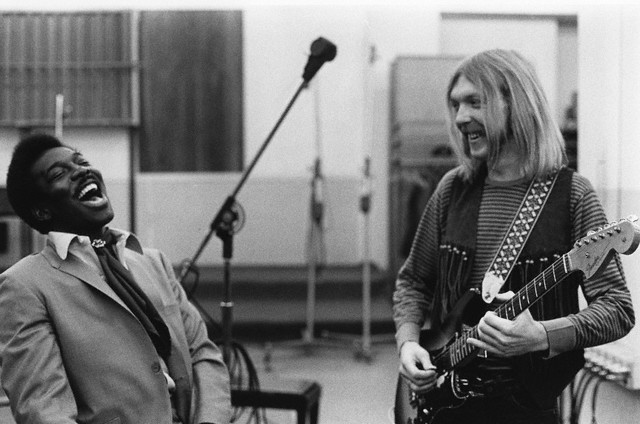
Track of the Week: Les McCann & Eddie Harris, "Compared to What"


In our world of digital music it is easy to think that it's so much easier to be exposed to music now than in the bad old days when you had to go out and buy CDs, tapes, and records if you wanted to listen to your favorite songs.  Digitization has certainly helped me explore genres that I had barely known before and to better find new music that I like.

That being said, the old days offered their own opportunities for discovery that no longer exist today.  Movie soundtracks have helped me find lots of great music.  For instance, my ears had never been graced by the Velvet Underground until I bought the soundtrack to The Doors, and heard "Heroin."  I was never the same.  Another great discovery came via the soundtrack to Martin Scorsese's Casino.  I liked the movie, but also thought that the soundtrack was superb, an interesting mix of jazz, blues, rock, vocal pop, and even classical.

There was one song that I'd only heard a snippet from in the film that really intrigued me, but not having access to Shazam and this coming in the early, undeveloped days of the internet, I had no way of knowing what it was called.  Once I bought the soundtrack, I discovered that the song was "Compared to What" by Les McCann and Eddie Harris.  I was thrilled by the relentlessly driving piano, fiery political lyrics, and the pairing of soul singing with killer jazz playing.  (The original recording, by Roberta Flack, is good, but not nearly as intense.)  "Compared to What" quickly become my favorite song on the soundtrack, one filled with gems like Roxy Music's "Love Is the Drug."  Recorded in 1969, "Compared to What" came out at a time when soul and rock acts were increasingly bringing in jazz influences.  (Think especially Jimi Hendrix at this time, the Allman Brothers Band, and the soon to come Steely Dan.)  In many respects this meant greater musical complexity and virtuosity, which is perhaps why "jazz fusion" is a dirty word for many rock critics, who tend to fetishize feeling and spirit over ability.  As much as I love punk rock's noise and the subtle rhythms of classic R&B, the older I get the more I appreciate jazz's pure musicianship, a great slice of which I discovered almost by accident.

Friday, June 27, 2014

Some "Overlooked" Films Worth Checking Out

I've been listening to a lot of movie podcasts during my morning commute, and it's had me thinking about movies that are really good but never quite get their due.  Back when I lived in Champaign-Urbana, Illinois, one of the year's highlights was when local boy Roger Ebert trekked down from Chicago to host his Overlooked Film Festival.  It was a great way to see films on the big screen that I may have missed, and deserved more acclaim.  A lot of movies in this genre are my all-time favorites.  For my purposes, I am thinking of films that did not get prerelease hype, major awards consideration, or  big box office to be "overlooked."  I am also including films that have never developed a cult following.  For instance, Dazed and Confused was overlooked on its initial release, but has developed quite a legion of fans (including yours truly.)


Croupier
If this film is remembered at all, it's for putting Clive Owen's name out there.  It's one I happened to see at a Chicago art house theater in the summer of 2000 back when I spent a lot of time going to movies by myself.  It's a gritty, noir story of a casino croupier who gets in too deep with a heist job.  Not surprisingly, it was directed by Mike Hodges, whose 1971 Get Carter is one of the best British films of all time, and a dark, noirish story as well.  Owen makes this movie in a fantastic performance as a world-weary writer willing to do wrong to get ahead.  Like all great noirs it explores the role of fate in the world, how larger events and schemes can crush individuals, and the price to be paid for one's moral choices.


The Damned United
Here's another British film starring another great Gen X actor, Michael Sheen.  Most folks stateside will remember him playing Tony Blair in The Queen and as David Frost in Frost/Nixon.  Those other films got a lot of attention, and like The Damned United, were scripted by Peter Morgan.  (The source material is by David Peace, one of my favorite contemporary authors and someone criminally overlooked in the US.)  All three films are character studies of famous people. While Queen Elizabeth, David Frost, and Richard Nixon are well-known in this country, 70s English football (soccer) coach Brian Clough is unknown even to Americans who follow soccer.  The Damned United follows Clough as he moves up in the coaching world to take the helm at Leeds United, a club infamous for its rough play, which Clough himself resented when he coached a competitor.  As you can imagine, his time there does not go well, as Clough obsessively tries to outdo his rival, the former coach, Don Revie.  Clough ends up getting fired after only 44 days, but the film also gets into his recovery and overcoming of failure.  By far the best soccer movie ever made.


Bernie
I love love love love this movie.  Part of it stems from being a big fan of Richard Linklater, but mostly because he absolutely nails his East Texas setting.  (Having lived there for three long years, I can attest to the film's accuracy.)  In case you don't know, it's based on the real story of Bernie Tiede, a small-town funeral director who struck up a relationship with a rich yet hated widow in town, only to murder her.  The twist is that Bernie is so beloved in the town, and his paramour so despised, that the locals don't want to see him punished.  Hollywood usually gets small town life wrong, depicting it either as a repository of forgotten virtues, or a freak show of murderous hatred.  This movie gets it right, as the friendliness, community and gregariousness mix with the noir, which is how I experienced small town life in my childhood.


Not Fade Away
This one surprisingly fell through the cracks a bit, even though it was Sopranos creator David Chase's film directorial debut.  It tells the story of a rock band in suburban 1960s New Jersey that tries to make it big, and doesn't.  As always, Chase is the poet laureate of the Garden State, and draws out how living in the shadow of New York's skyline inspires dreams of making it.  This film is not without its flaws, including a flat affect at times when more intensity is called for.  In a sense that might be a statement by Chase, who unlike most Hollywood types, is telling a story of failure, not success, in all of its soul-eroding reality.


A Mighty Wind
This is by far my favorite of the Christopher Guest mockumentaries (Spinal Tap was directed by Rob Reiner, so doesn't quite count.)  For some reason it has not achieved the following of Waiting for Guffman or Best In Show.  In this tale of 1960s folk musicians getting together for a memorial concert Guest more than ever mixes the humor at seeing clueless people taking themselves too seriously with some real emotional heft.  The story of folk-singing duo Mitch and Mickey is a sad one, with Mitch suffering from mental illness and Mickey trapped in an unfulfilling life.  Beyond the emotional stuff, there's some amazingly hilarious facsimiles of 60s folk music and album covers.

Wednesday, June 25, 2014

Regionalism And The Tea Party

The more I study the political history of the United States, the more obvious it is to me that regionalism has played and continues to play a significant role.  This is not so much a case of Red States vs. Blue States but of regions that cross state lines, and in some cases do not even dominate a particular state.  (For example, electoral maps from the last election show solidly Democratic territory in the Midwest in counties bordering the Mississippi River, even in conservative states like Iowa.)

That regionalism can do a lot to explain the Tea Party.  Earlier this year many pundits (and establishment Republicans) announced its demise, but recent events show that in certain parts of the country, the Tea Party is still going strong.  Most who follow politics are aware of how Tea Party candidate Chris McDaniel has been giving the plenty conservative Thad Cochran the fight of his life in Mississippi.  Less commented upon, but of perhaps greater significance, in the Texas Lieutenant Governor race Tea Party favorite Dan Patrick beat incumbent David Dewhurst.  In Texas this typically symbolic office is actually very important, and considering that Texas is effectively a one-party state, immense power will soon be wielded by a man who calls himself "a Christian first."

At the same time, Tea Party nominees are practically absent in the Northeast and Midwest, while those making waves hail from the South and West.  This is actually part of a much older story in the Republican Party where those regions have been the engine of the GOP's shift to the hard right.  Goldwater came from Arizona, Reagan from California, Jesse Helms from North Carolina, Strom Thurmond from South Carolina, Newt Gingrich from Georgia, etc.  The population shift to the Sun Belt in the past 50 years has helped make Republicans from that region dominant in the party, and has also amplified their presence in the House of Representatives, with states like Texas and Florida now sending huge delegations.

There is a strange irony, of course, in the fact that the two regions that are the most Tea Party-centric are also the regions that rely the most on government support.  Through the TVA, agriculture subsidies, and various other projects and giveaways, FDR sought to economically develop and modernize the South.  World War II and the Cold War brought oodles of bases and dollars to both regions, now crisscrossed by Interstate highways.  The federal government built up the infrastructure in both places, and then they very deftly used "right to work" laws and low wages to lure Northern companies down there that could now actually do business with the more modernized infrastructure in place.  Moreso that the South, the modern West is practically the creation of a federal government that killed and displaced its original inhabitants, and has long subsidized railroads and highways through practically empty areas that have also made convenient locations for military bases, bringing money to places with little economic base.

I must say it gets tiresome to live in a state like New Jersey, where we give more than we take from the feds, and then hear Tea Party hacks in places like Alaska and Alabama bitch about the size of the government.  It confirms a thought I've had for a long time, namely that the Tea Party is less about reducing the size of government than in making sure the government's largesse flows in a certain direction.  The rather grey supporters of the Tea Party don't want to part with their Social Security or Medicare.  They still want the government to build highways and to keep its military bases open.  However, they don't want tax money going to "moochers" and "takers" (we all know who they are, wink wink), or anyone who's "not like us."  That also means "securing the border," but not punishing corporations that hire cheap, undocumented labor.  I'm hardly the first person to point out that the whole Tea Party thing often seems to be a kind of white identity politics for hardcore conservatives.  Looking through a regional lens, and knowing the history of the South (and to an extent of the West), it's hardly surprising that those places are the hot beds of Tea Party activity.

In the future I doubt we will see the likes of Carl Palodino getting nominated states like New York anymore, but Mississippi will still keep producing Chris McDaniels, and Texas will still manufacture Dan Patricks.  If anything, we are about to witness a replay of the GOP's regionally-divided internal battles of the 1950s and 1960s.  Last time around the political style of the South and West won out; this time, if the party is to not fall into irrelevance due to generational replacement, the less radical conservatives might need to win.

Monday, June 23, 2014

To Vote, Or Not To Vote

The current political scene, especially here in New Jersey, has me wondering for the first time since I turned 18 whether I should vote or not.  I know in my heart of hearts that I likely will, but that's mostly due to my awareness of the struggles made to bring about the democratization of the vote in this country, and that one political party is basing its strategy around preventing people from voting.  I also think that it is just my civic duty to vote, no matter how distasteful the options are.

My choices in the upcoming election are not what's going to get me to the polls.  Here in New Jersey the various scandals surrounding our governor have revealed the extent to which he rules this state in tandem with Democratic political bosses.  In some of the races I'm voting in, it's either a Republican or a Christiecrat; what kind of choice is that?  In the senate race Cory Booker is running for a full term after taking office in a special election.  Having lived in Newark during Booker's tenure, I have not forgotten how in his later years he began to neglect the city in favor of his national political ambitions, or that he is very much a shill for Wall Street.  Why should I vote for someone out to protect the rapacious finance industry, even if they are a Democrat?  I had a similar feeling when I heard that Education Secretary Arne Duncan supported a recent court ruling stripping teacher tenure in California.  Teachers and their unions pushed hard for Obama's election, and now his own administration has repaid them by spitting in their face.

In a strange way, the Tea Party has given Democrats a secret weapon.  The Dems have done very little to act on the things that their base cares about, but then they can turn around and tell their voters "If you don't get out and pull the lever for us, *insert name of Tea Party troglodyte* will be in office and do all kinds of terrible things!"  I have been consistently voting for Democrats in recent years almost purely because I am so frightened of what the Republicans are doing.  Now it appears that this stopgap strategy on the part of progressives like me is enabling conservatives, since it allows Democrats to coast along without putting out initiatives of their own that might possibly upset their corporate donors.

So I guess I'll vote this year, but my ballot might not be complete.  Those Democrats who refuse to represent the interests of their supporters will get no support from me.  I know that my single vote is a piddly thing that won't change any politician's mind, I only hope enough like minded people might start doing the same and force those in the party's power structure to start listening to their base.  Democrats need to stop counting on the votes of people who they do little to help; until they stop doing that, there will be little, if any chance for progressive political gains.

Saturday, June 21, 2014

Track of the Week: Uncle Tupelo, "Whiskey Bottle"


I've been re-listening to Uncle Tupelo recently, a band whose music reaches me on a very specific level.  They hailed from Belleville, Illinois, a town very similar to the Nebraska burg where I grew up.  Both are blue collar, industrial towns located in a rural Midwestern setting.  It's a very specific living environment where you're surrounded by farmland and far from the big city but you don't really feel part of the country, either.  As far as I'm concerned, Jay Farrar and Jeff Tweedy were the poet laureates of the blue collar rural Midwest in the late 80s and early 90s, which coincided with my adolescence.  It was too bad that I didn't discover Uncle Tupelo until my senior year of high school, right as the band was coming apart.

Of all their songs, "Whiskey Bottle" might sum up best what it feels like to be trapped in an isolated town.  It's a feeling I often felt the most this time of the year, in the summer, where I had a lot of time to kill and nothing to do.  The weight of the vast Plains sky sagged heavy with boredom, which is why I didn't mind the hours I spent in my summer jobs walking the rows of corn fields with a detasseling crew, since at least they were a break from the feeling of being lost in space.  There's a brilliant line in the song that starts the chorus, "A long way from happiness/ in a three hour away town."  By "three hour away town" Farrar means a town that's a three hour drive from the nearest big city.  (My understanding was that it was a reference to Columbia, Missouri.)  Having grown up three miles from Omaha, I can feel these words in my bones.  Of course, back then I didn't drink and unlike the narrator of the song wasn't using a whiskey bottle for solace.  I mostly listened to music, read long novels too sophisticated for my age, and watched too much MTV.

Musically, "Whiskey Bottle," illustrates Uncle Tupelo's early mission to mix classic country music with The Clash.  The song starts with an acoustic guitar, a weeping steel guitar straight out of George Jones, and Jay Farrar's gruff, world-weary voice before the massively distorted electric guitar blasts into the chorus.  It's an absolutely thrilling combination of sounds, and one that still gets me, even as I walk from the subway up Broadway to my job amidst the concrete canyons that blot out the sky that was my constant childhood companion.  It's a long way from a three hour away town to the maelstrom of Manhattan, and these days this song makes me wonder just how the hell I got there.


Friday, June 20, 2014

Playlist: Soul Covers Rock


As readers of this blog know, I love vintage rock and classic soul.  I also think that performing original material is an overrated fetish.  A good song is something that ought to be cherished, shared, and played around with.  Just because someone recorded it first shouldn't mean that the song gets frozen in the vinyl amber of the original record, never to be altered again.  A great illustration of how songs can be reinterpreted in thrilling ways comes from covers that soul artists did of rock songs back in the 1960s.  Back then a popular song would be covered by lots of different people, often with great results.  Here are a few of my favorite covers in the specific souls covers of rock genre.

Wilson Pickett, "Hey Jude"
Let's start with Wilson Pickett, perhaps the most muscular soul singer that ever walked the planet earth this side of Levi Stubbs.  According to the story, he was cutting a session in Muscle Shoals, and sessions musician (and later Allman Brothers Band founder) Duane Allman suggested they do a version of "Hey Jude."  It was an audacious move that paid off with a supremely funky groove and some great singing from Pickett, especially when he screams as the band goes into the long "na na na na na" fadeout.  Allman's guitar solo is also just absolutely killer.

Aretha Franklin, "The Weight"
Aretha Franklin went from peak to peak in the late 60s and early 70s, including on this cover of the Band.  The original combined the voices of Rick Danko, Levon Helm, and Richard Manuel, but Lady Soul's pipes can carry the whole darn thing by themselves.  (Since it's a collaboration rather than a cover I couldn't include the Staples Singers doing this song with The Band on the formal list.  Nevertheless, Mavis Staples' singing here is some of her best.)

Otis Redding, "Satisfaction"
I've heard Keith Richards say that when he wrote "Satisfaction" he envisioned it as a soul song, with the loud, fuzzy guitar taking the place of a horn section.  Otis Redding obliged Keef by dropping this killer cover, complete with horns.  Instead of Jagger's punky sneer, Otis gives the song some of his patented sweat, making the frustration of the singer much more palpable.

Stevie Wonder, "We Can Work It Out"
Might as well end with where we started, with a Beatles cover.  "We Can Work It Out" has the distinction of being both one of my favorite Beatles' songs and one of my favorite Stevie Wonder songs.  Wonder gives the song an absolutely killer groove and some great "hey!"s to punctuate the song, not to mention a soaring harmonica solo.  Like all great covers it stays true to the song while still managing to turn it into something new, and I would argue, better.

Wednesday, June 18, 2014

The Pathological White Masculinity Files: 4Chan and Feminists of Color

Editor's Note: After having written on this topic so many times, I am starting a series I am calling The Pathological White Masculinity Files.  Since the Newtown massacre I have kept pushing for a real, national conversation on the dysfunctions and pathologies of white American masculinity.  It's not just big events like mass shootings that show this problem, and so I plan on exploring less bloody but nonetheless horrific examples of white American masculinity at work.

In case you haven't heard, users of the 4chan site have basically admitted to creating fake Twitter profiles posing as feminists of color in order to sow discord among feminists and to embarrass the women's movement, in particular the non-white women's movement.  This included the manufactured hashtag #EndFathersDay, something that some people at Fox News actually took seriously.  Using the #YourSlipIsShowing hashtag, activists have been outing those fake Twitter profiles.

I don't know all of the details, but I do know that this is taking typical troll behavior in an even more dangerous and threatening direction.  Trolls are probably the worst thing that the internet has given us, and I have been lucky to only occasionally have been trolled.  (Those words still hurt, even if they were being lobbed by pieces of human garbage.)  Of course, I'm a white guy, and women and especially women of color commonly face violent, aggressive, threatening trolling intended to silence them that makes what's happened on this blog look like child's play.  The so-called "Operation Lollipop"attempted the same, but in a much more organized and systematic manner.  I've heard it compared to a kind of non-governmental COINTELPRO, and I think that's an apt comparison, since the FBI used agents provacateurs and informers to silence similar movements back in the 1960s and 1970s.

One of the worst things about pathological white American masculinity is that it carries with it white supremacist assumptions.  Regardless of anything else, the fact that white men are to be the rulers of society is not to be challenged or questioned.  This is a big reason, naturally, why the fact of Barack Obama's presidency has caused unprecedented disrespect for the office and intransigence in Congress.  The same goes for the Internet.  The computer world has long been heavily white and very masculine, and the trolls at 4chan aim to keep it that way.  They just don't want black and brown people, and especially black and brown women, to be using "their" space.  Their upbringing and this society's assumptions about white masculinity make them feel not as if this is a terrible thing they are doing, but simply defending their birthright.

The pathologies of white masculinity are at their worst when white men feel cheated of the privileges they think are rightfully theirs.  This leads them to attack others whom they hold responsible, sometimes with words, sometimes with bullets.  Hence the actions of Elliott Rodger, who felt he was "owed" the sexual favors of women.  This pathology comes out with gunfire, but it also happens every day via rhetorical violence on the Internet.  Operation Lollipop is only one of many examples of what will be added to the Pathological White Masculinity Files.